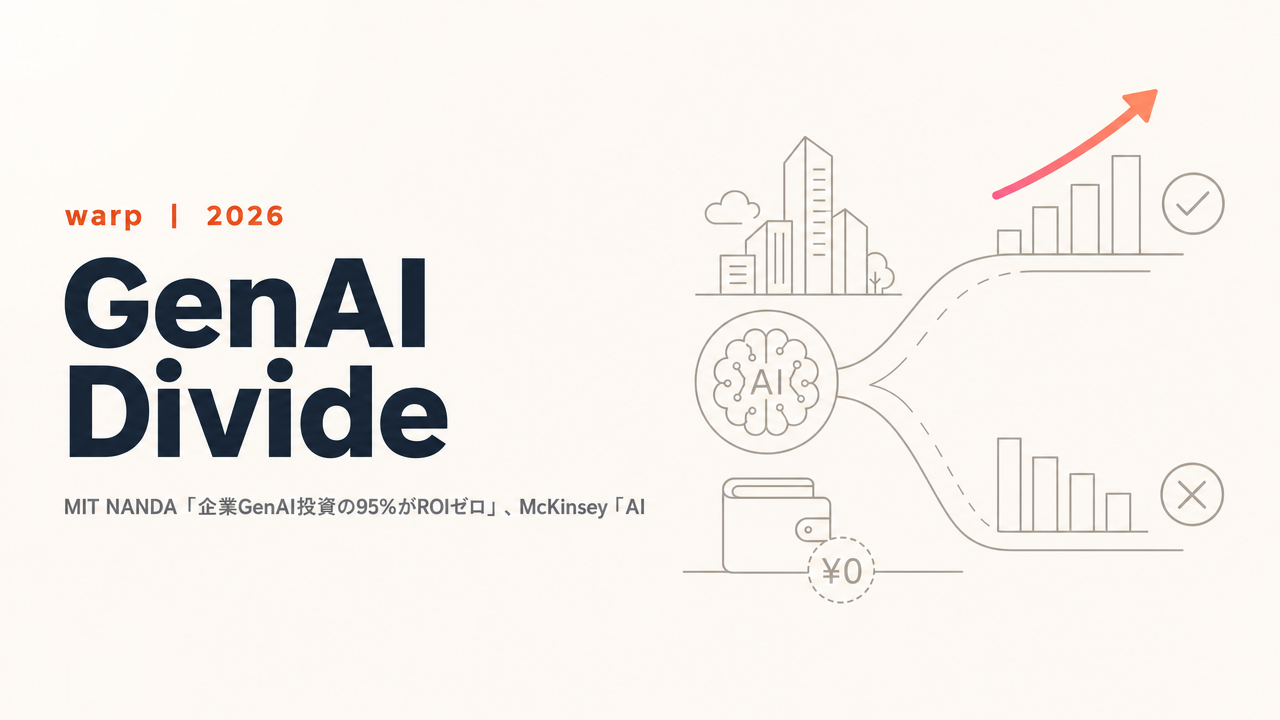
AI adoption is growing. But what about results?
Over the past year, organizations adopting AI have surged. Budgets have expanded, tools have grown more sophisticated, and department-level adoption is now common.
At the same time, another kind of voice is becoming more common:
- We're using AI, but we can't measure the results
- Efficiency has probably gone up, but we can't explain how
- We'll invest again next quarter, but we're not sure it's working
The problem isn't AI performance. It's not budget size either.
In most cases, the issue is the accountability structure.
AI isn't stalling. The accountability structure is.
Why AI Investment Fails to Produce Results
There's a wall that AI-forward organizations tend to hit within six months.
AI is running. Roles have been divided. Things are moving on their own. And yet — something stops somewhere.
The cause isn't AI performance. It's the absence of a clear answer to: who is responsible for what, and to what degree.
For example:
- Who says "approved" on AI output?
- What criteria does that judgment rely on?
- When results fall short, who reviews what?
- When something goes wrong, through which channel does it escalate?
All of these symptoms come from the absence of an accountability structure.
Ambiguous decision-makers. Undefined verification responsibilities. Decision criteria that aren't shared. Each gap is small — but they accumulate until the organization can't move.
AI is running. But the organization's accountability structure has stopped.
In this state, AI investment becomes "activity" — not "results."
Looking for AI training and consulting?
Learn about WARP training programs and consulting services in our materials.
The Three-Layer Structure of Organizations Where AI Investment Doesn't Pay Off
Layer 1: Insufficient Role Design — Accountability Is "Floating"
Most organizations hand off tasks to AI. But they haven't designed accountability for final decisions and responsibility.
The pattern that results looks like this:
AI produces output → someone reviews it → but who decides is unclear → final authority reverts to senior leadership.
In this structure, AI becomes a tool for efficiency — not an accelerator for decision-making.
Layer 2: Missing Outcome Design — Results Stay "Subjective"
"It feels faster." "It seems more convenient." These are feelings, not outcomes.
What changed in measurable terms after AI adoption?
Time saved? Decision speed? Conversion rates? Lead times?
Without defined outcome metrics, AI goes unevaluated, unimproved, and eventually becomes "an investment we keep making without being sure why."
Layer 3: Undesigned Accountability — Can't Speak to It as an Investment
Are reports to the executive team sounding like this?
- "We're using AI."
- "Operational efficiency is up."
That's activity reporting.
To justify continued — or expanded — investment, the conversation needs to sound like this:
"Under this accountability structure, this metric improved. That's why we're strengthening this area next quarter."
Define accountability in Layer 1. Measure outcomes in Layer 2. Articulate them in Layer 3.
When all three layers connect, AI investment moves from "cost" to "strategy."
AI Accountability Design Template (Simplified)
Can you answer these eight questions immediately?
- What is the AI's role?
- Who is the final decision-maker?
- Who is responsible for verifying AI output?
- What is the quantitative success metric?
- What is the qualitative success metric?
- Where are decision criteria stored?
- How often are decision criteria updated?
- Is there a response flow for when something goes wrong?
If these eight items aren't in order, AI is running — but the investment isn't structured.
When AI Investment Design Starts to Diverge
This is the time when more organizations are expanding AI adoption heading into the next period.
Before adding more tools. Before adding more roles. Whether accountability structure has been designed — this is where the gap opens.
The difference between organizations that adopt AI and organizations that manage AI comes down to this structure.


![Why 40% of AI Adoption Projects Fail [2026 Edition]: Three Traps Revealed by Stanford HAI's 88% and Gartner's 40% Cancellation Forecast](/images/columns/ai-adoption-failure-traps-stanford-gartner-2026/cover.png)