TIMEWELL
Solutions
Free ConsultationContact Us
TIMEWELL

Unleashing organizational potential with AI

ISO/IEC 27001 (ISMS) certification mark (SGS / ISMS-AC)

ISO/IEC 27001:2022 certified Certificate No. JP26/00000255 Scope: Planning, development and operation of SaaS products utilizing AI technology

Services

  • ZEROCK
  • TRAFEED
  • TIMEWELL BASE
  • WARP
  • WARP 1Day
  • WARP NEXT Corporate
  • WARP BASIC
  • WARP ENTRE
  • Alumni Salon
  • WARP for Schools
  • FDE
  • AI Consulting
  • ZEROCK Buddy
  • EMC GLOBAL

Company

  • About Us
  • Team
  • Why TIMEWELL
  • News
  • Contact
  • Free Consultation

Content

  • Insights
  • Knowledge Base
  • Case Studies
  • Whitepapers
  • Events
  • Solutions
  • AI Readiness Check
  • ROI Calculator

Legal

  • Privacy Policy
  • Manual Creator Extension
  • WARP Terms of Service
  • WARP NEXT School Rules
  • Legal Notice
  • Security
  • Anti-Social Policy
  • ZEROCK Terms of Service
  • TIMEWELL BASE Terms of Service

Newsletter

Get the latest AI and DX insights delivered weekly

Your email will only be used for newsletter delivery.

© 2026 株式会社TIMEWELL All rights reserved.

Contact Us
HomeColumnsTagsWARP
Tag

WARP

Articles about "WARP"

215 articles

215 articles (showing 12)

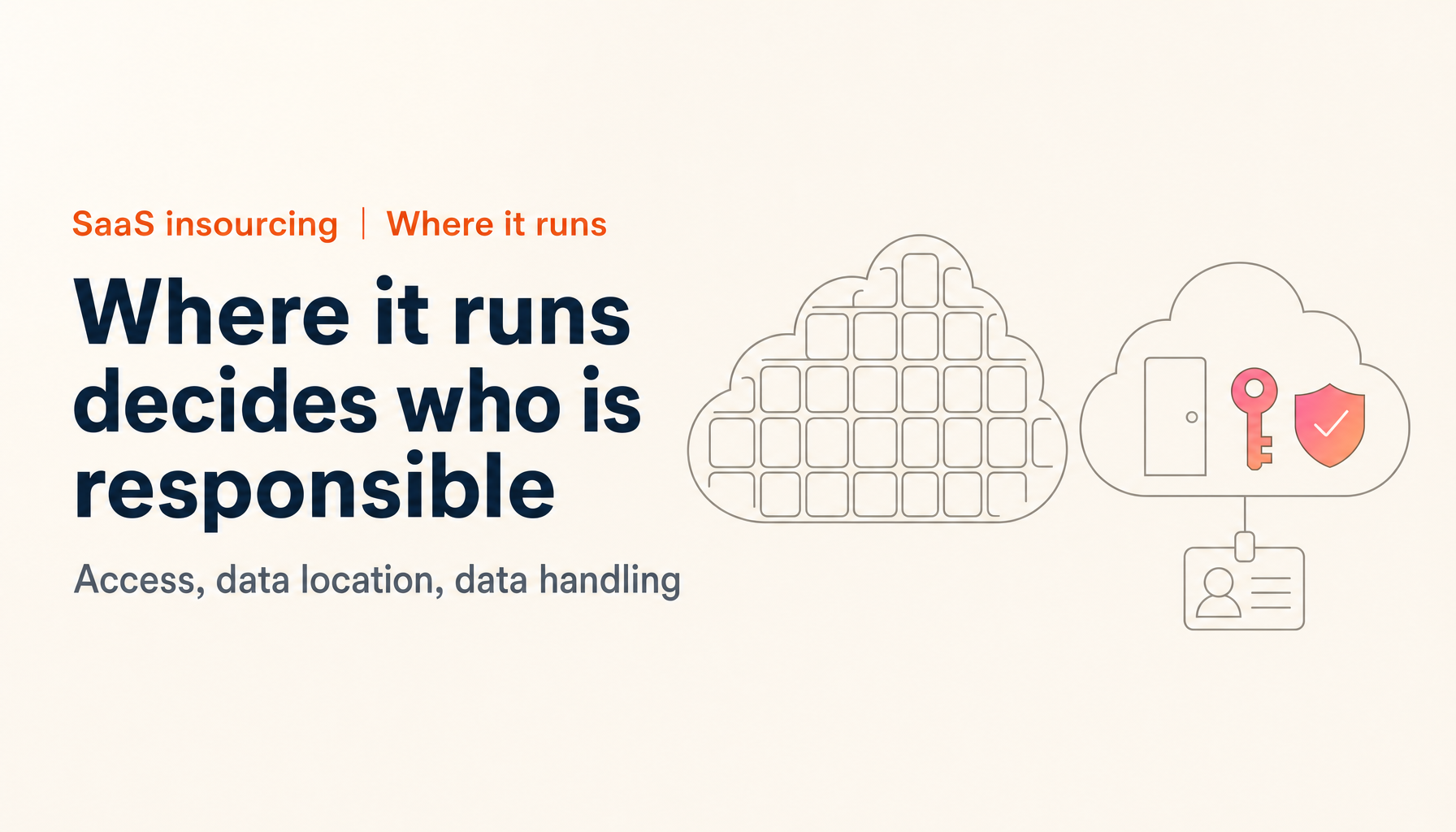
Running Business Apps in Your Own Cloud Tenant: Access, Data Location, and Personal Data
WARP

Running Business Apps in Your Own Cloud Tenant: Access, Data Location, and Personal Data

If you are dropping a SaaS product and building the business app yourself, my view is that it usually runs better inside your own cloud environment, your own tenant. The fifth and final article in this series covers how that differs from multi-tenant SaaS, what you gain in identity, access, data integration, and audit logs, why "who can touch the data" rather than where it sits decides whether Japan's APPI treats a vendor as an entrusted party, why choosing a Tokyo region does not remove the duty to understand foreign rules, and how operational responsibility shifts to you. It draws on NIST, AWS, the Japanese Personal Information Protection Commission's Q&A and the 2026 APPI amendment, and ISO/IEC 27001.

2026-09-29Ryuta Hamamoto
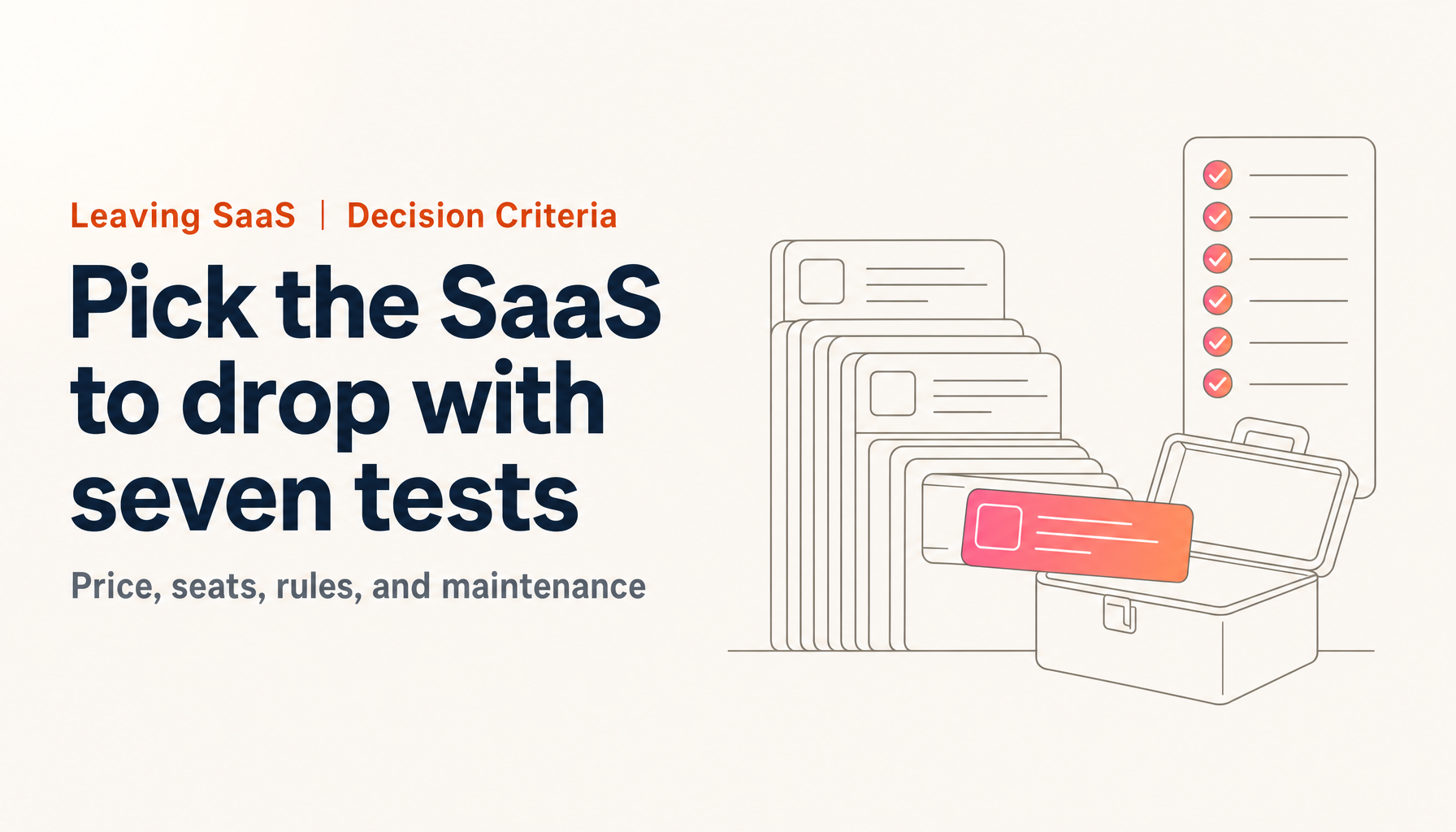
Should You Cancel Your Expensive SaaS and Build It Yourself? Seven Tests for the AI Era
WARP

Should You Cancel Your Expensive SaaS and Build It Yourself? Seven Tests for the AI Era

For IT heads, corporate planning teams, and CFOs who opened a SaaS renewal quote and thought "we could build this for less," here are seven tests for deciding whether to cancel a SaaS you already pay for and build a replacement in-house: price increases and currency exposure, per-seat pricing growth, how slowly the data and features change, legal and accounting complexity, the number of integrations, who will maintain it, and the cancellation and migration terms. It does not hide the evidence on the other side, including public guidance that favors SaaS and research showing AI-assisted development can be less stable. The first article in a five-part series.

2026-09-29Ryuta Hamamoto
Robotics Is Where Jev Belongs: The Decision Layer Between Motion and Planning
Physical AI

Robotics Is Where Jev Belongs: The Decision Layer Between Motion and Planning

Robot control is stacked in layers. Servos run near 1000 Hz, VLA models at 5–50 Hz, task planning below 1 Hz. In between sits a layer that only has to pick the next action, and today we fill it with branching logic or a large language model that is too slow. Jev, a model that writes nothing, is a part built for exactly that slot. Here is what Jev is, how to wire it into a robot, and where safety has to stay separate.

2026-09-20Ryuta Hamamoto
How Far to Insource AI: Drawing the Line Against Outsourcing
WARP

How Far to Insource AI: Drawing the Line Against Outsourcing

Insourcing is a means, not an objective. You do not need everything in house, and handing it all over causes its own problems. Two axes settle it: how often it changes, and how much your own operational knowledge matters. IPA found 85.5% of Japanese firms short of people to drive DX. Given that, here is how to decide what sits inside.

2026-09-20Ryuta Hamamoto
Why Generative AI Does Not Stick Inside Companies
WARP

Why Generative AI Does Not Stick Inside Companies

Usage is no longer the problem. Japan's 2026 information and communications white paper puts the share of firms intending to use generative AI at 68.9%. Yet 27.0% report no organisational effort around transforming how work is done. People are using it and nothing is changing, because the practice stays private to individuals. Here is what to put in place instead.

2026-09-20Ryuta Hamamoto
Is Jev Enterprise-Ready? Reading the Terms and the DPA
WARP

Is Jev Enterprise-Ready? Reading the Terms and the DPA

Getting an API key and running a sample takes thirty minutes. Answering "can we put our data in this?" takes reading the terms. Here is what TypeSafe AI's terms, privacy policy, DPA, and trust center actually say, and where the line sits. One trap: the published terms of use cover the website only.

2026-09-20Ryuta Hamamoto
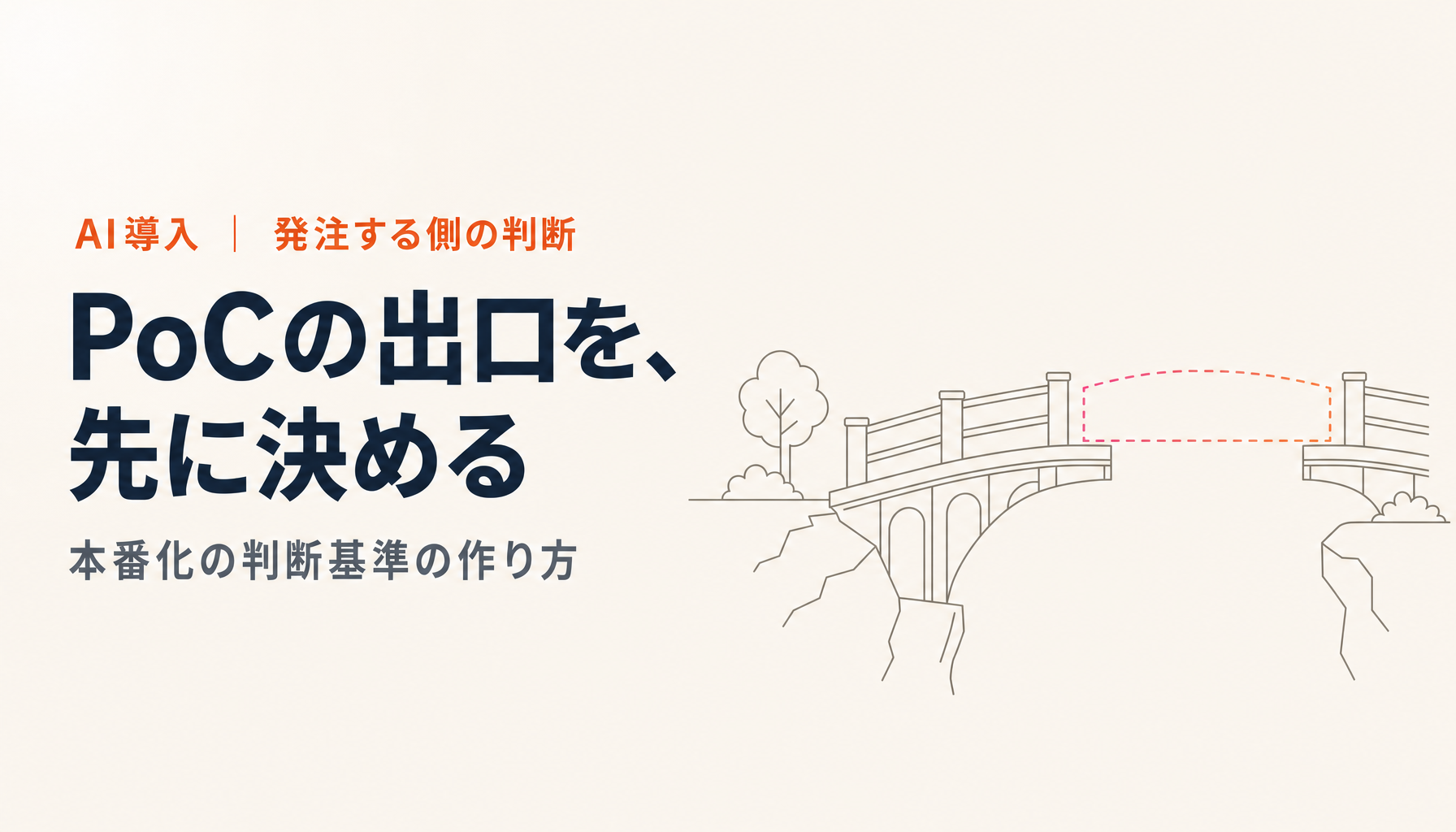
Getting Out of PoC Limbo: Decide the Exit First
WARP

Getting Out of PoC Limbo: Decide the Exit First

A proof of concept that goes nowhere is rarely a failure of enthusiasm or technology. It is a failure to define, before starting, what would justify going to production. In IPA's 2026 survey of Japanese firms, 91.6% reported AI made work faster; 3.9% reported higher revenue or profit. That gap is what PoC limbo actually looks like.

2026-09-20Ryuta Hamamoto
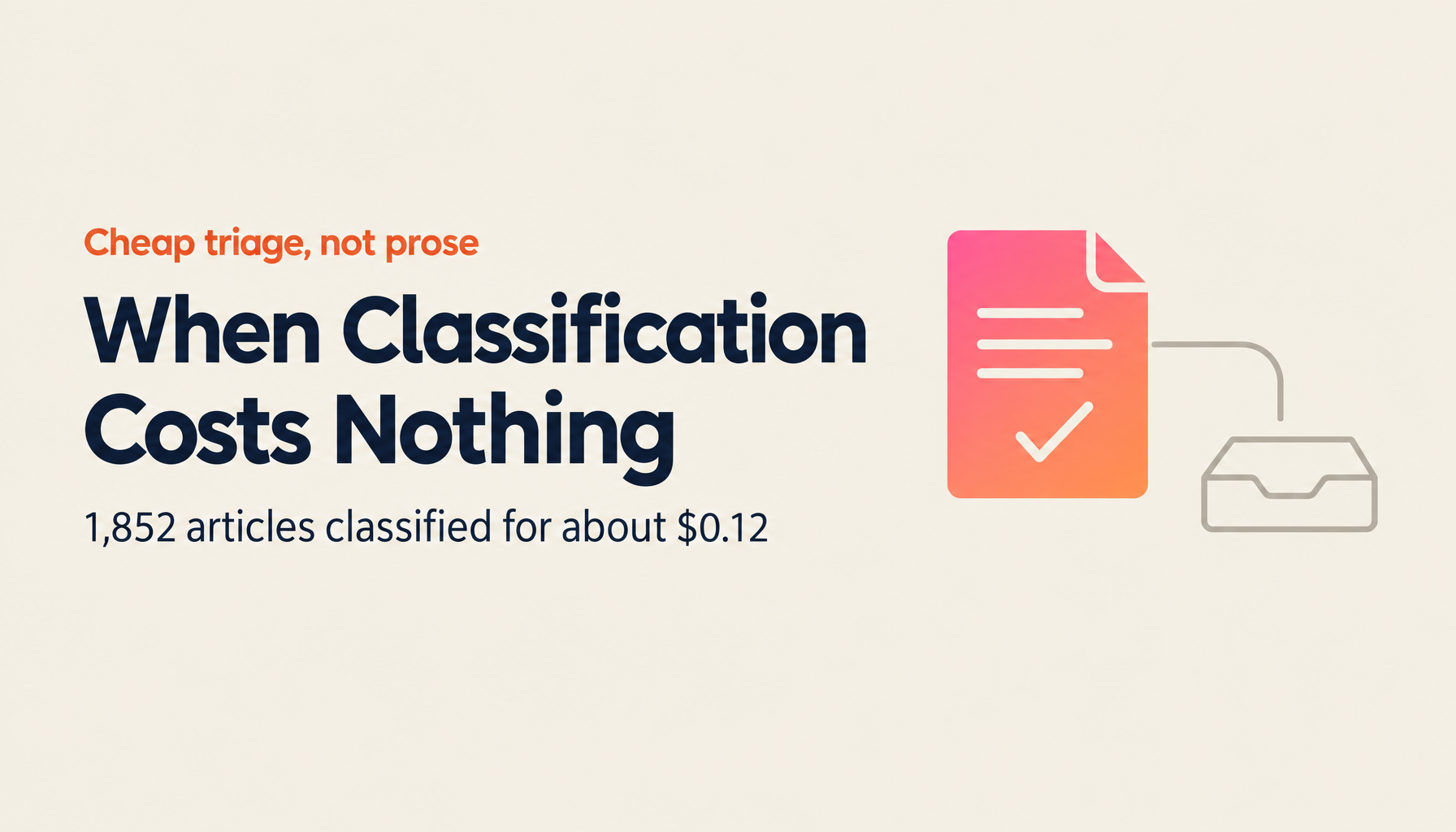
We Classified 1,852 Articles With Jev for $0.12. First-Pass Triage Just Got Too Cheap to Ration
Tech Trends

We Classified 1,852 Articles With Jev for $0.12. First-Pass Triage Just Got Too Cheap to Ration

We ran TypeSafe AI's Jev over all 1,852 Japanese articles on our own site. It took 49 seconds and, by the published price list, about $0.12. The interesting part of a model that writes nothing is not the speed. It is that first-pass triage stops being something you ration. Here are our measured numbers, what changes when the cost disappears, and 20 places the model fits.

2026-09-19Ryuta Hamamoto
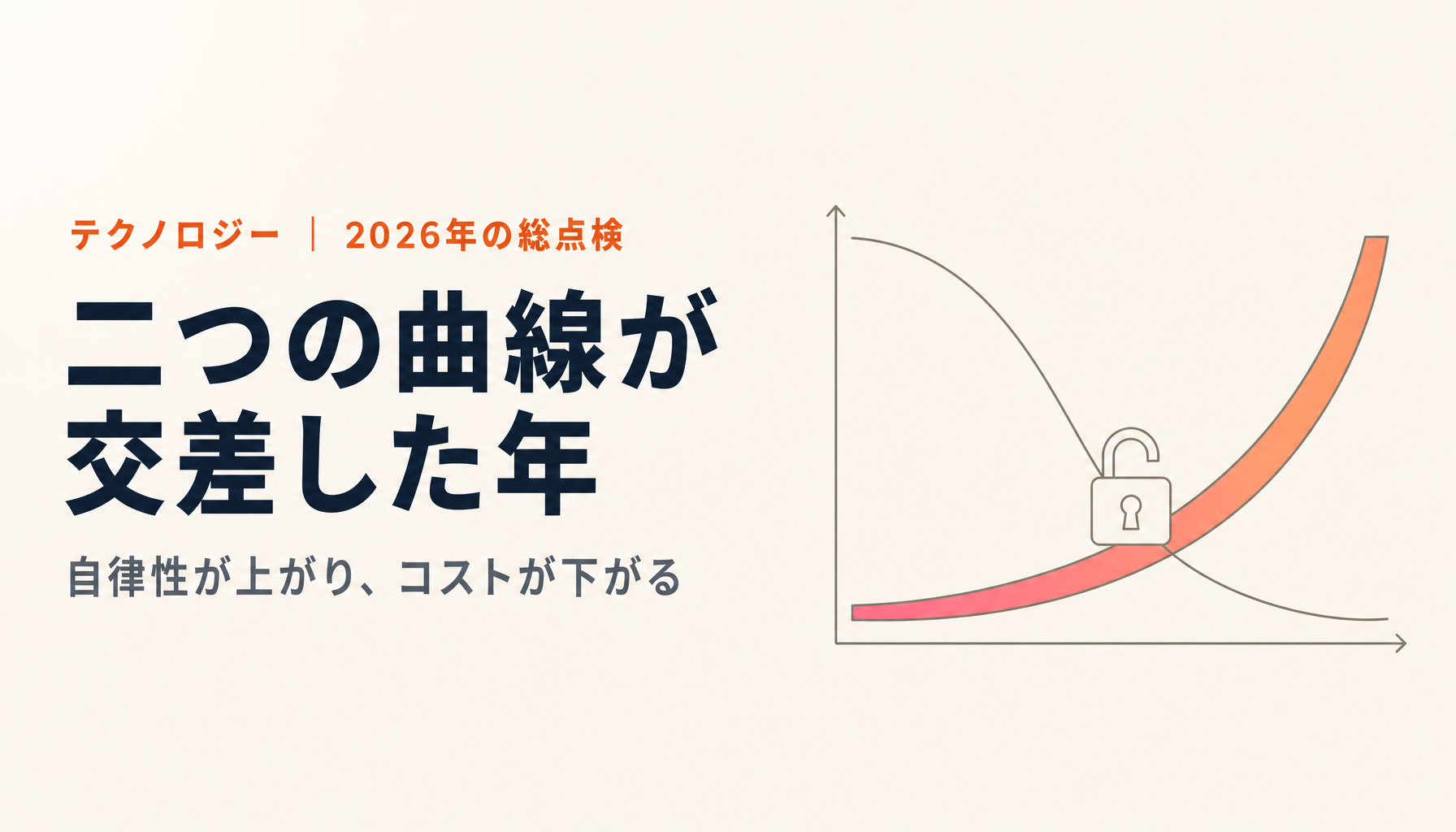
Did the Singularity Arrive in 2026? Rising Autonomy, Falling Cost, and Where the Two Curves Cross
Tech Trends

Did the Singularity Arrive in 2026? Rising Autonomy, Falling Cost, and Where the Two Curves Cross

In 2026 the question "did the singularity arrive?" stopped being a joke. This article defines it not as a single arrival but as the crossing of two curves, rising autonomy and falling cost, and lays out the primary record: the incidents Anthropic and OpenAI disclosed themselves, METR's time horizons, official price lists, efficiency approaches such as JEPA and SVG-specialized models, and where EU and Japanese rules stand. It closes with my "control singularity" view and what a company should do tomorrow.

2026-09-18Ryuta Hamamoto
FDEs and Business Ethnography | Turning What a Workplace Takes for Granted into Product
WARP

FDEs and Business Ethnography | Turning What a Workplace Takes for Granted into Product

Observation methods capture what people do. Ethnography captures why, in that group, it is taken for granted. The third article in our FDE practice series traces how an anthropological method reached corporate workplaces by way of Xerox PARC, explains Polanyi's tacit knowledge and Nonaka's socialization, shows how to write thick description, and lays out how ethnography differs from observation and why an FDE spends weeks on site. Contract-development business analysis targets "the process"; FDE ethnography targets "what this company takes for granted" and turns what it learns into standard product features. It also covers the time-boxing and deliverables that keep this from becoming live-in contract work.

2026-09-15Ryuta Hamamoto
Filming the Shop Floor and Analyzing It with AI | Consent, Camera Setup, and the Analysis Pattern
WARP

Filming the Shop Floor and Analyzing It with AI | Consent, Camera Setup, and the Analysis Pattern

Our engineers have started filming work on site, with permission, and analyzing the footage afterward with AI. Where observation means seeing things once, in the moment, video means seeing them again as many times as needed, and it captures what the eye cannot count well, such as the exact length of a wait or the number of screen switches. The fifth article in our FDE practice series covers how to obtain consent, the essentials of Japan's personal-data law and the camera-image guidebook, when to use a fixed camera versus screen recording, the boundary between what AI analyzes and what people keep, and how this differs from work analysis in contract engagements. FDE video analysis ends when the footage has become next week's working artifact.

2026-09-15Ryuta Hamamoto
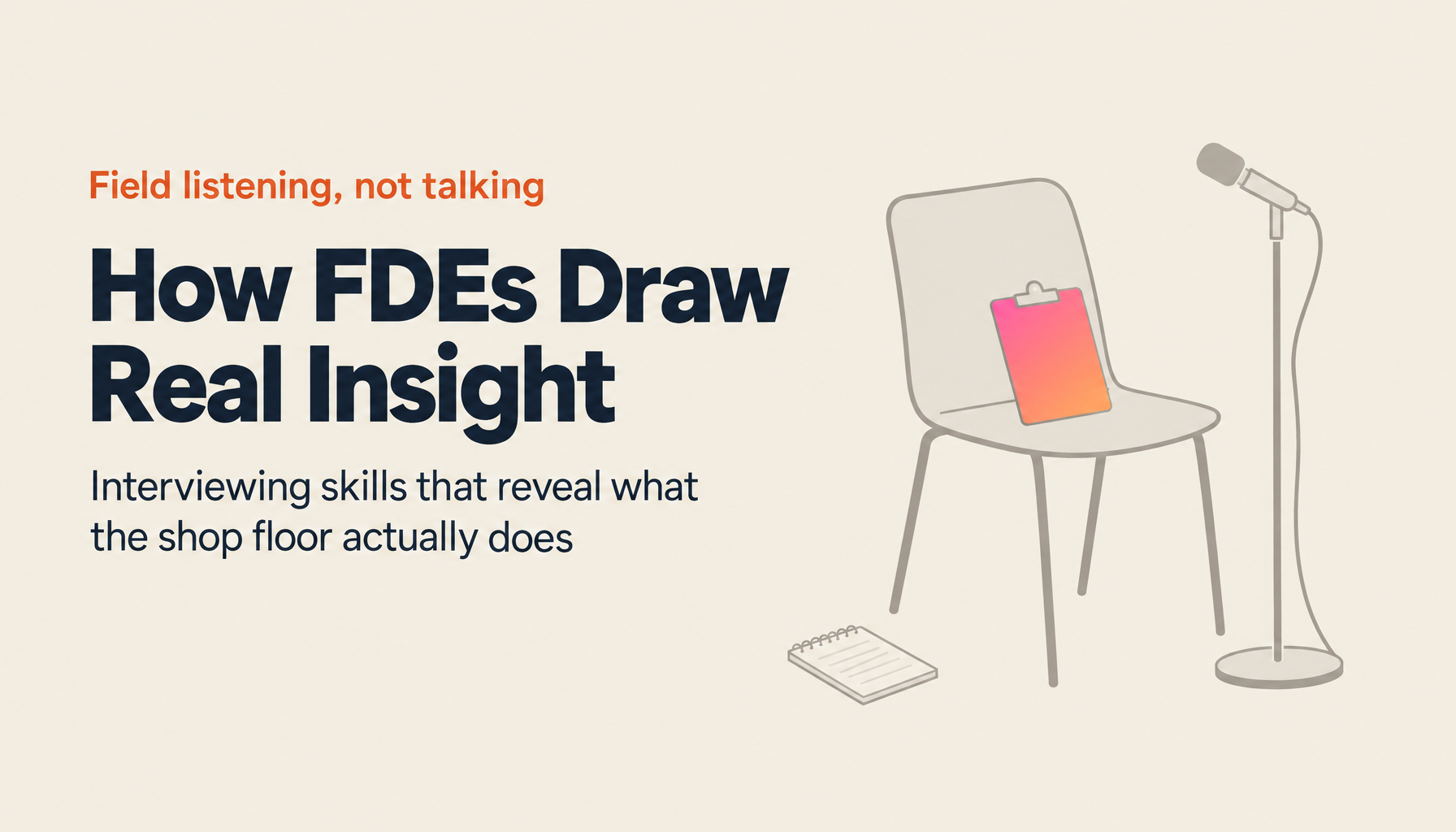
The Interview Skills That Make an FDE Work | How to Draw Real Insight Out of the Shop Floor
WARP

The Interview Skills That Make an FDE Work | How to Draw Real Insight Out of the Shop Floor

Whether a Forward Deployed Engineer succeeds is decided less by how fast they write code than by how they listen. Our engineers take interview training before they go on site, but the "form" you learn in training and the "eye for mismatch" you only develop in the field turned out to be different things. This article lays out the three kinds of FDE interviews, question design built on the critical incident technique and Toyota's five whys, silence and mirroring, working in pairs, and where AI transcription fits, in a form engineers can use as is.

2026-09-15Ryuta Hamamoto

Related Tags

ZEROCK(31)AI(29)DX(28)AI Agents(22)Generative AI(18)New Business(17)Inquiry-Based Learning(15)Claude Code(15)FDE(14)Enterprise AI(12)Anthropic(11)AI Adoption(10)High School Education(10)Startups(8)Field Work(7)
View all tags