TIMEWELL
Solutions
Free ConsultationContact Us
TIMEWELL

Unleashing organizational potential with AI

ISO/IEC 27001 (ISMS) certification mark (SGS / ISMS-AC)

ISO/IEC 27001:2022 certified Certificate No. JP26/00000255 Scope: Planning, development and operation of SaaS products utilizing AI technology

Services

  • ZEROCK
  • TRAFEED
  • TIMEWELL BASE
  • WARP
  • WARP 1Day
  • WARP NEXT Corporate
  • WARP BASIC
  • WARP ENTRE
  • Alumni Salon
  • WARP for Schools
  • FDE
  • AI Consulting
  • ZEROCK Buddy
  • EMC GLOBAL

Company

  • About Us
  • Team
  • Why TIMEWELL
  • News
  • Contact
  • Free Consultation

Content

  • Insights
  • Knowledge Base
  • Case Studies
  • Whitepapers
  • Events
  • Solutions
  • AI Readiness Check
  • ROI Calculator

Legal

  • Privacy Policy
  • Manual Creator Extension
  • WARP Terms of Service
  • WARP NEXT School Rules
  • Legal Notice
  • Security
  • Anti-Social Policy
  • ZEROCK Terms of Service
  • TIMEWELL BASE Terms of Service

Newsletter

Get the latest AI and DX insights delivered weekly

Your email will only be used for newsletter delivery.

© 2026 株式会社TIMEWELL All rights reserved.

Contact Us
HomeColumnsTagsZEROCK
Tag

ZEROCK

Articles about "ZEROCK"

131 articles

131 articles (showing 12)

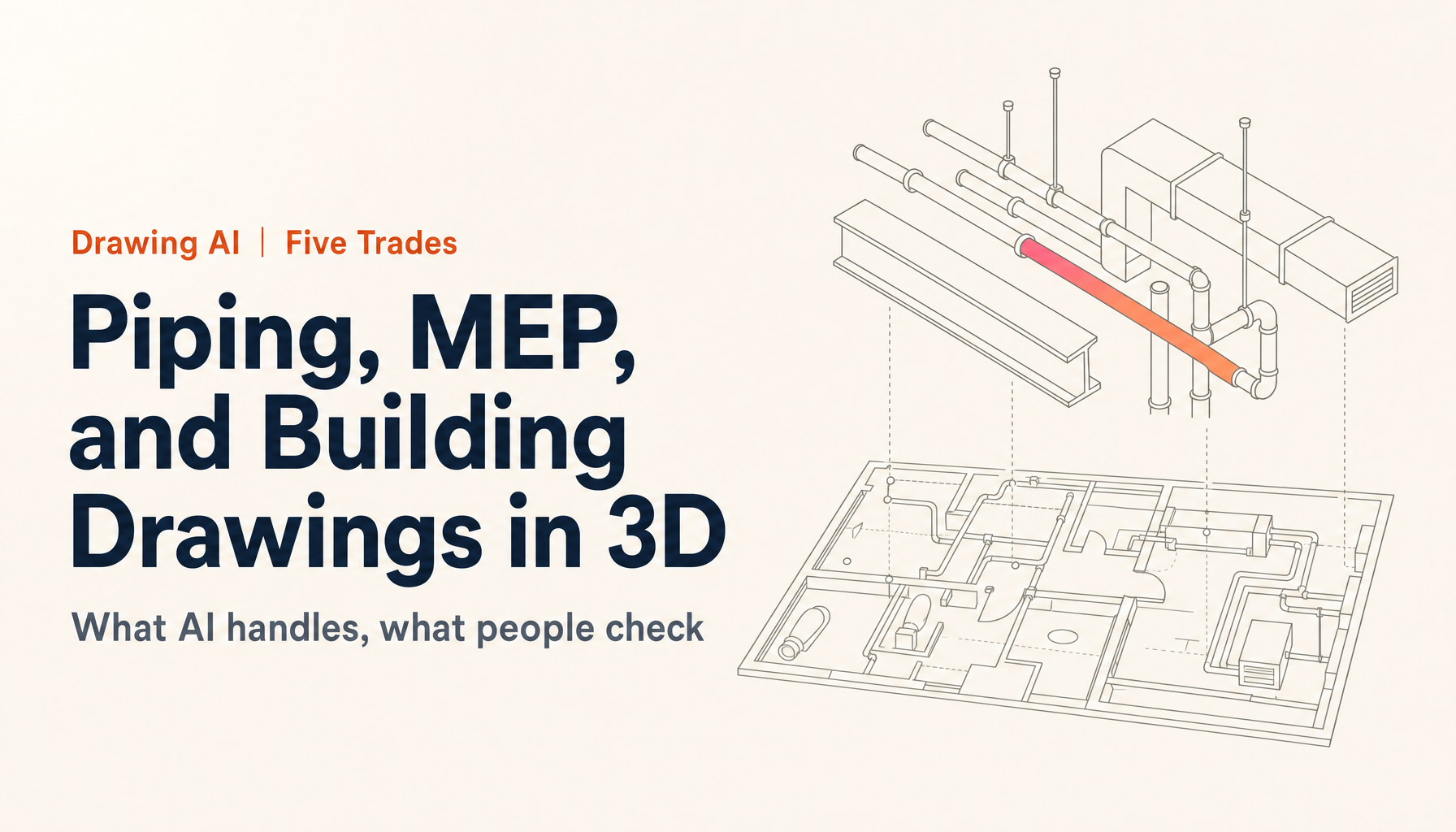
Converting Piping, MEP, and Building Drawings to 3D with AI: What to Delegate by Trade
ZEROCK

Converting Piping, MEP, and Building Drawings to 3D with AI: What to Delegate by Trade

Machinery, equipment, civil, building, and piping firms all want 2D drawings in 3D, but need different things. Trade by trade: what AI can handle and what people must still check.

2026-10-03Ryuta Hamamoto
How to Run a Price Negotiation: From Cost Inventory to a Four-Category Request
ZEROCK

How to Run a Price Negotiation: From Cost Inventory to a Four-Category Request

In Japan, 90.7% of small suppliers now get a price negotiation. Only 54.2% of the increase actually passes through. The bottleneck is no longer access to the table, it is what you bring to it. Here is the four-category structure the JFTC guideline sets out, why you should not hand your cost sheet to the buyer, and four ways to build the number you ask for.

2026-09-22Ryuta Hamamoto
A 30-Point Drawing Check List: Stop Misses With Process
ZEROCK

A 30-Point Drawing Check List: Stop Misses With Process

When drawing review lives in one person's head, the veteran spots a problem in five minutes and the junior engineer misses the same thing three releases in a row. That is a process gap, not an attention gap. Here are 30 checks grouped into dimensions, tolerance, manufacturability, procurement, and compliance, with a sheet you can sign off and keep.

2026-09-20Ryuta Hamamoto
How Long to Keep Drawings: Checking the 10-Year Rule Against the Statute
ZEROCK

How Long to Keep Drawings: Checking the 10-Year Rule Against the Statute

Everyone says drawings are kept for ten years, but no Japanese statute sets a retention period for drawings as such. The ten years is worked backwards from the Product Liability Act. Transaction records run two years under subcontracting law and books run seven under the Corporation Tax Act. Here is the statutory basis for each, plus a retention register you can hand an auditor.

2026-09-20Ryuta Hamamoto
Writing an RFQ for Machined Parts: The 12 Items a Drawing Misses
ZEROCK

Writing an RFQ for Machined Parts: The 12 Items a Drawing Misses

"I sent the drawing and never got a quote" usually means the shop is stuck on something you did not tell them. Generic RFQ templates stop at part name, quantity, and due date, which is nowhere near enough for a machined part. Here are the 12 items that belong alongside the drawing, plus a form you can send as is.

2026-09-20Ryuta Hamamoto
How to Estimate Machining Time: Setup, Cut, Measure, Rate
ZEROCK

How to Estimate Machining Time: Setup, Cut, Measure, Rate

Search for machining time estimation and you get cutting-condition formulas. But a quote does not need spindle speed. It needs setup plus cut plus inspection, converted into hours and multiplied by a charge rate. Here is how to build that up operation by operation, and how to turn it into something you can show a customer.

2026-09-20Ryuta Hamamoto
Nesting and Yield: What Really Sets Your Material Cost
ZEROCK

Nesting and Yield: What Really Sets Your Material Cost

Dividing part area by sheet area does not give you a material cost. Web width, clamp deadzone, kerf, and the standard sheet size decide how many parts come off a sheet, and that number is what sets the cost per piece. Here is how to calculate yield properly, with a sheet you can show a customer.

2026-09-20Ryuta Hamamoto
Twelve Checks When a Customer Drawing Arrives
ZEROCK

Twelve Checks When a Customer Drawing Arrives

Push a customer-supplied drawing straight to the floor and you get the classic failures: building to a superseded revision, working around an instruction nobody could read, missing a return obligation. Here are the twelve things to check between receipt and start, plus a receipt register. Revision and confidentiality are the two that slip most.

2026-09-20Ryuta Hamamoto
How an FDE Builds an Ontology from Field Notes | A Dictionary of Nouns and Verbs an AI Can Traverse
WARP

How an FDE Builds an Ontology from Field Notes | A Dictionary of Nouns and Verbs an AI Can Traverse

The dictionary of a company's nouns and verbs gathered through interviews, observation, ethnography, the KJ method, and video analysis is not usable by an AI agent as a dictionary. The sixth article in our FDE practice series explains how to extract five things from transcripts and observation records, nouns, verbs, relationships, states, and exceptions, and turn them into a structure of meaning an AI can traverse: an ontology. It covers the definition, why Palantir put it at the center of its product, its use in GraphRAG, the boundary between AI extraction and human meaning-making, and how it differs from data modeling in contract development. Putting ownership of the dictionary on the customer's side is the condition for the customer to run on their own.

2026-09-15Ryuta Hamamoto
Reading All-In's "Doomer Psyop" Episode Through a Data Sovereignty Lens
ZEROCK

Reading All-In's "Doomer Psyop" Episode Through a Data Sovereignty Lens

The All-In Podcast episode published on September 11, 2026 spent 96 minutes on three stories: the fight over a departing Anthropic researcher's post that "AI could kill us all by the end of the decade," OpenAI's announcement that 10,000 agents solved the Navier–Stokes problem in 88 hours and the accusation that it front-ran a user's research, and Nike's removal from the S&P 100. This article summarizes the episode, verifies the posts and announcements the hosts cited against primary sources, notes that Dario Amodei published his pacing essay the very next day, and adds my commentary, centered on the question that matters most for enterprises: where does the data you hand to an AI end up?

2026-09-13濱本 隆太
Why Japan Can Come Back in Physical AI: Policy, Numbers, and TIMEWELL's Declaration
Physical AI

Why Japan Can Come Back in Physical AI: Policy, Numbers, and TIMEWELL's Declaration

Japan was written off as a lap behind in generative AI. So why is physical AI, the AI that acts in the real world, the field where it can come back? This long read starts with the numbers Japan is losing on (IFR statistics), then goes through the AI Basic Plan (Phase II), the AI Robotics Strategy, the Japan Growth Strategy and its investment roadmap, the July-to-September news from NVIDIA, Arm, Hitachi and GENIAC, and the projected shortfall of 11 million workers by 2040. It reads the qualitative shift from tightly coupled to loosely coupled systems and from scale to integration and operations, and ends with TIMEWELL's own declaration that we are moving into physical AI.

2026-09-12濱本 隆太
Five Ways to Cut AI Coding Agent Costs While Keeping Data In-Country
ZEROCK

Five Ways to Cut AI Coding Agent Costs While Keeping Data In-Country

Coding agents such as Claude Code, Codex and Grok Build have grown heavy, and token bills are becoming a board-level topic. Using only what official documentation confirms, this piece lays out five ways to bring the cost down: switching the model an agent talks to, open-source agents such as OpenCode and Hermes Agent, open-weight models from China, NVIDIA, Google and others, domestic serverless inference such as Sakura's AI Engine, and on-prem operation on hardware such as DGX Spark or Mac Studio. It explains the pitfalls of each and, for newcomers, the idea of an AI gateway that cuts cost while keeping data in-country.

2026-09-12Ryuta Hamamoto

Related Tags

AI(34)WARP(31)Enterprise AI(26)AI Agents(18)Generative AI(17)AI Governance(11)Data Analysis(11)Drawing AI(10)Manufacturing DX(10)Manufacturing(9)Claude Code(9)Anthropic(8)Security(8)DX(8)Data Sovereignty(7)
View all tags