TIMEWELL
Solutions
Free ConsultationContact Us
TIMEWELL

Unleashing organizational potential with AI

ISO/IEC 27001 (ISMS) certification mark (SGS / ISMS-AC)

ISO/IEC 27001:2022 certified Certificate No. JP26/00000255 Scope: Planning, development and operation of SaaS products utilizing AI technology

Services

  • ZEROCK
  • TRAFEED
  • TIMEWELL BASE
  • WARP
  • WARP 1Day
  • WARP NEXT Corporate
  • WARP BASIC
  • WARP ENTRE
  • Alumni Salon
  • WARP for Schools
  • FDE
  • AI Consulting
  • ZEROCK Buddy
  • EMC GLOBAL

Company

  • About Us
  • Team
  • Why TIMEWELL
  • News
  • Contact
  • Free Consultation

Content

  • Insights
  • Knowledge Base
  • Case Studies
  • Whitepapers
  • Events
  • Solutions
  • AI Readiness Check
  • ROI Calculator

Legal

  • Privacy Policy
  • Manual Creator Extension
  • WARP Terms of Service
  • WARP NEXT School Rules
  • Legal Notice
  • Security
  • Anti-Social Policy
  • ZEROCK Terms of Service
  • TIMEWELL BASE Terms of Service

Newsletter

Get the latest AI and DX insights delivered weekly

Your email will only be used for newsletter delivery.

© 2026 株式会社TIMEWELL All rights reserved.

Contact Us
HomeColumnsWARPWhen a VC Goes Forward-Deployed: What It Means and How Founders Should Vet It
WARP

When a VC Goes Forward-Deployed: What It Means and How Founders Should Vet It

Published2026-10-21Ryuta Hamamoto
FDEVenture CapitalStartupsSales LaunchHiringManagementWARP

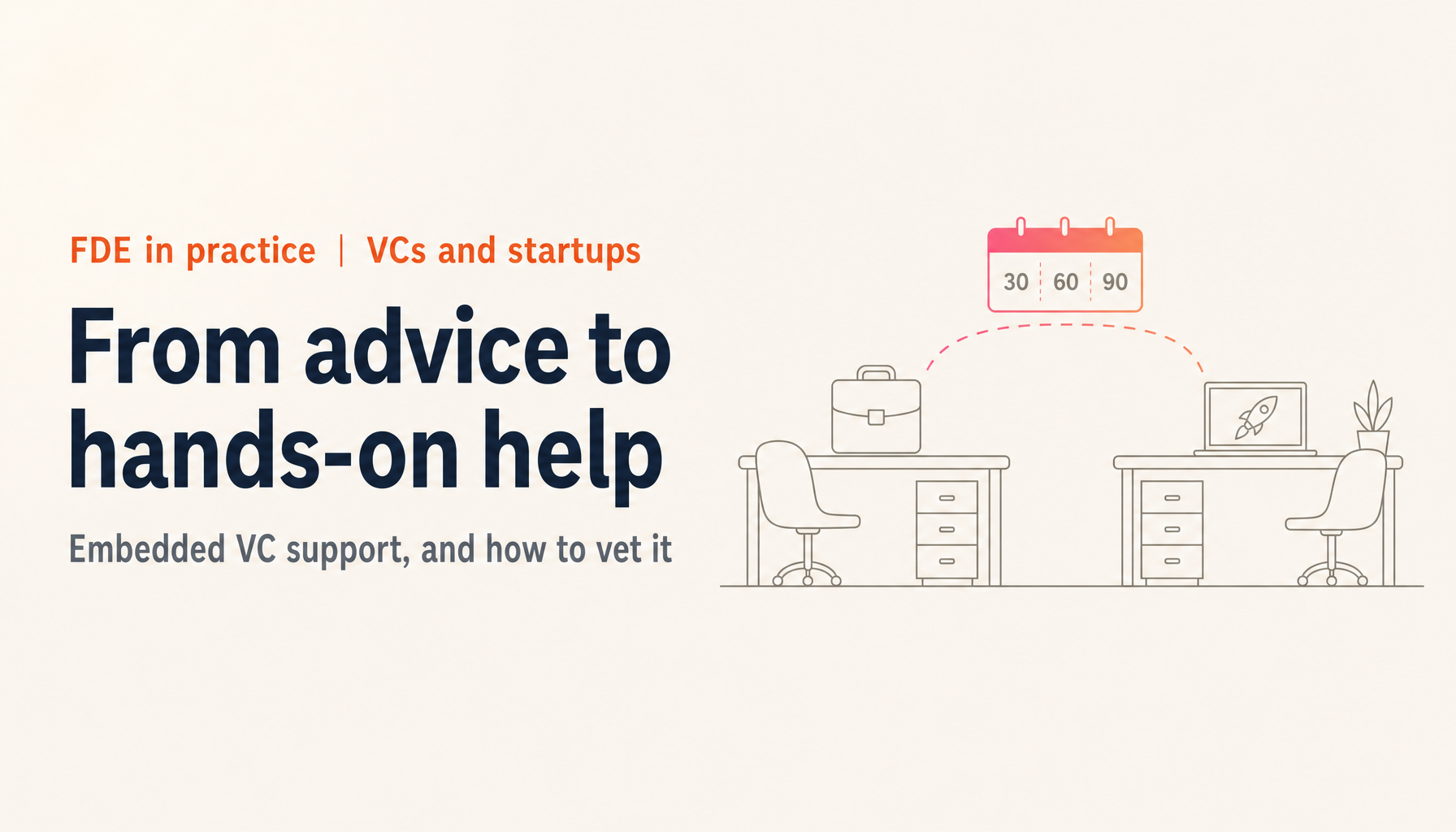
In October 2026, US venture capital firm Theory Ventures described its "Forward Deployment" approach, in which it embeds people in portfolio companies to help build sales and hiring. This article separates what has been published from what rests on the firm's own account, and sets out what it means for a VC to move from advice to execution, and five points a founder should check beforehand.

When a VC Goes Forward-Deployed: What It Means and How Founders Should Vet It
Share

Hello, this is Ryuta Hamamoto from TIMEWELL.

"VCs are becoming FDEs" is something I have been seeing a lot recently. One trigger is that on 16 October 2026, US venture capital firm Theory Ventures described an approach in which it embeds people in portfolio companies to help build sales and hiring together.1 From a founder's point of view, an investor who rolls up their sleeves with you, beyond money and advice, is a reassuring presence.

This article separates what has been published from what rests on the firm's own account. It then sets out what it means for a VC to move from advice to execution, and what founders should check beforehand. The basis is a single firm's disclosure, so I will not say this is a trend across VCs. What I cover is one published initiative, and a way of thinking about it for your own company.

What has been published

On 16 October 2026, Theory Ventures published a post titled "Forward Deployment." The author is Lauren DeMeuse of the firm. The firm says it built an "Intelligence Team" to make a partner's investment judgment repeatable as an organization. It has five functions: SIGINT, building data systems; HUMINT, growing a network of experts; GTMINT, speeding up portfolio companies' go-to-market through direct collaboration; MINT, building a marketing playbook; and TALINT, connecting talent and companies.2

Of these, the ones that go into portfolio companies are GTMINT and TALINT. The Forward Deployment post describes an FDE as someone who sits beside the customer, understands the work, and fills the last gap through customization. It then applies the same idea to VC. Capital and advice take a company most of the way. But the rest, such as the first sales hire, the first executive search and discussions at board meetings, happens inside the company. So Theory goes in.1

It gives portfolio company Ollama, a platform for running open-weight models, as an example. Here is what the post says.1

  • The engagement began in summer 2026, at one day a week
  • The person leading go-to-market sat in on dozens of interviews
  • Hiring and a GTM plan were put in place within 90 days
  • A working, scalable GTM technology stack was built
  • A customer pipeline was built for the new product, Ollama Enterprise
  • A sales organization was launched for the founding team

In a comment from Ollama's CEO, the GTM stack is said to serve millions of Ollama developers.

What has not been published

There are also many things the post does not say.

  • Cost. What the portfolio company pays for the engagement is not stated.
  • Team size and the standard duration and frequency. "One day a week" and "within 90 days" are for Ollama. They are not presented as a standard template.
  • Verification of results. The results come from the firm's own account and a quote from Ollama's CEO. No independent verification is given.
  • Scope. The post says the practices offered now are two, GTMINT and TALINT. It says nothing about extending to other areas.

The post also states the premise that makes this possible. The firm invests in a concentrated set of companies, so it can go into them when needed.1 I take that to mean it would be hard for a VC with a large number of portfolio companies to do the same.

Looking for AI training and consulting?

Learn about WARP training programs and consulting services in our materials.

Book a Free ConsultationDownload Resources

How I read this

The move from advice to execution overlaps with the spread of the FDE. Send people to the customer and fill the last gap: that model spread through AI implementation work from 2025 to 2026. I set out the figures in Why the FDE Market Grew So Fast. Theory's approach reads as that idea reaching the world of investing.

A founder's bottleneck really is the first sales hire and the first hires. What money and advice do not reach is the part where someone has to do the work. How do you choose the first salesperson, what do you ask in interviews, how do you build a sales playbook? If an experienced person comes in even one day a week, I think the speed of a launch can change.

But how big the effect is, we do not yet know. Because the results are the firm's own account, it is too early to take "launched within 90 days" as a general expectation. Ollama is already used by many developers, and conditions may have been favorable. The post does not let us tell.

Five things for a founder to check

From here on this is my own arrangement, not published fact. When a VC raises hands-on support, these are points worth confirming so that expectations do not diverge later.

1. What will be done, by whom, and how much.

"Going into the company" means different things to different people. Will they advise on sales, join sales calls, sit in on hiring interviews, or make documents? Write down the names of the people, how many days a week, and how many months. The "one day a week" and "within 90 days" in Theory's case can serve as a reference point.

2. How the portfolio company's information will be handled.

Getting into sales work means touching customer names, the state of deals and information on hiring candidates. Confirm the scope of confidentiality and the line on what the VC shares with other portfolio companies. It matters most if the same VC has invested in a competitor in the same market.

3. Who holds decisions.

The final call on hiring, sales policy and pricing is the founder's. Agree that the VC's people are in a supporting role and do not hold decision rights. Between "advice" and "execution" lies the question of who leads decisions.

4. Decide how it ends.

How long will support continue, and how will it move to self-sufficiency? In the Anthropic and FIS partnership covered in the FDE market article above, it was made explicit that the aim of embedding an FDE is not to stay on site but to hand over knowledge so the other side can run on its own. I think the same applies to VC support. Hand the sales playbook over to people inside the company. Leave the hiring process in writing. Decide what will remain after it ends.

5. How costs and consideration are set.

Theory's post says nothing about cost. If your company is offered this, confirm in writing whether the support is part of the investment terms or costs extra, and how it affects equity and the contract.

How this differs from bringing in an FDE yourself

VC support rests on a relationship in which the portfolio company's growth is also the VC's gain. When a business brings in an FDE itself, or uses an outside one, cost and results are set out in a contract. Both share the need to decide who does what, how far, and how it ends.

If you want to bring the FDE model into your own team, see the WARP program.

Summary

Theory Ventures has described its Forward Deployment approach, in which it embeds people in portfolio companies to help build sales and hiring. In the Ollama case, it says a one-day-a-week engagement put hiring and a GTM plan in place within 90 days. But that is the firm's own account, and neither cost nor independent verification is given. The post also says the approach assumes concentrated investment in a small number of companies.

From a founder's point of view, an investor who works with you beyond money and advice has value. That is exactly why it matters most to be clear beforehand about what will be done, by whom, how much, how far, and how it ends.

If you would like to talk through how to design involvement in your company or how to take on outside support, please reach out through the consultation form. I will update this article when more is reported.
References

Footnotes

  1. Why We Built a VC Firm Like an Intelligence Agency: Forward Deployment — Theory Ventures — 16 October 2026 ↩ ↩2 ↩3 ↩4

  2. Why We Built a VC Firm Like an Intelligence Agency — Theory Ventures — September to October 2026 ↩

This article was produced with the help of AI. A human verified the primary sources and edited the text before publication.

Considering AI adoption for your organization?

Our DX and data strategy experts will design the optimal AI adoption plan for your business. First consultation is free.

Book a Free Consultation
Book a Free Consultation45-minute online sessionDownload ResourcesProduct brochures & whitepapers

Share this article if you found it useful

Share

Newsletter

Get the latest AI and DX insights delivered weekly

Your email will only be used for newsletter delivery.

Related Knowledge Base

AI Adoption Roadmap

Solutions

AI Adoption & DX SupportEnd-to-end support from strategy to adoption

Learn More About WARP

Discover the features and case studies for WARP.

Contact UsView WARP Details

Related Articles

Why the FDE Market Exploded | 2026 in the Numbers on Jobs, Investment, Acquisitions, and Results

Why the FDE Market Exploded | 2026 in the Numbers on Jobs, Investment, Acquisitions, and Results

Job postings for Forward Deployed Engineers rose 5,230 percent between January 2025 and April 2026 on Indeed data. OpenAI launched a deployment company with more than $4 billion, AWS committed $1 billion, Anthropic set up a mid-market company with investment firms, and Palantir posted 93 percent revenue growth with a 47 percent operating margin in the second quarter of 2026. The eighth article in our FDE practice series reads why this role expanded so sharply from 2025 to 2026, through primary-source numbers on jobs, investment, acquisitions, and results, and then covers what the numbers do not say: how to tell a real FDE from a relabeled contractor.

2026-09-15
Will AI Kill Venture Capital? When OpenClaw Becomes Autonomous — The New Frontier for Founders and Investors

Will AI Kill Venture Capital? When OpenClaw Becomes Autonomous — The New Frontier for Founders and Investors

With the rise of autonomous AI agents like OpenClaw, how is the relationship between startups and venture capital changing?

2026-02-18
Running Business Apps in Your Own Cloud Tenant: Access, Data Location, and Personal Data

Running Business Apps in Your Own Cloud Tenant: Access, Data Location, and Personal Data

If you are dropping a SaaS product and building the business app yourself, my view is that it usually runs better inside your own cloud environment, your own tenant. The fifth and final article in this series covers how that differs from multi-tenant SaaS, what you gain in identity, access, data integration, and audit logs, why "who can touch the data" rather than where it sits decides whether Japan's APPI treats a vendor as an entrusted party, why choosing a Tokyo region does not remove the duty to understand foreign rules, and how operational responsibility shifts to you. It draws on NIST, AWS, the Japanese Personal Information Protection Commission's Q&A and the 2026 APPI amendment, and ISO/IEC 27001.

2026-09-29
Should You Cancel Your Expensive SaaS and Build It Yourself? Seven Tests for the AI Era

Should You Cancel Your Expensive SaaS and Build It Yourself? Seven Tests for the AI Era

For IT heads, corporate planning teams, and CFOs who opened a SaaS renewal quote and thought "we could build this for less," here are seven tests for deciding whether to cancel a SaaS you already pay for and build a replacement in-house: price increases and currency exposure, per-seat pricing growth, how slowly the data and features change, legal and accounting complexity, the number of integrations, who will maintain it, and the cancellation and migration terms. It does not hide the evidence on the other side, including public guidance that favors SaaS and research showing AI-assisted development can be less stable. The first article in a five-part series.

2026-09-29
FDEs and Business Ethnography | Turning What a Workplace Takes for Granted into Product

FDEs and Business Ethnography | Turning What a Workplace Takes for Granted into Product

Observation methods capture what people do. Ethnography captures why, in that group, it is taken for granted. The third article in our FDE practice series traces how an anthropological method reached corporate workplaces by way of Xerox PARC, explains Polanyi's tacit knowledge and Nonaka's socialization, shows how to write thick description, and lays out how ethnography differs from observation and why an FDE spends weeks on site. Contract-development business analysis targets "the process"; FDE ethnography targets "what this company takes for granted" and turns what it learns into standard product features. It also covers the time-boxing and deliverables that keep this from becoming live-in contract work.

2026-09-15
Filming the Shop Floor and Analyzing It with AI | Consent, Camera Setup, and the Analysis Pattern

Filming the Shop Floor and Analyzing It with AI | Consent, Camera Setup, and the Analysis Pattern

Our engineers have started filming work on site, with permission, and analyzing the footage afterward with AI. Where observation means seeing things once, in the moment, video means seeing them again as many times as needed, and it captures what the eye cannot count well, such as the exact length of a wait or the number of screen switches. The fifth article in our FDE practice series covers how to obtain consent, the essentials of Japan's personal-data law and the camera-image guidebook, when to use a fixed camera versus screen recording, the boundary between what AI analyzes and what people keep, and how this differs from work analysis in contract engagements. FDE video analysis ends when the footage has become next week's working artifact.

2026-09-15