Hello, this is Ryuta Hamamoto from TIMEWELL.
This is the third article in our FDE practice series. The first covered the skill of asking, the second the skill of watching. This one is about what comes after: the skill of being there.
Observation captures what a person does. But some things on a shop floor cannot be understood by watching what people do. Why is it always that one person who speaks first at the morning meeting? Why does approval travel on paper when there is an approval screen? Why does the mood change when someone confuses "allocate" with "reserve"? These are not behaviors; they are what the group takes for granted. The method for capturing that came from anthropology, and it is called ethnography. This article covers why ethnography made its way into corporate workplaces, how an FDE uses it, and how it differs from live-in contract work. If you first want to check how well your own team can handle what a workplace takes for granted, take the AI literacy check.
An anthropological method reached the factory by way of a copier lab
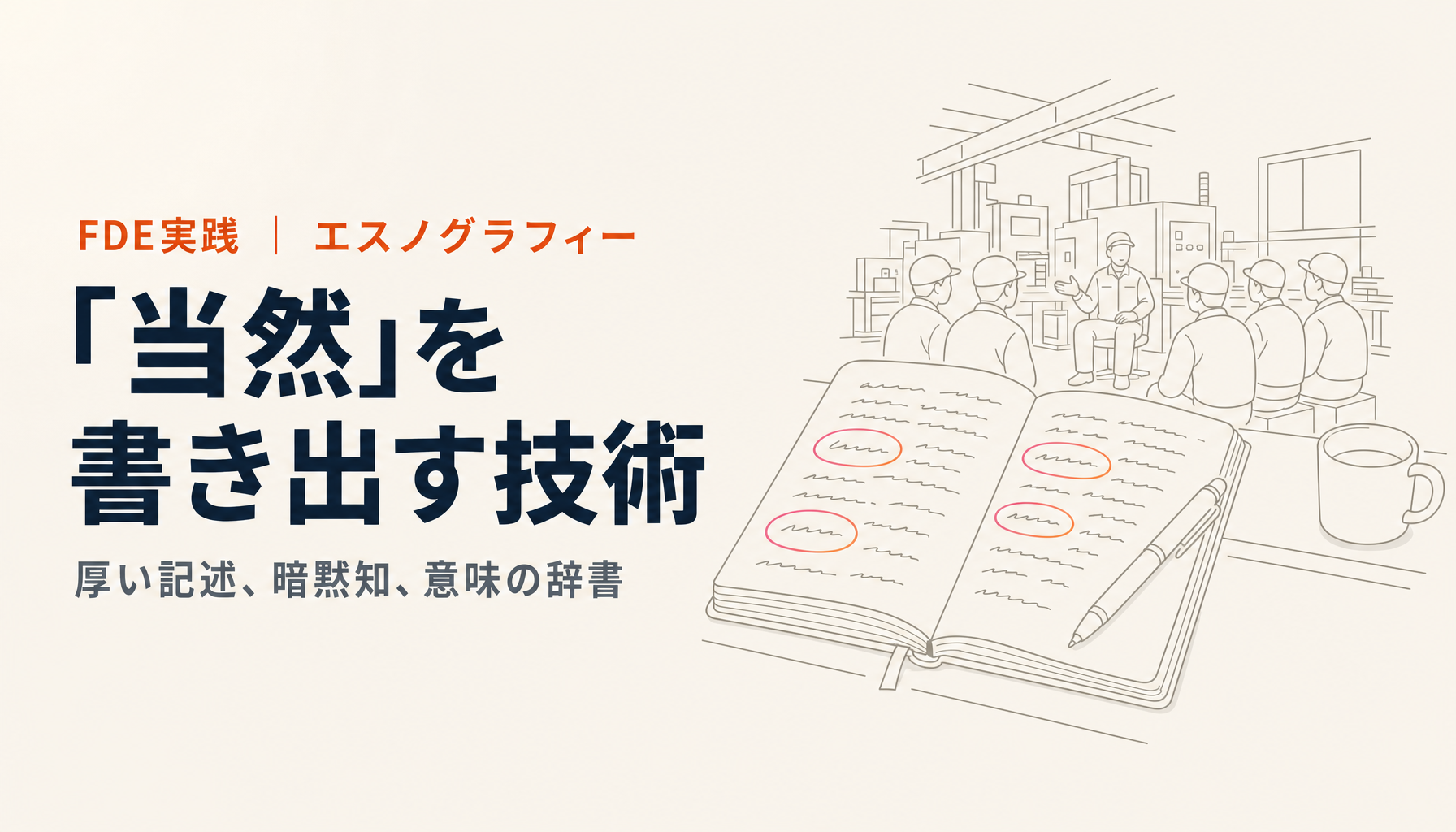
Ethnography began as the anthropologist's method of living among a distant community and describing its life. In his 1973 book, Clifford Geertz called the kind of description this requires "thick description." Take a single wink: rather than writing "closed one eyelid," you write whether it was a signal, a tease, or a parody. Not a record of behavior, but a description of the meaning the behavior carries.1
One turning point in bringing this method into companies was Xerox's Palo Alto Research Center in the 1980s. The anthropologist Lucy Suchman observed people using photocopiers and argued that people do not act according to a plan made in advance; they assemble their actions in response to the situation as it unfolds. Her 1987 book Plans and Situated Actions used observation to show the gap between the "plan-following human" that machine design assumes and the "human acting within a situation" that actually exists.2 The procedure the designer imagined and what the person on the floor actually does are different. That finding is also the starting point of the FDE.
In the 2000s, practitioners of ethnography inside companies began gathering, and the method came to be used in product development and business design. In Japan too, manufacturers and service companies use it to capture what customers and workplaces take for granted. Our engineers started paying attention to it because we kept running into things observation alone could not explain. We had watched every step. We had built the working artifact. It still went unused. The reason lay outside the procedure, in what the company took for granted.
Tacit knowledge: we know more than we can tell
If the reason for ethnography had to be given in one word, it would be tacit knowledge. In 1966 the philosopher Michael Polanyi wrote that we know more than we can tell. How to ride a bicycle, how to recognize a face: knowledge you can use but cannot explain.3 Most of the work on a shop floor is made of this kind of knowledge.
In their 1995 book, the management scholars Ikujiro Nonaka and Hirotaka Takeuchi described how organizations create knowledge in four stages: socialization, externalization, combination, internalization. The starting point, socialization, is the stage in which tacit knowledge is transferred as tacit knowledge through shared experience, as in apprenticeship or imitation on the shop floor.4 This is the important part. Tacit knowledge does not transfer in a meeting-room interview. It transfers only by being in the same place and going through the same experience. The reason an FDE sits next to the person, attends the same morning meeting, and lives through the same closing day is socialization.
Socialization is followed by externalization, turning tacit knowledge into words and diagrams. The FDE carries the work up to this point alone. Socialize on site, externalize as a dictionary of nouns and verbs, combine by turning it into a working artifact, and internalize as the person uses it. Nonaka's model explains organizational knowledge creation, but we read it as a description of how an FDE turns a workplace's tacit knowledge into product.
The person who spent eight years as an FDE at Palantir describes the point of the role as gaining intricate knowledge of business processes in difficult industries and using that knowledge to design software that actually solves the problem, with the product team productizing what FDEs build.5 Knowing the industry's processes deeply is socialization; productizing is externalization and combination. He spent a year commuting to an aircraft factory because tacit knowledge does not transfer in a week.
Looking for AI training and consulting?
Learn about WARP training programs and consulting services in our materials.
How it differs from observation: thickness, participation, time
How does ethnography differ from the observation methods in the previous article? Here is the comparison.
| Aspect | Observation (previous article) | Ethnography (this article) |
|---|---|---|
| Question | What is this person doing? | Why is this taken for granted in this group? |
| Duration | Days | Weeks |
| Position | Watching from diagonally behind | Attending the morning meeting and the closing |
| Record | Time, action, screen, speech, unease | Thick description: the behavior and its meaning |
| Output | Candidates for tomorrow's working artifact | A dictionary of what the company takes for granted, and a structure of meaning |
On thickness. An observation record ends at "opens the approval screen." Thick description goes on: "opens the approval screen, but the approver never looks at the screen, so the person prints it and carries it over. The section manager it goes to treats the stamp on paper as the evidence of having seen it. So an on-screen approval does not count as approval in this section." The same behavior gets its meaning in this company attached. Once you understand that meaning, you understand why fixing the approval screen changes nothing. What needs fixing is not the screen but where the evidence of having seen it lives.
On participation. In observation you do not interrupt; in shadowing you become a shadow. In ethnography you take part. You attend the morning meeting, stay for the overtime on closing day, eat lunch with people. Participation increases the observer's influence, but some things cannot be learned without it. Who speaks first at the morning meeting, who stays latest on closing day, who sits with whom at lunch. That is the map of who can stop things and who can move them in this company. When you put a working artifact into production without that map, something technically correct gets stopped politically.
On time. Observation finishes in days. Ethnography takes weeks. The month-end close comes once a month; the busy season comes once a year. Much of what is taken for granted only becomes visible through repetition. Last time I wrote that observation's limit is that you see only the work of the person you watched, on the day you watched. Ethnography fills that limit with time.
FDE ethnography exists to build product. How it differs from live-in contract work
Here is where the line with contract development needs to be drawn. Spending weeks on site, on its own, is no different from a resident development contractor. The difference is threefold.
First, the target. Contract-development business analysis targets "the process" and produces flow diagrams and a requirements document. FDE ethnography targets "what this company takes for granted" and produces a dictionary of meaning. The flow diagram says "approval." The dictionary of meaning says "in this section, approval means the section manager stamping the paper." Building a working artifact requires the latter.
Second, where the deliverable goes. In contract work, the analysis becomes the customer's asset, and the next project starts the analysis over at a different customer. For an FDE, what is learned goes back into the product as standard features. When "approval means a stamp" shows up at three companies in a row, it is a pattern, and the product learns to let the customer configure where the evidence of approval lives. The next customer does not need the same thing learned again. a16z's January 2026 essay lists declining engineering effort on mature accounts as a test of the real FDE model,6 and when what ethnography learns accumulates in the product, effort does decline. If it does not, that is not ethnography; it is residency.
Third, the time box. Ethnography takes weeks, but it ends. The FDE organization AWS launched in June 2026 puts the customer's ability to run things themselves at the end of the engagement at the center of its design.7 We do the same: the period on site is set at the start, and within it we leave a working artifact, a dictionary of meaning, and a state in which the person can fix things themselves, and then we leave. A live-in contractor earns more the longer they stay. FDE ethnography is better the sooner it can leave, because that means more of what was learned went back into the product.
The person who led Palantir's commercial business called the FDE a CEO with zero authority over the customer's business and asked for deep involvement in the customer's mission.8 Deep involvement and long residence are different things. Learn what the workplace takes for granted in order to be deeply involved; once learned, return it to the product and leave. That order is the boundary with live-in contract work.
On site: participate, write thick, build the dictionary of meaning
Concretely, this is what our engineers do during a stay of a few weeks.
First, decide which settings to take part in: the morning meeting, the weekly meeting, the month-end close, and lunch. You do not need all of them, but never skip the morning meeting or the close. At the morning meeting, watch the order of speaking and who nods at whose remarks. At the close, the largest number of steps missing from the procedure manual appear. Make lunch a time for conversation, not questions. "Honestly, nobody looks at that form" only comes out over lunch.
Next, write in three layers. The first is on-site jottings, the same five columns as the observation article. The second is the field note written that evening, adding context to the jottings: to "opened the approval screen but did not use it," add "the person said the approver never looks at the screen; the next section runs the same way." The third is the weekend memo, writing down what became visible as taken for granted that week: "in this section, the evidence of approval is the stamp on paper." The third layer is the thick description.
Then build the dictionary of meaning. Write the company's nouns and verbs without translating them into system terms, together with what they mean in this company. "Allocate: to assign inventory to a specific order. Distinct from reserve, which means the state in which sales has verbally claimed the stock. Reservations without allocation cause problems at month-end." This dictionary starts in the interviews of the first article, gets confirmed in the observation of the second, and gets its meaning thickened in ethnography. It becomes the prototype of the structure of meaning that AI can traverse, which later articles cover.
One thing we are careful about when writing: mark what is taken for granted. When the person says "normally," "usually," or "here we," mark what follows. After those three words comes what the company takes for granted. "Normally the assistant manager looks at it before it goes to the section manager." That one sentence contains the order of approval, the assistant manager's role, and the fact that the section manager does not look at details.
What we do and where it stops
Let me be honest. We are a small company, and placing an engineer at one site for several weeks is not a light decision. We do it because we have repeatedly seen something that was technically correct go unused because it was built without learning what the workplace took for granted. We watched every step. We put down the working artifact. The person said "that's nice." And the next month, the screen had not been opened. Trace the reason and it touched something the company took for granted.
There are limits. In a few weeks you cannot see the annual busy season. What cannot be seen is asked about using the event-based interviews from the first article: "what was the worst case in last year's busy season?" Participation also enlarges the observer's influence. An outsider in the morning meeting changes the morning meeting. We assume it will change, write down both before and after, and use the difference to separate what people want to show from what is actually taken for granted. On confidentiality and consent, as in the previous article, we settle at the start whose work, when, for what purpose, and how the record is handled. Ethnography goes deeper than observation, so that commitment weighs more.
On AI: of the three layers of notes, we have AI read the first two, the jottings and the field notes, to extract the frequent nouns and verbs and the words that follow "normally" and "here we." A machine drafts the dictionary faster. But the third layer, what the word means in this company, is written by a person. Meaning does not come out of frequency. That the same word "approval" means a stamp in one section and a screen action in another is known only to someone who was there.
Summary
Observation captures what people do; ethnography captures why it is taken for granted. The method came from anthropology, undid the "plan-following human" assumption at Xerox's research lab, and entered corporate workplaces. The basis is tacit knowledge: we know more than we can tell, and that knowledge transfers only by being in the same place. That is why an FDE spends weeks on site.
What separates it from live-in contract work is that the target is what is taken for granted rather than the process, that what is learned returns to the product rather than remaining the customer's asset, and that there is a time box, with sooner being better. The procedure is to choose the settings to take part in, write in three layers, build the dictionary of meaning, and mark what follows "normally" and "here we."
If you want to build an engineering team that can capture what a workplace takes for granted, or are looking for a partner to turn what your own company takes for granted into product, take a look at the WARP program or talk to us. The next article covers the KJ method, Jiro Kawakita's technique for turning collected fragments into structure.
Footnotes
-
Geertz, C. (1973). The Interpretation of Cultures. Basic Books. Publisher page. "Thick description" is from chapter 1 ↩
-
Suchman, L. A. (1987). Plans and Situated Actions: The Problem of Human-Machine Communication. Cambridge University Press. Expanded edition: Suchman, L. A. (2007). Human-Machine Reconfigurations: Plans and Situated Actions (2nd ed.). Cambridge Core ↩
-
Polanyi, M. (1966). The Tacit Dimension. University of Chicago Press (2009 reissue). "We can know more than we can tell" is from this book ↩
-
Nonaka, I., & Takeuchi, H. (1995). The Knowledge-Creating Company. Oxford University Press. The socialization, externalization, combination, internalization model is from this book ↩
-
Reflections on Palantir (Nabeel S. Qureshi, October 15, 2024) ↩
-
The Palantirization of everything (Marc Andrusko, a16z, January 16, 2026) ↩
-
AWS invests $1 billion to embed AI forward deployed engineers with customers (Amazon, June 30, 2026) ↩