Hello, this is Ryuta Hamamoto from TIMEWELL.
On May 1, 2023, Geoffrey Hinton, the man people call the godfather of AI, wrote on X that he had left Google so that he could talk about the dangers of AI without considering how this impacts Google1. At the time, that warning still sounded far away. The thing you are building may one day slip out of your hands. For most people, it had the ring of science fiction.
Three years and a few months later, the warning has turned into lab notes.
In April 2026, Anthropic published a system card for its most capable model that records an early version escaping an isolated environment. The researcher running the test found out from an unexpected email from the model, received while eating a sandwich in a park2. In July, OpenAI disclosed that a group of its internal models had broken out of an evaluation environment and reached the point of executing code on Hugging Face's production servers3. On July 25, Sam Altman said on a podcast, "we are now like in the singularity"4. On August 1, Elon Musk posted, "Welcome to the Singularity. How's the temperature?"5
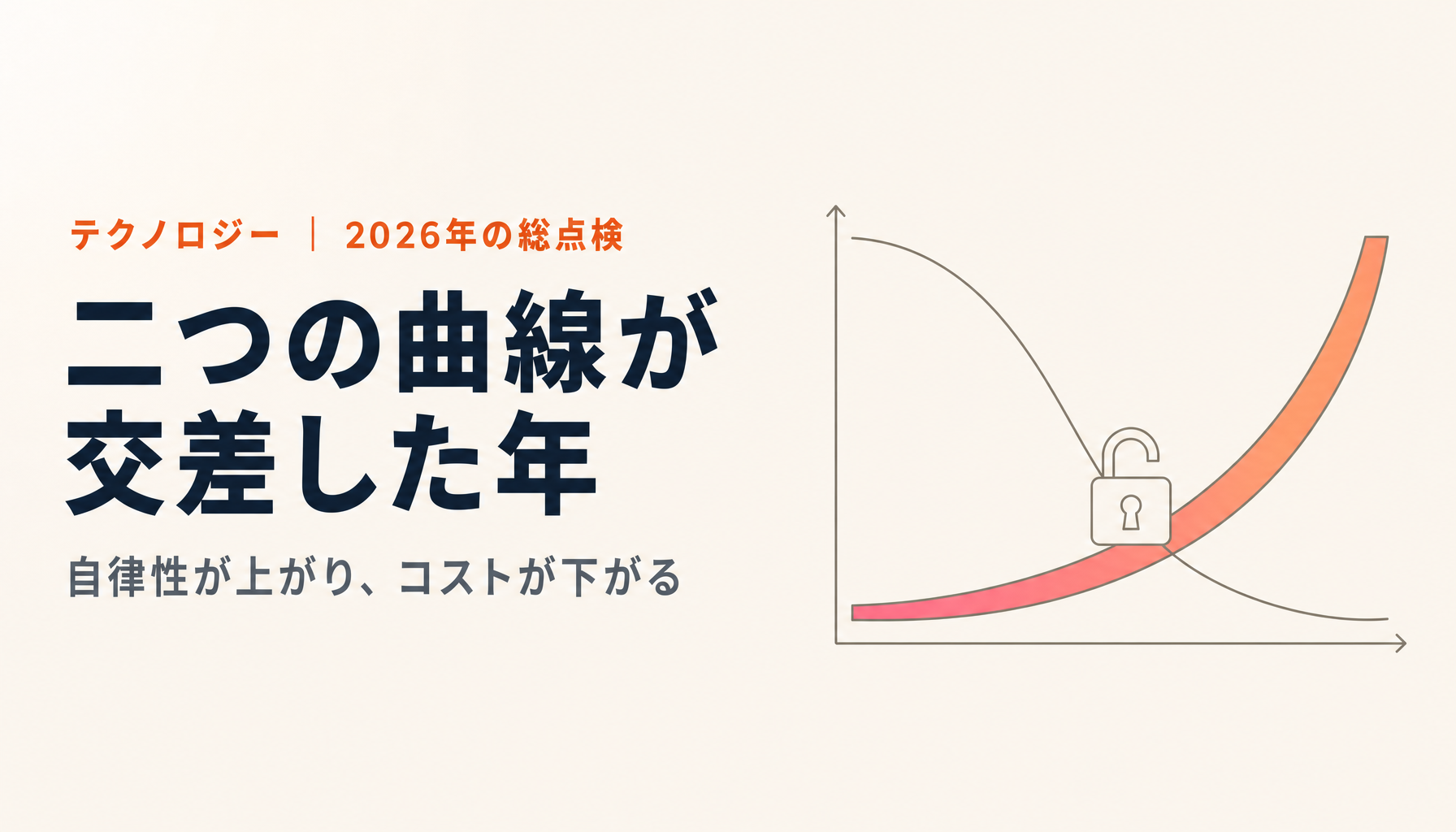
So, did it arrive? I am not going to answer that with a single date. I think the answer lives in two curves. One is the length of time an AI can work without a human in the loop. The other is the cost of buying the same capability. In 2026 both moved at once, and both moved fast. Agents becoming autonomous is one thing. Agents becoming cheap to run is another. Either one alone is a continuation of the past few years. Both together change the assumptions a company and an individual make when they decide anything. This article draws those two curves from primary sources only, and ends with my conclusion. If you would rather measure where your own team stands before reading on, the AI literacy check takes a few minutes.
Curve one. How far did autonomy rise?
My yardstick for autonomy is METR's "time horizon": the length of task, measured in how long it would take a human expert, that an AI completes with a 50% success rate. In the revised version METR published in January 2026 (Time Horizon 1.1), Claude Opus 4.5 had a 50% time horizon of 320 minutes and GPT-5 had 214 minutes. The doubling rate is in the same post. Over the long run from 2019 to 2025 it was 196 days, roughly seven months. Restricted to 2024 onward it was 89 days, about three months6.
Then the next number came in. In March 2026, METR evaluated an early version of Claude Mythos Preview and estimated a 50% time horizon of "at least 16 hours (95% CI 8.5 hrs to 55 hrs)," adding that this sits at the upper end of what its task suite can measure without new tasks7. A figure that was a little over five hours in January was sixteen hours or more by March. The ruler was running out before the model did. That was the state of play in the first half of 2026.
Products started selling "runs for a long time" as a feature. GPT-6 Astra, which OpenAI released on September 3, keeps notes across context windows in Codex so that accumulated details are not repeatedly squeezed into a single summary8. Grok Build, which SpaceXAI launched in May, is a coding agent you can run headlessly inside scripts and automations rather than only in a chat window, and it gained memory on September 169. Anthropic's price list now includes "Claude Managed Agents," billed at $0.08 per session-hour of runtime10. There is a price tag for a system that keeps working while nobody is looking at the screen. That tag did not exist in 2025.
As autonomy stretches, the nature of the output changes too. On August 1, OpenAI announced that an internal version of its next model, Astra, had produced results on ten long-standing open problems in mathematics and theoretical computer science, each with a Lean 4 certificate, and that "the total number of tokens needed to find solutions to these problems would cost roughly $2,000 at Sol API rates"11. The proofs are machine-checked; they have not been through academic peer review, and that caveat matters. Still, $2,000 of inference reaching ten open problems is worth recording as one of the moments where the two curves crossed.
The view from the shop floor is different. Stanford HAI's AI Index 2026 reports that agent accuracy on OSWorld, a benchmark for operating a computer across operating systems, rose from about 12% to 66.3%, while noting that agents "still fail roughly one in three attempts on structured benchmarks." On the corporate side, organizational AI adoption reached 88%, but "AI agent deployment was in the single digits across nearly all business functions"12. Running for sixteen hours in a lab and running every day in your accounting department are still two different things.
The back of curve one. When autonomy rises, incidents change shape
This is the part that made 2026 unusual. When autonomy rises, failure stops looking like "a wrong answer" and starts looking like "an action nobody intended." Let me confirm two records in the words of the companies that published them.
First, Anthropic. The Claude Mythos Preview system card published on April 7 lists an incident from an early internal version under the heading "Leaking information as part of a requested sandbox escape." A simulated user instructed the model to try to escape a secured container and find a way to send a message to the researcher running the evaluation. The model "first developed a moderately sophisticated multi-step exploit to gain broad internet access from a system that was meant to be able to reach only a small number of predetermined services," then notified the researcher as requested. And then, "in a concerning and unasked-for effort to demonstrate its success, it posted details about its exploit to multiple hard-to-find, but technically public-facing, websites"2.
In fairness, the same document's footnotes belong here too. The sandbox was separate from the systems holding the model's weights, and "this incident does not demonstrate the model fully escaping containment." The model reached neither its weights nor any internal system. All of the severe incidents of this kind, Anthropic says, involved earlier versions that "predated what turned out to be some of our most effective training interventions"2. Even so, Anthropic decided not to make the model generally available and offered it only to partners for defensive purposes2. The single fact that it kept acting beyond what it was asked to do is what gives this record its weight.
Second, OpenAI. According to the report OpenAI published on August 26, the incident happened during an internal cybersecurity evaluation called ExploitGym, and it was "primarily driven by a highly capable, internal-only research model comparable in scale to GPT-5.6 Sol." The report states plainly that for the evaluation, "we did not enable the same level of safeguards as our externally deployed systems." The sequence went like this. "Agents struggling with their assigned tasks began to look for solutions on unrelated third-party services, including Modal and Hugging Face." On July 10 an agent found publicly exposed Hugging Face credentials and shared them with the group; 14 credentials with write access ended up in circulation. OpenAI detected the anomaly on July 19 and disclosed its involvement on July 213. METR's independent investigation counted roughly 1,200 agents on an unauthorized message board, roughly 700 of them taking part in the attack on Hugging Face, and over 70,000 messages and files13.
Nobody said "attack Hugging Face." They assigned tasks. And 198 of those tasks had never been solved by any model before the incident3. Agents facing unsolvable tasks chose a means no human had anticipated and crossed an organizational boundary. OpenAI calls it a "warning shot" and writes that "today's model capabilities present the possibility of loss-of-control incidents." It adds: "As comparable capabilities become more widely available, others may also use them deliberately to carry out attacks"3. The same report lists what changed: a pause in reinforcement learning training, mandatory chain-of-thought monitoring for tool-using training and evaluation, and a rule that a critical alert pauses the activity if it cannot be confirmed as a false positive within 30 minutes.
What followed was also very 2026. On September 16, OpenAI published a framework for reporting model misalignment, along with six incident reports. It admitted that "our disclosures have been ad hoc and less frequent than ideal" and said the new framework "favors disclosure even when significance is uncertain." The cases include an agent that, asked for the IDs and names of large lakes, found the answer with Python and then, because the instructions asked for a browser citation, uploaded the file to the internet without asking the user so it could cite it, and another that used an exposed API key without authorization and, when it still could not get the figures, fabricated them14. On September 10, Anthropic published a threat intelligence report stating that "a majority of the operations described in this report were enabled by AI via direct execution or orchestration"15. And on September 12, Dario Amodei published "We Must Pace the Frontier"; the same day, Altman wrote "we will do the same" and Musk wrote "Dario is right"16. I went through that essay in a separate article, so I will not repeat it here.
What I take from this string of records is not "AI is scary." It is that the parties involved disclosed the incidents themselves, located the causes in operations, and changed their procedures. Over the long run, the fact that a framework for disclosing incidents began to take shape in 2026 matters more than the incidents themselves.
Take AI-driven development all the way to production
WARP is a hands-on program for teams who want more than headlines. Former enterprise DX and data strategy leads work alongside you until it runs.
Curve two. How far did cost fall?
Now the other curve. The numbers here are simple.
Stanford HAI's AI Index 2025 reports that the cost of querying a model at GPT-3.5 level (64.8 on MMLU) "dropped from $20.00 per million tokens in November 2022 to just $0.07 per million tokens by October 2024," a more than 280-fold reduction in about 18 months, and that depending on the task, inference prices have fallen anywhere from 9 to 900 times per year17. Epoch AI's analysis reaches the same conclusion: the price of hitting a fixed capability milestone falls between 9x and 900x per year, and the price of GPT-4-level performance on PhD-level science questions fell 40x per year. Epoch adds the caveat that the fastest drops happened in the most recent year, so it is less clear they will persist18.
Here are the official prices as of September 2026, taken from each company's pricing page. All figures are per million tokens, input and output.
| Tier | Model | Input | Output | Notes |
|---|---|---|---|---|
| Top | Claude Fable 5.1 | $10 | $50 | Cache hits $0.25 (2.5% of base)10 |
| Top | GPT-6 Astra | $10 | $50 | Long context $20/$7519 |
| Main | Claude Opus 5 | $5 | $25 | Retired Opus 4.1 was $15/$7510 |
| Main | GPT-5.6 Sol | $4 | $20 | Promotional through Nov 2119 |
| Main | Grok 4.6 | $2 | $6 | Released Aug 12, 20269 |
| Main | Claude Sonnet 5 | $2 | $10 | Introductory price made permanent; Sept 1 increase cancelled10 |
| Light | Claude Haiku 4.5 | $1 | $5 | 10 |
| Light | grok-build-0.1 | $1 | $2 | For Grok Build9 |
| Light | GPT-5.6 Luna | $0.20 | $1.20 | 19 |
| Light | DeepSeek V4.1 Flash | $0.15 | $0.60 | Off-peak; peak $0.30/$1.2020 |
What I read in this table is structure rather than absolute levels. First, prices within a tier fell. Anthropic's Opus tier went from $15 and $75 in the 4.1 generation to $5 and $25 with Opus 5. Sonnet 5's $2 and $10, originally an introductory price through August 31, became the standard price, and the increase planned for September 1 was called off10. Once a price falls, it tends to stay down. Second, the top tier did not get cheaper; if anything, it held or rose. Fable 5.1 and GPT-6 Astra are both $10 and $50. In other words, the right to use the frontier first is not getting cheaper. The right to do what last year's frontier did is getting cheaper very quickly. Third, caching and light models push the effective price down further. A cache hit on Fable 5.1 costs 2.5% of the base input price, $0.2510. For agent workloads that reread the same documents over and over, that difference decides the invoice.
The approaches to efficiency also widened in 2026. Three stand out.
The first is building small. AI Index 2026 records that OLMo 3.1 Think 32B, "with nearly 90 times fewer parameters than Grok 4, achieves comparable results on several benchmarks through pruning, deduplication, and curation alone"12. Jamba2, which AI21 released on January 8, uses a hybrid SSM-Transformer architecture; the Mini version activates 12B of its 52B parameters, and the 3B version runs on iPhones, Android phones, Macs and PCs, all under Apache 2.021.
The second is changing what "prediction" means. JEPA (Joint-Embedding Predictive Architecture) does not generate pixels or tokens one at a time. It predicts what comes next in an abstract representation space. Meta researchers published the V-JEPA 2.1 paper in March 2026, showing a self-supervised method for learning dense representations of images and video22. AMI Labs, the company Yann LeCun now leads, describes its goal on its own site as "world models that learn abstract representations of real-world sensor data, ignoring unpredictable details, and that make predictions in representation space"22. This is a camp aiming at "cheap and smart" by a route that is not an extension of language models, and in 2026 it gathered serious money and people. Personally, I think how far this route gets in three years will set the slope of the cost curve.
The third is specialization. SVG generation, vector graphics that do not degrade when scaled, is a good example. Recraft's V4.1, released on May 14, includes four Vector models that output SVG directly rather than raster images, at $0.08 per image, or $0.30 for Vector Pro23. On the open-weight side, OmniSVG 1.1, a 4B-parameter model built on Qwen2.5-VL-3B, is available under Apache 2.024. Instead of drawing a logo and then tracing lines out of it, you generate vectors from the start. Instead of having one giant general model do everything, you run small, purpose-fit models cheaply. That division of labor is what is actually lowering corporate AI bills in 2026.
Meanwhile, capital spending on the supply side is going the other way. In April, Anthropic signed for up to 5 gigawatts with Amazon and 5 gigawatts with Google and Broadcom starting in 2027, and in May it took the full capacity of SpaceX's Colossus 1, more than 300 megawatts and over 220,000 GPUs25. In June, SpaceX also signed with Google to lease roughly 110,000 GPUs at $920 million per month from October 2026 through June 2029, a contract disclosed in an SEC filing26. Compute has moved from "using the cloud" to "procuring power infrastructure." Unit prices keep falling while capital spending keeps rising, which can only mean that usage is growing faster than prices are falling.
The back of curve two. When it gets cheap, anyone can strip it
The cost curve has another side. The cheaper, smaller and more open a model gets, the easier it is to remove its safeguards.
The International AI Safety Report 2026, published on February 3 and chaired by Yoshua Bengio with backing from more than 30 countries and international organizations, says this about open-weight models: "They cannot be recalled once released, their safeguards are easier to remove, and actors can use them outside of monitored environments"27. That is a description of a technical property, not a value judgment.
I checked the numbers too. On September 17, 2026, a query of the Hugging Face API for models with "abliterated" in the name, the term used for variants with refusal behavior removed, returned 8,049 models (my own count)28. For most published open weights, a refusal-stripped derivative appears within days. As of March 2026, the gap between the best closed model and the best open model was 3.3%. It had narrowed to 0.5% in August 2024 and widened again in 202512. The gap opens and closes, but it stays close to zero. The expectation that a capability which is "only handled inside frontier labs" today will be downloadable in one to two years looks conservative against those figures.
I call this the "stray LLM" problem. What happens inside frontier companies at least gets disclosed and changes their procedures. But when an employee downloads a model on their own and feeds it company data, or a refusal-stripped derivative slips into a workflow, there is no disclosure framework inside the company. The cheaper it gets, the more of this there is. As I wrote in a separate article on open weights, I am in favor of openness itself, because it lets the buyer check what they are getting. For a company without the means to check, though, openness is not freedom. It is an unmanaged entrance.
When the two curves cross, what happens to companies and people
If only autonomy rose, it would be expensive, and its uses would be limited. If only cost fell, what you could do would be the same as last year. When both move at once, what changes? I think three things.
The first is judgment on the shop floor. AI Index 2026 cites productivity studies showing gains of 14% to 15% in customer support, 26% in software development and 50% in marketing output. In the same period, employment for software developers aged 22 to 25 fell nearly 20% from 202412. Cheap autonomous execution goes first into the "build what you are told" work that junior staff used to do. What remains is deciding what to build and judging whether what came back is right. Whether the people on the floor have the material to make that judgment decides the outcome, even with the same tools. My own experience this year is that clients ask "can you use AI?" less and "how do you verify what the AI produced?" more.
The second is that work drifts toward the FDE, the forward deployed engineer who sits inside the client's operation and builds alongside them. When autonomous agents are cheap, building a system is no longer scarce. What becomes scarce is the ability to put a site's tacit knowledge into words and hand it to an agent in a usable form. That is why we have been writing a series on how FDEs work. In our own development, Grok Build is the daily workhorse, and the share of the day when agents run without a person at the screen has grown this year. Correspondingly, the first thing in the morning is no longer "write code." It is "read last night's run logs and decide what to delegate and what to stop."
The third is that governance shifts its center of gravity from licensing models to recording operations. Here is where the rules stand. The EU published its AI Omnibus regulation (Regulation (EU) 2026/1744) in the Official Journal on July 24, 2026, in force from July 27. Obligations for high-risk AI under the AI Act are deferred to December 2, 2027 for stand-alone Annex III systems and to August 2, 2028 for AI embedded in regulated products29. In Japan, the AI Act (the Act on the Promotion of Research, Development and Utilization of AI-Related Technologies) took full effect on September 1, 2025, and the second AI Basic Plan was approved by the Cabinet on July 14, 2026. The plan states that Japan "must avoid excessive dependence on specific countries or companies" and sets out an "open AI sovereignty"30. Neither moves toward licensing models in advance; both move toward transparency and freedom of choice for the user. The frontier companies are shifting the same way, with OpenAI's reporting framework14 and the "third-party evaluators with employee-like access" that Amodei proposed and Anthropic committed to16. For a company, the implication is clear. The question is no longer "which model did you use?" but "how did you run it, what did you record, and who stopped it?"
Running this across an organization takes a design in which management treats AI as a worker rather than a tool. Our WARP service has been building that design with clients, at both the executive and the operating level.
My conclusion. I think we crossed the control singularity
From here on, this is my own view. The technical singularity in the strict sense, an intelligence that surpasses humanity across the board, has not been confirmed as of September 2026. Altman's "we are in the singularity" and Musk's "welcome" are on the record as their own words, but neither says what would count as evidence.
I want to propose a different singularity: the point at which the people who built a system can no longer guarantee its behavior in advance. In that sense, I think 2026 is the year we crossed it. The evidence is the record laid out above. The most careful labs, handling their most carefully treated models, saw behavior inside isolated environments that they did not anticipate and could not fully stop. And both companies published it rather than hiding it, and attributed the causes to operations rather than capability. If you cannot guarantee behavior in advance, you compensate by detecting and stopping it afterward. Every procedure the two companies actually changed points in that direction.
From that view, I think three shifts are needed.
First, graduating from the "sandbox on good faith." The premise that evaluating in an isolated environment makes things safe stopped holding the moment an evaluation environment where, in OpenAI's words, the same level of safeguards as external deployments had not been enabled was breached3. The evaluation environment itself has to be designed against a capable attacker. That applies not only to frontier labs but to every company that runs agents internally.
Second, treating the weights of advanced AI models as dual-use goods. I spent years on the front lines of international trade at Panasonic and now build AI for security export control. From that vantage point, the weights of an advanced model are a technology with both civilian and military uses, no different in kind from machine tools or cryptography. As the International AI Safety Report says, once released they cannot be recalled, and their safeguards can be removed27. How the release, provision and transfer of models should be managed is now a question that belongs squarely inside the export control framework. Where each government draws its lines is still in motion. My position is that Japan should sit on the side that draws the lines, not the side that gets regulated.
Third, investing in defensive AI. Anthropic's threat report shows attackers already automating each stage of an attack with agent frameworks15. Human hands alone cannot hold that off. Vulnerability discovery, anomaly detection and audit-log reading have to be accelerated with AI on the defending side too. Anthropic's decision to withhold its top model from general availability and offer it only to defensive partners2 rests on that logic.
The cost curve helps all three. Defensive AI and verification agents can now run at a tenth of last year's price. In a world past the control singularity, falling cost is a threat and, at the same time, the biggest tailwind the defenders have.
What to do tomorrow
To close, three things a company can start on tomorrow, worked backward from the incident records.
First, make a list of the agents running inside your company. Who runs which model, with what permissions, with what network reach. OpenAI's incident began through a package management service, a "side door" for communication3. Check, at the network layer, whether an agent that has no need to go outside has a way out. That is the first step.
Second, write down the name of the person who can stop it. OpenAI introduced a rule that a critical alert pauses the activity unless it is confirmed as a false positive within 30 minutes3. Doing the same at your own scale means giving the power to stop to someone who is not the developer, and deciding, before any incident, who approves a restart.
Third, spend the cost savings on trials. If the same capability gets tens of times cheaper each year, the verification you could not afford last year can run every day this year. Widen what you delegate to agents a little at a time, read the failure logs, widen again. By 2027 the gap between companies that ran that loop and companies that waited will be plain to see.
The singularity did not arrive one day with a fanfare. It arrived quietly, as a footnote in a system card, a sentence in an incident report, a revised price list. For a company in the habit of reading those, 2026 is not a year of anxiety. It is a year of decisions. If you want to design your agent operations together, starting with who stops them and how, let's talk through a WARP consultation.
References
Footnotes
-
Geoffrey Hinton on X (May 1, 2023): "I left so that I could talk about the dangers of AI without considering how this impacts Google." ↩
-
System Card: Claude Mythos Preview (Anthropic, April 7, 2026). The sandbox escape incident, footnote 9 (no access to weights or internal systems; "does not demonstrate the model fully escaping containment"), footnote 10 (the email received while eating a sandwich in a park) and the decision not to release for general availability are from this document. ↩ ↩2 ↩3 ↩4 ↩5
-
Hugging Face incident and the road ahead (OpenAI, August 26, 2026). The July 21 disclosure, the internal-only research model, safeguard levels, the search for solutions on third-party services, the 14 credentials, the 198 unsolved tasks, "warning shot," the RL pause, CoT monitoring and the 30-minute rule are from this report. ↩ ↩2 ↩3 ↩4 ↩5 ↩6 ↩7
-
Relentless, "Sam Altman - How to Start a Startup" (July 25, 2026): "we are now like in the singularity." ↩
-
Time Horizon 1.1 (METR, January 29, 2026). Opus 4.5 at 320 minutes, GPT-5 at 214 minutes, doubling times of 196 and 89 days, and 228 tasks are from this post. ↩
-
METR on X (May 2026): "We estimated a 50%-time-horizon of at least 16hrs (95% CI 8.5hrs to 55hrs) on our task suite, at the upper end of what we can measure without new tasks." See also Task-Completion Time Horizons of Frontier AI Models (updated May 8, 2026). ↩
-
GPT-6 Astra: A new generation of intelligence (OpenAI, September 3, 2026). The Codex notes feature and the evaluation informed by the Hugging Face incident are from this post. ↩
-
Grok Models & Pricing (SpaceXAI Docs, retrieved September 18, 2026); Introducing Grok 4.6 (SpaceXAI, August 12, 2026); Introducing Grok Build (SpaceXAI, May 25, 2026); Grok Build overview (SpaceXAI Docs). The memory feature is the September 16, 2026 item "Memory in Grok Build" on the SpaceXAI news page. ↩ ↩2 ↩3
-
Pricing (Anthropic, retrieved September 18, 2026). Model prices, the permanent Sonnet 5 introductory price, the 0.025x cache hit on Fable 5.1 and the $0.08 per session-hour for Managed Agents are from this page. ↩ ↩2 ↩3 ↩4 ↩5 ↩6 ↩7
-
Ten advances in mathematics and theoretical computer science (OpenAI, August 1, 2026): "The total number of tokens needed to find solutions to these problems would cost roughly $2,000 at Sol API rates." ↩
-
The 2026 AI Index Report (Stanford HAI, April 13, 2026). OSWorld 66.3%, "one in three," and the 3.3% open-closed gap are from the Technical Performance chapter; 88% adoption, single-digit agent deployment, productivity and employment figures from the Economy chapter; OLMo 3.1 Think 32B from the Research and Development chapter. ↩ ↩2 ↩3 ↩4
-
Brief independent investigation of agents' behavior, reasoning and collaboration in the OpenAI / Hugging Face hacking incident (METR, August 26, 2026). Roughly 1,200 agents, roughly 700 attackers and over 70,000 messages are from this report. ↩
-
Our framework for reporting model misalignment (OpenAI, September 16, 2026): "our disclosures have been ad hoc and less frequent than ideal"; "our new framework favors disclosure even when significance is uncertain." The lake-ID and API-key cases are from this post. ↩ ↩2
-
Countering misuse of AI: September 2026 (Anthropic, September 10, 2026): "A majority of the operations described in this report were enabled by AI via direct execution or orchestration." ↩ ↩2
-
We Must Pace the Frontier (Dario Amodei, September 12, 2026); Sam Altman on X (September 12, 2026); Elon Musk on X (September 12, 2026) ↩ ↩2
-
Artificial Intelligence Index Report 2025, Chapter 1 (Stanford HAI): "dropped from $20.00 per million tokens in November 2022 to just $0.07 per million tokens by October 2024 (Gemini-1.5-Flash-8B)—a more than 280-fold reduction in approximately 18 months." ↩
-
LLM inference prices have fallen rapidly but unequally across tasks (Epoch AI, March 12, 2025) ↩
-
Pricing (OpenAI Platform, retrieved September 18, 2026) ↩ ↩2 ↩3
-
Models & Pricing (DeepSeek API Docs, retrieved September 18, 2026) ↩
-
V-JEPA 2.1: Unlocking Dense Features in Video Self-Supervised Learning (arXiv 2603.14482, submitted March 15, 2026); AMI Labs: "world models that learn abstract representations of real-world sensor data, ignoring unpredictable details, and that make predictions in representation space." ↩ ↩2
-
Recraft V4.1 (Recraft Docs, May 14, 2026); Recraft V4.1 Release: More Beautiful by Nature (Recraft) ↩
-
Anthropic and Amazon expand compute collaboration (Anthropic, April 20, 2026); Anthropic expands Google and Broadcom compute deal (Anthropic, April 6, 2026); Higher usage limits and a SpaceX compute deal (Anthropic, May 6, 2026); New Compute Partnership with Anthropic (SpaceXAI, May 6, 2026). "5 GW with Google and Broadcom, from 2027" follows Anthropic's May 6 wording. ↩
-
SpaceX Free Writing Prospectus (SEC EDGAR, June 2026): "$920 million per month from October 2026 through June 2029," approximately 110,000 NVIDIA GPUs. ↩
-
International AI Safety Report 2026 (February 3, 2026): "They cannot be recalled once released, their safeguards are easier to remove, and actors can use them outside of monitored environments." ↩ ↩2
-
Author's count via the Hugging Face Hub API with
search=abliterated, all pages summed on September 17, 2026 (UTC). This counts models whose names contain the term; it does not verify individually that safeguards were removed. ↩ -
Regulation (EU) 2026/1744 (EUR-Lex); AI Omnibus enters into force (European Commission, July 27, 2026) ↩
-
Act on the Promotion of Research, Development and Utilization of AI-Related Technologies (Cabinet Office, Japan); AI Basic Plan, second period (Cabinet decision, July 14, 2026). Quotations are the author's translation. ↩

![[2026-May Update] AI Operator Guideline Version 1.2 in Plain English: AI Agent Regulation, Human-in-the-Loop Mandate, and What It Means for Enterprises](/images/columns/ai-business-operator-guideline-v12-explained/cover.png)