This is Hamamoto from TIMEWELL.
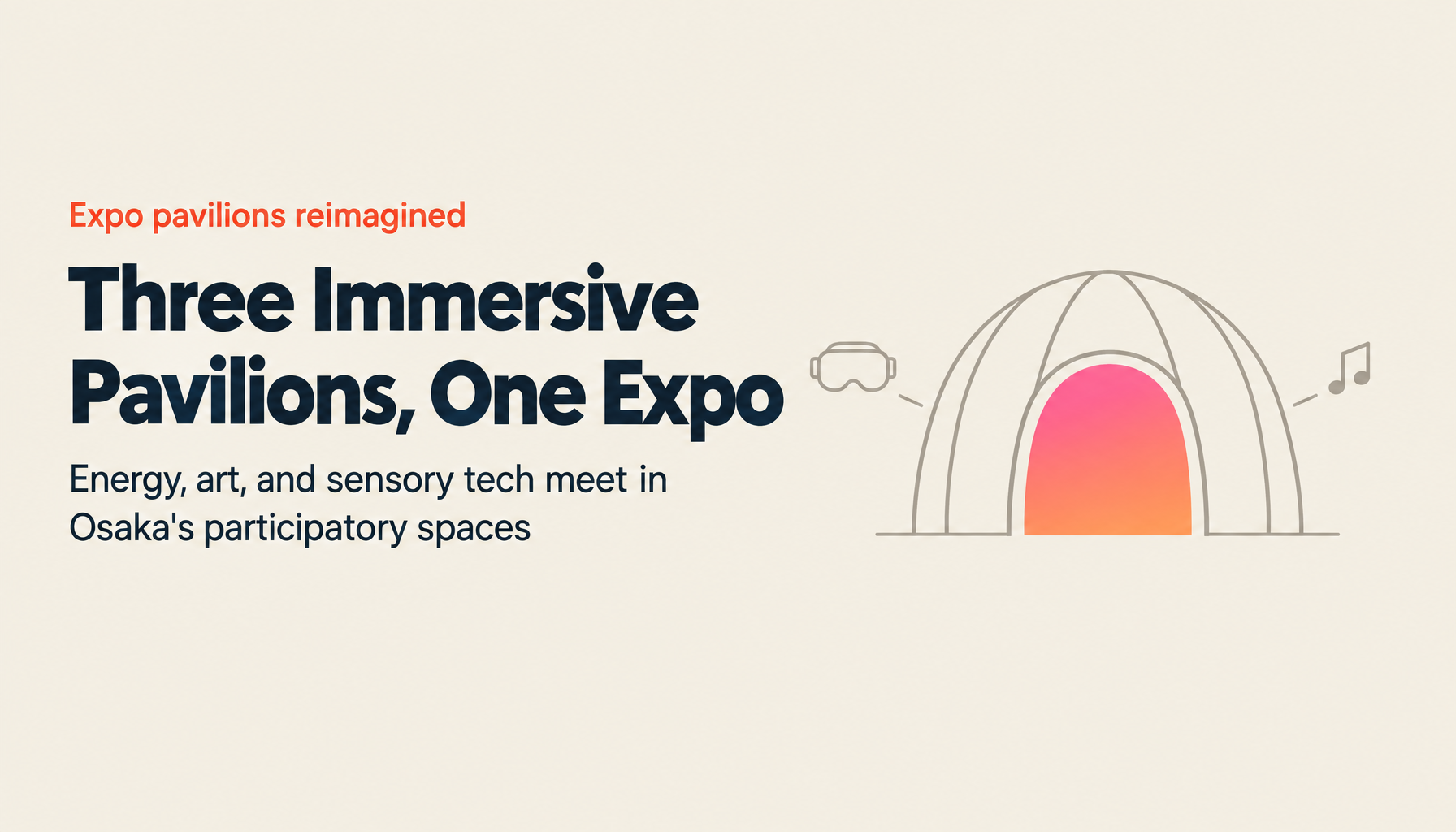
Expo 2025 Osaka's interactive pavilions attracted attention from business professionals and general visitors alike as spaces that offered practical, stimulating learning through experience rather than observation. The exhibits covering energy futures, environmental themes, and children's sensory development went beyond conventional display — each was designed to make visitors feel something, not just see something.
Major energy companies including the Japan Gas Association, Osaka Gas, and the Panasonic Group collaborated to produce participatory exhibitions and demonstrations for visitors of all ages. The result: a series of pavilion spaces where advanced technology, art, and environmental consciousness merged into genuinely novel experiences.
This article covers three of the most distinctive interactive pavilion experiences at the Expo.
- The Obake Wonderland Pavilion — Energy, VR, and Environmental Storytelling
- Inochi no Asobiba Kurage-kan — Sound, Art, and Sensory Experience
- Panasonic's Crystal Forest and Australia's Rainforest Recreation
- Summary
The Obake Wonderland Pavilion — Energy, VR, and Environmental Storytelling
The Obake Wonderland Pavilion, led by Osaka Gas and the Japan Gas Association, used a fantasy framework to communicate something with genuine weight: the importance of energy recycling and CO2 reduction. The approach was deliberate — by packaging the message inside an immersive ghost-world experience, the pavilion made environmental content accessible and emotionally resonant in ways that direct information delivery does not.
Visitors entering the pavilion encountered sweet scents and dreamlike visual effects that immediately signaled a departure from conventional exhibition design. After putting on VR goggles, they entered a virtual space populated by friendly ghost characters who offered gifts — cakes, guitars, hamburgers, items with universal appeal. Then King CO2 appeared and destroyed the pavilion, introducing a sudden shift from playfulness to urgency. The sequence made sense: enjoy the abundance, experience the threat, understand the stakes.
The experience was calibrated for multiple audiences simultaneously. Children under six, for safety reasons, used tablets rather than VR goggles — they experienced the same content in a form appropriate to their age. Older children and adults used the full VR setup. The result: a single exhibit that worked as entertainment for a five-year-old and as a technology demonstration for a business professional.
The concept "Bakero Mirai" (Transform the Future) was not just a slogan — it was the structural logic of the pavilion experience. The promise was that energy can be transformed, and so can the future. Visitors left with a higher awareness of energy resource regeneration than they had brought in, without sitting through a lecture.
From a business perspective, the Obake Wonderland Pavilion was a case study in how major corporations can use event contexts to demonstrate CSR commitments in ways that actually reach people. Traditional corporate sustainability communications often have minimal impact. An immersive experience that makes children feel what CO2 destruction looks like, and then offers them agency in reversing it, is a fundamentally different kind of communication.
Looking for AI training and consulting?
Learn about WARP training programs and consulting services in our materials.
Inochi no Asobiba Kurage-kan — Sound, Art, and Sensory Experience
The Inochi no Asobiba Kurage-kan (Life's Playground: Jellyfish Hall) was a sensory art space under a white roof structure — a "life's playground" where sound, touch, and vision combined into an integrated experience. The pavilion placed sound at the center of the design: wind chimes and suspended objects that responded to air movement, instruments visitors could touch and play with staff support, and a 360-degree screen where generative visuals expanded in real time alongside live musical performance.
The jazz pianist and interdisciplinary artist Nakajima Sako — also known as a mathematics researcher and educator — was involved in the pavilion's production design. Children from Cambodia and Japan participated together, collecting waste materials and assembling them into a large-scale collaborative collage. The pavilion's approach to music, materials, and participation created a genuinely multinational space where cultural boundaries were less visible than they often are in international exhibition contexts.
For visitors with hearing impairments, the pavilion offered something particularly meaningful: vibration as a channel for experiencing sound. Instruments and installations were designed so that those who could not hear the music could feel it. This was not an afterthought accommodation — it was integrated into the pavilion's design logic, reflecting an understanding that sensory experience is broader than what any single sense delivers.
The 360-degree screen technology, where generated visuals responded to visitor movements and the live performance, created a genuinely novel environment. The experience crossed the boundary between watching and participating in ways that are difficult to describe accurately in writing — it was the kind of thing that required being in the space to understand.
For business observers, the Kurage-kan pavilion demonstrated what happens when technology serves art rather than the reverse. The immersive technology was impressive, but it functioned as a container for a human experience rather than as the experience itself. This is a distinction with real implications for anyone designing event experiences, branded environments, or customer engagement.
Panasonic's Crystal Forest and Australia's Rainforest Recreation
The Panasonic Pavilion ("Nomo no Kuni" — The Land of Nomo) gave each visitor a transparent crystal object. When the crystal was held up to one of the columns distributed throughout the space, sounds played and colors changed. Visitor movements and expressions were analyzed in real time and translated into personalized visual representations on screens throughout the space.
The pavilion created an experience that was both individual and collective: each visitor's crystal interaction was unique, but the cumulative effect of all the interactions was visible throughout the space simultaneously. Children who discovered that different crystals produced different results began experimenting — the pavilion worked without explaining itself, which is a design achievement.
Other elements in the space included bottles that, when shaken, activated bioluminescent bacteria-like effects on the surfaces of simulated squid — a demonstration of actual research into natural bioluminescence. The connection between scientific research and playful presentation was explicit rather than accidental.
The Australia Pavilion took a different approach: instead of technology as the primary medium, it used environmental recreation. The pavilion interior reproduced an Australian old-growth forest at scale — visitors walked through it, hearing the sounds of the actual ecosystem alongside visual representations of the wildlife. Cockatoos and other native birds were depicted with precision that made them genuinely difficult to distinguish from footage. A hidden-animal discovery challenge sent visitors through the forest looking for specific species — a game format that created prolonged engagement with the natural history content.
Additional areas offered recreations of the Southern Hemisphere night sky and Australian coastal environments. For visitors who had never been to Australia, the pavilion worked as an immersive introduction. For those who had, it worked as an accurate and affectionate representation of something they recognized.
Summary
The interactive pavilions at Expo 2025 Osaka shared a common design commitment: visitors were participants, not spectators. The Obake Wonderland pavilion made environmental education feel like an adventure. The Kurage-kan made music tangible for visitors who could not hear. Panasonic's crystal forest made individual interaction visible at a collective scale. Australia's rainforest brought a distant ecosystem into immediate, sensory range.
For business professionals evaluating how technology can serve communication — whether in product launches, corporate events, or customer experiences — these pavilions provided working models. The question they answered in practice: how do you make people feel something about a complex topic in the time they are willing to give you?
The energy and art experiences demonstrated at the Expo were not just engaging in themselves. They were demonstrations of a principle: that the most effective communication does not explain — it creates the conditions for understanding to emerge from experience.
Reference: https://www.youtube.com/watch?v=PbX8O-Ukv48


![Three Must-Do Steps to Take Parental Leave Even During Your Busiest Season [Pre-Leave: Personal Account Part 2]](/images/columns/3.png)