This is Hamamoto from TIMEWELL.
Preparation is the Entire Game
A day at Osaka Expo 2025 involves continuous outdoor movement, extended queue waits in direct sun, and heavy reliance on your smartphone. Any preparation failure in these three areas — physical comfort, phone power, navigation — compounds immediately and is difficult to recover from inside the venue.
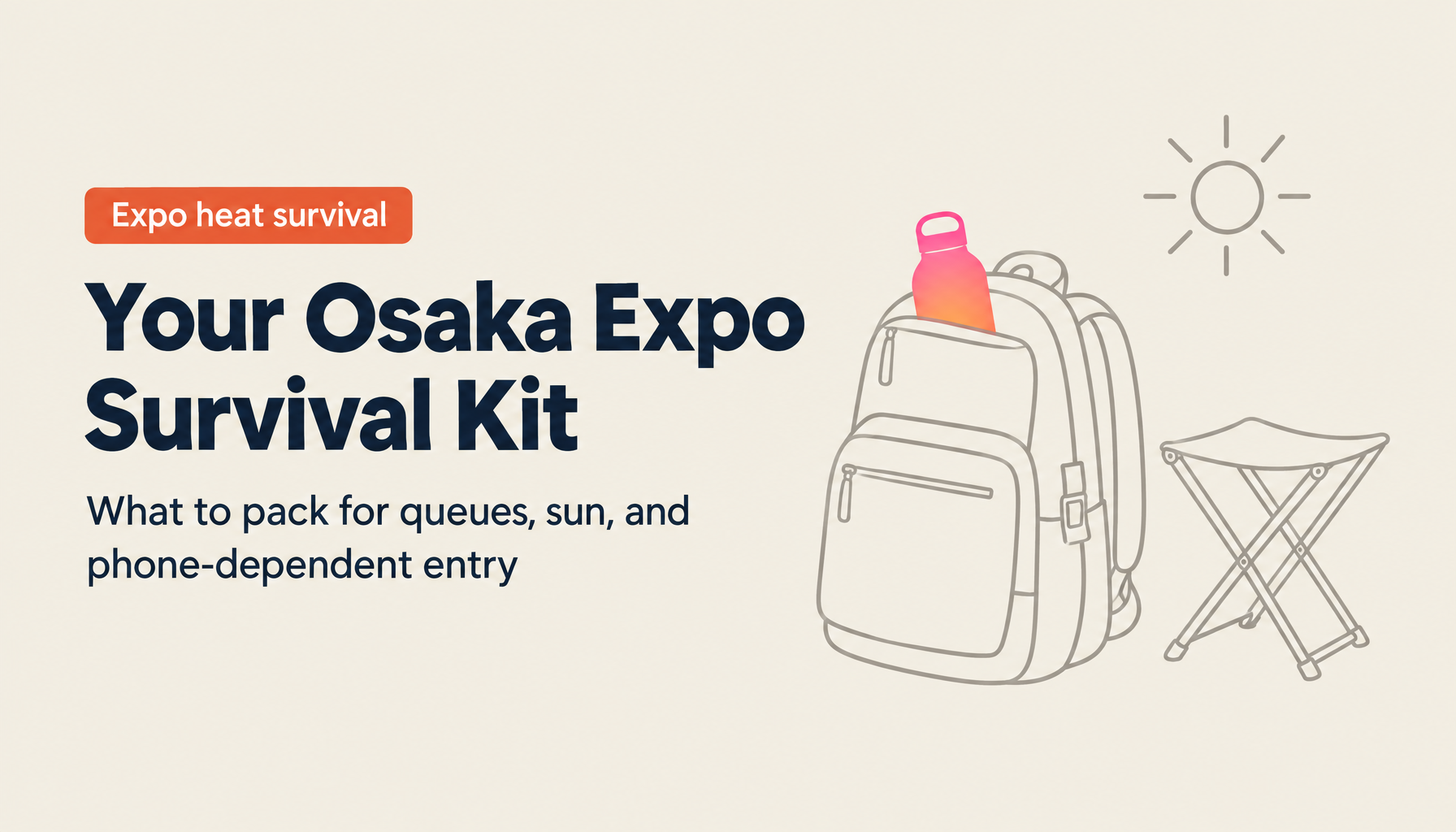
This guide covers what you are not allowed to bring, what you need to bring, and what actually works for heat management in a sustained high-temperature environment.
- Prohibited items and security screening
- Essential items: the practical list
- Heat countermeasure testing: what works and what doesn't
- Summary
Looking for AI training and consulting?
Learn about WARP training programs and consulting services in our materials.
Prohibited Items and Security Screening
What Cannot Be Brought In
The venue uses X-ray security screening — similar to airport-style checks — at all entry gates. The process takes approximately 30 seconds per person when bags are well-organized. Disorganized bags slow the process and may trigger manual inspection.
Prohibited items:
| Category | Specifics |
|---|---|
| Dangerous goods | Fireworks, explosives, anything fire-producing |
| Alcohol | External alcohol is prohibited; alcohol is sold inside the venue |
| Glass and cans | Only plastic bottles and insulated metal water bottles are permitted — glass and aluminum cans are not |
| Noise equipment | Megaphones, portable speakers — anything capable of directing high-volume sound at others |
| Large luggage | Rolling suitcases and carry-on sized bags; store at Osaka Station, New Osaka Station, or Sakurajima Station before arrival |
| Camera equipment | Tripods and selfie sticks over 1 meter when extended; compact handheld gimbals may be permitted |
| Personal transport | Roller skates, kick scooters, bicycles |
| Animals | Only certified service dogs (guide dogs, hearing dogs, assistance dogs) |
Practical notes: Glass-bottled energy drinks purchased at a station convenience store have caused gate problems. Check your bag before approaching. The bottle prohibition is the most commonly forgotten rule.
Digital Preparation for Security
Screenshots of your Expo ID QR code, pavilion reservations, and entry ticket stored offline on your device allow you to present credentials even if network connectivity is poor at the gate. Print critical information as a backup if you want full redundancy.
Essential Items: The Practical List
The Backpack
A hands-free backpack is the correct bag choice. It allows camera use, item retrieval, and physical navigation without putting your bag down. A backpack with spring-loaded zipper hardware (which opens with one hand and one motion) reduces friction every time you need to access something. Organize it so that your most-needed items — mobile battery, ticket QR, water — are accessible from the top or an outer pocket.
Mobile Batteries
Two mobile batteries at 10,000mAh each — carried simultaneously — is the documented practical recommendation. The expo's QR-based entry system, reservation management, navigation, and cashless payment all run through your phone. Battery failure is a genuine operational problem, not just an inconvenience. Carrying extra batteries weighs significantly less than the consequences of running out.
Internal charging at the venue requires finding a charging point, which takes time. Using your own batteries is faster.
Folding Chair
A compact folding chair for use during queue waits. The difference in accumulated fatigue between standing and sitting for the same duration is significant across a full-day visit. Available on Amazon at accessible price points; carry it collapsed on or in your bag.
Printed Map
The official app requires a login each time it's opened and consumes battery continuously when running. A printed A3-size PDF of the full venue map — with handwritten annotations for pavilion reservation status and entry method (advance reservation only / first-come / free entry) — removes navigation dependency from the phone.
Print the latest version before departure; the map is updated regularly.
The Full Checklist
- Backpack (hands-free, organized)
- Mobile batteries x2 (minimum 10,000mAh each)
- Insulated water bottle (filled, refillable at 32 water stations)
- Printed venue map with personal annotations
- Folding chair
- Windbreaker or light jacket (indoor air conditioning; sea breeze at Yumeshima)
- Hat or sun umbrella
- Sunscreen (SPF 50+ preferred; reapply)
- Sunglasses
- Compression leggings (circulation support for extended walking)
- Salt tablets (electrolyte replenishment)
- Antibiotic wet wipes and body sheets
- Snacks (for sustained energy during queue waits)
- Small garbage bag (venue bins may be distant)
- Eco bag (venue does not provide plastic shopping bags)
- Cashless payment setup (credit card or IC card — most transactions do not accept cash)
- QR code screenshots saved offline
Heat Countermeasure Testing
What Works
Cooling towel — Soak in water, wring, wrap around neck. Immediate temperature reduction; most effective of the tested items. Reusable; re-soak at water stations.
Cooling spray (skin contact type) — Apply to bare skin. Rapid evaporative cooling. Effective on arms, neck. Lasts longer than body-spray types.
Cooling body gel — Apply by hand to skin. Sustained cool sensation. Note: may irritate sensitive skin; patch test before use.
Electric fan — Direct airflow reduces perceived temperature effectively during queue waits. Battery models are portable and light. Works well in combination with a damp cooling towel.
Insulated water bottle with ice — Fill with ice water before entry. The thermal insulation maintains cold temperature throughout the day. Cold hydration has both physiological and psychological cooling effects.
What Did Not Work as Expected
Adhesive neck cooling sheets ("8-hour cooling" type) — Peel off quickly during physical activity. Claimed duration not realized in conditions involving movement and sweat.
Chemical ice packs (Hiyaron-type) — Activated by snapping, lasts approximately 30 minutes. Cost-to-duration ratio makes these impractical for extended use.
The Priority Order
For actual heat management under expo conditions, prioritize physical cooling methods:
- Cooling towel (wet, on skin)
- Electric fan with directional airflow
- Cooling spray (skin contact)
- Insulated cold water bottle
- Salt tablets with water (heat illness prevention)
Sunscreen, hat, and shade are baseline requirements, not substitutes for active cooling during extended outdoor exposure.
Summary
The preparation checklist is long because the failure modes are specific and consequential. Arriving without a mobile battery creates a QR code problem. Arriving without a printed map creates a navigation problem when the battery runs low. Arriving in heat without a cooling towel creates a physical performance problem by mid-afternoon.
None of these problems are difficult to prevent. All of them are difficult to solve once inside the venue.
Prepare the night before. Charge everything. Print the map. Pack the cooling towel.
Reference: https://www.youtube.com/watch?v=ivIWqbZJ-qg