This is Hamamoto from TIMEWELL.
Expo 2025 Osaka's operational design contains several non-obvious elements that determine the quality of a visit. Entry is relatively smooth; exit at closing time is not. The venue is fully cashless in a way that surprises visitors who did not prepare. The reservation system has four distinct methods with different strategic applications. And the venue's 155-hectare footprint requires navigation planning that the official app alone does not fully support.
This article covers the operational layer — the practical mechanics of the visit from start to finish.
- Access, entry, and security
- Inside the venue: navigation, cashless, and crowd management
- Pavilion reservations and exit strategy
- Summary
Access, Entry, and Security
Getting to the Venue
The venue is on Yumeshima — an artificial island in Osaka Bay. The primary transit routes:
From Tokyo: overnight highway bus to Namba, transfer to Osaka Metro Chuo Line to Yumeshima Station. Yumeshima Station was purpose-built for the expo; the East Gate is immediately visible from the exit. Walk time from station exit to gate: under 5 minutes.
East Gate: optimal for visitors using the metro line. Serves the central pavilion zone and the Signature Pavilion cluster.
West Gate: accessible by shuttle bus from Sakurajima Station, Cosmo Square Station, or taxi. Optimal for West-side pavilions and the Future Life Zone.
For visitors arriving by bullet train at Shin-Osaka, the connection is: Shin-Osaka → JR/metro → Osaka-Namba → Chuo Line → Yumeshima. Total time from Shin-Osaka: approximately 45–60 minutes depending on transfers.
Timed Entry Tickets
Expo 2025 Osaka uses timed entry — your ticket specifies the hour of entry. Available windows: 9 AM, 10 AM, 11 AM, 12 PM, and an evening ticket from 4 PM. The 9 AM window is the most contested; purchasing well in advance is essential.
Practical consideration: the 9 AM entry is the correct choice for visitors targeting same-day registration for popular pavilions. The competition for same-day slots begins the moment the registration window opens within the venue, and earlier entry means earlier access.
Security Checkpoint
The security system operates at airport level: X-ray machines and metal detectors at all entry gates. Security staff will ask you to separate liquids from your bag and place them in a separate tray — the same process as international airports.
Prepare in advance: organize your bag so that liquids (including water bottles, nutritional drinks) are accessible without unpacking everything. Glass bottles and aluminum cans are prohibited beyond this point.
Electronic tickets display on your smartphone screen; given that signal can be unreliable under the load of tens of thousands of simultaneous users, screenshotting your QR code before entering the security area is the reliable approach. A printer-generated QR is even more reliable if you have access to one.
Fully Cashless Venue
Expo 2025 Osaka is the first world exposition to operate as a fully cashless venue. Cash is not accepted anywhere inside the grounds. Accepted payment methods: credit and debit cards, IC cards (Suica, ICOCA, etc.), and QR code payment apps.
For visitors who typically carry cash: purchase a prepaid IC card before arrival. These are available at all major train stations. A ¥2,000–¥3,000 load will cover incidentals; meals at pavilions typically range from ¥800–¥2,000 per item.
Looking for AI training and consulting?
Learn about WARP training programs and consulting services in our materials.
Inside the Venue: Navigation and Crowd Management
Venue Scale
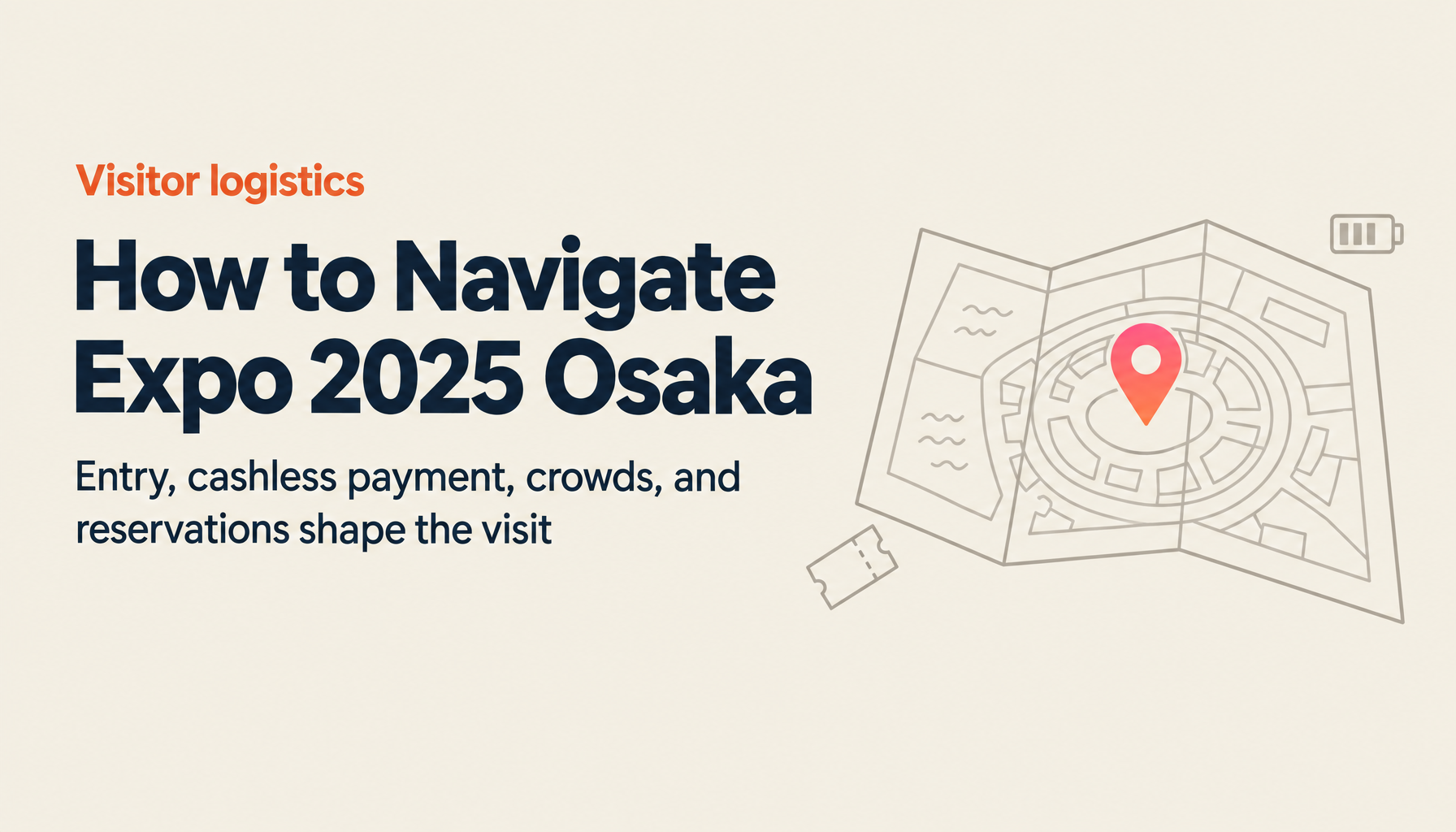
The venue covers 155 hectares — approximately three times the area of Tokyo Disneyland and equivalent to 33 Tokyo Dome footprints. This scale has practical implications: a full crossing from East Gate to West Gate on foot takes approximately 23 minutes. The internal shuttle bus (operational from July 1) covers the same distance in 10 minutes for ¥400.
The official app's map requires zooming to read pavilion names — workable for checks, not for moving navigation. Printing an A3 or A4 venue map before arrival and annotating it with your target pavilions and their entry methods is strongly recommended. Several unofficial maps created by frequent visitors (available through the official expo information channels) consolidate reservation availability and same-day registration windows onto a single sheet.
Mobile Battery and Water
Two 10,000mAh batteries is the correct minimum for a full day. The phone runs navigation, QR codes, reservation management, camera, and real-time updates simultaneously from entry to exit. One battery will not last the full day.
Water: 32 refill stations are distributed across the venue, typically near vending machines. Pre-chill your water bottle before arrival — refill dispensers provide unchilled water. Carry enough capacity to go 45–60 minutes between stations during peak periods when popular refill points have queues.
Staff as Information Sources
The official app shows real-time wait times for pavilions, but direct staff consultation adds context the app cannot provide. Staff positioned near pavilion entrances and at the East Gate information point know the current operational status — which pavilions have just had same-day slots released, which outdoor events are running behind schedule, which food court queues are shorter than usual.
In a venue this large, real-time human intelligence from staff who are watching the flow is more actionable than any app data.
Pavilion Reservations and Exit Strategy
The Four Reservation Methods
The expo uses four reservation methods in sequence:
- Two-month prior lottery: application opens exactly two months before your visit date. Results are by draw, not speed. Apply for your top one or two priorities.
- Seven-day prior lottery: opens one week before your visit. Second pass at mid-tier popular pavilions. Results before your visit.
- Three-day prior first-come (midnight): speed competition at 0:00 AM, three days before visit. Know your target before midnight; have the app and account session maintained.
- Same-day registration: within 10 minutes of entering the venue, registration for remaining slots opens. First-come within the venue.
One active reservation at a time. After completing a visit, the next registration becomes available. Inside the venue: initiating your next booking approximately 10 minutes before your current visit ends is the optimal timing.
The English-language tour option, where available, tends to have shorter waits than the Japanese-language tour at the same pavilion. For English-comfortable visitors, checking whether an English-language option exists at target pavilions is worth the effort.
Exit Timing and the Congestion Pattern
This is the operational detail that most pre-visit planning does not account for: pavilions close at 9 PM, the venue closes at 10 PM, and the transition from 9 PM onward produces a large-scale simultaneous exit. The East Gate experiences significant queuing after 9 PM; the path from the gate to Yumeshima Station adds 500+ meters of walking beyond the gate itself.
The practical effect: if you have a time-sensitive onward journey (last train, hotel check-in), allow 45–60 minutes of buffer from the pavilion you intend to finish at to your departure station. The gap between "venues close at 9 PM" and "I am at my hotel by 10:30 PM" is not reliably achievable without planning this explicitly.
One mitigation strategy: aim to finish your final pavilion by 8:30 PM, which puts you in the exit flow before the 9 PM rush rather than in the middle of it.
Summary
| Category | Key Point |
|---|---|
| Access | East Gate via Yumeshima Station (metro); West Gate via shuttle from Sakurajima |
| Entry | Timed ticket required; screenshot QR code; X-ray security |
| Cashless | No cash accepted; IC card or credit card required |
| Navigation | Print A3 map before arrival; annotate with targets and entry methods |
| Battery | 2 × 10,000mAh minimum for a full day |
| Reservations | Four methods in sequence; one active reservation at a time inside venue |
| Exit | Allow 45–60 min buffer after 9 PM; leave final pavilion by 8:30 PM if time-sensitive |
The expo rewards preparation in proportion to the effort invested. The visitors who find it exhausting and confusing arrived without the operational knowledge this article covers. The visitors who find it manageable and substantive prepared these elements before arrival.
Reference: https://www.youtube.com/watch?v=OT1tjRgSDJQ