The Cold War That Once Divided the World
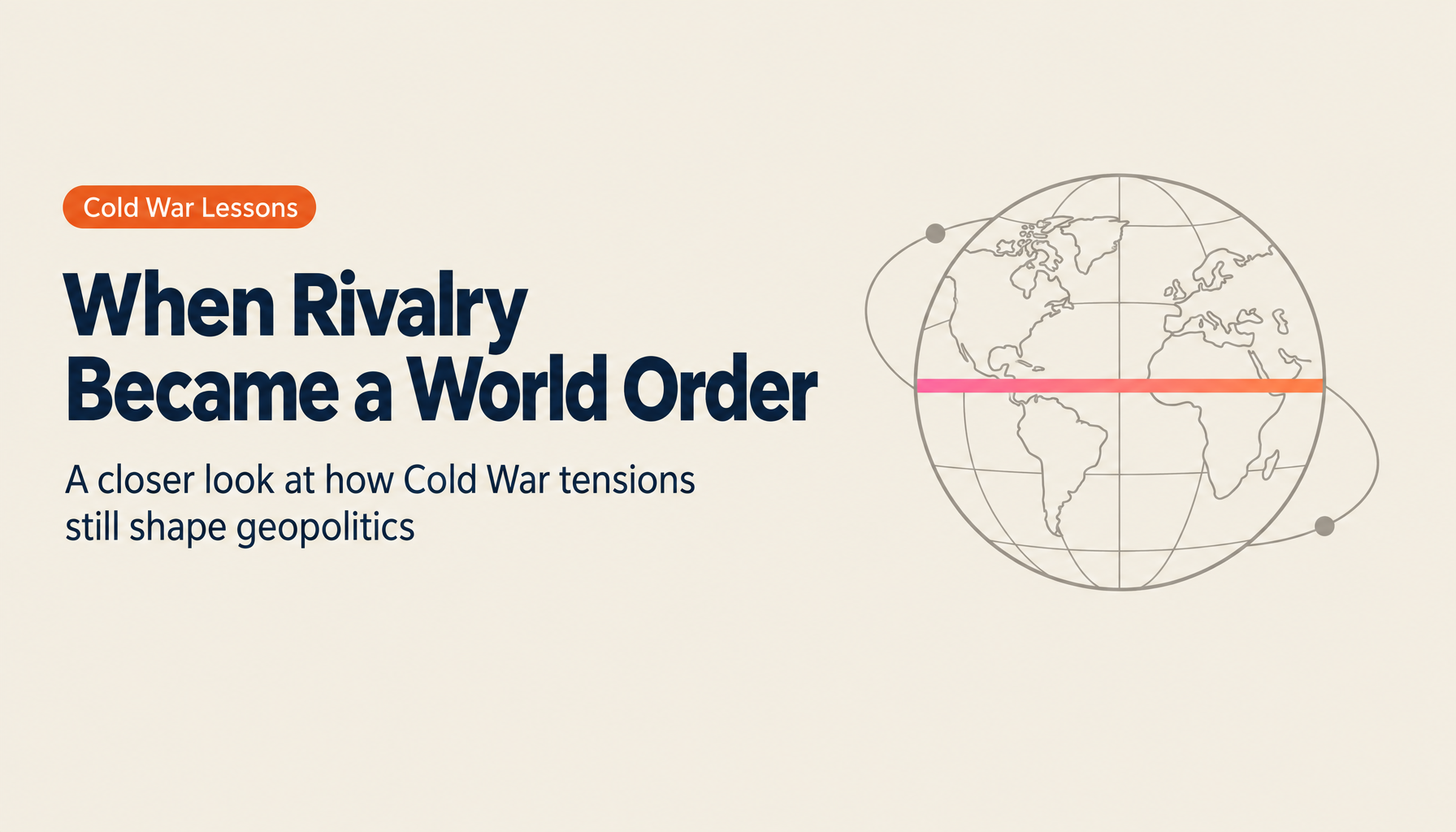
The Cold War once divided the world in two and plunged people into the terror of nuclear war. Is it merely a relic of history? As historian Michael Kimmage explains, the Cold War fundamentally shaped the international order after World War II, and its influence extends to today's geopolitics, economics, and even our everyday lives. From the discord between American and Soviet leaders at the Potsdam Conference, to the fall of the Berlin Wall, to the dissolution of the Soviet Union — this nearly half-century of confrontation was a relentless sequence of ideological clashes, fierce arms races, proxy wars around the world, and suffocating intelligence battles.
This article, drawing on Kimmage's analysis, digs deep into the major events of the Cold War from its beginning to its end, the theories and strategies that shaped it, and the motivations of those involved. The nuclear brinkmanship of the Cuban Missile Crisis, the tragedy triggered by the Domino Theory, the reality of the CIA and KGB's intelligence war, and the unexpected end brought about by Gorbachev's reforms. By unpacking these historical facts, we can gain an important perspective for understanding the international conflicts and shifts in power balance that face modern society. Let us embark on a journey through this enormous historical tide called the Cold War, learning from it and seeking lessons for the future.
The Origins and Escalation of the Cold War — From Ideological Conflict to Nuclear Threat Proxy Wars and Geopolitical Maneuvering That Shook the World The Path to the Cold War's End — From Gorbachev's Reforms to the Soviet Collapse and Beyond Summary The Origins and Escalation of the Cold War — From Ideological Conflict to Nuclear Threat
The seeds of the Cold War were sown immediately after the end of World War II in 1945. At the Potsdam Conference held on the outskirts of Berlin, the leaders of the victorious powers — Harry Truman of the United States, Joseph Stalin of the Soviet Union, and Winston Churchill of Britain (later replaced by Clement Attlee) — met together. This conference was supposed to determine the postwar world order, but instead became an occasion for exposing the deep divisions between the two superpowers. As Kimmage points out, at this very moment one could already see both countries' moves to divide the world into their respective spheres of influence, and the unbridgeable gulf between Stalin and Truman. The United States, representing capitalism and liberalism, and the Soviet Union, leading the communist and socialist camp — their fundamentally incompatible ideologies amplified mutual distrust and suspicion, creating what became known as the "Iron Curtain" that divided the world into "East" and "West."
As the Cold War intensified, both sides threw themselves into military buildups, especially the development of nuclear weapons. When the United States operationalized the atomic bomb in 1945, the Soviet Union raced to catch up, succeeding in nuclear testing in 1949. The competition then escalated to hydrogen bomb development, and both countries came to possess enough nuclear capability to completely destroy each other. This "balance of terror" deterred direct armed conflict, but kept the world perpetually on the brink of nuclear war. The most iconic example of this was the Cuban Missile Crisis of autumn 1962. American spy planes discovered that the Soviet Union was constructing a medium-range nuclear missile base in Cuba, just 90 miles from Florida. This was a direct threat to the American mainland and, as Kimmage calls it the "apex of the Cold War," the closest humanity ever came to nuclear war. Within the White House, hardline options including an immediate invasion of Cuba were considered, but President John F. Kennedy ultimately chose a naval blockade and diplomatic negotiations. It has been suggested that if an invasion had been carried out, Fidel Castro might have urged the Soviets to retaliate with nuclear weapons — it was truly a hair's-breadth situation. Kimmage analyzes that Soviet Premier Nikita Khrushchev's motive for deploying missiles to Cuba was less about expanding influence in the Caribbean than about pressuring the United States over the West Berlin issue and recovering from Soviet disadvantages in Europe. However, this gamble backfired, damaging Soviet prestige and becoming one of the factors contributing to Khrushchev's eventual downfall.
The Cold War was also an era of intense intelligence operations and spy warfare. The 1960 U-2 Incident was its defining event. An American high-altitude reconnaissance plane, the U-2, was shot down over Soviet territory and its pilot Gary Powers was taken prisoner. Initially the United States claimed it was a weather observation plane, but the Soviets had captured Powers alive and displayed him along with the wreckage to the world, publicly condemning American intelligence activities. This incident forced the cancellation of the planned summit between President Eisenhower and Premier Khrushchev, and pushed US-Soviet relations — which had briefly shown signs of thawing — back into a state of tension. As Kimmage emphasizes, the Cold War was a battle over images, perceptions, and narratives, and the U-2 incident became a golden propaganda opportunity for the Soviet Union. Both countries used spy planes like the U-2, and later reconnaissance satellites, to probe each other's nuclear facilities and weapons deployments. The fact that Lee Harvey Oswald, identified as the assassin in the JFK assassination, was an American citizen who had lived in the Soviet Union and had a Russian wife speaks to the complex human exchanges of the Cold War era and the mutual suspicion that had both countries wondering whether everyone around them was a spy. Recently released JFK files also suggest there was an exchange of information about Oswald between the US and Soviet Union, showing that the "Iron Curtain" was not necessarily an impenetrable wall.
Turning to the domestic sphere, the Cold War also cast a dark shadow over American society. The storm of McCarthyism, known as the "Red Scare," swept across the land. In the early 1950s, Wisconsin Senator Joseph McCarthy denounced many people in government agencies, academia, journalism, and even Hollywood's entertainment industry as communists or their sympathizers, based on thin evidence and accusations. As Kimmage points out, while there were real instances of Soviet infiltration of the State Department and nuclear secrets being leaked by the Rosenbergs, McCarthy amplified these facts far beyond reality and staged a "witch hunt" that swept up unrelated people. Roy Cohn, who served as his right-hand man, would later become a mentor to Donald Trump. McCarthyism caused many people to lose their jobs, damaged their social reputations, and derailed careers. In Hollywood in particular, a "blacklist" was created that stripped talented directors and screenwriters of their platforms. This was an extremely unfortunate episode in American political history — using fear to silence people and suppress dissent against the government — demonstrating the self-contradiction of a nation that claimed to stand for freedom and democracy. The irony is that the external threat of the Cold War corroded domestic freedom from within.
Proxy Wars and Geopolitical Maneuvering That Shook the World
The US-Soviet confrontation of the Cold War avoided direct armed conflict, but sparked proxy wars in various parts of the world. Both superpowers intervened in civil wars and regional conflicts around the globe — expanding their own influence and weakening the opposing camp — and had the sides they each supported fight each other. One of the most important theories Kimmage cites as central to American policy during the Cold War is the "Domino Theory." This was the idea that if one country became communist, neighboring countries would topple like dominoes into communism one after another. This theory exerted a powerful influence on American foreign policy in the early to mid Cold War — especially its Asia policy. However, Kimmage criticizes this theory as "highly oversimplified" and argues that it "promoted many misconceptions in American diplomacy." The most tragic example of this is the Vietnam War. Obsessed by the fear that if Vietnam fell to communism, surrounding countries like Laos and Cambodia would also fall like dominos, America waded ever deeper into a quagmire of war. As a result, the United States suffered enormous human and material losses and domestic public opinion became deeply divided. The Domino Theory was not just a policy element — it became the cause of some of the greatest mistakes the United States made during the Cold War.
The stage for proxy wars extended beyond Vietnam. The Korean War (1950-1953) stands as an important early Cold War proxy conflict. Following the post-WWII division of the Korean Peninsula at the 38th parallel, fierce fighting broke out between North Korea — backed by the Soviet Union and China — and South Korea — backed by UN forces led by the United States. The war ended in an armistice without a clear winner or loser, and the division of the Korean Peninsula has been fixed in place ever since. As Kimmage points out, the Korean War was a war in which the United States neither won nor lost, and because its conclusion is still not in sight, it may receive less attention than the Vietnam War. The Soviet invasion of Afghanistan in 1979 was also an important proxy war at the end of the Cold War. The Soviets intervened militarily to support Afghanistan's communist government, but the United States provided weapons and funding to the Islamic armed group the Mujahideen through the CIA to counter Soviet forces. Kimmage analyzes that this war became drawn-out and bogged down for the Soviets — it was called "the Soviet Union's Vietnam" — and ultimately became one of the factors in the eventual Soviet collapse. However, this intervention also brought "blowback" for the United States. From among the Mujahideen that America had supported, figures such as Osama bin Laden — who would later found al-Qaeda and orchestrate the 9/11 attacks — arose. Cold War proxy wars also unfolded in Latin America (Guatemala, Chile, etc.) and Africa (Angola, Mozambique, etc.), producing many casualties and deep-seated conflicts whose scars remain in many places today.
The Cold War was also the stage for a shadow war between intelligence agencies — most notably the CIA (Central Intelligence Agency) of the United States and the KGB (Committee for State Security) of the Soviet Union. According to Kimmage, in the early Cold War the CIA was officially assigned offensive tasks including regime change, engineering coups, and interference in other countries' domestic politics. Examples include electoral interference in Italy and regime change operations in Guatemala and Iran — in particular, the overthrow of the Mosaddegh government in Iran became a major factor behind the 1979 Iranian Revolution and anti-American sentiment. The CIA attempted to justify these activities by arguing that the Soviets were doing the same things. The KGB, for its part, also conducted wide-ranging intelligence activities domestically and internationally — suppressing dissidents, running propaganda operations (including disinformation campaigns known as "active measures"). Kimmage does not definitively conclude whether the KGB was more successful than the CIA, but he points out the KGB's enormous power and repressive means within the Soviet Union, and the fact that it operated under comparatively fewer constraints such as media oversight or parliamentary scrutiny — the KGB could operate under a thicker veil of secrecy. The popular drama "The Americans" depicts Soviet sleeper agents living inside the United States, but Kimmage notes that the dramatic activities shown in the series differ from reality — most actual sleeper cells provided little valuable intelligence. Rather, the most valuable sources for the Soviet Union were American "moles" (internal traitors) such as Julius Rosenberg and Aldrich Ames, who sympathized with the Soviet Union or were bought with money. Information broadcasts from the West, such as Radio Free Europe, also played a role in influencing citizens in Eastern bloc countries and indirectly supporting dissident movements.
Geopolitical maneuvering was also a critical aspect of the Cold War. Initially, the communist camp maintained close cooperation between the Soviet Union and China. Especially in the 1950s, China modeled itself on the Soviet Union under Stalin, and the two countries were so close as to exasperate the United States. However, the "Sino-Soviet Split" surfaced in the early 1960s. Mao Zedong sought greater independence from the Soviet Union and border conflicts arose. Deepening conflicts over ideological lines and national interests transformed former allies into "frenemies" or outright adversaries. It was American President Richard Nixon and National Security Advisor (later Secretary of State) Henry Kissinger who cleverly exploited this situation. Nixon's 1972 visit to China marked the beginning of "triangular diplomacy" that transformed the bipolar US-Soviet confrontation into a tripolar US-Soviet-China structure, greatly shifting the Cold War's balance of power. Kissinger is praised by some as a "genius" for his adroit diplomatic skills, while others persistently criticize his hardline policies and human rights violations — particularly in Latin America — and his legacy remains contested to this day. In the Cold War era, "non-aligned countries" that belonged to neither the American nor Soviet camp also made their presence felt. These countries sought to develop independent foreign policies while avoiding being drawn into the conflict between the two major blocs. The Cold War was not simply a US-Soviet conflict — it was a complex geopolitical game that drew in countries around the world. And its most tragic, physical symbol was the Berlin Wall. In 1961, to stem the flow of people leaving East Germany, the Soviet Union and East German government constructed a wall dividing East and West Berlin — literally dividing the city, the country, and Europe, and becoming a symbol to the world of the repressive nature of the Eastern bloc.
The Path to the Cold War's End — From Gorbachev's Reforms to the Soviet Collapse and Beyond
A major turning point in the long-running Cold War tension came in 1985, when the relatively young Mikhail Gorbachev was appointed General Secretary of the Communist Party of the Soviet Union. As Kimmage describes him, Gorbachev was a "reformer" who set about bold reforms under two slogans — "perestroika" (restructuring) and "glasnost" (openness) — to restore the stagnating Soviet society and economy. Kimmage analyzes that Gorbachev's true aim was not to negate the socialist system itself, but rather to "save" socialism by returning to Leninist roots and breathing life into a rigid system. However, the reforms proceeded in an unexpected direction, contrary to his intentions. When glasnost permitted a degree of freedom of expression, long-suppressed public discontent and the aspirations for independence among the various nationalities that made up the Soviet Union erupted all at once. Economic reforms also failed to produce sufficient results, and rather than improving, citizens' living standards in some respects actually worsened.
Triggered by Gorbachev's reforms, a wave of pro-democracy movements broke out in a chain reaction across Eastern European satellite states. Beginning with the establishment of a non-communist government in Poland in 1989, communist governments in Hungary, Czechoslovakia, and East Germany fell one after another. This became known as the "Revolutions of 1989" and marked the decisive moment of the Cold War's end. The most iconic of these events was the fall of the Berlin Wall on November 9th of that year. Triggered by a miscommunication at a press conference by an East German government official, crowds of citizens rushed to the Berlin Wall. When border guards opened the gates, people climbed over the wall and East and West Berliners were reunited in jubilation. Images of people dancing on and breaking down the wall were broadcast around the world as symbols of the triumph of freedom and the end of the Cold War. Kimmage describes that moment as "emotionally, when the Cold War ended." The Hungarian Revolution of 1956 had been the first major act of resistance against Soviet domination, but it was crushed by Soviet tanks. By 1989, however, the Soviet Union under Gorbachev had lost both the will and the power to suppress Eastern European countries through military force.
The wave of the Eastern European revolutions also reached the Soviet Union itself. The Baltic states (Lithuania, Latvia, Estonia) declared independence, and other constituent republics including the Russian Republic issued sovereignty declarations one after another. Gorbachev tried to maintain the federation, but its centripetal force rapidly dissipated. Kimmage points out that the fundamental cause of the Soviet collapse lay in its very nature — diverse peoples and states had been forcibly bound together through authoritarian violence and repression. When Gorbachev tried to remove that violence and repression, the constituent states declared "we no longer want to be part of the Soviet Union," and the giant empire, to use Kimmage's words, "vanished like smoke in an instant." On December 25, 1991 — Christmas Day — the Soviet flag was lowered from the Kremlin and the Russian Federation's flag was raised. Here, the Union of Soviet Socialist Republics officially ceased to exist, and the Cold War came to a complete and final end. Kimmage describes the dissolution of a nuclear-armed giant empire with almost no violent chaos as "one of the most mysterious events in history."
There are various evaluations of America's role in the Cold War's end, and particularly the contribution of President Ronald Reagan. Kimmage credits Reagan for advancing dialogue with Gorbachev and opening the path to a peaceful end to the Cold War through arms control negotiations. Reagan maintained a hardline anti-communist stance while avoiding pushing the Soviet Union too far into a corner and kept the door to dialogue open. While the Cold War actually ended during the presidency of his successor, George H.W. Bush, Bush also contributed by skillfully managing the turbulent period of the Soviet collapse and Eastern European changes to avoid catastrophe. While Kimmage concludes that the main causes of the Soviet collapse were internal, he argues that America's role in wisely navigating that process and guiding it to a peaceful conclusion was significant.
After the Cold War ended, NATO (North Atlantic Treaty Organization) — established to counter the Soviet threat — has continued to exist and expand while adapting its role. During the Cold War, Western European nations formed its core, but in the post-Cold War era, former Eastern bloc countries and former Soviet republics have joined one after another. Kimmage points out that NATO is simultaneously a relic of the Cold War era and a body that continues to play an important role today. In particular, he warns that in the current Ukraine war, NATO members (Poland, Slovakia, Romania) share borders with Ukraine, putting the alliance closer to a conflict's front lines than ever before. And to the question "Are we in a new Cold War today?", Kimmage answers "Unequivocally yes." The structure of East-West confrontation centered on Washington and Moscow, geopolitical tensions, and the nuclear element — these all evoke the Cold War era. At the same time, the fact that there is a "hot war" such as the current one in Ukraine, where the US and Russia are more directly involved even if indirectly, suggests that the situation may be even worse than the Cold War of old — Kimmage sounds a warning note. The technology competition of the Cold War era — for example, the Soviet Union's lead with Sputnik's launch (1957) and the American scientific and technological investment it stimulated (resulting in American advantage in fields like microchip technology), and both countries' excessive nuclear arms race (the absurdity of mutually assured destruction) — also provides important lessons for thinking about today's struggle for technological supremacy and the arms race.
Summary
The Cold War is not merely history. It was a massive structural transformation that determined the postwar world order and continues to deeply influence international relations, economics, technology, and human consciousness right up to the present day. As we have seen through historian Michael Kimmage's analysis, the US-Soviet confrontation that began with discord at the Potsdam Conference brought about an ideological clash, a "balance of terror" through nuclear weapons, the near-apocalyptic tension of the Cuban Missile Crisis, proxy wars around the world, and the division of the world symbolized by the Berlin Wall.
Important Lessons to Learn from the Cold War
The danger of ideological confrontation: The clash of two ideologies — liberalism and communism — divided the world in two, amplified distrust and fear, and produced many tragedies. The question of how powers with different values can coexist remains relevant today.
The threat of nuclear weapons: The Cuban Missile Crisis laid bare just how easily nuclear weapons could destroy humanity. It reminds us of the fragility of nuclear deterrence and the importance of nuclear disarmament.
The risk of oversimplification like the Domino Theory: The tragedy of the Vietnam War demonstrates the danger of trying to understand complex international situations through simple theories. The importance of objective analysis and multifaceted perspectives comes into sharp relief.
The influence of information warfare and propaganda: The U-2 Incident, McCarthyism, and the activities of the CIA and KGB demonstrate how information manipulation and propaganda can have an enormous impact on public opinion and policy decisions. The importance of media literacy is only increasing.
The possibility of unexpected change: Just as Gorbachev's reforms unintentionally led to the Soviet collapse, history often moves in unpredictable ways. Preparedness for change and the ability to respond flexibly are essential.
The importance of dialogue and diplomacy: Just as dialogue between Reagan and Gorbachev opened the path to the Cold War's end, this shows that diplomatic efforts and the pursuit of dialogue must never be abandoned, no matter how difficult the circumstances.
As Kimmage suggests, we may be living in an era that can be called a "new Cold War." Geopolitical tensions are rising, and the confrontational structures of the past are reappearing in changed forms. Deeply understanding the history of the Cold War should serve as a compass for deciphering the challenges facing the modern world and building a more peaceful, stable future. To learn from the mistakes of the past and draw lessons for the future — that is the responsibility that falls to all of us living today.
Reference: https://www.youtube.com/watch?v=a0YRyRpD44A
Looking for AI training and consulting?
Learn about WARP training programs and consulting services in our materials.
TIMEWELL's AI Consulting
TIMEWELL is a professional team supporting business transformation in the AI agent era.
Our Services
- AI Agent Implementation Support: Business automation using GPT-5.2, Claude Opus 4.5, and Gemini 3
- GEO Strategy Consulting: Content marketing strategy for the AI search era
- DX Promotion & New Business Development: Business model transformation through AI
In 2026, AI is evolving from something you "use" to something you "work with." Shall we think together about your organization's AI strategy?
Related Articles
- The Reality of Working Reduced Hours After Two Maternity Leaves — and How Work Perspectives Shift | TIMEWELL
- Before Paternity Leave, Part 2: Three Things You Must Do to Take Leave During a Busy Season
- A Fifth-Generation Construction Company Owner Finds His Own Path at a Hands-On Architecture Firm — Fujita Construction