What Is Economic Security? Lessons from the Takaichi Administration's Policies on Building a Stronger Japan
Hello, this is Hamamoto from TIMEWELL.
"Economic security" — you have probably been hearing this phrase in the news more and more. But honestly, many people may still be fuzzy on what it actually means.
"Isn't security about the military?" "What does the economy have to do with national security?" "I hear Prime Minister Takaichi is focused on this — but what is she actually trying to do?"
This article answers those questions. Starting from the basic concept of economic security, through the specific policies of the Takaichi Sanae administration, to what companies and researchers are being asked to do — all explained in a way that is accessible even if this is your first encounter with the topic.
What You Will Learn from This Article
- The definition of economic security and why it matters now
- The Takaichi administration's "six pillars of national strength" and "crisis management investment"
- What "strategic autonomy" and "strategic indispensability" mean
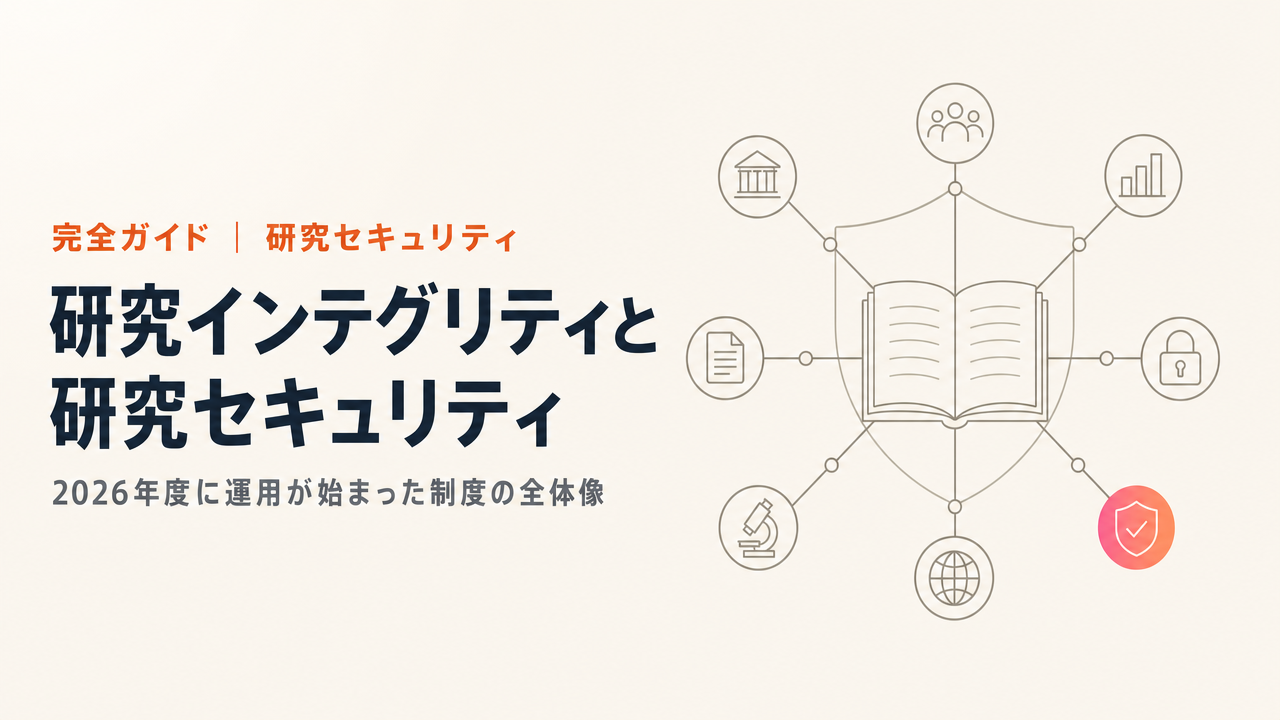
- What research integrity and research security are
- Why security clearance matters
- The relationship between dual-use (military-civilian) technology and economic growth
Chapter 1: What Is Economic Security?
In a Single Sentence
Economic security means "using economic means to protect national safety."
More specifically: ensuring a stable supply of goods essential to national life (semiconductors, pharmaceuticals, food, and so on), preventing Japan's advanced technology from flowing overseas, and building an economic structure that is not excessively dependent on any single country.
Traditionally, "security" meant primarily defending the nation through military force. In the modern world, however, we have entered an era in which the economy itself is used as a weapon.
Why the Economy Is Now a Security Issue
Some concrete examples.
Example 1: Mask shortage (2020) When COVID-19 swept the world, Japan faced a severe mask shortage. Why? Because approximately 80% of the masks used in Japan had been imported from China. The moment China restricted exports, the health of Japanese citizens was threatened.
Example 2: Semiconductor shortage (2021 onward) A global semiconductor shortage forced Japanese automakers to sharply cut production. The underlying cause was heavy dependence on overseas manufacturers — including Taiwan's TSMC — for semiconductor production.
Example 3: Energy crisis (2022 onward) Following Russia's invasion of Ukraine, Europe lost access to Russian natural gas supplies and fell into a severe energy crisis. The danger of depending on a single country for energy was recognized worldwide.
The lesson from these examples: "economic dependency relationships" are themselves security risks.
From "Separation of Economics and Politics" to "Fusion of Economics and Politics"
For a long time, the dominant view was "politics and economics are separate." Free trade, specialization by comparative advantage, a globally efficient economy — these were the ideals of globalization.
But the world has now entered an era of fusion between politics and economics. China's rare earth export restrictions. America's semiconductor export controls. Russia's natural gas supply cutoff. All of these are examples of economics being used as an instrument of political goals.
Replace siloed classification work with AI.
METI's FY2024 data shows 52% of foreign exchange law violations stem from classification errors. Download the TRAFEED product catalog covering features and rollout.
Chapter 2: The Takaichi Administration's Economic Security Policy
Japan's First Female Prime Minister and "Crisis Management Investment"
On October 21, 2025, Sanae Takaichi was inaugurated as the 104th Prime Minister of Japan — the country's first female prime minister, and an expert in economic security from her time as Minister of Economic Security.
The centerpiece of Prime Minister Takaichi's economic policy is "crisis management investment" — strategic investment by public and private sectors working together to get ahead of risks across economic security, food security, energy security, and other domains.
The Three Pillars of the Economic Package
In November 2025, the Takaichi cabinet approved a comprehensive economic package: a supplementary budget of 17.7 trillion yen, totaling 21.3 trillion yen when tax reductions are included.
| Pillar | Content |
|---|---|
| First pillar | Protecting household livelihoods and addressing inflation |
| Second pillar | Achieving a strong economy through crisis management investment and growth investment |
| Third pillar | Strengthening defense capabilities and diplomatic power |
Source: Prime Minister's Office, Press Conference by Prime Minister Takaichi (October 21, 2025)
The "Six Pillars of National Strength" and National Strategic Technologies
In her book Kokury-oku Kenkyu: Nihon Rettou wo, Tsuyoku Yutakani (Sankei Shimbun Publishing, 2024), Prime Minister Takaichi identifies six elements of Japan's "national strength."
- Diplomatic capability — negotiating power in the international community
- Defense capability — military deterrence
- Economic capability — the foundation of economic activity
- Technological capability — science and technology innovation
- Intelligence capability — information gathering and analysis
- Human capital — people as a resource
In November 2025, the government approved a "Basic Plan for Science, Technology and Innovation" designating six fields as "national strategic technologies":
| Field | Examples |
|---|---|
| AI and advanced robotics | Generative AI, autonomous robots |
| Quantum | Quantum computers, quantum cryptography |
| Semiconductors and communications | Advanced semiconductors, next-generation communications |
| Biotech and healthcare | Drug discovery, regenerative medicine |
| Nuclear fusion | Clean energy |
| Space | Satellites, rockets |
These fields will receive priority allocation of research funding and preferential tax treatment.
Chapter 3: "Strategic Autonomy" and "Strategic Indispensability"
There are two concepts that are essential to understanding economic security.
What Is Strategic Autonomy?
Strategic autonomy (senryakuteki jiritsusei) refers to "a state in which the country can maintain national life and the economy on its own, without excessive dependence on other countries."
Simply put: "the capability to get by on our own when it matters."
Specifically:
- Building the capacity to manufacture semiconductors domestically
- Securing pharmaceutical raw materials from multiple countries
- Diversifying energy sources (nuclear, renewable energy, etc.)
What Is Strategic Indispensability?
Strategic indispensability (senryakuteki fukaketsusei) means creating a state where "things would be difficult without Japan."
Simply put: "becoming an irreplaceable presence that the world depends on."
Specifically:
- Developing materials and components that only Japan can produce
- Creating technologies that become global standards
- Participating in shaping international rules
The Relationship Between the Two
| Concept | Goal | Example |
|---|---|---|
| Strategic autonomy | Not depending | Tripling domestic semiconductor production capacity (2030 target: 15 trillion yen) |
| Strategic indispensability | Being depended upon | Maintaining and expanding global market share in advanced materials and manufacturing equipment |
These two can be thought of as "defense" and "offense." Fortify the defense through strategic autonomy; sharpen the competitive edge on offense through strategic indispensability. Pursuing both simultaneously is how Japan's economic security is strengthened.
Chapter 4: Research Integrity and Research Security
For those working at universities and research institutions, these two concepts are particularly important.
What Is Research Integrity?
Research integrity refers to the soundness and fairness of research activity.
As research internationalization progresses, new risks have emerged:
- Conducting research while concealing foreign government funding
- Conflicts of interest (producing results that favor one's own interests)
- Misappropriation of research outcomes
Preventing these and conducting transparent, sound research is what "ensuring research integrity" means.
What Is Research Security?
Research security refers to "protecting research from improper external influence or interference."
The concerns of particular note include:
- Foreign government co-optation of researchers (e.g., the "Thousand Talents Plan")
- Military diversion of advanced technology
- Illicit removal of intellectual property
In December 2024, the Ministry of Education, Culture, Sports, Science and Technology (MEXT) formulated a "Direction for Ensuring Research Security at Universities and Other Institutions." A research security consultation desk was also established in April 2025.
The Relationship Between the Two
| Concept | Meaning | Applies to |
|---|---|---|
| Research integrity | Ensuring soundness and fairness of research | All researchers |
| Research security | Protecting research from external threats | Particularly risk-exposed fields |
Research integrity is "a rule that everyone should naturally follow." Research security is "additional measures to take when specific risks are present."
Chapter 5: Intelligence and Security Clearance
What Is Intelligence?
Intelligence refers to the activity of gathering and analyzing information related to national security, and providing it to policymakers. In Japanese it is sometimes translated as "joho katsudo" (information activities) or "chohokatsudo" (intelligence activities).
Prime Minister Takaichi, in her book, positions "intelligence capability" as an important element of national strength. The LDP Intelligence Strategy Headquarters has also stated that "strengthening national intelligence functions is an urgent imperative in order to protect national interests and ensure national security."
What Is a Security Clearance System?
A security clearance is a credential, certified by the government, that authorizes access to classified information.
In the United States, the United Kingdom, and many other countries, anyone working on matters involving national secrets must undergo a background check and obtain a security clearance. Japan had not adequately established such a system — until recently.
Takaichi's Long-Held Objective
Takaichi advocated strongly for the creation of this system from her time as Minister of Economic Security.
The reasons:
- Japanese engineers and researchers, lacking security clearances, were being excluded from international joint research projects
- They could not participate in international academic conferences dealing with advanced technology
- They could not bid on government procurement contracts overseas
In other words, Japan was missing out on opportunities for international science and technology cooperation because this system did not exist.
Enactment of the Important Economic Security Information Protection and Utilization Act
In May 2024, the "Important Economic Security Information Protection and Utilization Act" was enacted and came into force in May 2025. This introduced a security clearance system for the economic security domain to Japan.
Takaichi has reflected on social media: "It took about one year and nine months from my declaration of intent to create an economic security version of the security clearance system."
Chapter 6: Dual-Use Technology and Economic Growth
What Is Dual-Use?
Dual-use refers to technology that can be used for both civilian and military purposes. In Japanese it is sometimes called "gunmin ryoyo gijutsu" (military-civilian dual-use technology).
Much of the technology that supports our daily lives is, in fact, dual-use.
| Technology | Civilian use | Military use |
|---|---|---|
| Internet | Communications, social media | Military communications |
| GPS | Car navigation, map apps | Missile guidance |
| Drones | Aerial photography, logistics | Reconnaissance, attack |
| Semiconductors | Smartphones, appliances | Weapons systems |
Japan's Challenge
Japan's Science Council has maintained a post-war policy of "opposition to research for military purposes." The background is a reflection on how science and technology was used in war.
However, this policy has caused Japan to fall behind the world in leveraging dual-use technology. DARPA (the Defense Advanced Research Projects Agency) in the United States gave the world the internet and GPS, both of which transformed civilian life. China is also eliminating the boundary between military and civilian technology through its "military-civilian fusion" strategy.
Prime Minister Takaichi's Vision
Prime Minister Takaichi aims to achieve both economic growth and security through investment in dual-use technology.
The logic:
- Invest in dual-use technologies
- Innovation occurs in the civilian sector
- The economy grows and tax revenues increase
- The budget needed for defense capability strengthening becomes available
The government has announced the establishment of the "Defense Innovation Technology Research Institute (tentative name)" — expected to function as a "Japan-DARPA" supporting the development of advanced technologies including AI, autonomous systems, and quantum.
Chapter 7: When Economic Priorities Compromise Security
The Risks of Dependence on China
"It's cheap." "It's efficient." Japanese companies have expanded their transactions with China for these reasons. But that very fact has become a security risk.
METI estimates that if 80% of imports from China were disrupted for six weeks, Japan's value-added production would fall approximately 15%.
The METI "Trade White Paper" shows China standing out as the country where supply chain risk has risen most sharply over the past decade (rated 4.5 on a five-point scale).
Decoupling vs. De-risking
Should Japan sever its economic relationship with China entirely?
Decoupling (complete separation) is not realistic. China is Japan's largest trading partner; completely cutting ties would be an enormous economic blow.
What has gained attention instead is de-risking — reducing dependence while maintaining the relationship and diversifying risk. At the 2023 G7 Hiroshima Summit, the countries agreed on a policy of "de-risking rather than decoupling."
Corporate Responses
Reasons Japanese companies are considering relocation away from China (multiple responses allowed):
- Opacity of China's policy environment: 65%
- U.S.-China economic rivalry: 44%
- Risk management: 37%
Countries being considered as relocation destinations:
- Vietnam: 46%
- Japan (domestic): 40%
- Thailand: 25%
Chapter 8: What Is Required of Us
For Companies
Review your supply chain
- Assess your degree of dependence on specific countries
- Consider diversifying procurement sources
- Explore domestic procurement for critical components
Strengthen export control
- Conduct background checks on counterparties
- Cross-reference against the Foreign User List
- Retain evidence records
Prepare for the security clearance system
- Deepen your understanding of the system
- Consider obtaining clearance for relevant personnel as needed
For Universities and Research Institutions
Ensure research integrity
- Make the sources of external funding transparent
- Manage conflicts of interest
Strengthen research security
- Screen international students and foreign researchers at admission
- Comply with "deemed export" regulations
- Manage sensitive technology appropriately
Balance international collaboration with security
- The goal is to reduce risk, not eliminate it entirely
- Healthy international collaboration should be encouraged
Improving Export Control Efficiency
TRAFEED, the AI agent TIMEWELL provides, streamlines export control operations.
- Counterparty screening completed in five seconds
- Automatic cross-referencing against the Foreign User List, U.S. SDN List, and other multiple lists
- Automatically generated reports explicitly stating the reasoning and reference URLs behind each determination
Streamlining the compliance obligations so that time can be returned to the research and creative work that actually matters — that is what TRAFEED is designed to do.
If you are reviewing export-control operations or classification workflows, download the TRAFEED product catalog (PDF) or contact us.
Summary
Key points from this article:
- Economic security means protecting national safety through economic means — indispensable in an era of politics-economics fusion
- The Takaichi administration advances "crisis management investment" and prioritizes six national strategic technologies
- Strategic autonomy is "the power not to depend"; strategic indispensability is "the power to be depended upon"
- Research integrity is about soundness of research; research security is about defending it from threats
- Security clearance is necessary to participate in international cooperation
- Investment in dual-use technology can achieve both economic growth and security
- De-risking — reducing dependence on China while maintaining the economic relationship
Economic security is not "a topic for a handful of specialists." Each of us needs to understand how our own work connects to national security, and take action on what we can. That is the first step toward building a stronger Japan.
References
- Prime Minister's Office, Press Conference by Prime Minister Takaichi (October 21, 2025)
- LDP, Policy Address by Prime Minister Takaichi at the 219th Extraordinary Diet Session
- Sankei Shimbun Publishing, Kokury-oku Kenkyu: Nihon Rettou wo, Tsuyoku Yutakani (2024)
- PwC Japan, Overview of the Economic Security Promotion Act
- METI, Economic Security Policy
- MEXT, Research Integrity and Research Security
- Cabinet Office, Research Integrity
- Sanae Takaichi Official Site, "Toward Establishing the Security Clearance System"
- Nikkei, "What Is Dual-Use?"
- Toyo Keizai, "Prime Minister Takaichi's Science, Technology and Security Integration Strategy"
- RIETI, "The Ideal Supply Chain Balancing Economic Interests and Security"
Related Articles
- 2024 Guide: What Is Export Classification? From Basics to Practical Application
- Critical Minerals: Next-Generation Mining Through Vertical Integration and Technological Innovation
- Defense Innovation Frontier: DIU and Applied Intuition on Closing the Technology Gap and the Future of National Defense Strategy