I am Ryuta Hamamoto, CEO of TIMEWELL Inc. This piece is about a service-relevant policy story I think Japanese practitioners should be tracking.
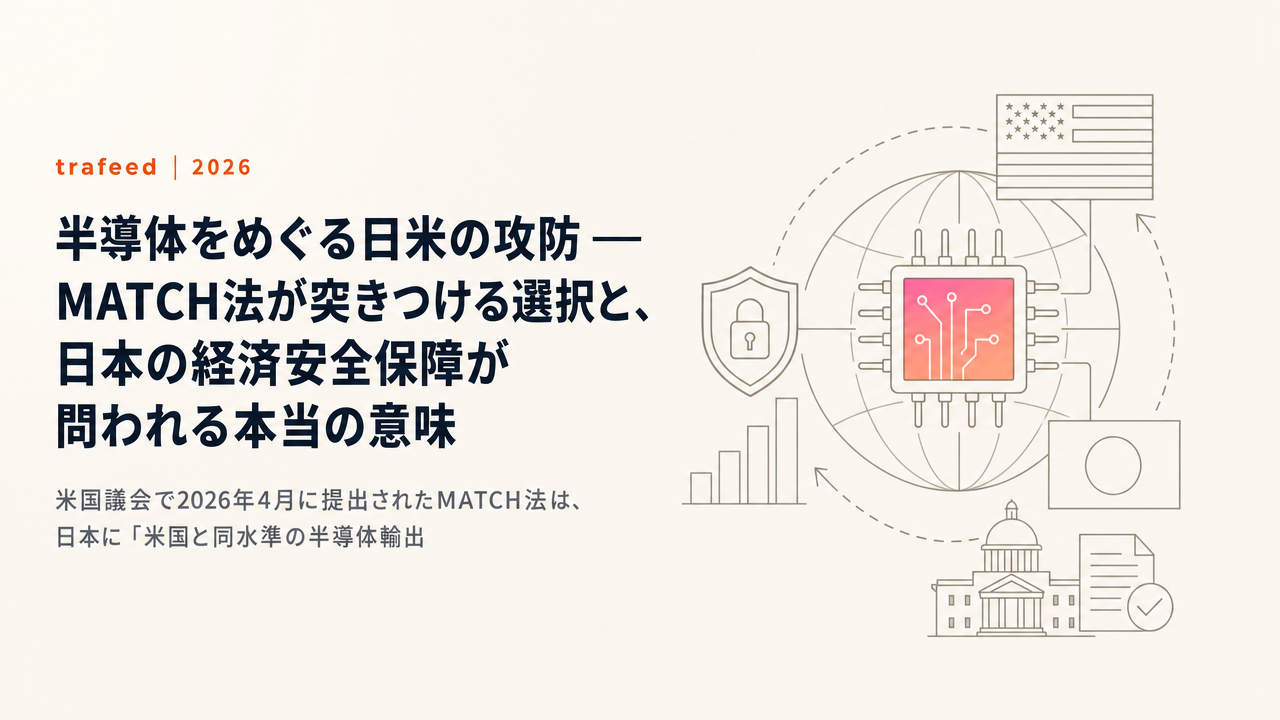
In April 2026, a bill called the MATCH Act — short for the Multilateral Alignment of Technology Controls on Hardware — was introduced in the US Congress. The name is forgettable; the substance is not. If the bill becomes law, Japan will have 150 days to either adopt export controls equivalent to those of the US, or watch its semiconductor-equipment makers lose the ability to ship to China and other "countries of concern" altogether.
The Japanese makers in scope — Tokyo Electron, Canon, Hitachi High-Tech, SCREEN, and others — carry an outsized share of the global semiconductor-equipment market. Several of them earn over 30 percent of revenue in China, and a sudden zero would be a direct hit to corporate earnings. Treating MATCH as a "company problem," however, misses the point. It is a forced choice about how actively Japan intends to shape the rules of the US-China semiconductor contest. In effect, it is a litmus test.
Why semiconductors carry this much weight
Worth a quick reset on first principles.
A semiconductor is not just an industrial part. The heart of every smartphone, car, weapon system, and AI training cluster is silicon. In the AI era, the performance of leading-edge logic chips translates directly into military capability and economic competitiveness. NVIDIA's GPUs accelerate model training; TSMC, which fabricates those GPUs, has become the chokepoint of the global information industry. That is the structure.
China understands this better than anyone. Beijing has poured state capital into the "Made in China 2025" and "Tech Power by 2035" agendas to localize semiconductor production. But fabrication at the leading edge is hard. Manufacturing equipment is effectively monopolized by the US, Japan, and the Netherlands, so China has had to buy from outside.
In October 2022, the Biden administration moved to cut that supply line. By extending the Foreign Direct Product Rule (FDPR), the US imposed sweeping restrictions on the export of advanced semiconductors and equipment to China for AI and military use. The reach extended to any company in the world that used US technology — quietly drawing Japanese and Dutch equipment makers into the regulatory perimeter. From there, the US-Japan back channel went into overdrive.
How Japan got to the 23-item rule
On 31 March 2023, METI revised its Foreign Exchange and Foreign Trade Act ordinance to add 23 categories of semiconductor manufacturing equipment to the export-control list. EUV-related tools and precision instruments used in deposition, cleaning, and lithography were included. Implementation followed on 23 July 2023.
That a strong push from the US sat behind the decision is now common knowledge. Reuters reported at the time that "the US has requested stronger controls," and METI acknowledged that "the measure was taken after dialogue with allies and like-minded countries, having earned their understanding." But this was not Japan rolling over. The rule was designed with Japanese discretion baked in — exports to "white list" countries remain permitted, opting for substance-based management rather than a blanket worldwide ban.
That was not enough for Washington. In July 2024, the US government signaled to allied capitals that it was considering an FDPR expansion that would impose stricter trade restrictions if equipment makers such as Tokyo Electron (TEL) and ASML continued to ship to China. Bloomberg called the proposed measure "the harshest" yet; TEL's share price dropped nearly 7.5 percent in reaction. Japan and the Netherlands pushed back, and their companies were excluded from the round of restrictions that followed — but the reprieve was temporary.
Replace siloed classification work with AI.
METI's FY2024 data shows 52% of foreign exchange law violations stem from classification errors. Download the TRAFEED product catalog covering features and rollout.
What is genuinely different about the MATCH Act
Then April 2026 brought the MATCH Act.
What makes this bill structurally different from past US measures is the shape of the pressure. Until now, Washington's leverage was indirect: "our rules constrain US-touching activity, which therefore constrains foreign companies." The MATCH Act flips that into something starker — if allied governments do not adopt equivalent rules domestically, the US will sanction those allies' companies directly.
Mechanically: within 150 days of enactment, if Japan, the Netherlands, or other named countries fail to put US-equivalent restrictions into national law, the US government can bar the semiconductor-equipment makers of those countries from exporting to "countries of concern" outright.
Representative Baumgartner (R), one of the sponsors, put it like this: "We cannot leave open the back doors that let the Chinese Communist Party keep acquiring the tools it needs to make progress in chip manufacturing." You can hear the American impatience in that sentence. Even sweeping US restrictions are blunted as long as Japanese and Dutch firms keep shipping legacy generations of equipment to China; the Chinese semiconductor industry advances regardless. MATCH is the attempt to close that gap by pulling allies fully into the regulatory net.
What Tokyo is thinking
What is the Japanese government doing under that pressure?
Minister of State for Economic Security Kimi Onoda has placed export control and economic security at the center of her portfolio. Serving in the Takaichi cabinet, she has been visibly engaged on the AI side of national security — for example, publicly stating that her office had asked X for improvements over the sexual-image generation problem associated with Grok. She is unusually willing to operate at the intersection of technology and security.
LDP lawmaker Akihisa Shiozaki (Cabinet Affairs Subcommittee No. 2 / Science, Technology and Innovation Strategy Investigation Committee) is deeply involved in shaping export-control and economic-security policy. He played a role in endorsing the Seventh Science, Technology and Innovation Basic Plan, and is a leading internal voice for "treating technological advantage as a national strategy."
Digital Minister Masaaki Taira works on My Number adoption and cyber-national-security, framing this issue from the intersection of digital infrastructure and sovereignty. When OSTP Director Kratsios visited Japan, Taira welcomed the roughly 1.6 trillion yen of US investment into Japan during the AI era — signaling a posture that takes both economic security and US-Japan coordination seriously.
The honest tension inside the Japanese government is this. Comply fully with the US and Japanese firms lose painful slices of their China business. Refuse, and Tokyo risks losing access to US markets and US-origin technology. Either way, declining to participate in the US security architecture carries a diplomatic cost that does not show up on a balance sheet.
Inside those three tensions, the government's playbook is to keep using "our own national-security judgment" as the public framing while coordinating substance closely with Washington behind the scenes.
What does "economic security" actually protect
It is worth pausing to ask the basic question. "Economic security" has become a phrase that can wrap almost anything — export controls, supply-chain resilience, anti-technology-leak measures. What is the core for Japan?
Three questions seem to get at it.
The first is self-reliance. Avoiding a position in which Japan is one-sidedly dependent on another country in a strategic industry. Energy taught us this lesson; the same logic now applies to semiconductors. Japan is strong in manufacturing equipment, but the materials and precision components that go into that equipment have meaningful overseas dependencies. Knowing where the weak point is and keeping the supply chain diversified is non-negotiable.
The second is indispensability. Remaining a country that the global supply chain cannot run without. This is offensive economic security, not defensive. The cleaning equipment that Tokyo Electron and SCREEN make, and the silicon wafers from Shin-Etsu, underpin most of the world's leading-edge chip production. Sustaining and strengthening that indispensability is what gives Japan negotiating leverage.
The third is the ability to judge. Having the institutional capacity to operate export controls correctly. Which transaction risks military diversion? Which counterparty is a flagged end-user of concern? Answering those questions fast and at high quality demands real expertise and real information infrastructure.
On the ground, export control still runs on paper and tribal knowledge
This is where the picture gets uncomfortable.
Across many Japanese companies — and particularly mid-sized and smaller manufacturers — the day-to-day reality of export-control compliance still depends on one or two specialists' personal knowledge and on slogging through dense legal manuals. Since the 23-item additions in 2023, the regulated surface area has expanded, and notifications and ordinance changes under the Foreign Exchange and Foreign Trade Act now come thick and fast. The reach of catch-all control — which can require a license even for items not on the list, if there is suspicion of military diversion — is broad. Asking a company to capture every risk by hand is structurally hard.
METI's 2025 export-control outreach program reconfirmed in plain language that smaller firms are "not coping." Asking one specialist to internalize hundreds of regulated categories, verify end-users across counterparties, and assemble evidence is past the point of being a human-scale workload.
That is the gap TRAFEED was built to close. As of January 2026, our company TIMEWELL launched TRAFEED as the world's first AI agent purpose-built for Japan's security export-control regime (list-based and catch-all), with Okayama University as the design partner.
What TRAFEED replaces is the implicit "I'll figure it out" judgment process. Applicability checks for list-based controls, concern-level scoring for catch-all controls, and automatic generation of the supporting evidence — those steps now run end-to-end as a single AI workflow (core technology patented). The reviewer's time concentrates on the final judgment, and what used to be an opaque, person-dependent compliance posture becomes a visible "organizational capability."
If MATCH passes and Japan tightens its rules further, the workload of export-control work only gets heavier. The right frame for AI agents is not "an efficiency tool" but "the operating base for being a company that can stay compliant under economic-security regimes."
What 150 days actually means
If MATCH is enacted (as of May 2026, it is moving through the House Foreign Affairs Committee), Japan faces a choice within 150 days — strengthen its rules, or negotiate a specific carve-out as an excluded country under MATCH.
Historically, in the 23-item rounds of 2023, Japan held to the position that the design and scope of the controls reflected its "own judgment," after intensive pre-coordination with the US. The same approach is likely this time. But the US under Trump prefers transactional pressure on allies — the 2026 tariff disputes have proven that. Optimism about "managing it diplomatically" is not on offer.
The real challenge for Japan is less the strength of the rules than whether the operating system to run those rules can be built in time. There is always a gap between changing the law and being able to execute it on the ground. Every expansion of the regulated surface complicates corporate review and license workflows, and stretches METI's licensing capacity. Without parallel investment in operational infrastructure, you end up with the worst case: "the law exists, but it does not function."
Where Japan's posture should land
Watching the MATCH debate, one observation keeps coming back. Japan has, for a long time, treated economic security as a response to external requests. The US strengthens its rules, so Japan moves. We participate in Wassenaar and nonproliferation regimes, so we manage. What has been harder to find is a proactive vision of "what kind of world order do we want to build."
That stance is no longer sufficient. Semiconductors are this century's oil — a strategic resource. With Japan holding an overwhelming hand in manufacturing equipment, the moment to use that card in international rule-making is now. Not just respond to US asks, but bring our own answers to the table: what values does Japan want to defend? What forms of technology leakage will we not tolerate? How do we hold both fair competition for companies and a meaningful security perimeter? Those are the questions a country sitting at the negotiating table should arrive with.
The reason I built TRAFEED comes down, in the end, to the same thinking. The goal is to grow the number of companies and practitioners who can engage with export control not as "a compliance cost to begrudge" but as "the work of building, ourselves, the mechanism that keeps Japanese technology from being misused." The role AI can play in that is still at the entrance.
The US-Japan semiconductor contest will keep intensifying over the next few years. Read the other way, that is also a real chance for Japan to stand on the rule-design side as a leading economic-security country. The MATCH Act's 150 days is both a deadline and an invitation to reframe the question.
What to do about it
Whether or not MATCH lands in Japanese law, the weight of export-control work in Japan is going to keep increasing. The list-based categories grow; catch-all judgments require ever more nuanced reading of context; evidence-retention and submission duties are tightening. Running operations entirely out of one specialist's head is no longer survivable.
TRAFEED is built to carry that weight as organizational capability rather than personal knowledge. It has moved from joint validation with Okayama University into commercial deployment, with 20+ universities and companies now onboard. List-based applicability, catch-all concern scoring, background checks for students and researchers, and the evidence record behind every judgment — all of it runs end-to-end. The core technology is patented, and the team ships every week to keep up with regulatory change.
"We spend over 1,000 hours a year on applicability judgments." "When one specialist leaves, we cannot operate." "We never have evidence ready in time for audits." "Between the 23-item rules and the MATCH Act debate, we do not know where to start." If any of those land, please get in touch. We will walk through your current workflow with you, and arrange a TRAFEED demo and free trial.
References
[1] Reuters. "Japan to add semiconductor manufacturing equipment to export controls following US request." https://jp.reuters.com/markets/global-markets/WCSD2MKFZRJXJJYFCS75SVTWMI-2023-03-31/ (2023-03-31)
[2] ASCII.jp. "MATCH Act in the US Congress could have major implications for Japanese semiconductor companies." https://ascii.jp/limit/group/ida/elem/000/004/394/4394393/ (2026-04-06)
[3] Nikkei. "US lawmakers seek tighter China semiconductor controls in new bill, asking Japan and Netherlands to align." https://www.nikkei.com/article/DGXZQOGN1607M0W6A410C2000000/ (2026-04-16)
[4] Jiji Press. "Bipartisan bill to tighten controls on China; could affect Japanese and European semiconductor-equipment companies." https://www.jiji.com/jc/article?k=2026040300273&g=int (2026-04-03)
[5] Bloomberg. "US weighs harshest measures yet on China chip controls, warns allies." https://www.bloomberg.co.jp/news/articles/2024-07-17/SGR111T0AFB400 (2024-07-17)
[6] Bloomberg. "Japan and Netherlands excluded from new US semiconductor restrictions on China." https://www.bloomberg.co.jp/news/articles/2024-07-31/SHHEC6T0G1KW00 (2024-07-31)
[7] CISTEC. "Overview of the draft ordinance adding 23 categories of semiconductor manufacturing equipment." https://www.cistec.or.jp/service/doushikoku/handotai23_pubcome00.pdf (2023-04-28)
[8] JETRO. "Latest trends in US economic security." https://www.jetro.go.jp/ext_images/biz/seminar/2026/fe8ffa2e2b35f703/260213_JETRO_ORB.pdf (2026-02-13)
[9] PR TIMES / Tokyo Shimbun. "TIMEWELL Inc. launches TRAFEED beta — world's first AI agent purpose-built for Japan's security export control." https://prtimes.jp/main/html/rd/p/000003952.000072793.html (2026-03)
[10] METI. "Amendments to the Foreign Exchange and Foreign Trade Act on security trade controls." https://www.meti.go.jp/policy/anpo/20251114koufu_setsumeishiryou.pdf (2025-11-14)
If you are reviewing export-control operations or classification workflows, download the TRAFEED product catalog (PDF) or contact us.