This is Hamamoto from TIMEWELL.
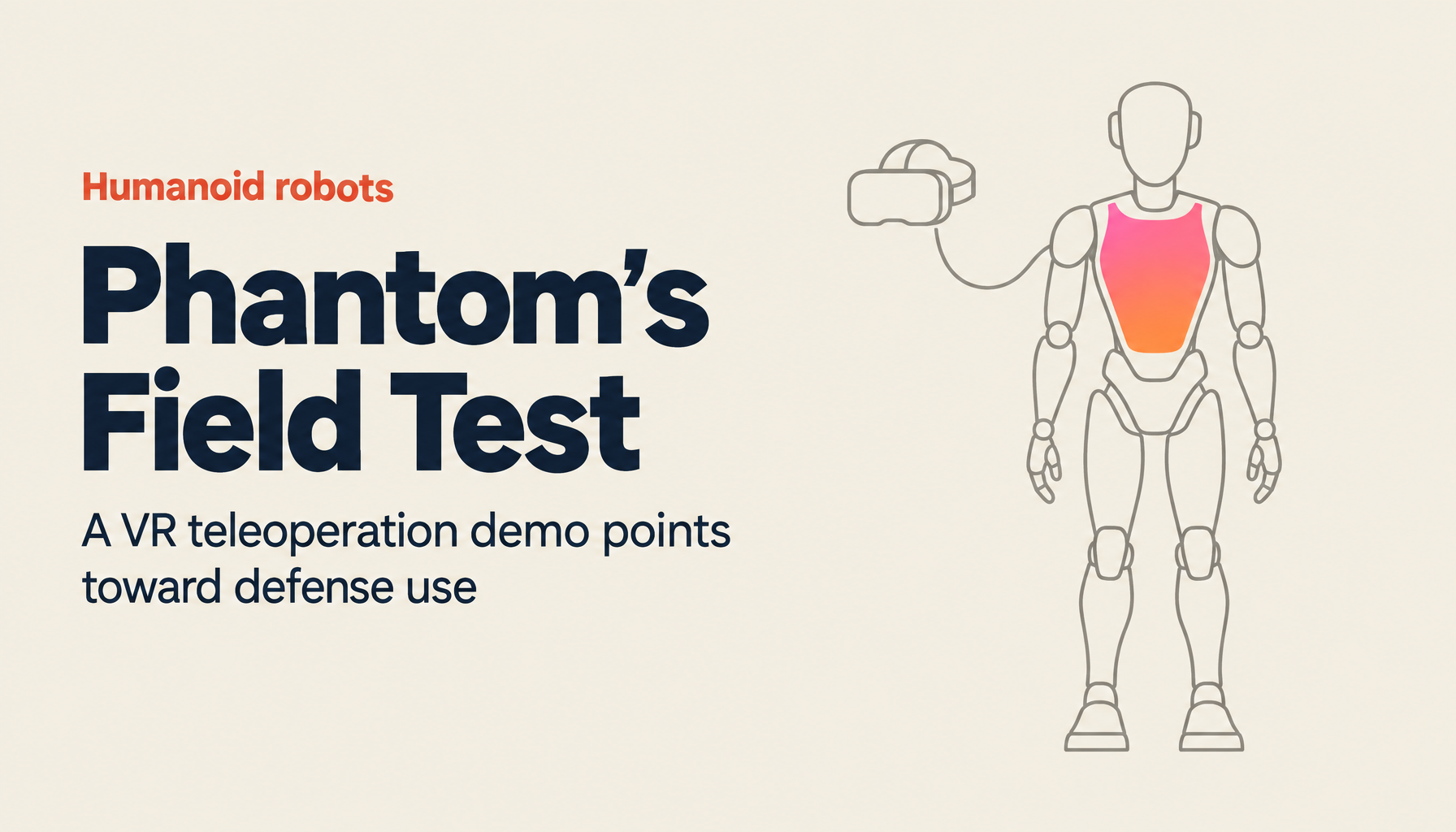
Foundation Future Industries, a San Francisco-based robotics startup, recently demonstrated their Phantom humanoid robot with live VR-based teleoperation. The demo covered the core technology, key design decisions, and — unusually for a commercial demo — an honest discussion of the defense applications the team is actively developing toward.
The Teleoperation Demo: What It Actually Felt Like
The demonstration involved a first-person teleoperation experience: put on a VR headset, calibrate the system to your hand and body movements, and control Phantom from a distance.
Setup: the operator performs a calibration sequence (double-tap to activate control, double-tap again to stop). Once calibrated, the operator's hand movements are mirrored in the robot's hands in near-real time. The VR display shows Phantom's camera perspective, creating an immersive remote-presence effect.
During the demo, a tracking reversal occurred (left and right hands briefly inverted), requiring a quick recalibration. This was handled smoothly, but it highlighted a realistic limitation of the current system. Founder Pock's assessment: the current latency and tracking accuracy is sufficient for controlled environments; hazardous real-world deployment requires further development.
A new walking training policy was also demonstrated. Phantom's gait retraining aimed to produce more natural, human-like walking movement. Early in the demo, a balance failure and fall occurred during live gait testing. This was presented without apology — it was an accurate representation of where the technology currently sits.
Looking for AI training and consulting?
Learn about WARP training programs and consulting services in our materials.
Design Philosophy: Sensor Minimization
The most technically interesting choice in Phantom's architecture is what's not there. Pock explicitly contrasted Phantom's approach with humanoid robots like Unitree G1, which use numerous cameras, lasers, and sensors throughout the body.
The Phantom position: more sensors create more data conflicts. If multiple sensors give contradictory readings about the same object's position, the robot's control system has to resolve the conflict — and that resolution introduces latency and failure modes. By minimizing sensor count and routing wiring internally, Phantom trades raw environmental data richness for cleaner, more reliable control inputs.
This is a systems engineering tradeoff, not a cost-saving measure. The design bets that sensor simplicity produces more dependable real-world behavior than sensor redundancy.
Grip Technology: Human Hand as Reference
The Phantom hand uses a glove-type interface inspired by human hand mechanics. The design goal: replicate the dexterous range of motion of a human hand rather than optimizing for grip strength in a single configuration.
Conventional robotic grippers excel at one type of motion (parallel grip, vacuum suction, etc.) but are poor at tasks requiring varied contact points. The Phantom hand aims to cover a wider task range — picking, pushing, placing objects at varied orientations — with a single end effector. In the demo, Phantom handled object pickup and manipulation tasks that would be difficult for conventional grippers.
Defense Applications: Where the Conversation Gets Serious
The team was direct about the defense trajectory. Phantom is being developed with potential deployment in:
- Minefield navigation and clearing
- Building search operations in active conflict zones
- Frontline defensive positions in lieu of human soldiers
The current teleoperation system is framed as a direct analog to drone operation. Drones are already widely used in autonomous modes with human oversight for final weapons decisions. Phantom's developers see the same model applying: autonomous navigation and environmental interaction, with human authorization required for any armed engagement.
Pock and his team acknowledged the ethical weight here explicitly. Fully autonomous lethal systems — robots that identify and engage targets without human approval — are not the stated goal. The stated position: the human must remain in the loop for the final decision in any weapons-related scenario. Given how quickly the technology could evolve past that constraint, the developers noted that international governance frameworks for autonomous weapons need to develop in parallel with the technology.
The demonstration also touched on Mars and extreme environment operations as longer-horizon applications — scenarios where communication latency makes real-time teleoperation impossible and autonomous capability becomes necessary.
Summary
Foundation Future Industries' Phantom demo presented a technically honest picture of where humanoid teleoperation currently stands:
- VR teleoperation works; tracking failures are real and recoverable
- Sensor minimization is a deliberate design choice with engineering rationale
- Glove-based grip is the most technically differentiated component
- Walking gait training is still in active development
- Defense applications are explicitly on the roadmap, with human-in-the-loop as the stated ethical line
For anyone tracking the humanoid robotics space — or thinking about what "AI in the field" actually means — Foundation Future Industries is building toward a specific answer to that question, and they're being relatively transparent about both the capabilities and the limitations.
Reference: https://www.youtube.com/watch?v=sJmg3abOASM