This is Hamamoto from TIMEWELL.
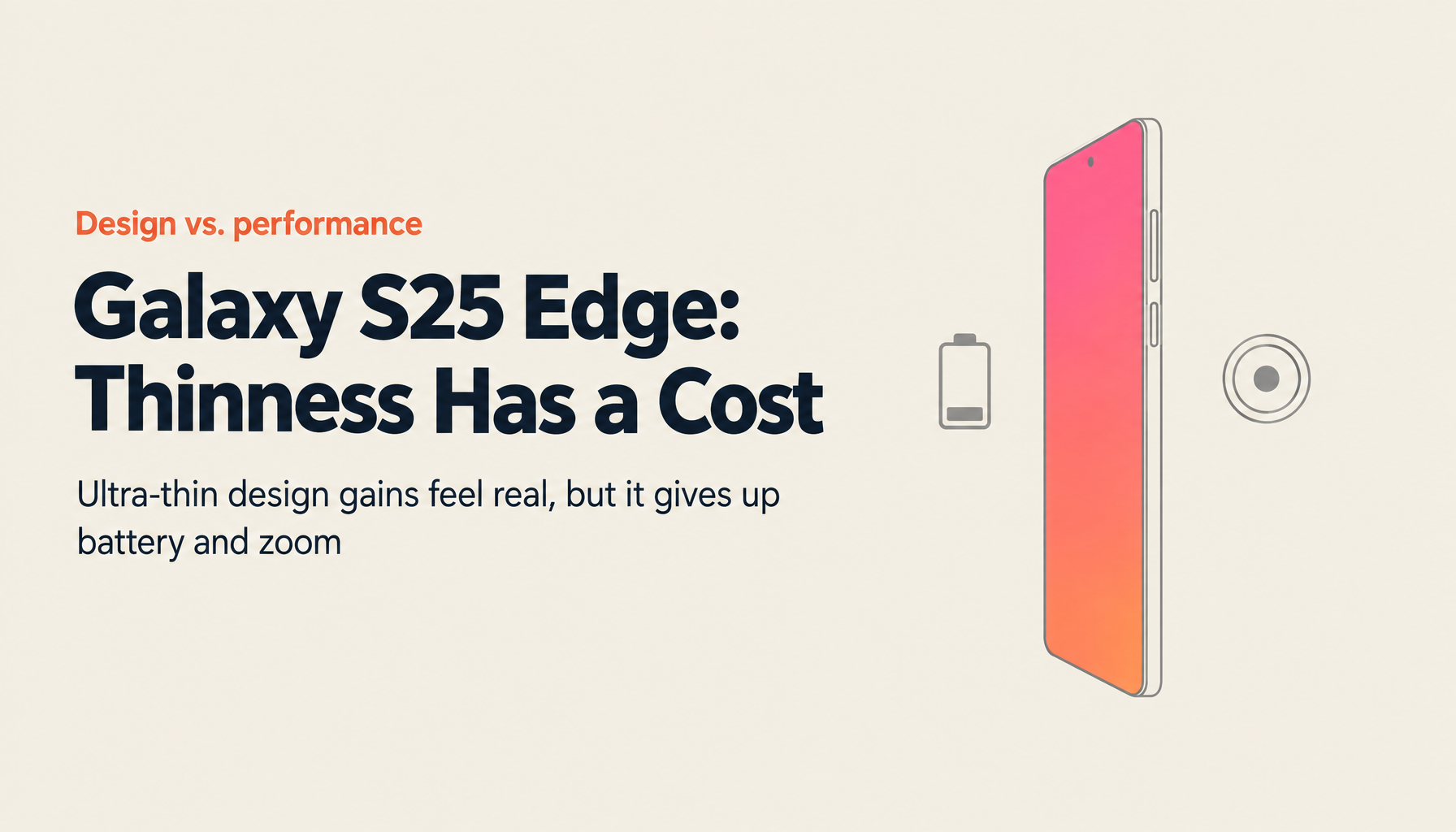
The smartphone market is increasingly dividing between two competing priorities: pure thinness and full-spec performance. The Galaxy S25 series makes that tension explicit — and the S25 Edge, at 5.8mm, is the clearest test case for whether ultra-thin design has matured enough to satisfy practical users.
The Design Trade-Off: What's Given Up for 5.8mm
The Galaxy S25 lineup spans a clear thickness spectrum:
- S25 Ultra: 8.2mm
- S25 Plus: 7.7mm
- S25 Edge: 5.8mm
That 2.4mm difference between the Edge and Ultra isn't cosmetic — it requires real hardware decisions.
Camera: The S25 Edge shares the S25 Ultra's 200MP main camera sensor, which is a genuine strength. But the telephoto lens is omitted. Only the 200MP main and a 12MP ultrawide remain. For zoom photography — sports events, concerts, distant subjects — the Edge offers less capability than the Ultra or even mid-range phones with dedicated telephoto systems.
Battery: The S25 Edge carries a 3,900mAh battery, roughly 25% smaller than the S25 Plus despite having a comparable (or larger) screen. For users who typically charge once per day in predictable environments, this may be manageable. For travel days, long events, or unpredictable schedules, it becomes a planning concern.
Materials: The thinness is enabled by advanced materials — titanium structure, ceramic elements, Gorilla Glass — that provide durability despite reduced thickness. The internal layout removes some graphite and copper to create the space needed, compensating with structural reinforcement at key stress points.
Looking for AI training and consulting?
Learn about WARP training programs and consulting services in our materials.
What Users Actually Experience
The physical sensation is the genuine differentiator. Holding a 5.8mm phone feels noticeably different from anything at 8mm. Pocket presence is minimal; the device feels closer to a card than a phone. This isn't a spec — it's an experience, and for some users it's the deciding factor.
With a case, the Edge retains a thinner profile than other phones without cases. The ultra-thin advantage survives real-world use conditions better than critics sometimes suggest.
The fingerprint sensor position and screen edge behavior are slightly adjusted from previous models, which some users report requiring adaptation time.
The Technology Gap: Silicon-Carbon Batteries
The most discussed potential resolution to the thin-phone battery problem is silicon-carbon battery technology. Compared to conventional lithium-ion, silicon-carbon offers meaningfully higher energy density — more capacity in less physical space.
The OnePlus 13 demonstrated this practically: 6,000mAh capacity in a standard phone body using silicon-carbon chemistry. Applied to an ultra-thin form factor, the same chemistry could allow a device at S25 Edge dimensions to carry 4,500–5,000mAh rather than 3,900mAh — closing most of the gap without increasing thickness.
The expected market trajectory: silicon-carbon batteries become more prevalent in flagship phones over the next 1–2 years, significantly changing the trade-off calculus for ultra-thin designs.
Market Context
The ultra-thin segment is competitive. iPhone 17 Air rumors specify a similar thin-first priority. Other manufacturers have experimented with extreme thinness for years. What's different now is the material and manufacturing maturity — titanium frames, ultra-thin glass, advanced packaging — that makes these designs structurally viable rather than fragile compromises.
For business users evaluating the S25 Edge: the camera and battery limitations are real but context-dependent. A user who primarily shoots in natural light, stays in wifi proximity, and values single-hand ergonomics will find fewer friction points than a user who regularly shoots in varied conditions and needs full-day charge confidence.
Summary
The Galaxy S25 Edge represents the clearest current example of where ultra-thin smartphone design sits in 2025:
- 5.8mm thickness with meaningful ergonomic advantages
- Main camera (200MP) retained; telephoto omitted
- Battery (3,900mAh) 25% smaller than S25 Plus
- Premium materials enable durability without thickness
- Silicon-carbon batteries are the technology most likely to resolve the battery trade-off in next-generation thin phones
The design direction is set. The limiting factors are engineering constraints, not philosophical choices — and those constraints are actively being solved.
Reference: https://www.youtube.com/watch?v=5nKLu2CSxx8