How to Design an AI Training Program — A Practical Guide to Department-Specific Curricula and Impact Measurement
This is Hamamoto from TIMEWELL.
"We want to raise the AI literacy floor across the whole company, but we don't know how to design the training." This is a question I'm being asked more and more from HR and learning and development teams.
The context is clear. Nomura Research Institute data shows that 57.7% of Japanese companies have already deployed generative AI, but 70.3% of those companies cite "insufficient employee literacy and skills" as a key challenge. The tools are in place; the people who can use them aren't. Leave that gap unaddressed and the AI investment becomes pure sunk cost.
Looking for AI training and consulting?
Learn about WARP training programs and consulting services in our materials.
Why "Ad-Hoc Training" Fails
Let me lay out the most common failure patterns first. If any of these sound familiar, it's time to rethink your design.
| Failure Pattern | Example | Root Cause |
|---|---|---|
| Lecture-heavy | Three hours of AI theory, no hands-on practice | Gap between knowledge and application |
| One-size-fits-all | Same curriculum for sales and engineering | Ignores differences in departmental work |
| Event-only | Annual training with no follow-up | No plan to reinforce learning |
| Goal-free | "Deepen AI understanding" as the objective | Unmeasurable goal |
| Fully outsourced | Training company handles everything, no internal know-how built | No internalization strategy |
The common problem across all of these: "running the training" has become the goal. The actual goal is "employees can use AI in their daily work" — not the training event itself. Confuse the two and you end up with an annual ritual that consumes budget and collects satisfaction surveys.
Five Steps to Curriculum Design
Step 1: Understand the Current Skill Level
Before designing anything, get an accurate read on where employees actually are. Use a company-wide survey or sampling to identify the following:
| Level | Definition | Corresponding State |
|---|---|---|
| Level 0 | No experience | Has never used an AI tool |
| Level 1 | Has tried it | Has experimented with ChatGPT or similar personally |
| Level 2 | Using at work | Uses AI regularly in daily business tasks |
| Level 3 | Applied use | Can design prompts and integrate AI into workflows |
| Level 4 | Promoter | Can coach others and plan AI utilization initiatives |
According to IPA's "DX Trends 2025," 85.1% of Japanese companies feel a shortage of DX talent. In my experience, at most companies, Level 0 to 1 accounts for 60–70% of the workforce. Building a curriculum without this baseline picture means guessing in the dark — and landing either too advanced or too basic.
Step 2: Set Department-Specific Learning Targets
Rather than company-wide uniform goals, define what each department should be able to do after training. This is the core of curriculum design.
| Department | Target | What They'll Be Able to Do |
|---|---|---|
| Sales | Level 2 → 3 | Use AI to draft proposals; apply AI to customer analysis |
| Engineering | Level 2 → 4 | Integrate AI into code review; design test automation |
| Admin (HR, Finance, General Affairs) | Level 1 → 2 | Use AI daily for form drafting, data compilation assistance |
| Marketing | Level 2 → 3 | Generate content ideas; streamline market research with AI |
| Corporate Planning | Level 1 → 3 | Assist with management data analysis; use AI for meeting material preparation |
It's obvious that sales and engineering need very different skills — but what gets overlooked is the admin function. HR, finance, and general affairs are often assumed to be "AI-irrelevant," but they handle large volumes of tasks where AI delivers immediate value: template documents, FAQ responses, and similar routine work.
Step 3: Build the Curriculum
Work backward from the learning targets to construct the curriculum. Here are practical configurations by department.
Sales Curriculum (4 sessions × 2 hours each)
| Session | Theme | Content | Hands-On |
|---|---|---|---|
| 1 | AI basics and sales applications | How generative AI works; where it fits in the sales process | Try competitive research using ChatGPT |
| 2 | Efficient proposal creation | Prompt design fundamentals; managing output quality | Draft a proposal for an actual deal |
| 3 | Customer analysis and insight discovery | Analyzing meeting history; generating customer need hypotheses | Analysis exercise using CRM data |
| 4 | Practical workshop | Integrating AI into your team's actual workflow | Each participant presents their business improvement plan |
Engineering Curriculum (4 sessions × 2 hours each)
| Session | Theme | Content | Hands-On |
|---|---|---|---|
| 1 | AI-driven development fundamentals | Coding assistance AI; overview of test automation | Try code generation with GitHub Copilot or similar |
| 2 | Prompt engineering | Technical prompt design; context control | Implement complex requirements using AI |
| 3 | Code review and quality management | AI-powered code review; security checks | Experience automating review of existing code |
| 4 | Integration into the development workflow | Embedding in CI/CD; setting team usage guidelines | Design how to integrate AI into your team's development flow |
Admin Curriculum (3 sessions × 2 hours each)
| Session | Theme | Content | Hands-On |
|---|---|---|---|
| 1 | AI basics and admin applications | Basic generative AI operation; information security precautions | Draft emails and meeting minutes |
| 2 | Routine task efficiency | Document creation, data organization, FAQ response automation | Create actual department forms using AI |
| 3 | Practical application and reinforcement | How to integrate into workflow; understanding internal guidelines | Create a one-month AI utilization plan |
A note on the most important element of any curriculum: the hands-on material. Use the participants' actual data and actual work — not hypothetical case studies. For sales, use real deal data. For admin, use the reports they actually produce every month. Without the experience of "this actually helps my work," behavior won't change after training.
Step 4: Set Up the Delivery Structure
Once the curriculum is finalized, decide how to deliver it.
| Format | Advantages | Disadvantages | Best For |
|---|---|---|---|
| In-person group session | Active Q&A, builds team cohesion | Hard to schedule, higher cost | Kickoffs, workshops |
| Online (synchronous) | Location-independent, can be recorded for review | Harder to sustain attention | Lecture portions, foundational content |
| E-learning (asynchronous) | Self-paced | Harder to maintain motivation | Knowledge input |
| On-the-job training | Directly tied to real work, high retention | High burden on the trainer | Advanced skill development |
My recommended combination: e-learning first for foundational knowledge, then a group session for hands-on practice, followed by OJT for reinforcement. Spending group session time on lecture content is a waste. Move the theory to pre-work e-learning and use the group time for hands-on exercises.
Step 5: Establish Operating Rules and Follow-Up Structure
Training doesn't end when the session does. The follow-up structure that sustains skill development until it's embedded in daily work is what actually determines whether training succeeds.
Examples of follow-up activities:
- Weekly 15-minute retrospectives where each person shares an example of how they used AI that week
- A dedicated Slack or team chat channel for questions and information sharing
- Monthly skill checks with a quick test to verify comprehension
- An internal AI utilization contest at the three-month mark, collecting and recognizing business improvement examples
Honestly, the follow-up structure has more impact on outcomes than the training content itself. Three hours of training won't change anyone. Three months of continuous practice will.
Measuring Outcomes
A framework for measuring training effectiveness and reporting results to executive leadership.
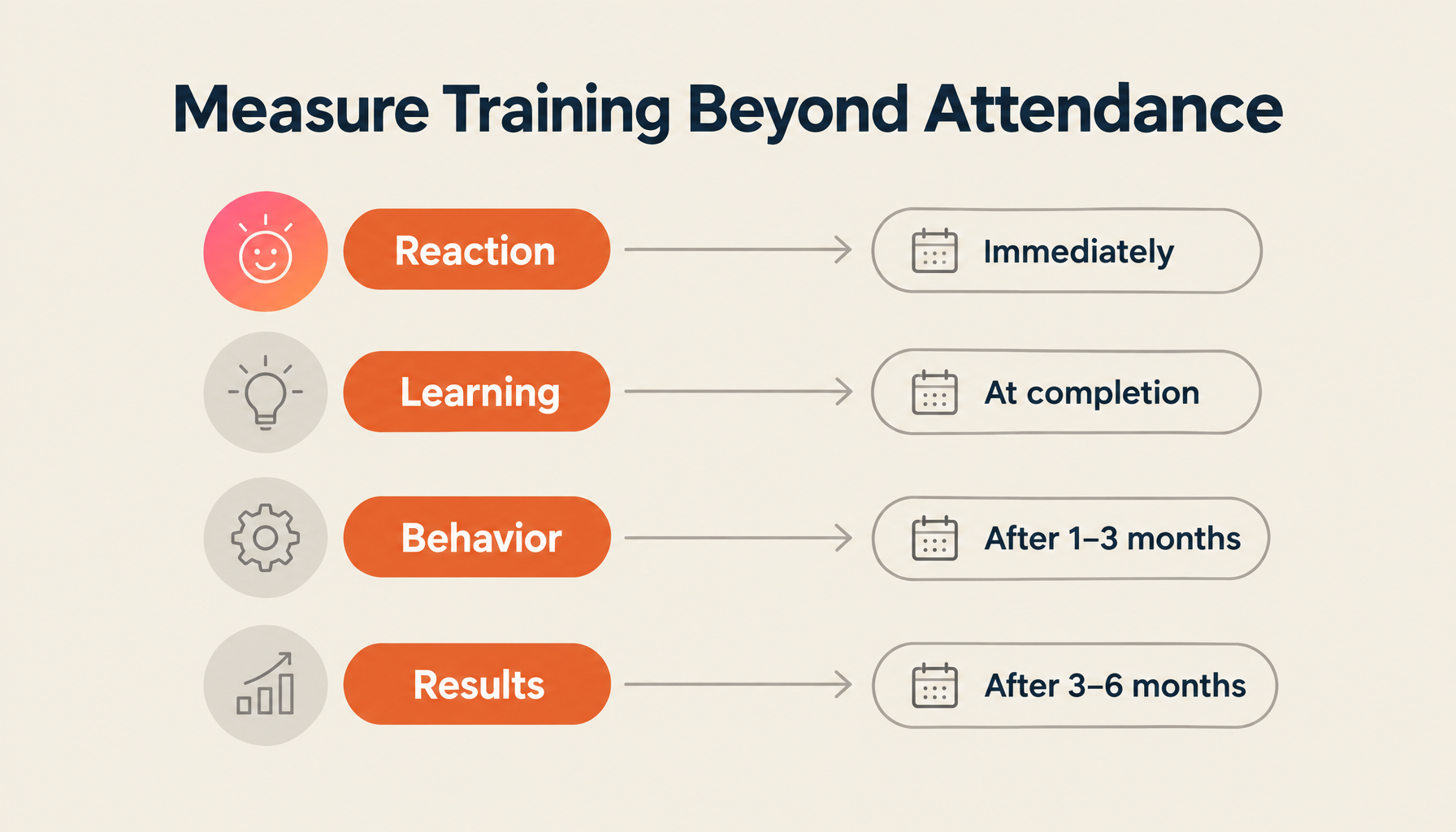
Four-Level Evaluation Using the Kirkpatrick Model
| Level | What's Evaluated | How to Measure | When to Measure |
|---|---|---|---|
| Level 1: Reaction | Participant satisfaction | Post-training survey | Immediately after training |
| Level 2: Learning | Knowledge and skill acquisition | Comprehension test, skills assessment | At training completion |
| Level 3: Behavior | Application to work | Usage rate survey, manager assessment | 1–3 months after |
| Level 4: Results | Contribution to business outcomes | KPI comparison (time reduction rate, error rate, etc.) | 3–6 months after |
Most companies stop at Level 1 satisfaction surveys. But what executives want to know is Level 3 to 4 — "what changed in how people actually work." High satisfaction with no change in practice means the training investment isn't being recovered.
Specific KPI Examples
| KPI | How to Calculate | Benchmark Target |
|---|---|---|
| AI utilization rate | % of employees using AI at least once a week | 70%+ at three months post-training |
| Work time reduction | Before/after comparison of time spent on target tasks | 20–30% reduction in target work |
| Output quality | Error rate, customer satisfaction, number of review comments | 10–20% improvement |
| Internal case count | Number of AI utilization/improvement examples reported | At least 1 per department per month |
| Skill level advancement | Pre/post skill assessment score comparison | Average improvement of 1+ level |
CloudAce research shows that 80.2% of companies that set KPIs for their AI utilization initiatives achieved their targets. The reverse is also true: companies without KPIs struggle to produce measurable results. Build the measurement framework in from the start — it's a prerequisite.
Leveraging Subsidies
AI training may qualify for Japan's "Employee Career Development Assistance Subsidy" (人材開発支援助成金). This Ministry of Health, Labour and Welfare program subsidizes a portion of the expenses and wages associated with employee vocational training.
Key requirements include:
- Submitting a training plan in advance and obtaining approval from the regional labor bureau
- The training must be conducted as off-JT (outside of regular duties)
- Meeting the minimum training hours requirement (10 hours or more, etc.)
- Filing an application for the subsidy after training completion
The eligibility requirements and subsidy rates change annually, so check the Ministry of Health, Labour and Welfare website or your nearest Hello Work office for the latest information. The application process is admittedly cumbersome, but the program can significantly reduce training costs — it's worth using.
Curriculum Design Checklist
A checklist of items that tend to be missed at the design stage.
During the design phase:
- Have you conducted a company-wide skill level assessment?
- Have you defined learning targets by department?
- Is the curriculum balanced between knowledge and practice?
- Does hands-on practice use actual company data and real work?
- Have you incorporated information security guidelines?
During the delivery phase:
- Have you distributed pre-learning materials?
- Have you selected and prepared the trainer (internal or external)?
- Have you secured participants' schedules?
- Have you prepared the hands-on environment (tool accounts, etc.)?
During the follow-up phase:
- Have you planned post-training follow-up activities?
- Have you decided on outcome measurement KPIs and measurement timing?
- Have you set a reporting schedule for executive leadership?
- Have you designed an improvement cycle for the next round of training?
Summary
Training should be evaluated not on "whether it happened" but on "whether it produced results." Building the measurement framework into the design from the start is the only way to justify training investment.
As your next action: start with a company-wide skill level assessment. Once you know where people are, the question of which departments need what level of curriculum answers itself. Planning a "company-wide AI training" without that assessment means designing a program that won't actually connect with the front line.
TIMEWELL's WARP provides end-to-end support for corporate AI training program design, delivery, and outcome measurement — with curricula directly tied to practical application. WARP NEXT is a long-term accompaniment model where the program is updated monthly to reflect the latest AI developments. WARP BASIC is a customized short-format program with department-specific curriculum options. Reach out even if you're at the stage of thinking through the overall training design.
![[2026 Edition] App Development Training for Non-Engineers — Build an App in 3 Months Without Writing a Line of Code](/images/columns/default-column.png)