Hello, this is Ryuta Hamamoto from TIMEWELL Corporation.
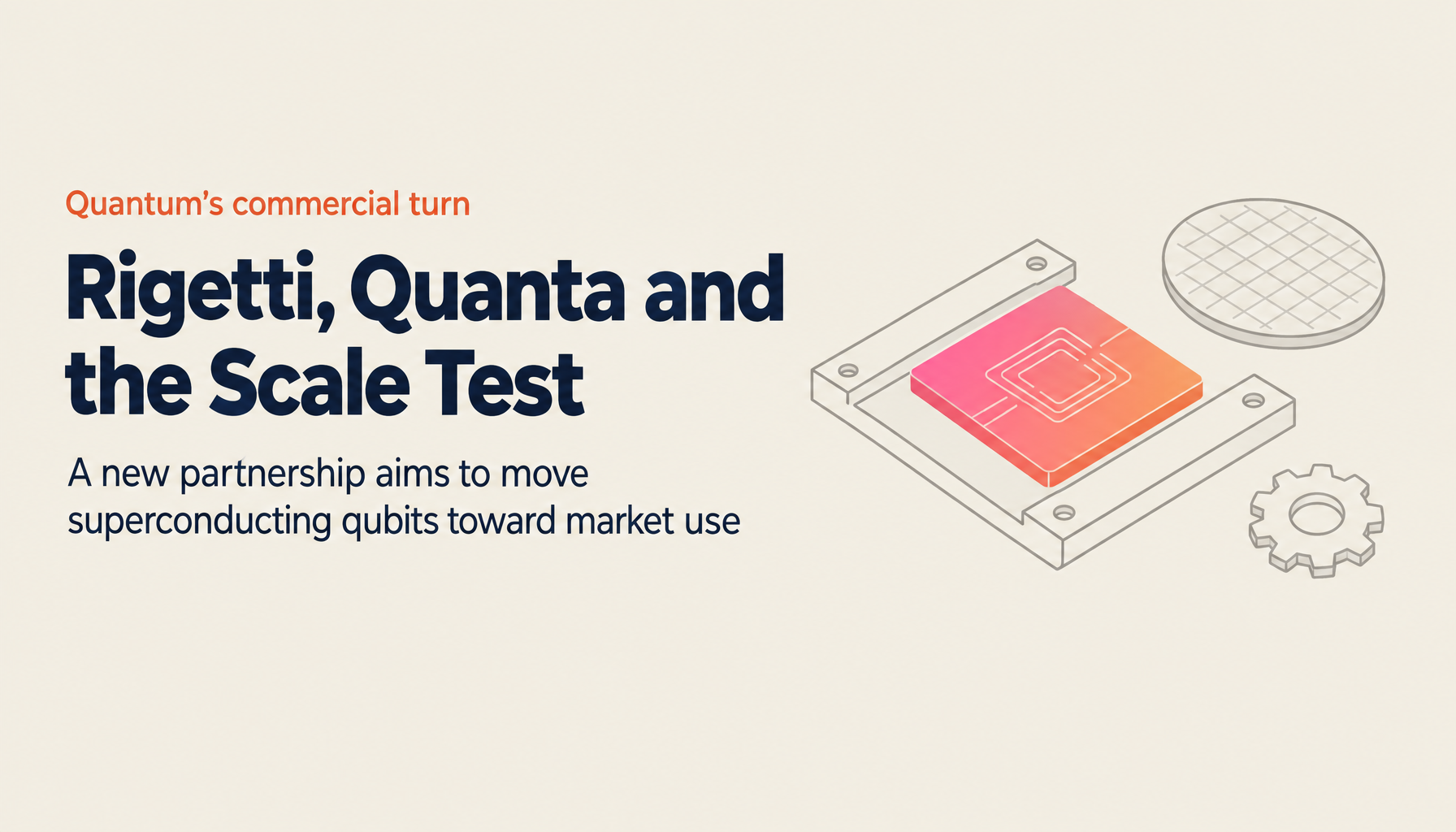
A significant development has arrived in the quantum computing industry. Rigetti Computing — a pioneer in superconducting quantum computers — has announced a strategic partnership with Quanta Computer, the world's largest notebook PC and server manufacturer (annual revenue: $43 billion), and closed a $35 million equity investment from Quanta.
This partnership marks a symbolic transition for the field: from the research phase to the commercialization phase. This article examines the details of the deal, the competitive environment in quantum computing, and what enterprises should be thinking about as the technology matures.
The Rigetti × Quanta Partnership in Full
Background
The strategic collaboration agreement between Rigetti and Quanta was announced on February 27, 2025. Quanta's $35 million equity investment in Rigetti closed on April 30, 2025, at approximately $11.59 per share.
Partnership Summary
| Item | Detail |
|---|---|
| Investment amount | $35 million (~¥5.2 billion) |
| Investment type | Equity (~$11.59/share) |
| Duration | 5 years |
| Total investment scale | $100M+ combined over 5 years |
| Objective | Accelerate development and commercialization of superconducting quantum computing |
Why This Partnership Matters
Rigetti's strengths: Rigetti is one of the few quantum computing companies with a fully integrated hardware-software stack — from superconducting chip design and fabrication to software platform development. The company operates its own Fab-1 quantum chip manufacturing facility.
Quanta's strengths: Quanta Computer is the world's largest contract manufacturer of notebooks, servers, and workstations — building products for Apple, Dell, HP, and other major brands. The company's capabilities in mass production and quality control are among the best in the world.
Combining Rigetti's quantum technology expertise with Quanta's manufacturing scale creates a credible path to both scaling up quantum systems and reducing costs simultaneously.
Quantum Computing: The Basics and the Current State
To understand the significance of this partnership, it helps to understand where quantum computing actually stands today.
What Is a Quantum Computer?
Conventional computers process information as bits — either 0 or 1. Quantum computers use quantum bits (qubits), which leverage quantum mechanical properties to exist in a superposition of 0 and 1 simultaneously. This property enables certain categories of computation to be performed at dramatically higher speed.
The Major Approaches
| Approach | Leading Companies | Key Characteristics |
|---|---|---|
| Superconducting | Rigetti, IBM, Google | Operates at near-absolute-zero; most mature approach |
| Topological | Microsoft | Theoretically high error resistance; commercial timeline TBD |
| Ion trap | IonQ, Quantinuum | High qubit quality; scalability is the main challenge |
| Photonic | Xanadu, PsiQuantum | Room-temperature operation possible; large-scale potential |
Rigetti uses the superconducting approach. The company targets a 36-qubit modular system release in mid-2025, with a 100+ qubit system as a year-end goal.
Looking for AI training and consulting?
Learn about WARP training programs and consulting services in our materials.
The Competitive Landscape: Google, IBM, and Microsoft
Rigetti is not alone. The major technology giants are in an active development race.
Key Players in 2025–2026
Google: Released the Willow quantum chip to significant industry attention. Alphabet's stock has risen approximately 90% on the strength of AI momentum and quantum computing expectations. Google claimed "quantum supremacy" in 2019 and remains a leading force in the field.
IBM: Published a roadmap featuring the Kookaburra processor (1,386 qubits). The plan involves connecting three chips via quantum communication links, building a combined system of 4,158 qubits. IBM also announced the IBM Quantum Nighthawk (120 qubits) in November 2025, demonstrating 30% more complex circuit execution while maintaining error rates.
Microsoft: Pursuing proprietary topological qubits, which theoretically offer extremely low error rates. Microsoft also provides cloud-based quantum computing services via Azure Quantum.
Market Size Projections
| Year | Market Size |
|---|---|
| 2025 | ~$3.5 billion |
| 2030 | ~$20 billion |
| 2035 | ~$9.55 billion (alternate estimate) |
Note: projections vary by research firm. CAGR is estimated at 41.8% — a rapid growth trajectory across all credible forecasts.
The Technical Challenges Remaining
Commercial deployment of quantum computers still requires solving several key technical problems.
Challenge 1: Scaling Up Qubit Count
Current quantum computers operate at tens to hundreds of qubits. Solving practical real-world problems is expected to require thousands to tens of thousands. The difficulty: maintaining the near-absolute-zero environment required for superconducting qubits grows exponentially harder as qubit count increases.
Challenge 2: Error Correction
Qubits are extremely sensitive to environmental noise and prone to computational errors. Achieving reliable logical qubits — error-corrected qubits that behave consistently — requires many physical qubits per logical qubit. Rigetti's modular architecture is one proposed solution to this problem.
Challenge 3: Software and Algorithms
Hardware advances alone are not sufficient. The algorithms and programming tools needed to extract value from quantum hardware must keep pace. Rigetti's full-stack approach — owning both hardware and software development — is a competitive advantage here.
Industries Quantum Computing Will Transform
When quantum computing reaches practical deployment scale, the following sectors are expected to see fundamental change:
Key Application Areas
- Drug discovery and materials science: Accelerated molecular simulation enables faster identification of drug candidates and design of new materials
- Financial engineering: Faster portfolio optimization and risk calculation improves the precision of financial models
- Logistics and optimization: Route optimization and supply chain management at previously impossible scale
- Cryptography: Current encryption methods may become vulnerable to quantum attacks; development of quantum-resistant cryptography (PQC) is now urgent
- Machine learning: Quantum machine learning may enable entirely new categories of AI models
What Enterprises Should Do Now
Full commercial deployment of quantum computing is projected for approximately 2027–2030 — but preparation needs to begin today. In particular, transitioning to post-quantum cryptography is an immediate priority for any organization that handles sensitive data.
At TIMEWELL, our consulting service WARP helps organizations analyze the business implications of emerging technologies — including quantum computing and AI — and develop mid-to-long-term DX strategies. Our team of specialists works alongside clients from strategic planning through execution, helping them build competitive advantage ahead of the technology curve.
What to Watch Going Forward
After 2026, the quantum computing industry will be shaped by several key developments:
- Rigetti's 100+ qubit system launch: Whether the Quanta partnership enables the manufacturing scale-up will be pivotal
- Google Willow next-generation chip: Extending the demonstrated range of quantum supremacy
- IBM Quantum Network: Realizing a 4,000+ qubit multi-chip system
- Quantum cloud services expansion: Broader adoption of QaaS (Quantum as a Service) via AWS Braket, Azure Quantum, and IBM Quantum Network
- Post-quantum cryptography standardization: Full implementation of NIST post-quantum cryptography standards across enterprises
Summary
- Rigetti Computing and Quanta Computer have formed a 5-year, $100M+ strategic partnership; the initial $35M equity investment has closed
- Rigetti's full-stack quantum technology combined with Quanta's mass manufacturing capability creates a credible path to superconducting quantum computer commercialization
- Competition from Google, IBM, and Microsoft is intensifying across the industry, accelerating the overall pace of development
- The quantum computing market is growing at 41.8% CAGR, projected to reach approximately $20 billion by 2030
- Scaling qubit counts and establishing error correction remain the primary technical barriers to commercial deployment
- Drug discovery, finance, logistics, and cryptography are among the sectors most directly affected by near-term quantum advances
![Inside Elon Musk's Mind: The Grand Plan Rewriting Humanity's Future [Part 1]](/images/columns/elon-musk-master-plan-part1/cover.en.png)
![Inside Elon Musk's Mind: The Grand Plan Rewriting Humanity's Future [Part 2]](/images/columns/elon-musk-master-plan-part2/cover.en.png)