The Complete Guide to List Controls and Catch-All Controls: Export Classification in Practice
Hello, this is Hamamoto from TIMEWELL. Today I want to walk through the practical points that every export control practitioner needs to know about the two pillars of Japan's export control system: "list controls" and "catch-all controls."
"Our products don't fall under list controls, so export control doesn't apply to us." "What even is a catch-all control? I've never heard of it." "I'm not sure how to go about export classification."
These are comments we hear from many companies. Even products that don't fall under list controls can require an export license in certain situations. This article covers both regulatory frameworks in full — their overall structure and the practical steps for export classification.
Chapter 1: Understanding the Two Pillars of Export Control
What Are List Controls?
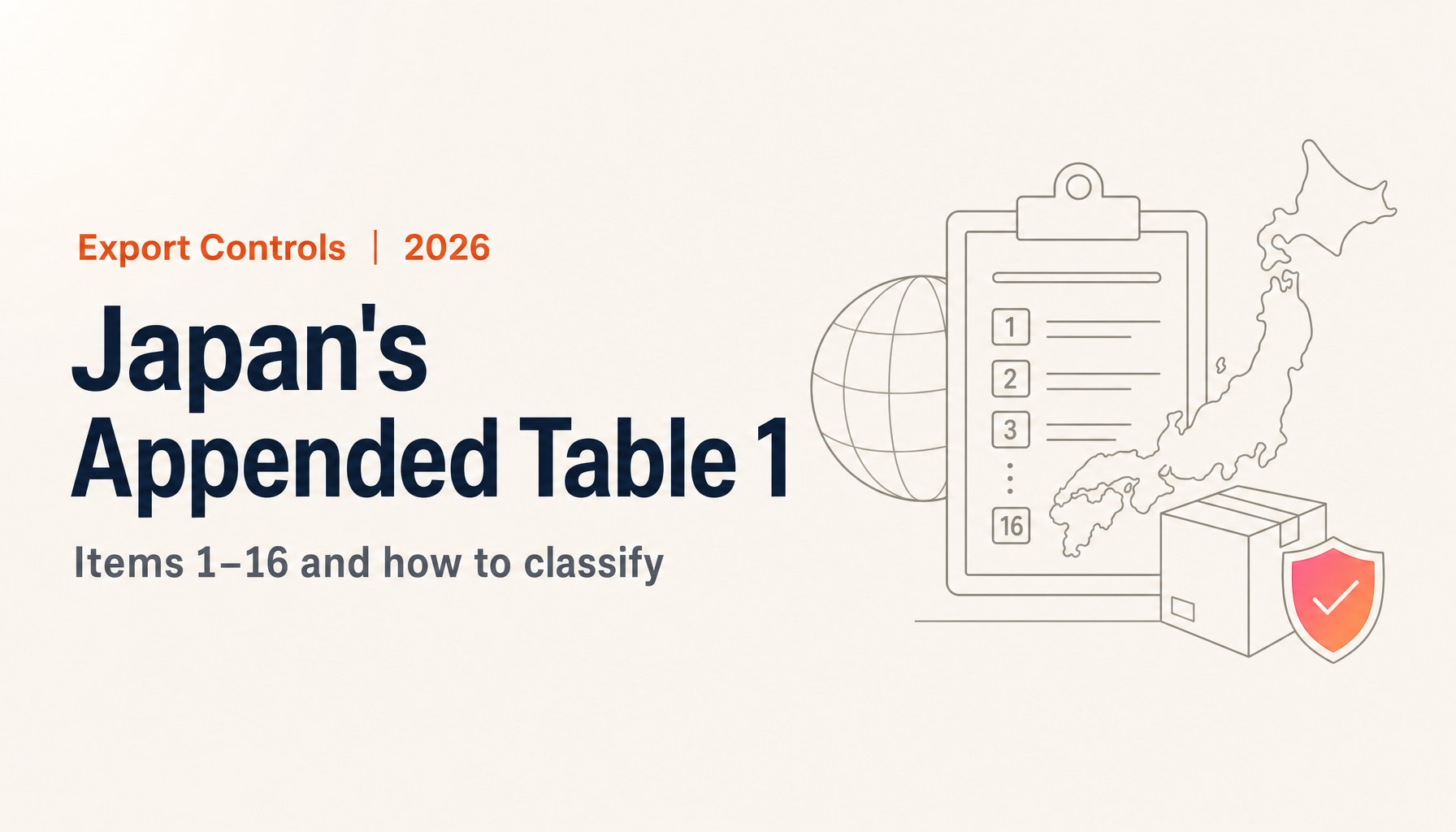
List controls are regulations that apply to specific goods and technology enumerated in Appended Table 1 of the Export Trade Control Order. The regulated items are specifically designated in advance — weapons, nuclear-related materials, missile-related materials, chemical weapons-related materials, advanced materials, and similar categories.
Exporting any of these items generally requires a permit from the Minister of Economy, Trade and Industry (METI). Exporting without such a permit constitutes a violation of the Foreign Exchange and Foreign Trade Act (FEFTA), which carries severe penalties.
The 15-Item Classification Framework
List-controlled goods are divided into 15 categories.
| Item No. | Category | Examples |
|---|---|---|
| 1 | Weapons | Firearms, ammunition, military vehicles |
| 2 | Nuclear | Nuclear fuel materials, nuclear reactors |
| 3–4 | Chemical / biological weapons-related | Chemical agents, biological agents |
| 5–9 | Missile-related | Rockets, unmanned aircraft |
| 10–15 | Advanced technology (dual-use) | Machine tools, electronic equipment, cryptography |
Table 1: Classification of list-controlled goods
Items 1 through 9 relate primarily to weapons of mass destruction and their delivery systems. Items 10 through 15 are so-called "dual-use" items — goods and technology that can be used for both civilian and military purposes.
What Are Catch-All Controls?
Catch-all controls apply to goods and technology that do not fall under list controls, but where there is a risk that they could be used in the development or manufacture of weapons of mass destruction or conventional weapons.
"Not being on the list" does not mean "safe." If there are concerns about end-use or the end-user, even non-list-controlled goods may require a permit.
Why Catch-All Controls Are Necessary
Developing weapons of mass destruction draws on a wide range of general-purpose goods. Technology advances quickly, and new diversion risks emerge constantly. It is not practically possible to list everything.
That is why catch-all controls were introduced — as a mechanism to "plug the gaps in list controls." They allow regulations to apply to items not on any list when concerns exist.
Replace siloed classification work with AI.
METI's FY2024 data shows 52% of foreign exchange law violations stem from classification errors. Download the TRAFEED product catalog covering features and rollout.
Chapter 2: Export Classification in Practice
What Is Export Classification?
Export classification (gaihihantei in Japanese) is the process of determining whether a product or technology "falls under" or "does not fall under" list-controlled items. It is the most fundamental and important task in export control.
An incorrect determination can result in unauthorized export and potential legal liability. Conversely, misclassifying a non-controlled item as controlled generates unnecessary license application work and reduces operational efficiency.
The Classification Process
Step 1: Gather Product Information
Clearly identify the intended use, functions, and technical specifications of the product in question. This may require not only catalogs and specification sheets but detailed technical documentation such as design drawings and test data.
Step 2: Identify the Potentially Applicable Item Number
Based on the nature of the product, identify which item numbers could potentially apply. For machine tools, Item 6 is likely relevant; for sensors, Item 14 may apply. Some products may fall within the scope of multiple item numbers.
Step 3: Compare Against Ministerial Ordinance Provisions
For the identified item numbers, cross-reference the provisions in the Foreign Exchange and Foreign Trade Act's Export Order ministerial ordinance against the product's specifications. Check the regulated technical parameters — precision, performance, capacity, and so on — and determine whether the product meets those thresholds.
Step 4: Record the Determination
Properly record and retain the determination result. If the item is controlled, prepare for the license application process. Even for non-controlled items, document the reasoning behind the determination.
Key Points for Classification
Accurate grasp of technical specifications: Catalog-listed nominal values can differ from actual performance. Where necessary, base the determination on measured data.
Interpreting regulations: Uncertainty about how to interpret regulatory text is common. In such cases, returning to the underlying purpose of the regulation is a useful approach.
Leveraging expert input: For borderline cases or situations where the determination has significant business implications, obtaining a second opinion from an external specialist reduces risk.
Chapter 3: Catch-All Controls in Practice
When a Permit Is Required
A permit under catch-all controls is required when either the "objective requirement" or the "inform requirement" is met.
Objective requirement: Based on facts the exporter can independently verify, either of the following conditions applies:
- There is a risk that the goods or technology will be used in the development of weapons of mass destruction or similar
- There is a risk that the end-user is engaged in the development of weapons of mass destruction or similar
Inform requirement: The exporter has received direct notification from METI
How to Verify End-Use
End-use verification means determining how the exported product will ultimately be used.
Verification methods:
- Reviewing end-use statements in contracts and purchase orders
- Direct discussions with the customer
- Obtaining an End User Certificate (EUC)
Once the end-use is understood, assess whether it relates to the development, manufacture, use, or stockpiling of weapons of mass destruction. Clearly civilian use raises no concerns, but military-related uses or research and development purposes warrant careful attention.
How to Verify End-Users
Check the Foreign User List: Cross-referencing against METI's published list of entities of concern is the first step. If a counterparty appears on this list, a permit is required regardless of end-use.
Check for other red flags: Even if a party does not appear on the Foreign User List, a comprehensive review is needed — including ties to the defense industry, a history of regulatory violations, and risk factors associated with the country of operation.
Chapter 4: Handling Dual-Use Items
What Is Dual-Use?
Dual-use technology refers to technology that can be used for both civilian and military purposes.
Examples of dual-use items:
- High-precision machine tools (automobile parts manufacturing ↔ centrifuge components)
- High-performance computers (simulation ↔ nuclear weapons design)
- Certain chemicals (semiconductor manufacturing ↔ chemical weapons production)
- Cryptographic technology (security ↔ military communications)
Even companies that believe they "don't deal in defense goods" may be subject to export control if they handle any of these products.
Classifying Dual-Use Items
Whether a dual-use item falls under list controls is determined by comparing the product's technical specifications against the ministerial ordinance provisions.
For computers, for example, the metric used is "Adjusted Peak Performance" (APP), and computers exceeding a certain APP value are subject to control. For machine tools, positioning accuracy and the number of NC axes serve as the classification criteria.
Non-Controlled Status Does Not Mean Problem-Free
Dual-use items, by their very nature, can potentially be diverted for weapons of mass destruction development — which means catch-all controls are particularly likely to apply even when list controls do not.
After completing list-control classification, always verify end-use and the end-user, and carefully consider whether catch-all controls apply.
Chapter 5: Export Classification Support with TRAFEED
AI-Assisted Export Classification
TRAFEED offers an AI-assisted export classification function using multi-LLM consensus. When product information is entered, multiple AIs cross-reference it against regulatory provisions and return a determination along with supporting rationale.
The AI's determination is a reference point — the final judgment must always be made by a human. But having AI provide an advance determination and rationale significantly improves the efficiency of practitioners' work.
Counterparty Verification Function
TRAFEED also provides the ability to cross-reference counterparties against Japan's Foreign User List and international sanctions lists. Name-variation handling and continuous monitoring features reduce the risk of missed checks.
Classification History Management
TRAFEED stores a history of all past determinations, accessible at any time. This makes it straightforward to respond to audits and to reference prior determinations when classifying similar products.
Conclusion: "I Didn't Know" Is Not a Defense
List controls and catch-all controls are the two pillars of export control. The assumption that "it's not on the list, so it doesn't apply" is dangerous — failing to verify end-use and end-users can result in a catch-all control violation.
Export classification is a specialized task, but by following proper procedures and drawing on expert support and appropriate tools as needed, high-quality determinations are achievable.
If you are uncertain about a determination, do not hesitate to consult with METI in advance or bring in an external specialist. "I'm not sure, so I'll call it non-controlled" is the most dangerous approach of all.
If you are interested in improving the efficiency of your export classification work or the accuracy of your end-user verification, please reach out to us at TIMEWELL. We would be happy to walk you through TRAFEED's capabilities.
References [1] METI, "Export Control Item Guidance," 2025 [2] CISTEC, "A Guide to Export Classification," 2025
If you are reviewing export-control operations or classification workflows, download the TRAFEED product catalog (PDF) or contact us.
Related Articles
- 2024 Guide: What Is Export Classification? From Basics to Practical Application
- Critical Minerals: Next-Generation Mining Through Vertical Integration and Technological Innovation
- Defense Innovation Frontier: DIU and Applied Intuition on Closing the Technology Gap and the Future of National Defense Strategy