From Ryuta Hamamoto at TIMEWELL
This is Ryuta Hamamoto from TIMEWELL Corporation.
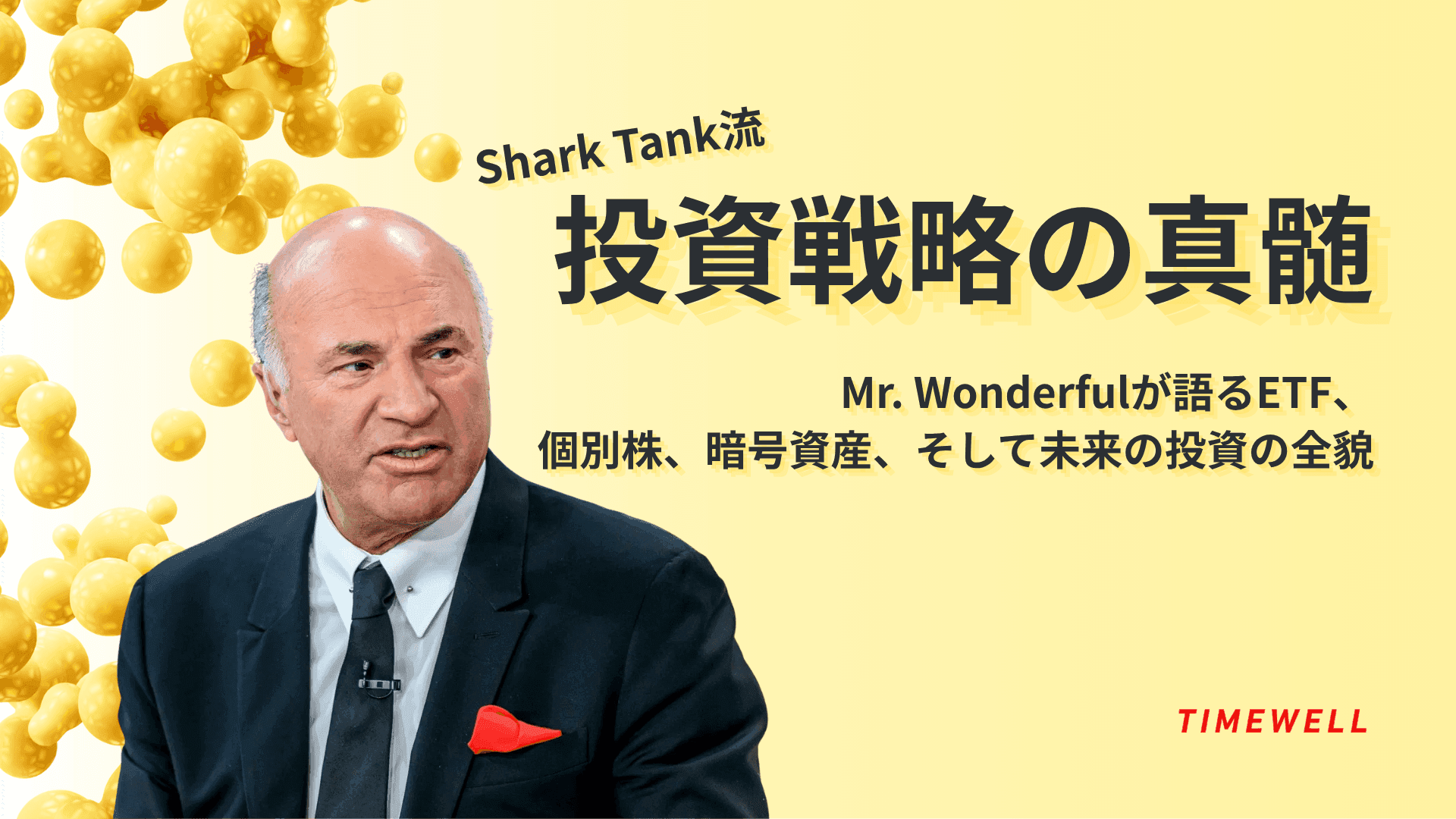
In 2026, Kevin O'Leary — better known as Mr. Wonderful from Shark Tank — continues to attract attention with his distinctive approach to investing.
"Buy infrastructure, not assets." Rather than holding crypto directly, O'Leary invests in the exchanges that power it: Robinhood, Coinbase, WonderFi. He keeps a fixed 2.5% allocation to Bitcoin and Ethereum and insists that three crypto positions are more than enough. The bulk of his family wealth sits in O'Shares ETFs (OUSA and OUSM). His Beanstox app now includes a Bitcoin ETF (IBIT). And the $15 million he lost when FTX collapsed — money he'll never see again — has become one of his most cited lessons on the danger of groupthink.
This article covers Mr. Wonderful's full 2026 investment playbook.
Kevin O'Leary in 2026: At a Glance
| Topic | Position |
|---|---|
| Crypto strategy | "Buy infrastructure (exchanges), not assets" |
| Exchange investments | Robinhood, Coinbase, WonderFi |
| Crypto allocation | Bitcoin and Ethereum at 2.5% each; three positions only |
| Portfolio core | O'Shares ETFs (OUSA and OUSM) |
| Beanstox app | Now includes Bitcoin ETF (IBIT) and Gold ETF (IAU) |
| Total crypto exposure | Roughly 20% of personal portfolio |
| FTX loss | $15 million (full endorsement fee) |
| GENIUS Act | "Could unlock a trillion-dollar opportunity" |
Who Is Kevin O'Leary?
Background
Kevin O'Leary built his name on Shark Tank, where he earned the "Mr. Wonderful" nickname — part compliment, part irony.
Career highlights:
- Founded SoftKey International (later The Learning Company)
- Sold to Mattel in 1999 for $3.5 billion
- Shark Tank investor since 2009
- Chairman of O'Leary Ventures
- Founder of O'Shares ETFs
Investment Philosophy
Core principles:
- "Nobody can time the market"
- Long-term investing and the compounding effect above all else
- Diversification with a focus on dividend-paying stocks
- Eliminate emotional decision-making
Looking for AI training and consulting?
Learn about WARP training programs and consulting services in our materials.
Crypto Strategy: "Buy the Infrastructure"
The Gold Rush Playbook
O'Leary doesn't hold crypto the way most investors do. He buys what makes crypto run.
The philosophy:
"I buy infrastructure, not assets." During the Gold Rush, it wasn't the miners who got rich — it was the entrepreneurs selling pickaxes, shovels, and jeans.
Exchanges he invests in:
- Robinhood
- Coinbase
- WonderFi
Why exchanges?
"The beauty of a crypto exchange is that it generates revenue regardless of asset prices or volatility."
The Three-Position Rule
Simplification:
"If you want crypto exposure, three positions are all you need today. I used to have 27."
The three positions:
- Bitcoin (fixed 2.5% allocation)
- Ethereum (fixed 2.5% allocation)
- Stablecoins (liquidity buffer)
Full portfolio breakdown:
- Crypto-related: roughly 20%
- Bitcoin: 5%
- Gold: 5%
The GENIUS Act
At Consensus Toronto in June 2025:
- O'Leary pushed for faster regulatory clarity
- "If the GENIUS Act passes, it could unlock a trillion-dollar opportunity"
ETFs and the Core Strategy
O'Shares ETFs: The Heart of Family Wealth
The majority of O'Leary's family assets sit in O'Shares ETFs — not in Shark Tank deals, not in Bitcoin.
Key funds:
- OUSA: O'Shares U.S. Quality Dividend ETF
- OUSM: O'Shares U.S. Small-Cap Quality Dividend ETF
His words:
"Forget Shark Tank. Forget Bitcoin. Sure, I have 5% in Bitcoin and 5% in gold. But the 'meat' of my U.S. portfolio is OUSA or OUSM."
How He Selects Investments
Three criteria:
- Quality: Strong financial performance and a healthy balance sheet
- Diversification: Exposure across different market sectors
- Income: Companies that pay dividends — this is the most important one
Beanstox: Now Includes Bitcoin ETF
O'Leary's investing app Beanstox now offers crypto and gold exposure through regulated ETFs.
Newly added:
- IBIT: iShares Bitcoin Trust (BlackRock)
- IAU: iShares Gold Trust
What this signals:
- A former crypto skeptic embracing Bitcoin — but only through a regulated, structured vehicle
- The crypto debate has shifted from "should you own it" to "how should you own it"
The FTX Collapse: A $15 Million Lesson
What Happened
O'Leary was one of FTX's celebrity endorsers — and he paid for it.
The losses:
- FTX endorsement fee: $15 million, all of it gone
- Legal fallout: sued as a celebrity promoter
Court outcome:
- A federal judge dismissed most of the claims against him
The Groupthink Warning
O'Leary on CNBC Squawk Box:
"I fell into groupthink."
The takeaway:
- Dangerous consensus is real, even among sophisticated investors
- Due diligence doesn't stop because everyone around you agrees
- High-return promises deserve the most scrutiny, not the least
Investment Strategy in Detail
The Power of Compounding
The concept O'Leary returns to most often is compounding — the math of time working in your favor.
Core rules:
- Automatically invest 10–15% of income from an early age
- The S&P 500 has historically returned 8–10% per year
- At that rate, assets roughly double every seven years
Asset Allocation by Age
Recommended mix:
| Age | Equities | Bonds |
|---|---|---|
| 22 | 70% | 20–30% |
| 50 | 60% | 40% |
| 60+ | 50% | 50% |
His Take on Short-Term Trading
On day trading:
- "Only a small group of professionals can make it work"
- "Most retail investors lose money"
- It requires relentless research and discipline
On short selling:
- "You're exposing yourself to potentially unlimited losses"
- The dot-com bubble produced countless cautionary tales
Shark Tank Track Record
Women Entrepreneurs
O'Leary has shared a striking pattern from his Shark Tank portfolio.
The numbers:
- Roughly 90% of his returns come from investments in women-led businesses
- He attributes this to operational efficiency, adaptability, and speed
Startup Investment Principles
The math of diversification:
- "80% of startups fail"
- "The remaining 20% more than make up for the losses"
- He recommends a minimum of seven investments to manage risk
Then vs. Now: How O'Leary Has Evolved
| Topic | Then (circa 2021) | Now (2026) |
|---|---|---|
| Stance on crypto | Skeptical | Active investor via "infrastructure" strategy |
| Crypto positions | 27 | 3 (dramatically simplified) |
| Bitcoin allocation | Unclear | 2.5% fixed |
| Exchange investments | None | Robinhood, Coinbase, WonderFi |
| Beanstox | Basic features | Bitcoin ETF (IBIT) added |
| FTX | Endorsement deal | $15M loss, litigation |
| Regulatory stance | Ambiguous | Actively supporting GENIUS Act |
| Portfolio core | Variable | Concentrated in O'Shares ETFs (OUSA/OUSM) |
Putting It Into Practice
Advice for Beginners
Step 1: Clear high-interest debt
- Pay off credit cards (21–23% interest) before investing
- No investment return beats eliminating that kind of cost
Step 2: Set up automatic investing
- Auto-invest 10–15% of income
- Start with an S&P 500 index ETF
Step 3: Diversify deliberately
- Keep individual stocks below 5% of your total portfolio
- Use index investing as the foundation
Crypto-Specific Cautions
Lessons from O'Leary's mother:
- Never let crypto exceed 20% of your total portfolio
- Never put more than 5% in a single asset
- Avoid concentration at all costs
Key Considerations
Strengths of This Approach
1. Simplicity
- Three positions cover your crypto exposure
- ETF-centric management reduces complexity
2. Infrastructure stability
- Exchanges generate revenue regardless of price swings
- Fee-based businesses are structurally resilient
3. Regulated products
- BlackRock's IBIT offers crypto exposure within a familiar wrapper
- Lowers the risk profile of an inherently volatile asset class
Risks to Keep in Mind
1. The FTX lesson
- Groupthink happens to professionals too
- Due diligence is never optional
2. Crypto volatility
- Fixed allocation rules only work if you stick to them
- Emotional buying and selling erode any strategy
3. Fee drag
- Check the expense ratios on any ETF you hold
- Long holding periods minimize the compounding impact of fees
Key Takeaways
Kevin O'Leary's 2026 investment strategy comes down to two ideas: "buy infrastructure" and "simplify."
The essentials:
- "Buy infrastructure, not assets": Robinhood, Coinbase, and WonderFi over crypto directly
- Three crypto positions only: Bitcoin and Ethereum at 2.5% each, plus stablecoins
- He once held 27 crypto positions — now just three
- Family wealth concentrated in O'Shares ETFs (OUSA and OUSM)
- "Forget Shark Tank. Forget Bitcoin. The 'meat' of my U.S. portfolio is OUSA."
- Beanstox now includes Bitcoin ETF (IBIT) and Gold ETF (IAU)
- Crypto represents roughly 20% of his personal portfolio
- FTX collapse: $15 million lost — "I fell into groupthink"
- GENIUS Act: "Could unlock a trillion-dollar opportunity"
- 90% of Shark Tank returns come from women-led businesses
From crypto skeptic to infrastructure investor — O'Leary's evolution over the past five years has been sharp. The FTX loss gave him a painful but instructive lesson. And at the center of everything he says is a belief that never changes: nobody times the market perfectly, but compounding rewards those who start early and stay consistent.