From Ryuta Hamamoto at TIMEWELL
This is Ryuta Hamamoto from TIMEWELL Corporation.
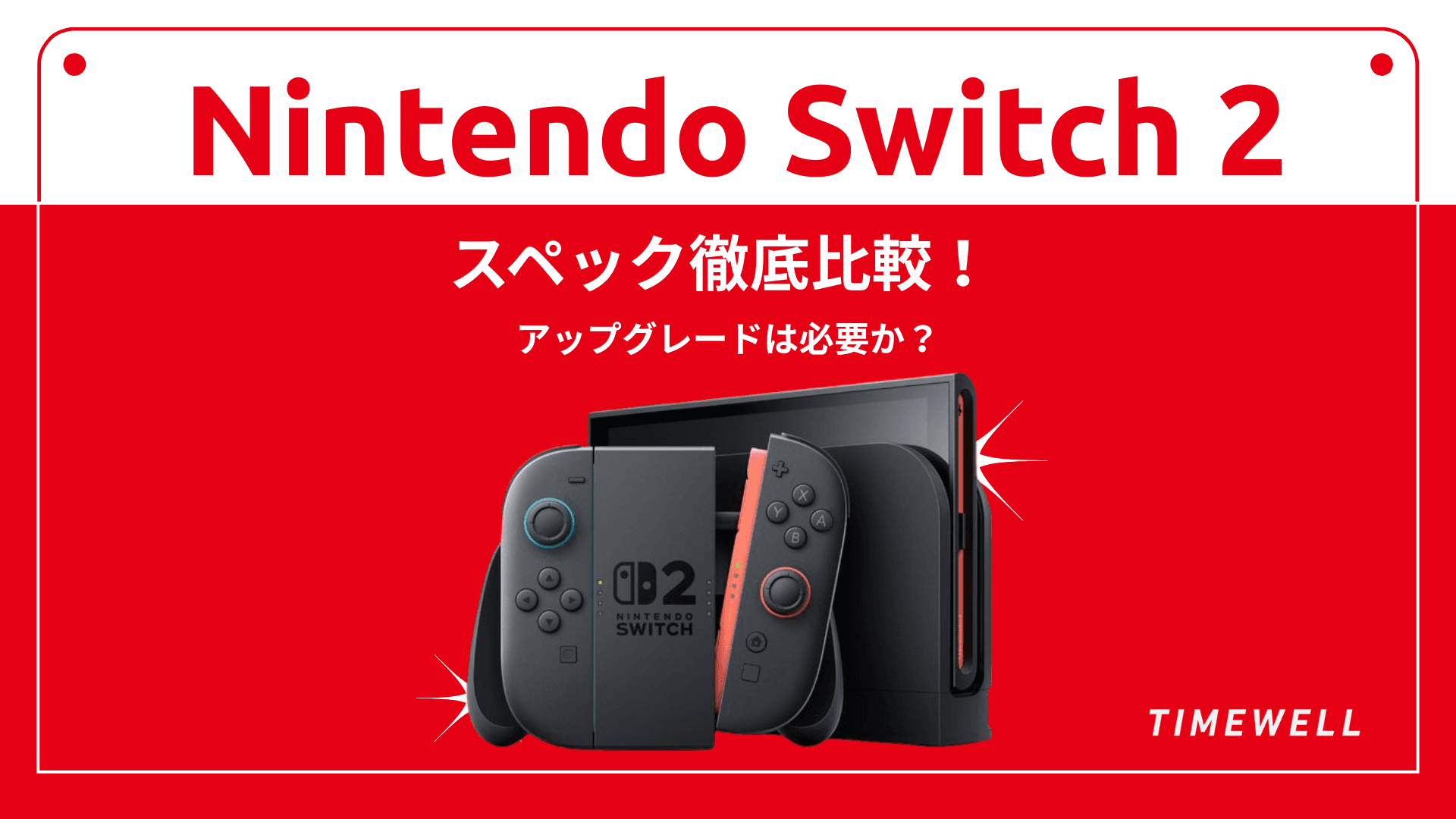
Nintendo has announced Nintendo Switch 2 — the successor to a console that has sold over 140 million units and defined a generation of portable gaming. The question most current Switch owners are asking: is this worth upgrading to?
This article works through the specs head-to-head: price, storage, design, display, battery, dock, and the new features that don't exist on the original system. This is an on-paper comparison based on announced information; real-world performance will add further context once units are in hand.
Looking for AI training and consulting?
Learn about WARP training programs and consulting services in our materials.
Price, Storage, and Design
Price The original Switch launched at $300 (¥32,978 in Japan). Nintendo Switch 2 is priced at approximately $450 (¥49,980, or ¥69,980 for the multilingual version). The ¥17,000 / $150 premium reflects both the hardware improvements and, likely, the features being added — but it's a meaningful jump that factors into any upgrade decision.
Storage This is one of the clearest improvements. The original Switch shipped with 32GB internal storage (the OLED model had 64GB). Switch 2 comes with 256GB — eight times the base model's capacity. Given that modern game files have grown substantially in size, this was one of the most-requested improvements, and Nintendo delivered.
One important caveat: Switch 2 uses microSD Express cards for storage expansion — a faster standard than the microSD cards used in the original Switch. Existing microSD cards are not compatible with Switch 2. Users with large collections stored on microSD will need new cards when transitioning. The 256GB internal storage reduces the urgency, but it's a real consideration for heavy downloaders.
Design Switch 2 is physically larger: approximately 10.4 inches wide and 4.5 inches tall with Joy-Con attached, versus 9.4 by 4 inches for the original. Thickness is maintained at 13.9mm — Nintendo kept the portability profile while expanding the footprint.
Two USB-C ports are available (top and bottom), up from one. The addition of a top port enables charging in tabletop mode without awkward cable routing, and also supports camera accessories.
The kickstand received a substantial redesign. The original Switch kickstand was narrow, limited in angle adjustment, and prone to snapping off at inconvenient moments. Switch 2's kickstand is full-width and free-angle — similar in concept to Microsoft Surface stands — providing genuine stability across a range of positions.
Joy-Con, Display, and Dock
Joy-Con 2 Joy-Con 2 is larger and heavier than the original: approximately 65–68g per unit versus 48–51g. This addresses consistent user feedback that the original Joy-Con felt small, particularly for extended play sessions.
The color scheme shifts from the iconic neon red/blue combination to a darker gray with accent colors. More colorful options will likely follow.
The attachment mechanism changes from a sliding rail system to magnetic docking with a release button on the back. This makes attaching and detaching smoother.
New functional additions: a C-button dedicated to Game Chat (Nintendo's built-in communication system), mouse control mode for compatible games, and larger SL/SR buttons for handheld-sideways and shared-play scenarios.
Display The display moves from 6.2 inches (720p, 60Hz LCD) on the original Switch to 7.9 inches (1080p, 120Hz, HDR10) on Switch 2. Pixel count roughly doubles. The 120Hz refresh rate is a significant improvement for motion-heavy titles.
The one notable absence: the panel is LCD, not OLED. The OLED model of the original Switch set a high bar for portable display quality with superior black levels and contrast. Switch 2's base model steps back to LCD, though the improvements in every other dimension — size, resolution, refresh rate, HDR — still represent a meaningful upgrade over the original LCD-based Switch models.
Dock The Switch 2 dock outputs up to 4K HDR, versus the original dock's 1080p ceiling. For users with 4K televisions, this is a substantial upgrade in TV-mode visual quality.
The dock is somewhat larger than the original (approximately 4.5 × 7.9 inches vs. 4.1 × 6.8 inches). It includes a cooling fan to manage heat during sustained 4K output, and a wired LAN port is built in — the original Switch dock required a separate USB adapter for wired internet, while the OLED model's dock included a LAN port.
Battery Life and New Features
Battery Switch 2 has a larger battery than the original: 5,220mAh versus 4,310mAh. Counterintuitively, the estimated play time is shorter — approximately 2 to 6.5 hours for Switch 2, versus approximately 4.5 to 9 hours for the original Switch.
The reason is straightforward: Switch 2's more powerful processor and larger, higher-resolution, higher-refresh-rate display draw more power than the larger battery can fully offset. For users who prioritize extended play in handheld mode without access to a charger, this is worth factoring in.
Joy-Con battery life is unchanged: approximately 20 hours per charge, with a 3.5-hour recharge time on both models.
Game Share Game Share lets one Switch 2 owner with a compatible game invite up to three other players — including players on original Switch hardware — to join in local multiplayer without those players owning the game. This is a significant feature for group play, reducing the cost of getting everyone into the same game.
Game Chat Switch 2 includes a built-in microphone and a dedicated C-button on Joy-Con 2 to open the Game Chat interface. Voice chat with friends works directly from the console without requiring a smartphone app or external service — a long-requested improvement. Game Chat works across different games, functions as a persistent social layer, and supports video chat via the optional Nintendo Switch 2 Camera. Accessibility features include automatic voice-to-text and text-to-speech.
Is the Upgrade Worth It?
| Feature | Original Switch | Switch 2 |
|---|---|---|
| Price | ~$300 | ~$450 |
| Storage | 32GB (OLED: 64GB) | 256GB |
| microSD | Standard microSD | microSD Express (incompatible with old cards) |
| Display | 6.2" LCD, 720p, 60Hz | 7.9" LCD, 1080p, 120Hz, HDR10 |
| TV output | Up to 1080p | Up to 4K HDR |
| Joy-Con | Rail attachment | Magnetic attachment |
| Battery | 4,310mAh, ~4.5–9hr | 5,220mAh, ~2–6.5hr |
| Built-in mic | No | Yes |
| Game Chat | No | Yes |
| Game Share | No | Yes |
The hardware improvements are substantial: larger and better display, much more storage, improved Joy-Con ergonomics, 4K dock output. The new social features — Game Chat and Game Share — represent genuine capability additions, not just incremental polishing.
The tradeoffs are real: the price increase is meaningful, battery life gets shorter despite a bigger battery, and the microSD incompatibility forces a card upgrade for users with large stored libraries.
For users who play online frequently, want to use Game Share with friends and family, or regularly use the console in handheld mode and want better image quality, Switch 2 offers clear and concrete improvements. For users satisfied with the original Switch who play primarily single-player titles offline, the case is less compelling, at least until more game titles arrive that specifically use Switch 2's new capabilities.
Reference: https://www.youtube.com/watch?v=KBRE7-YuQmE
TIMEWELL AI Consulting
TIMEWELL is a professional team helping businesses transform in the AI agent era.
Services
- AI Agent Implementation: Business automation using GPT-5.2, Claude Opus 4.5, and Gemini 3
- GEO Strategy Consulting: Content marketing strategy for the AI search era
- DX and New Business Development: Business model transformation through AI
In 2026, AI is evolving from a tool you use to a partner you work with. Let's build your AI strategy together.