This is Hamamoto from TIMEWELL.
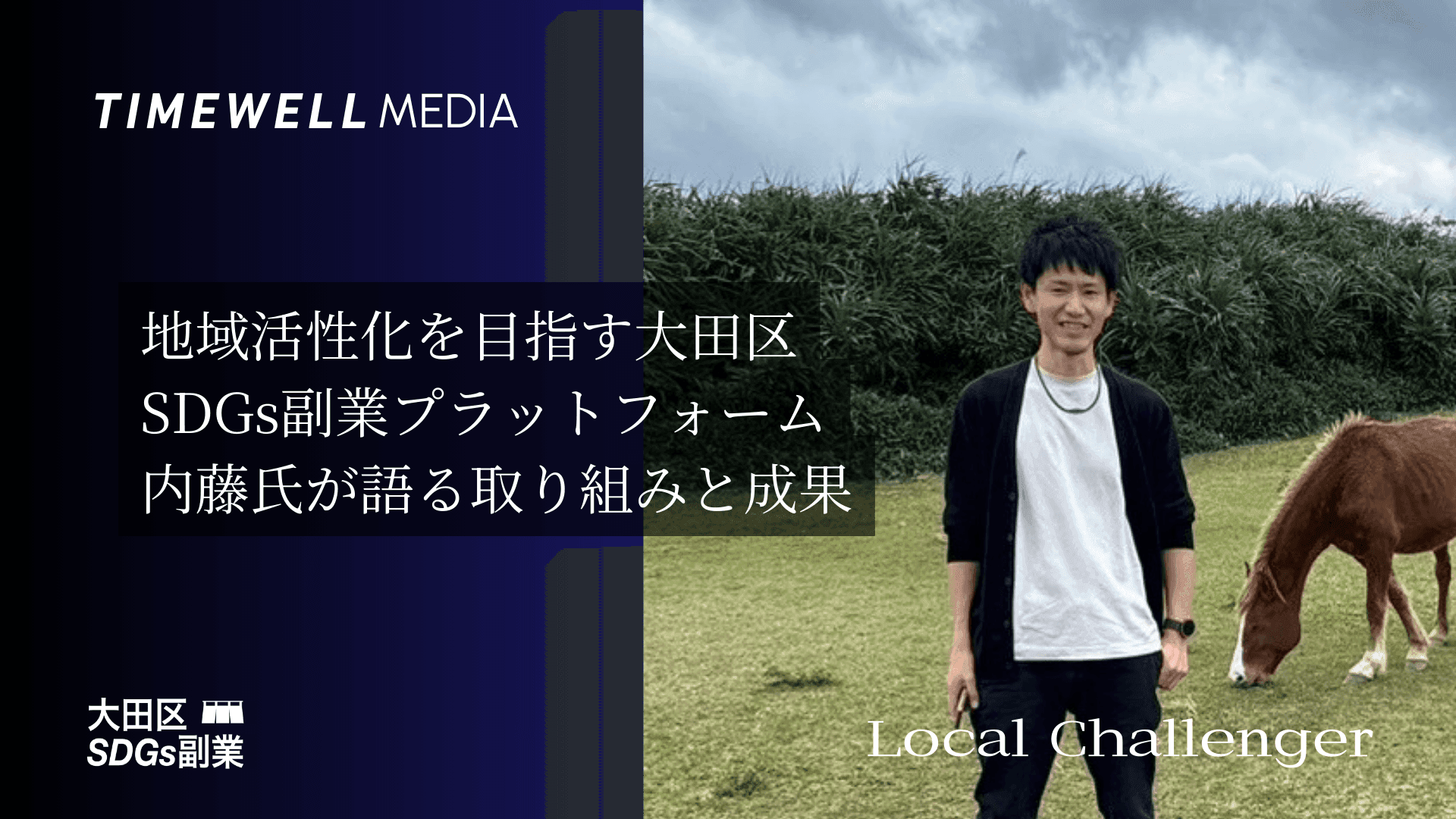
Ota City in Tokyo has established a side-job platform as part of its commitment to achieving the SDGs — a program that pairs specialists from various fields with local shopping districts and small manufacturers, giving them a structured channel to contribute their expertise as paid side work. We sat down with Naito Nobuhito, one of the program's participants, to hear about his experience and what the project has actually achieved.
Finding a Local Stage for Accumulated Experience
What brought you to the Ota City SDGs program?
Naito: My interest in local community support goes back to when I was involved in Tohoku reconstruction work through my main job. That led me to pro bono work in the Tohoku recovery and NGO support in Southeast Asia. Even now, my primary role centers on ICT-based regional revitalization through primary industries. I had been looking for a way to contribute to my own neighborhood when I came across the Ota City SDGs side-job platform, and it resonated with me immediately.
Ota City is home to a large number of shopping districts, and I felt it was a place where the skills I had built through years of community engagement could genuinely be put to use.
Were you nervous about joining?
Naito: Honestly, yes. I wasn't sure what kinds of businesses I'd be supporting, or whether my particular background would be a good fit. But when I attended the first meeting and heard from the Ota City shopping district federation coordinator and the city staff, I realized I just needed to show up with what I already knew. Any gaps in experience would sort themselves out in practice.
Being based some distance from Ota City, I also wondered whether remote communication would work. The pandemic had normalized online interaction to the point where it turned out not to be a problem at all.
Looking for AI training and consulting?
Learn about WARP training programs and consulting services in our materials.
LINE-Based Support: What the Project Actually Involved
Walk us through what you have been working on.
Naito: Within the platform, I joined a project using LINE to support shopping district businesses. A team of four, each assigned to specific stores, accompanied our shops over a four-month engagement. Together with each store owner, we thought through how to use LINE for customer acquisition, building repeat visitors, and improving day-to-day operations. We set goals based on each store's individual situation and advised them on how to get the most from LINE.
What moments stood out to you?
Naito: Every store owner I worked with was juggling their main business while taking on something new with LINE. What struck me was how seriously they engaged. They completed every task I gave them without exception.
Watching a store's LINE infrastructure take shape — seeing the friend count grow, seeing actual visible progress — created a real sense of shared achievement. In one store that ran a referral campaign, progress was slow at first. Even people close to the owner weren't hearing about it. But by sticking with it consistently, referral coupons started being used, and both of us were able to look back and feel the effort had been worth it. That said, there were also cases where we tried multiple approaches and still didn't hit our friend-count targets. Growing a base from scratch is genuinely hard.
What Participation Has Meant Personally
How has the experience affected you?
Naito: Contributing my knowledge in a context completely different from my main job, and seeing it make a concrete difference for merchants — that has built real confidence. Working directly with business owners to design actual store systems has fed back into skills I use at work too. The two roles reinforce each other.
On a more personal level, two years of conversations with the people who run these local stores has reminded me that I genuinely enjoy talking with people in my community. That's a different kind of gain from skill development — a rekindled connection to the place I live.
What would you like to do going forward?
Naito: The two years I've spent on this platform have produced real trust with the merchants and real results through LINE. Looking ahead, I want to build cleaner onboarding materials for stores that are brand new to LINE, so their launch phase is smoother. I also feel strongly that this model isn't unique to Ota City — similar challenges exist in communities all over Japan. My hope is that, working with ONE X, who provides the administrative support infrastructure for the program, we can eventually scale this to other regions.
Related Articles
- The Reality of a Part-Time Employee Who Worked Full-Time, Took Two Maternity Leaves, and Changed Her View of Work | TIMEWELL
- Before Paternity Leave — What You Absolutely Must Do to Take Leave Even During a Busy Period
- Pursuing a Hands-On Architecture Firm: Finding My Own Way as the 5th Generation of a Construction Company | Fujita Construction