This is Hamamoto from TIMEWELL.
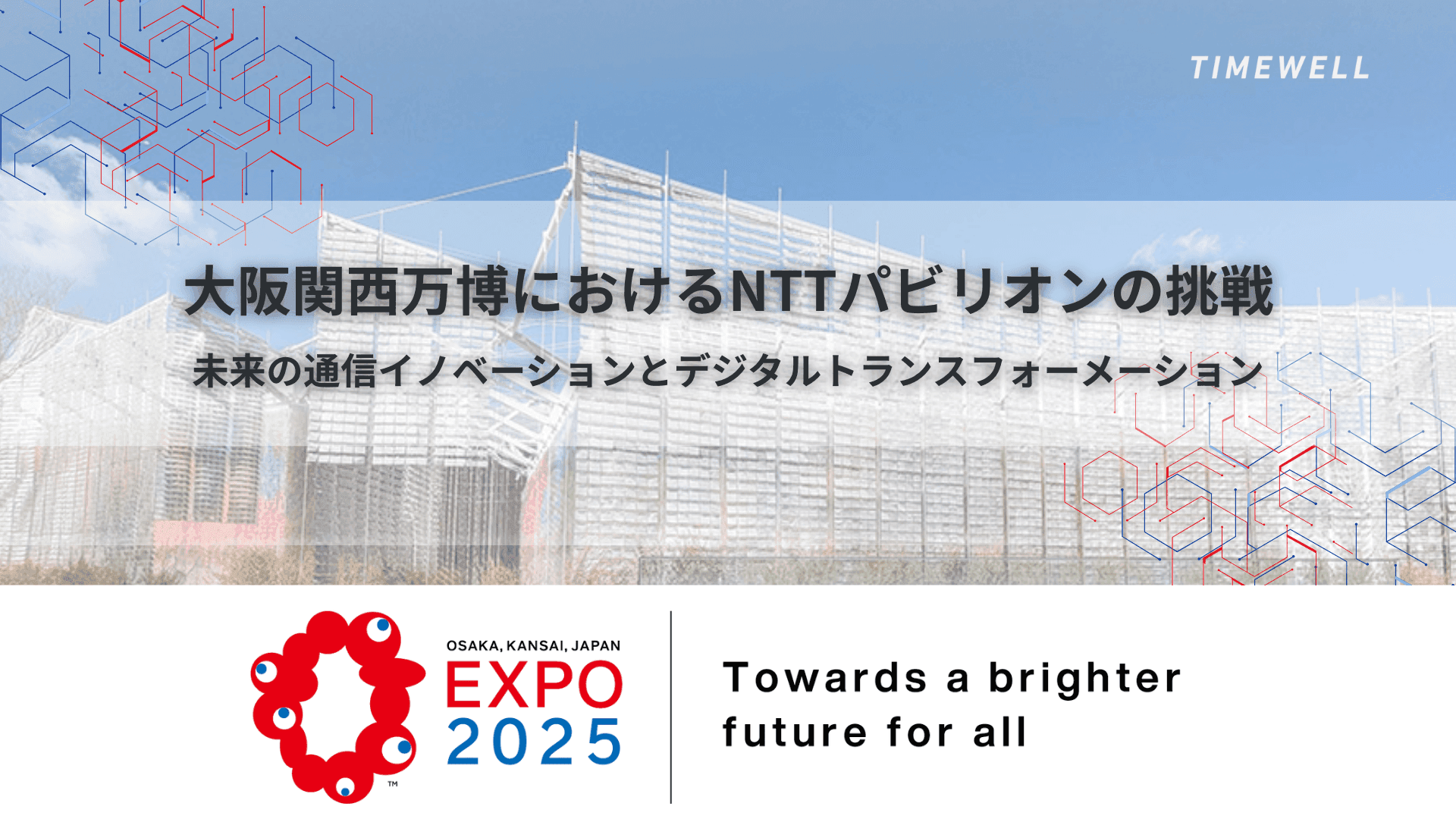
NTT's pavilion at Expo 2025 Osaka is drawing attention not as a conventional exhibition space but as a working laboratory for the future of human communication. Under the theme "PARALLEL TRAVEL," the pavilion showcases the company's vision for what connectivity can become — and grounds that vision in concrete demonstrations rather than concept renders.
NTT's history at World Expos dates to 1970, when the company introduced visitors to wireless telephony and real-time video transmission for the first time. This time, NTT is using the pavilion to demonstrate opto-electric fusion devices and the IOWN concept — technologies aimed at cutting data center power consumption to one-hundredth of current levels while enabling richer, lower-latency communication than any existing infrastructure supports.
Visitors walk through a history of communication — letters, telephone, video call, live streaming — that culminates not in a screen but in an experience. Sound, image, vibration, and ambient environmental information transmitted in real time from another location. The "distance" between places begins to feel like an artifact of old infrastructure rather than an inescapable constraint.
PARALLEL TRAVEL: What the Experience Actually Demonstrates
The pavilion's centerpiece is a suite of demonstrations built around the idea of spatial presence transmission. The most striking involves a live rehearsal feed from Perfume, the electronic pop group, transmitted from a studio in Tokyo to the Osaka venue in real time.
What distinguishes this demonstration from ordinary video streaming is the information it carries beyond the image. Vibrations from footsteps are transmitted. Spatial audio captures the acoustic environment of the studio rather than just the music mix. Lighting shifts are reproduced. Visitors wearing 3D glasses experience a depth and spatial realism that standard 2D transmission cannot approximate. The effect is of being near the performance rather than watching a recording of it.
Other demonstrations let visitors place themselves in the exhibit: take a photo, and it appears on a large display alongside those of other visitors, enabling casual interaction with strangers through a shared visual space. A handheld sensor captures the visitor's own appearance and movement, integrating them in real time into the exhibit environment. These are not passive experiences designed around screens — they are designed to make the visitor feel like a participant in an emerging communication paradigm.
The through-line of the exhibit is that each barrier between people — letter requires waiting; phone loses the face; video call loses the body; virtual meeting loses the room — has been an artifact of the technology available at the time. PARALLEL TRAVEL is NTT's argument that the next generation of infrastructure can dissolve those barriers systematically.
Looking for AI training and consulting?
Learn about WARP training programs and consulting services in our materials.
IOWN and Opto-Electric Fusion: The Technical Foundation
Behind the experiential demonstrations lies a substantial R&D program. NTT's IOWN (Innovative Optical and Wireless Network) concept proposes a fundamental shift in how information is processed and transmitted: replacing electronics-based signal processing with photonics-based processing at every stage of the network.
The energy implications are significant. Current data centers and network infrastructure consume enormous and growing amounts of electricity, driven in part by the conversion losses inherent in moving data between optical fiber (which carries light signals) and electronic processing chips (which require conversion to electrical signals at each node). IOWN eliminates that conversion overhead by keeping data in optical form throughout. NTT's target is to reduce the power consumption of ICT infrastructure to one-hundredth of present levels by the 2030s.
The pavilion's exhibit traces this lineage from the 1970 Expo innovations through to the present. Visitors see side-by-side comparisons of electrical-signal and optical-signal systems, with demonstrations showing how IOWN-based transmission achieves the same or better throughput at dramatically lower power draw. The numbers are presented accessibly rather than technically, with the emphasis on what reduced energy consumption means for the sustainability of AI and data-intensive applications.
Opto-electric fusion devices — chips that integrate optical and electronic functions without the conversion overhead — are the hardware manifestation of this vision. The pavilion shows early examples of these devices in operation, making concrete what has been a largely theoretical infrastructure concept.
NTT's Global Vision: Communication Without Distance
Interviews with pavilion staff, including representative Yoshikawa-san, reveal the organizational ambition behind the technology demonstrations. NTT frames its mission not as a telecommunications company but as a company whose purpose is to eliminate the experience of distance between people.
Yoshikawa-san describes scenarios that go well beyond current video calls: real-time tactile interaction with someone in another city, spatial presence in a meeting room across an ocean, communication with communities on the Moon or Mars as those become inhabited spaces. These are long-range goals, but they are presented as engineering targets rather than science fiction — achievable extensions of the trajectory the IOWN demonstrations represent.
The pavilion also includes a virtual NTT experience called "Another Me Planet," where visitors generate an AI-rendered version of themselves in a future professional role and receive a voice message from that alter ego, synthesized using NTT's own voice synthesis technology. A free-dialogue experience uses NTT's proprietary large language model "tsuzumi" to let visitors interact with AI in natural conversation. These elements are aimed at younger visitors — making the pavilion's themes accessible as aspirational rather than purely technical.
Yoshikawa-san connects the technical agenda explicitly to broader social challenges: the energy demands of AI, the environmental load of global connectivity infrastructure, the growing need for communication tools that reinforce human relationships rather than replacing them. NTT's argument is that these problems can be addressed by the same infrastructure investment that makes richer communication possible — that the path to sustainable ICT is also the path to communication that feels fully human.
Summary
NTT's PARALLEL TRAVEL pavilion at Expo 2025 Osaka is a working demonstration of a communication vision that has been decades in development. The real-time spatial transmission of video, audio, vibration, and environmental information — illustrated through Perfume's live performance data — shows what IOWN-enabled infrastructure can deliver today. The opto-electric fusion devices on display represent the hardware path to power consumption one-hundredth of current levels by the 2030s.
The exhibit bridges technical depth and accessible experience in a way that makes the future feel proximate rather than abstract. For visitors interested in the long-term trajectory of connectivity, AI infrastructure, and human communication, the NTT pavilion is one of Expo 2025 Osaka's most substantive offerings.
Reference: https://www.youtube.com/watch?v=IPYNBWLNFmE
Related Articles
- The Reality of a Part-Time Employee Who Worked Full-Time, Took Two Maternity Leaves, and Changed Her View of Work | TIMEWELL
- Before Paternity Leave — What You Absolutely Must Do to Take Leave Even During a Busy Period
- Pursuing a Hands-On Architecture Firm: Finding My Own Way as the 5th Generation of a Construction Company | Fujita Construction