This is Hamamoto from TIMEWELL.
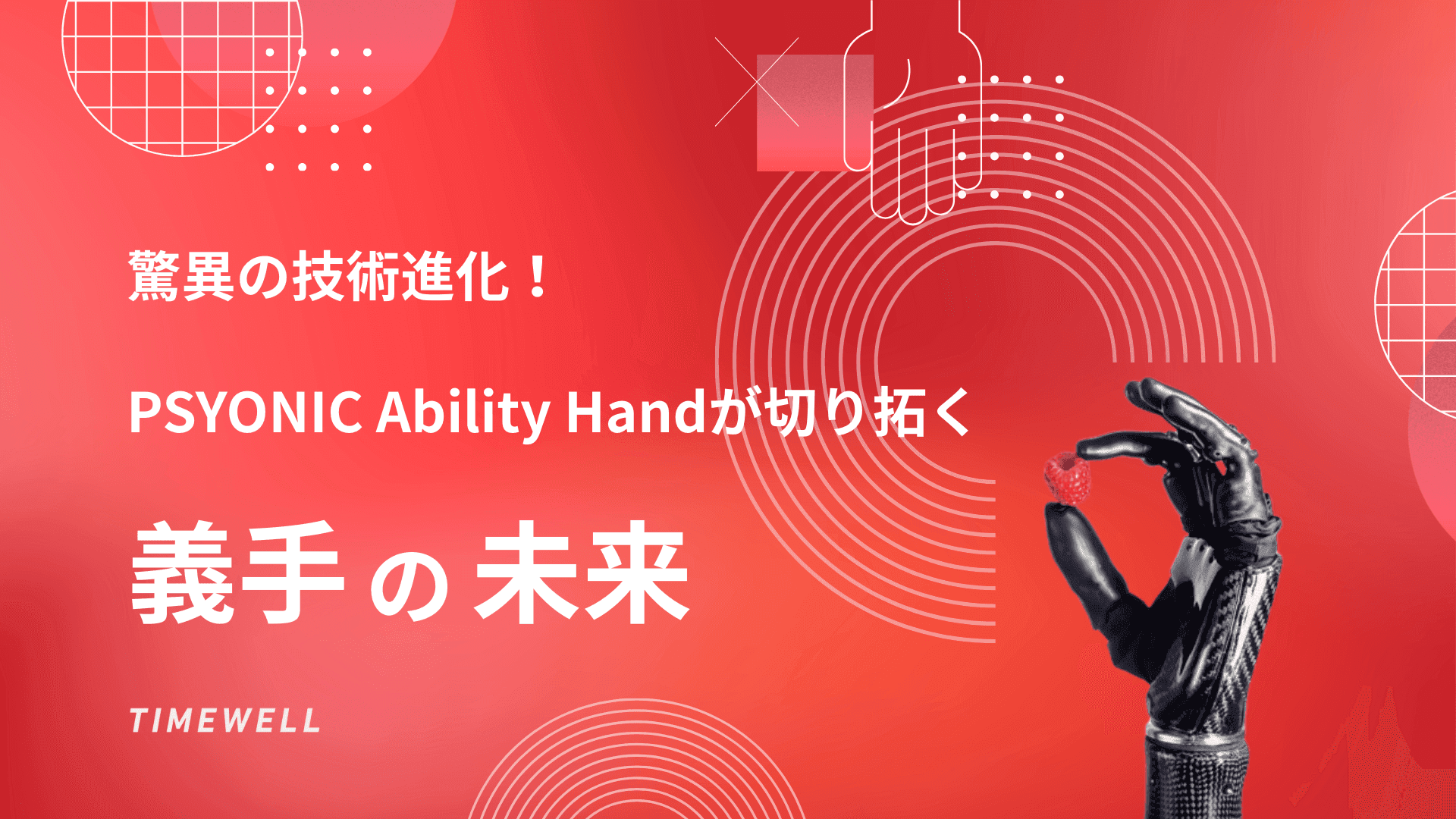
Technology reviews rarely venture into territory that intersects directly with the human body. The PSYONIC Ability Hand occupies exactly that territory — it is not a gadget in the conventional sense, but a powered multi-articulating prosthetic designed to restore hand function for people who have lost a hand or forearm. Built from carbon fiber and metal, paired to a smartphone app via Bluetooth, controlled through electromyography (EMG) signals from the residual limb, and priced to fall within US Medicare coverage — it represents the current high-water mark of commercially available bionic hand technology.
Design and Construction
Materials and Durability
The Ability Hand uses carbon fiber for its primary structure, keeping total weight below the average weight of a human hand while maintaining the rigidity needed for real-world use. Metal components are used at joints and motor housings where durability requirements are highest.
The device is fully waterproof. This is more significant than it sounds — water damage is a common failure mode for powered prosthetics, and the constraint to keep hands away from water creates real limitations in daily life. The Ability Hand removes that constraint entirely.
Bluetooth App and Grip Presets
The device pairs with a dedicated smartphone app, and the pairing process is notably fast — approximately two seconds from power-on to connection. Within the app, users can select from more than ten preset grip configurations:
- Cylinder Grip: for doorknobs, bottles, and cylindrical objects
- Pinch Grip: for pens, small objects, and fine manipulation
- Hand-Shake: for formal greetings
- Sleeve: for threading an arm through clothing
- Pointer Grip: index finger extended, for tapping keyboards
- Hang Loose, Peace, and others including a humor-named option
Grips can be organized into sequences and grouped by activity — daily use, exercise, mealtimes — and cycled through in order using specific muscle activation patterns. The app displays EMG signal levels in real time, which proves useful during the calibration and training process.
Pricing and Medicare Coverage
PSYONIC has designed the Ability Hand to fall within US Medicare reimbursement limits — the public insurance program covering adults 65 and older and people with qualifying disabilities. This is a deliberate design constraint, not a cost-cutting measure. The goal is to make the device accessible to the population that needs it most, rather than positioning it as a premium product available only to those who can self-fund.
Looking for AI training and consulting?
Learn about WARP training programs and consulting services in our materials.
EMG Control: How the Ability Hand Reads Muscle Intent
The Basic Mechanism
Electromyography detects the electrical signals generated when muscles contract. In the context of prosthetic control, EMG sensors are positioned inside the custom-fabricated socket — the interface between the residual limb and the prosthetic — at locations corresponding to two muscle groups: typically a flexor (used for closing) and an extensor (used for opening).
The app displays the differential signal between these two sensors in real time. Contracting the flexor muscle drives the signal positive, closing the grip. Contracting the extensor drives it negative, opening the grip. The rate of grip movement is proportional to signal strength — faster contraction produces faster movement, slower contraction produces slower movement.
What the Control System Actually Feels Like
Initial operation requires trial and error. Finding the right muscle activation — the right level of deliberate contraction in the right muscle group — takes practice. Untrained users can achieve basic open and close movements within minutes; confident fine control develops over sessions.
Grip switching is accomplished through rapid double-activation of the open signal. To cycle through a preset sequence, the user opens quickly twice, then closes to confirm the selected grip. This requires concentration and familiarity but becomes more natural with use.
The haptic feedback system adds a meaningful dimension: vibration motors inside the socket deliver a brief pulse when the fingers make contact with an object and the grip is complete. This provides confirmation that a successful grip has been achieved without requiring the user to look at the hand.
Connection to Broader EMG Applications
EMG sensing is not new — it has been used in clinical diagnostics and rehabilitation for decades. Meta is currently developing EMG-based input interfaces for AR glasses. What PSYONIC has done is build a tightly integrated system where the EMG signal chain, the mechanical hand, and the software control layer are designed together around the specific demands of prosthetic use.
Practical Testing: What the Ability Hand Can Do
Water Bottle
Using Cylinder Grip to pick up a water bottle is straightforward. The grip conforms to the cylindrical shape, the haptic feedback confirms contact, and lifting is stable. Difficulty: low.
Small Berry
Switching to Pinch Grip and attempting to pick up a small berry proves significantly harder. Changing arm angle affects the EMG signal pattern, making precise positioning difficult. Multiple attempts are needed for a consistent result. Difficulty: high.
Banana Peeling
Pinch Grip applied to the banana stem, then pulling downward. Position calibration is the main challenge, but after a few tries the motion goes smoothly. Difficulty: moderate.
Keyboard Typing
With Pointer Grip (index finger extended), one-finger typing works without issue. The fingertip activates capacitive touchscreens — tapping and swiping on a smartphone are both functional. Difficulty: low.
Handwriting
Pinch Grip holds a pen at the appropriate force level. The grip is stable. But generating smooth, controlled strokes on paper is difficult — the nuanced force modulation that produces readable cursive is beyond what an untrained user can achieve in a short session. The result is legible but rough. Difficulty: high.
Key Observations from Testing
The Ability Hand performs well on tasks that require gripping, holding, and positioning. It struggles with tasks that require fine dynamic force control — precisely modulated pressure over a continuous motion.
| Task | Difficulty |
|---|---|
| Water bottle grip | Low |
| Berry pickup | High |
| Banana peeling | Moderate |
| Keyboard typing | Low |
| Handwriting | High |
PSYONIC has also demonstrated the device connected to neural implants in more advanced prototype configurations, suggesting the roadmap extends well beyond current EMG-based control toward more direct brain-to-prosthetic signal pathways.
Summary
The PSYONIC Ability Hand is the clearest demonstration currently available of what prosthetic technology can do. Carbon fiber construction, full waterproofing, Bluetooth app integration, more than ten customizable grip presets, EMG control proportional to muscle activation speed, and haptic confirmation — these capabilities combine into a device that is, for the tasks it handles well, genuinely close to functional hand replacement.
The limits are real: complex dynamic force tasks remain beyond what the current control system can reliably deliver. Tying shoelaces, throwing a frisbee, or other highly coordinated bimanual activities are not yet within reach.
What matters most is the trajectory. An untrained user can achieve meaningful functionality within minutes. A trained user, using a custom-fitted socket, will achieve substantially more. And the device is priced for the population that needs it — not for a premium market that can absorb the cost of experimental technology.
The technology is not yet at the point where a prosthetic hand is indistinguishable from the original. It is well past the point where a prosthetic hand is a meaningful substitute.
Reference: https://www.youtube.com/watch?v=VTs8wnMsh0k
TIMEWELL AI Consulting
TIMEWELL is a professional team supporting business transformation in the AI agent era.
Services
- AI agent implementation: Business automation using GPT-5.2, Claude Opus 4.5, and Gemini 3
- GEO strategy consulting: Content marketing strategy for the AI search era
- DX acceleration and new business development: Business model transformation through AI
In 2026, AI is shifting from "something you use" to "something you work with." Let's think through your organization's AI strategy together.
Related Articles
- The Reality of a Part-Time Employee Who Worked Full-Time, Took Two Maternity Leaves, and Changed Her View of Work | TIMEWELL
- Before Paternity Leave — What You Absolutely Must Do to Take Leave Even During a Busy Period
- Pursuing a Hands-On Architecture Firm: Finding My Own Way as the 5th Generation of a Construction Company | Fujita Construction