Hello, I'm Hamamoto from TIMEWELL.
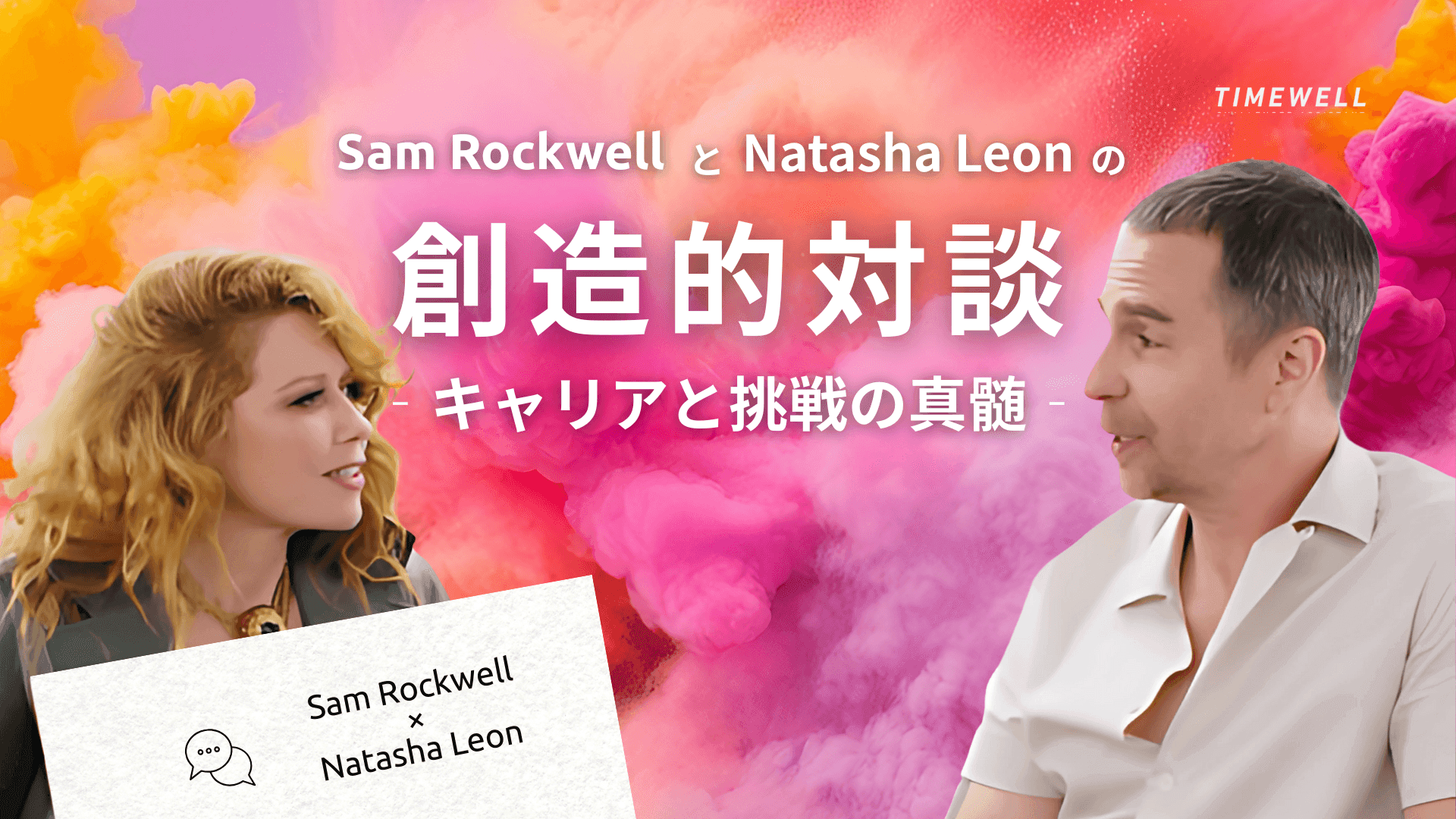
Ahead of The Bad Guys 2 (theatrical release August 1, 2025), Sam Rockwell and Natasha Leon joined WIRED for a conversation that covered far more than the film. They talked about how they found their way into acting, what physical and psychological disciplines sustain a long career, how they think about their public personas, and what it means to work well with other people — on set and off.
The conversation is worth unpacking not just as entertainment industry content, but as a record of how two experienced creative professionals think about craft, identity, and longevity.
How They Got Here: The Career Origin Stories
Natasha Leon's path into acting was shaped early by the tension between family expectations and personal instinct. She traces her sensibility to childhood exposure to classic films — a voice, a cadence, an emotional register that stuck. She credits early work with director Mike Nichols (including Heartburn with Meryl Streep and Jack Nicholson) as formative, and speaks warmly about the significance of the stage work — particularly Pee-wee's Playhouse — that defined a certain era of experimental performance.
Her accent and voice — distinctive, specific, unmistakably New York — come up in the conversation. She describes it as an inheritance: not something constructed for effect, but a genuine artifact of her background and the films she absorbed growing up. "I sound like I'm from a movie because I grew up watching movies." It's an identity rather than a brand.
Sam Rockwell's approach is different in texture but similar in seriousness. He arrives at each role with deep physical preparation — the splits he does as part of his warm-up are a recurring topic, delivered with characteristic self-deprecating humor. He talks about his brief time practicing Eagle Claw Kung Fu and how physical disciplines inform his sense of character. Performance, for Rockwell, is rooted in the body.
He speaks frankly about his inner life as a performer. He calls himself "Existential Sammy" — someone who takes the work seriously but keeps a certain ironic distance from himself, examining his own patterns and value systems and letting that examination feed into how he makes choices. It's a version of self-awareness that's both emotionally honest and functionally useful.
Looking for AI training and consulting?
Learn about WARP training programs and consulting services in our materials.
On Working Together and Team Dynamics
Both actors describe their approach to collaboration in ways that go beyond standard "teamwork is important" language.
Natasha Leon frames acting as fundamentally co-created: "Every moment on stage is shaped by the people around you." She's not describing deference — she's describing a form of genuine attention and responsiveness that makes the work better. Her ability to really listen, to be surprised, to react authentically to what another person is actually doing rather than what you expected them to do — that's the skill she values most.
Rockwell talks about the neighborhoods where he's spent time, the chance encounters, the re-encounters with old colleagues — these become the texture of his creative life. He runs through a few anecdotes about unexpected run-ins on the street in the East Village that led to real creative collaborations. His instinct is to stay porous, to not over-control the inputs to his work.
They discuss the fictional project "Bugsy Seagull Tai Chi" — partly a joke, partly a genuine exploration of what it would mean to fuse physical practice and storytelling. The riff is funny, but it reveals something real about how both of them think: they want their physical disciplines to be legible in the work, not hidden behind a polished surface.
On Long Careers: What Sustains the Work
The most substantive part of the conversation is about staying alive creatively over decades.
Natasha Leon draws on her experience with projects like Russian Doll and Orange Is the New Black — both demanding in different ways — to talk about surviving the grind of production schedules and pressure. Her answer is essentially: you use the difficulty. The stress of a long shoot becomes material. The exhaustion shows up in the performance in ways that would be impossible to manufacture.
Rockwell reflects on White Lotus, Three Billboards Outside Ebbing Missouri, and other projects he's proud of — but his most interesting observation is about the nature of preparation. He doesn't just prepare to play a character; he prepares to be present in the room where the character needs to emerge. The logistics, the warm-ups, the physical practice — all of it is clearing space for something real to happen.
Both share a skepticism about performance that's purely technical. You can learn the techniques, but technique in isolation produces work that feels constructed. What they're both after is work that feels necessary — where the character isn't put on but arrived at.
Self-Branding in the Social Media Era
The conversation takes an interesting turn when it reaches personal branding and social media presence.
Rockwell jokes about "being on Instagram 29 hours a day" — by which he means his persona is continuously visible, continuously updated, impossible to fully control. He's figured out how to work with this rather than resist it. The Sam Rockwell who exists in public consciousness is something he has input on, but it's also something that takes on its own life.
Leon connects her very specific public identity — the accent, the look, the particular kind of characters she plays — to authenticity rather than strategy. She didn't construct those elements; they emerged from who she is. The brands that last, she implies, are the ones that are genuinely an expression of the person rather than a calculated product.
For business professionals thinking about personal brand, the lesson is subtle but clear: distinctiveness comes from specificity, and specificity comes from actually having a perspective, not from manufacturing one.
Takeaways Beyond Entertainment
The conversation between Rockwell and Leon is, on one level, a promotional interview for an animated film. But it's also a sustained discussion of what serious creative work looks like — and what it demands.
The principles they articulate are applicable well beyond acting:
- Physical discipline supports intellectual work. The body isn't separate from how you think.
- Real collaboration requires genuine attention, not just coordination.
- Sustained careers require finding the work generative, not just enduring it.
- Authenticity is harder to fake than it looks, and audiences — like colleagues — can usually tell the difference.
Reference: https://www.youtube.com/watch?v=lCF2292zMOM
Related Articles
- The Reality of a Part-Time Employee Who Took Two Maternity Leaves and How Her View of Work Changed | TIMEWELL
- Before Taking Parental Leave — Three Things You Absolutely Must Do, Even During the Busiest Season
- Committed to Hands-On Work: How a Fifth-Generation Builder Found His Own Path at Fujita Construction