Hello, I'm Hamamoto from TIMEWELL.
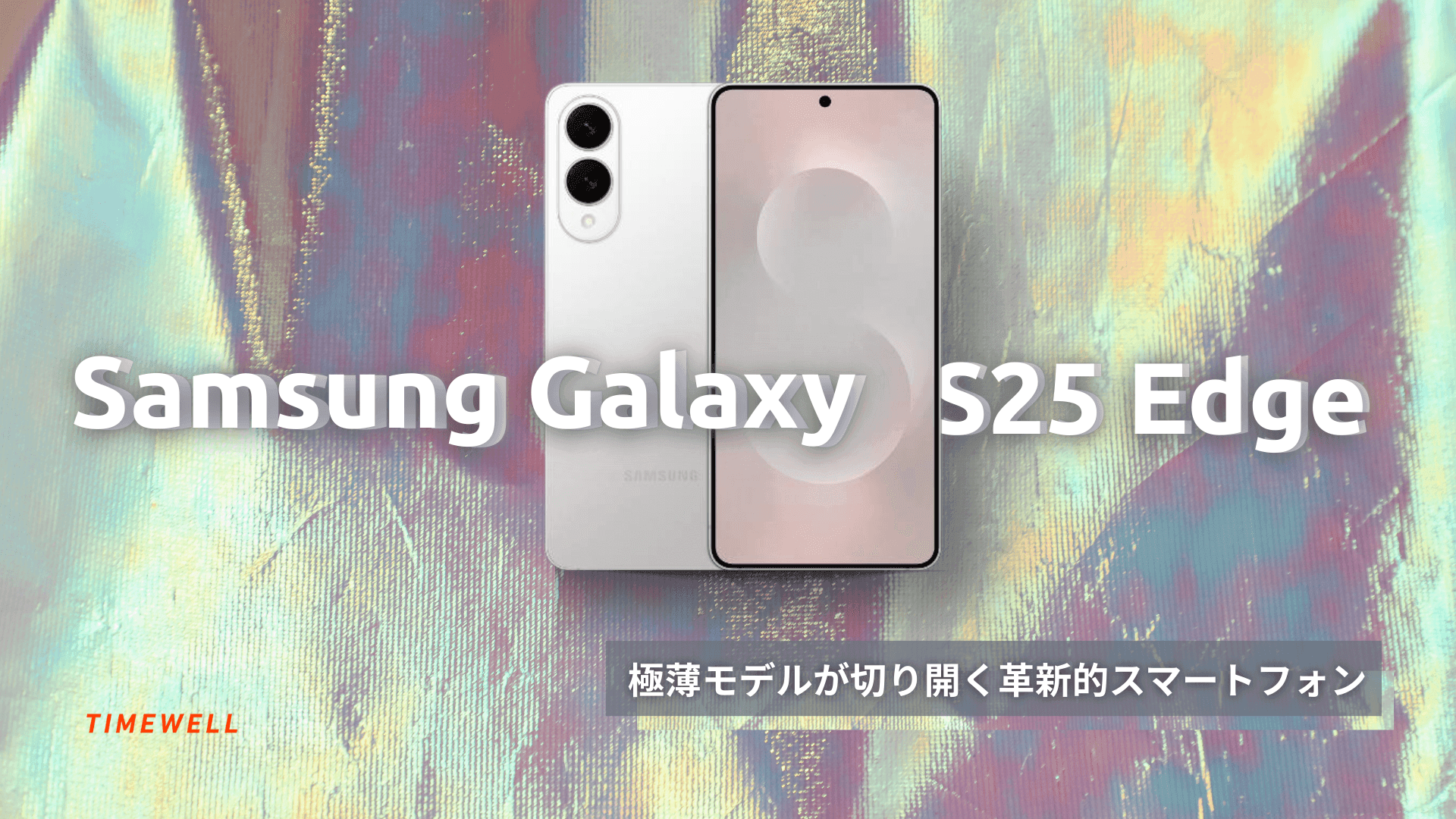
The smartphone market has been pushing in two directions simultaneously: more capability, and less physical bulk. Samsung's Galaxy S25 Edge is a direct response to the second push — an ultra-thin flagship that attempts to bring serious performance into a 5.8mm body.
Design and Physical Form Factor
The S25 Edge's defining feature is its 5.8mm thickness. That's a meaningful departure from the S25 Ultra and requires engineering every internal component around space constraints that didn't exist in previous flagships.
The titanium frame (borrowing from the S25 Ultra's material choice) gives the device durability without adding bulk. Color options are restrained: black, silver, and a subtle blue-tinted silver — none of the louder options Samsung sometimes offers.
The flat side profile is consistent throughout. Physical buttons and the SIM tray are sized to maintain the profile rather than creating protrusions. In hand, the device reads as intentionally minimal — the design is serving the thinness rather than the other way around.
Camera System
The camera configuration is where the slim design requires the most obvious trade-off:
- 200MP main sensor — same resolution as the S25 Ultra
- 12MP ultrawide — standard secondary lens
- No telephoto lens — removed to free internal space
The 200MP sensor is genuinely capable. Low-light performance benefits from the large sensor area, and the image processing pipeline handles most situations well. The absence of a telephoto lens limits zoom range meaningfully — optical zoom beyond the ultrawide range isn't available.
For business users, this translates to: excellent document, environment, and wide-angle shots; limited reach for distant subjects. Most professional use cases are covered; dedicated zoom photography is not.
Display
The 6.7-inch AMOLED panel matches the S25 Plus's display:
- 1440p resolution
- 120Hz refresh rate
- High peak brightness
The visual quality is consistent with what Samsung's premium lineup delivers. The display doesn't reflect the slim profile in any negative way.
Looking for AI training and consulting?
Learn about WARP training programs and consulting services in our materials.
Internal Performance
The Snapdragon 8 Elite processor is the same chip in the S25 Ultra. Processing speed, multitasking capacity, and AI inference performance are equivalent. The NPU handles on-device AI tasks — image processing, voice recognition, predictive actions — at the same level as Samsung's highest-end model.
Storage options are 256GB and 512GB. No expandable storage.
Battery
The 3,900mAh battery is the most discussed specification in the context of the slim design. The S25 Plus carries 4,900mAh — a 1,000mAh difference. The S25 Edge's smaller cell reflects the physical reality of fitting a battery into a 5.8mm chassis.
Charging specifications:
- 25W wired
- 15W wireless
Samsung's software-side power management compensates partially for the capacity gap, but under heavy use the battery life disadvantage is real. For users who regularly exceed ten hours of active screen time, this is a genuine limitation.
Thermal Management
Thin chassis means less room for heat dissipation. Samsung has optimized the internal component layout and material choices to manage this, but the S25 Edge will run warmer under sustained computational loads than the Ultra. For typical business use — email, documents, video calls — this doesn't surface as a problem. For extended video processing or gaming sessions, it will be more apparent.
Market Positioning
The S25 Edge sits between the S25 and S25 Ultra in a specific way: it takes the Ultra's core processing and camera sensor while replacing the Ultra's form factor with a deliberately thin one.
The trade-offs made (no telephoto, smaller battery, reduced thermal headroom) are deliberate design decisions, not engineering failures. They reflect a judgment that a segment of users values thinness and portability above zoom range and maximum battery life.
The competitive context Samsung is navigating includes Apple's anticipated iPhone 17 Air. Samsung is moving first in the ultra-thin flagship category, establishing the design language and specifications before Apple's response is known. Whether that first-mover position translates to sustained preference will depend on how the iPhone 17 Air lands.
Practical Assessment
For business professionals, the S25 Edge offers:
- Flagship-class processing in a phone that doesn't feel heavy after a full day of carrying
- A 200MP camera capable of professional-quality images in most conditions
- A premium build quality that reads well in professional settings
- Battery life that requires monitoring on heavy-use days
What it doesn't offer compared to the Ultra: zoom flexibility, maximum battery endurance, or the full four-camera system.
The device is a clear choice for users who have found flagship phones increasingly bulky and want capability without mass. It's not the right choice for users who rely on telephoto for their work.
Reference: https://www.youtube.com/watch?v=yWBz2qZJ8zY
Related Articles
- The Reality of a Part-Time Employee Who Took Two Maternity Leaves and How Her View of Work Changed | TIMEWELL
- Before Taking Parental Leave — Three Things You Absolutely Must Do, Even During the Busiest Season
- Committed to Hands-On Work: How a Fifth-Generation Builder Found His Own Path at Fujita Construction