Hello, I'm Hamamoto from TIMEWELL.
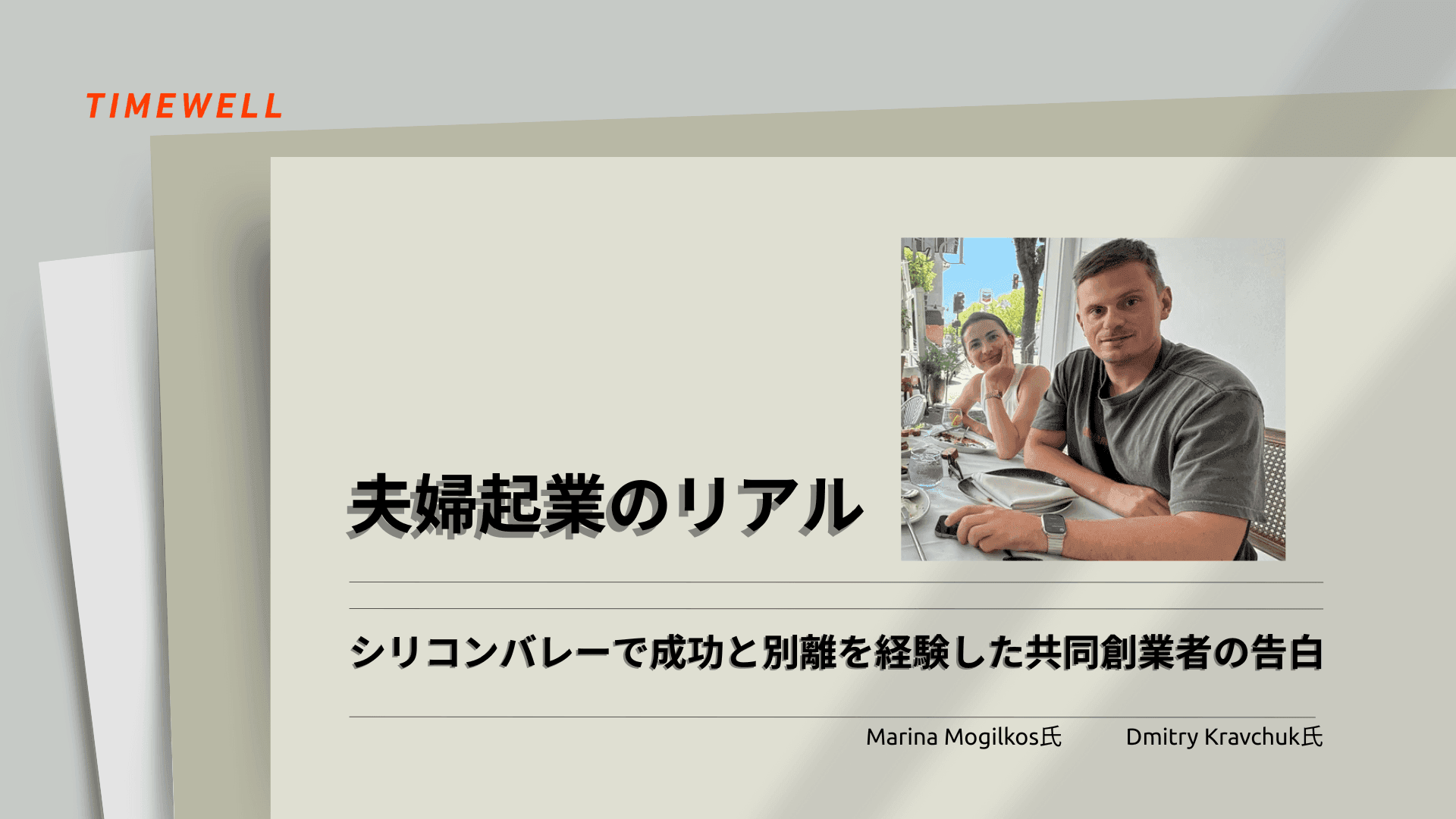
Marina and Dmitri arrived in Silicon Valley in 2015 with no local network, limited English (particularly on Dmitri's side), and a language travel startup called LinguaTrip. By 2017-2018, revenue was growing at 3x year-over-year and staff had expanded from 5-6 people to 60 in under six months. Then they decided to dissolve their business partnership — not because the company was failing, but because each of them had grown in different directions.
The Starting Point: Complementary Founders
Marina describes the founding dynamic directly: Dmitri was the visionary who proposed targets that seemed unreasonable — fundraising in Silicon Valley, building a product that changes the market — while she translated those visions into operational execution and product expertise.
"If it weren't the two of us, this company wouldn't exist," she says.
Dmitri's boldness produced moments that Marina frames as productive naivety. From a small apartment in St. Petersburg, he cold-messaged Mark Zuckerberg on LinkedIn. He got a response from Alfred Lin at Sequoia Capital — "That's great, keep us posted" — and interpreted this as near-confirmation of interest. He now understands it was a polite non-answer. At the time, the misunderstanding gave them confidence to push through the next six months.
Similar cultural mistranslations happened repeatedly: enthusiastic language from investors ("This is amazing!") read as genuine interest when it was often social courtesy. Post-meeting silence wasn't rejection — it was an "open door" approach that avoids a hard no while leaving the possibility open if the startup becomes notable later.
Whether this cultural gap helped or hurt is complicated. The confidence built on misread signals may have been necessary to keep going in a market with many invisible rejection mechanisms.
Looking for AI training and consulting?
Learn about WARP training programs and consulting services in our materials.
The 51/49 Rule
One structure they established early proved consistently valuable: Dmitri held 51% equity to Marina's 49%, giving him formal final decision-making authority.
"I had never heard anyone propose 51/49 instead of 50/50," Marina says. "But it's genius. From day one, everyone knows who the key decision-maker is."
For Marina personally, having a designated final decision-maker was also a personality fit — she describes herself as someone who plans contingencies (Plan B, Plan C) and prefers not carrying sole responsibility for the company's highest-stakes calls.
The practical result: they disagreed regularly, but disagreements didn't become deadlocks. They report never having a serious argument. Some investors flagged the married co-founder structure as a red flag ("What if you have a fight?"). They ignored it.
The Growth Phase and Its Mistakes
LinguaTrip's rapid expansion created specific problems Dmitri identifies clearly in retrospect:
Hiring mistake: During the 3x growth period, they promoted existing team members into management roles — a social media manager became an operations director — prioritizing loyalty over demonstrated capability. "They had been here for 2-3 years and enjoyed the company. I wanted to reward that." The correct approach at that stage, he now believes, was to hire people who had already managed organizations at that scale — external hires who had lived through a similar growth phase before.
Fundraising strategy: They minimized dilution by raising only what they could clearly plan to spend. This preserved their ownership percentage but meant they didn't bring in experienced investors who could have provided guidance on exactly the decisions where they made mistakes — hiring at scale, responding to acquisition approaches.
The acquisition they didn't consider: An acquirer expressed interest when LinguaTrip was in early growth. Dmitri declined without hearing the terms. "Whatever the offer is, the rule should be: hear it first, then decide. That's the first rule." Beyond the financial return, a successful early exit creates a founder track record that makes subsequent ventures significantly easier to fund.
Why the Partnership Ended
By 2019, Marina and Dmitri restructured their arrangement so they were no longer business partners in the same role. Both were still involved in LinguaTrip, but separately.
Marina's reason: Financial concentration risk. Having a single household income source — one company, shared between two people — created anxiety that increased over time. The pandemic made this concrete: LinguaTrip's travel business collapsed, and they had to pivot to online English education. The YouTube channel she had been building separately kept the family afloat during that period. The experience led her toward her current model of 19 different income streams.
Dmitri's reason: The dynamic of building the same thing together removed the ability to independently impress or surprise each other. "As a man, I want to be able to surprise her, to achieve something she didn't expect from me. But when we're co-equal partners building the same thing, everything is 'ours' — how do you create that?" He describes preferring a structure where each partner has their own domain, brings different things home, and can genuinely surprise the other.
Network effect: When they always attended the same events together, their networks were largely overlapping. After separating their professional activities — Marina into media, Dmitri into his own ventures — their combined network expanded significantly. "Now our networks are completely different. We can introduce each other to people the other would never have met."
What Marina Misses
Now running her media company as CEO (with a COO but no peer-level business partner), Marina is candid about what the partnership provided:
"Investors are great, but you can't call them every day. I miss having someone who was always available to think through problems with me." Specifically, she misses Dmitri's particular quality of thinking in very large terms — "Let's build a billion-dollar company!" — as a counterweight to her more cautious, contingency-focused instincts.
"Sometimes I think: how cool would it be if he worked at my company. But I understand his goals and ambitions — it wouldn't make sense."
Advice for Couples Considering Co-Founding
Both agreed on these principles:
Decide who has final authority before you start. "Be clear about who makes the final call."
Align on what you're trying to achieve and how. Not just the goal, but the path — how much to raise, how to handle acquisition interest, what your hiring philosophy is.
Enjoy the process. Challenges are inevitable; experiencing them together is itself valuable, regardless of outcome.
"That was an amazing journey," Marina says. "We overcame a lot together and grew. I don't regret any of it."
Reference: https://www.youtube.com/watch?v=KnWKFp472GI
Related Articles
- The Reality of a Part-Time Employee Who Took Two Maternity Leaves and How Her View of Work Changed | TIMEWELL
- Before Taking Parental Leave — Three Things You Absolutely Must Do, Even During the Busiest Season
- Committed to Hands-On Work: How a Fifth-Generation Builder Found His Own Path at Fujita Construction