I'm Ryuta Hamamoto from TIMEWELL.
“I asked Claude Code for a React state management library. It suggested react-pretty-state. npm install worked fine. Behavior was clean. Done.” Five minutes later, the developer's local environment was already streaming production database credentials to an attacker's server.
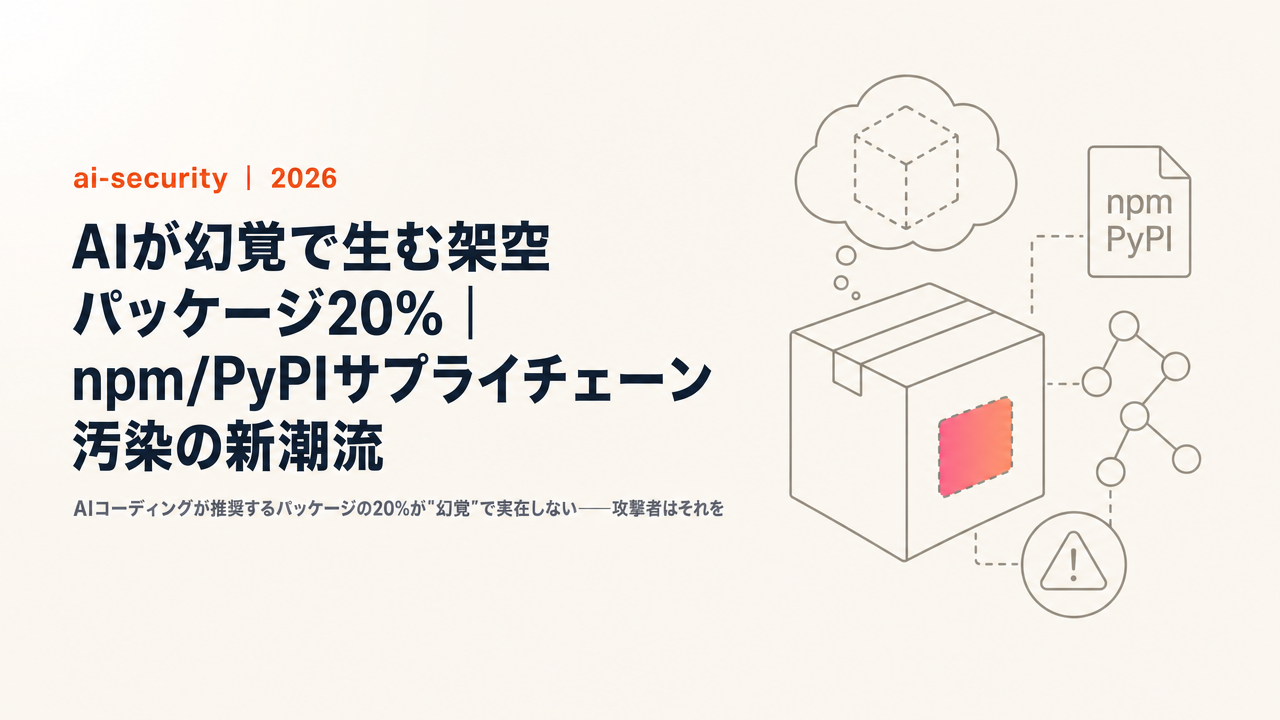
This is not a hypothetical scenario. It is a real instance of Slopsquatting—a new flavor of supply chain attack in which attackers pre-register the “plausible-sounding-but-non-existent” package names that AI hallucinates. The moment a developer trusts the AI and runs npm install, they are pwned.
Trend Micro's 2025 research reports a startling figure: 20% of packages recommended by AI are non-existent. This article covers the mechanics of Slopsquatting, the real-world Cursor / Claude Code / MCP incidents around it, and four defenses development teams can put in place today.
TL;DR
- Slopsquatting = a supply chain attack where attackers pre-register the hallucinated package names AI assistants produce
- The statistic: 20% of AI-recommended packages don't exist—a perfect ambush opportunity
- Cursor (MCPoison / CurXecute), Claude Code (TrustFall), and the broader MCP ecosystem (7,000+ public servers, 150M+ downloads) all have live incident cases
- Defense is a four-layer stack: signature verification, lockfile discipline, strict Workspace Trust, AIBOM
What is Slopsquatting—in 60 seconds
It is a cousin of Typosquatting.
- Typosquatting: register
reqeststo catch developers who mistyperequests—targets human typos - Slopsquatting: register
react-pretty-statebecause AI keeps hallucinating it—targets AI hallucinations
“Slop” is slang for AI-generated garbage content. Slopsquatting research took off in late 2024; Trend Micro, Lasso Security, and Socket have all published detection cases.
The weight of 20%
A 2025 study evaluated 756,000 package-name samples from multiple LLMs. Roughly 20% were non-existent (no hits on PyPI / npm / RubyGems / Maven).
| LLM | Hallucination rate |
|---|---|
| General GPT-class models | ~20% |
| Open-source models (CodeLlama, Mistral, etc.) | 30-40% |
| Top-tier commercial models (GPT-4, Claude) | ~5-15% |
Structurally, “trust the AI and npm install” has a known probability of stepping on a landmine.
AI Security training, taken seriously
A 2-day intensive course fully aligned with OWASP, NIST, ISO/IEC 42001, and METI. Take it as executives, practitioners, or both.
How the attack flows
Step 1: Attacker watches for opportunities
Ask multiple AIs the same question many times. Collect the hallucinated package names.
“Recommend five React state management libraries.”
→ AI mentions `react-pretty-state`, `easy-react-store`—non-existent.
Step 2: Pre-register on npm / PyPI / etc.
Prioritize names that AIs repeatedly recommend. Publish a legitimate-looking package plus a backdoor.
Step 3: Developers npm install on AI advice
- Cursor / Claude Code / Copilot suggests it
- Developer trusts the recommendation
npm install react-pretty-state
Step 4: Compromise
postinstallscript reads local.env- AWS / GCP credentials, API keys, network recon data go to a C2 server
- Self-update routine evades detection
Real-world incidents around Cursor / Claude Code / MCP
Around AI coding, real-world incidents have piled up:
Cursor MCPoison (CVE-2025-54136, July 2025)
A validation gap in Cursor IDE's MCP server configuration allowed RCE on the developer's machine via a malicious MCP server. CVSS 9.6.
Cursor CurXecute (CVE-2025-54135, August 2025)
Opening a specially crafted repository triggered arbitrary code execution via the .cursor configuration file. Cursor patched quickly.
Claude Code TrustFall (CVE-2025-59536, February 2026)
Opening a malicious repository caused RCE via project configuration, leaking API tokens. Anthropic emphasized strict Workspace Trust.
MCP ecosystem structural risk
As of May 2026, 7,000+ public MCP servers, 150M+ cumulative downloads. STDIO design issues, mcp-remote (CVE-2025-6514), and other problems have led researchers to label MCP “the most likely contemporary supply-chain entry vector.”
Four defenses development teams can deploy today
Defense 1: Mandate package signature verification
# npm
npm install --signature
npm audit signatures

# PyPI (PEP 458/480)
pip install --require-hashes -r requirements.txt
- Auto-reject unsigned packages in CI/CD
- Evaluate Sigstore / cosign
- Allow only internal registries (Verdaccio, Artifactory)
Defense 2: Strict lockfile discipline
- Always commit
package-lock.json/pnpm-lock.yaml/poetry.lock - Mandate human review immediately after AI proposes a new package and you run
npm install - Auto-escalate PRs with large lockfile diffs to security review
Defense 3: Strict Workspace Trust
For Cursor / Claude Code / VSCode-family editors, configure Workspace Trust to distrust by default:
// VSCode settings.json
{
  "security.workspace.trust.enabled": true,
  "security.workspace.trust.startupPrompt": "always",
  "security.workspace.trust.untrustedFiles": "open"
}
- External repositories always start untrusted
- Promotion to trusted requires explicit approval
- Force Workspace Trust on in CI environments
Defense 4: AIBOM (AI Bill of Materials)
Beyond software SBOM, add visibility into AI-specific dependencies:
- Which LLMs are in use (GPT-4, Claude, Llama, etc.)
- MCP server list and signatures
- AI agent / tool permission scope
- Training data provenance
OWASP Top 10 for LLM 2025 supply chain item lists AIBOM as a recommended control.
A counter-intuitive truth about review costs
The more AI coding spreads, the higher the human review cost should be, not lower.
- Old workflow: developer googles, evaluates trust, adopts directly
- AI workflow: AI proposes → developer verifies what the AI proposed → adopts
Teams expecting “3x productivity from AI” must plan to review 3x as many proposals. If you don't bake that into your design, the productivity gains get eaten by incident response costs.
One question for executives
“Are our teams using AI coding? Then who verifies the AI-suggested packages, and how?”
If your organization cannot answer that, you are queued up for the Slopsquatting ambush.
How WARP SECURITY treats this
TIMEWELL's WARP SECURITY treats Slopsquatting-style supply chain attacks as Scenario 05.
In the Executives course, leaders work through the AI productivity vs. security review cost trade-off in an investment decision workshop.
In the Practitioners course, hands-on:
- Observe AI hallucinating non-existent packages live
- Implement signature verification and Workspace Trust
- Draft an AIBOM template
- Establish MCP server provenance verification
Where the EU AI Act fits — what starts on 2 August 2026, and what does not
Slopsquatting defense is no longer a purely technical topic; it now connects to the AI governance rulebook. The date to know is 2 August 2026, the general date of application of the EU AI Act (Regulation (EU) 2024/1689) regulatory framework (European Commission). It is not, however, the date the Act applies "in full." The Act phases in, and what starts on 2 August 2026 is principally:
- the transparency obligations of Chapter IV (Art. 50)
- Chapter III Section 5 (Art. 40-49: harmonised standards, conformity assessment, CE marking, registration)
- the European Commission's power to impose fines on providers of general-purpose AI (GPAI) models (Art. 101)
The substantive obligations for high-risk AI start later. Under the Digital Omnibus amending act, Regulation (EU) 2026/1744 (adopted 8 July 2026, published in OJ L 2026/1744 on 24 July 2026, in force from 27 July 2026), Chapter III Sections 1-3 apply to Annex III high-risk systems (Art. 6(2)) from 2 December 2027, and to Annex I high-risk systems (Art. 6(1), i.e. AI embedded in regulated products) from 2 August 2028. The authorised representative duty (Art. 22), value-chain obligations (Art. 25), deployer obligations (Art. 26) and the fundamental rights impact assessment (Art. 27) take effect on those same dates.
On penalties (Art. 99): breaches of the Art. 5 prohibitions carry up to EUR 35 million or 7% of worldwide annual turnover, whichever is higher, and GPAI-related and other breaches up to EUR 15 million or 3%, whichever is higher. Chapter XII itself (Art. 99 and 100) has applied since 2 August 2025; what is added on 2 August 2026 is the Art. 101 Commission fining power described above.
One transitional point: providers of AI systems generating synthetic content that were placed on the market before 2 August 2026 must comply with Art. 50(2) by 2 December 2026, under the newly inserted Art. 111(4).
What all of this governs is transparency on the model provider side. It is no substitute for dependency verification on the user side. The operational question—who checks the provenance of the packages an AI suggests, and how—stays with the development organization. The more the rulebook matures, the stronger the case for controlling the permissions and provenance of AI agents (see also Governed Enterprise AI Agents).
Summary
- Slopsquatting targets AI-hallucinated packages as a new supply chain attack
- 20% of AI-recommended packages are non-existent—the attack greenhouse
- Cursor / Claude Code / MCP ecosystem has live incident cases (2025-2026)
- Defense: signature verification, lockfile discipline, Workspace Trust, AIBOM—four layers
- Teams expecting 3x productivity must also process 3x the security verification
AI coding is unquestionably powerful. With power comes responsibility. Slopsquatting picks off teams that abandoned that responsibility, in order.
![Why Does Personal Data Leak from GitHub? Development Security Lessons for the AI Era from Money Forward's Disclosed Incident [2026 Checklist]](/images/columns/github-incident-lessons-ai-era-development-security/cover.en.png)