The Speech That Speaks to Every Professional
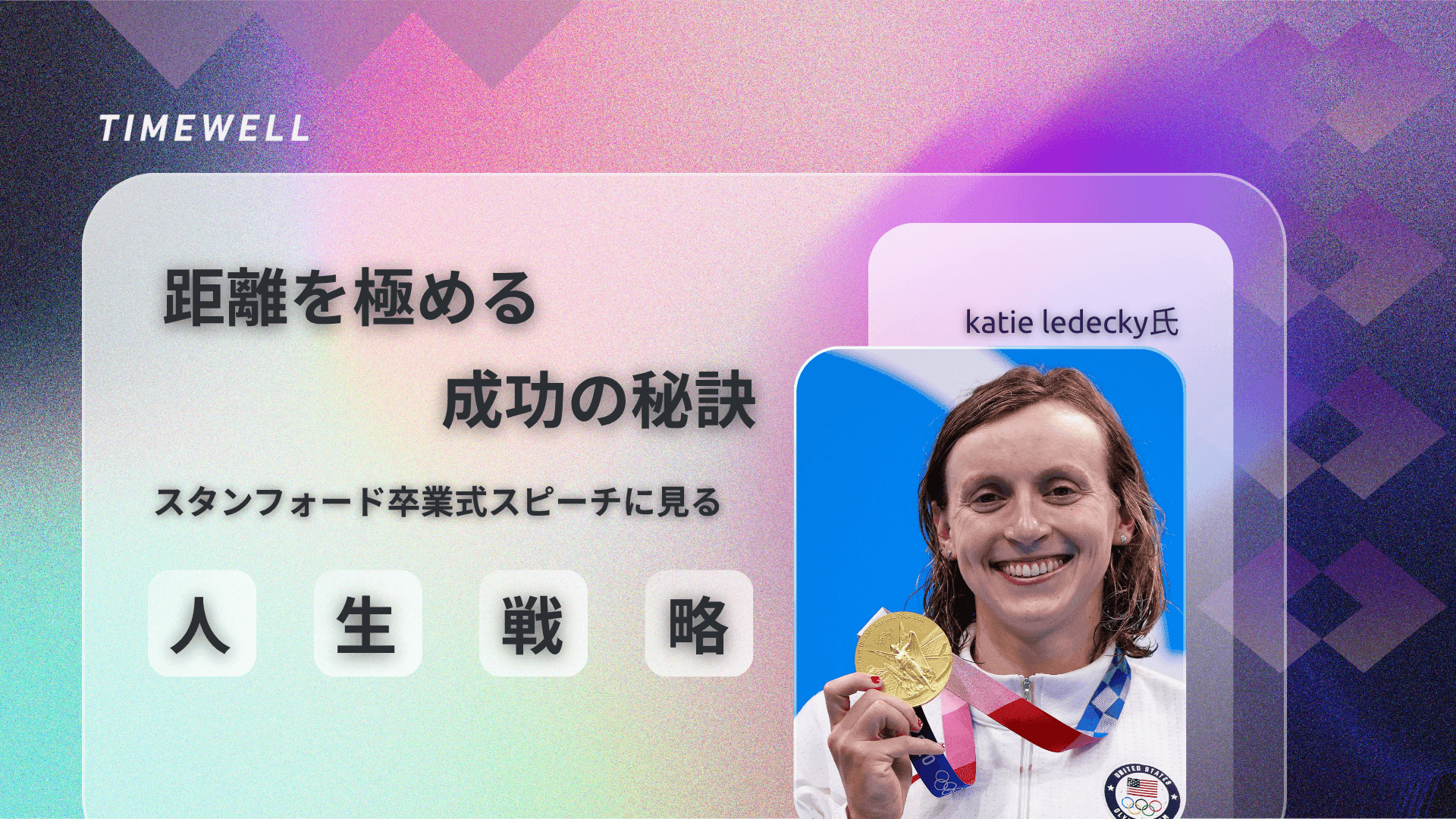
The article introduced here is based on the moving commencement speech delivered at Stanford University's 134th graduation ceremony on June 15, 2025, by Katie Ledecky — a student-athlete and the most decorated female Olympian in US history with 14 medals — offering practical advice for anyone building a career or life strategy as a business professional.
This speech is not merely a recitation of personal accomplishments. It digs deeply into strategic time management, goal setting, and the passion for daily process that underlies success in work and life. The audience — graduating on Father's Day surrounded by the warmth of family and friends — found in it an invitation to reflect on their own paths forward.
Woven throughout the speech are memories from Ledecky's younger years, the trials of competitive swimming, and the life lessons she drew from them: the weight of a single second, the discipline of competing against your past self, and how to perform at your best in an ongoing battle with yourself. These insights are rich with meaning for executives, employees, and entrepreneurs at every level.
This article focuses on three core themes from the speech — pacing, process, and time — and explains both what each means concretely and how each can be applied in business.
Looking for AI training and consulting?
Learn about WARP training programs and consulting services in our materials.
Strategic Pacing: Each Moment Creates the Future
In the opening of her speech to Stanford graduates, Katie Ledecky spoke about the importance of "pacing" through her own experience. She began with gratitude to her family, friends, and former swim coaches, reflecting on the warmth of campus life — and then shared a formative episode from her father about "the weight of a moment."
Her father showed young Katie a stopwatch, having her race to start and stop it, making her feel just how small a fraction of a second 1/100 second really is — and how that fraction can determine the outcome of a race. This memory connects directly to the themes of endless practice on the Olympic stage and the question of how to get maximum value from limited time.
She also presented a striking number: during her four years at Stanford she experienced approximately 104,000,000 seconds. The point was not statistical — it was to make the audience feel how the accumulation of individual moments becomes the foundation of a future life. Each of those numbers represents a choice, and the choices pile up into a life.
These episodes illustrate why acting decisively in the right moment sometimes leads to great success — and why careful balance and recovery must follow. Her Olympic debut offers a vivid demonstration: at 15 years old, representing the US internationally for the first time, she took the lead immediately and maintained her own pace. Mid-race she felt the loneliness and anxiety of swimming alone at the front, and voice after voice — coaches, commentators — called to her from poolside. "Ease up." "Adjust your pace." These warnings, meant to reassure the crowd, felt like pressure to the swimmer herself. But in the end, she trusted her instincts, stayed at the front, and won by a large margin.
The deeper point is that excellent strategic pacing is not merely a technical skill — it rests on a commitment to honoring each moment in every part of daily life. Whether in business or on the Olympic stage, this strategy is the foundation on which future success is built.
Key takeaways on pacing:
- Trust your own pace; sometimes prioritize instinct over outside opinion
- Continuous effort and daily training translate directly into performance in the moment
- Learn from experience and failure; update your strategy flexibly
Learning From Passion and Consistency: A Track Record of Process-Driven Growth
Throughout her speech, Ledecky argued that the process of achieving goals — not the victories themselves — is where the real value lies. For any business professional, the story of a champion grinding through the work behind a single gold medal is deeply motivating.
She spoke of waking at 4am as a child, supported by her family, to attend morning swim practice. Her father's lesson — that tiny differences in time determine outcomes, that the discipline of accumulation matters in every domain beyond sports — took on new meaning at the Olympic stage. Even 1/100 second, compounded over years of consistent effort, produces an enormous difference.
She also recalled what she called the "ice cream episode" — her mother, unable to find low-fat chocolate yogurt, substituted chocolate ice cream as breakfast. What sounds like a small story carries a larger message: even without the perfect environment, daily effort and creative problem-solving, and the joy of celebrating small wins, are what drive long-term growth. The perfect conditions rarely arrive. You work with what you have.
Ledecky set her goals against her past self rather than her competitors. She aimed to beat yesterday's version of herself, accumulating small time improvements day by day. When she broke her own personal record for the first time in nine years, the feeling was not simply the joy of winning — it was the experience of genuine self-renewal.
She described this process as also improving self-awareness: the daily accumulation generates a feedback loop — reassessing your own capabilities, setting the next goal, updating your approach — that creates a cyclical growth model. Pursuing outcomes alone is not enough. It is the small daily efforts — detailed planning and repeated feedback — that make large success possible. The gold medal is a byproduct of the process; the process itself is where the real value lives.
Key process insights:
- Set goals against yourself, not others
- Small daily wins are indispensable to long-term growth and self-renewal
- Enjoy the challenge itself; use failure as fuel for the next step
Time Management and Relationships: The Support That Enables Future Breakthroughs
In the final section of her speech, Ledecky spoke about the importance of time and human connection.
She shared that during races, lap by lap, she pictured the faces of her grandparents, family, and close friends — holding on to their support to push through difficult moments. This episode points to the universal truth that human connection gives us hope and strength for the future. She also spoke of racing while not at her best on the international stage — feeling anxious and overwhelmed — yet the presence of her teammates and family steadied her, and their warmth turned the loneliness of competition into inner calm that lifted her performance.
Ledecky says it is the combination of time management and relationships that allows a person to run the long marathon of life. No matter how talented you are, there is a limit to how far you can go alone. In limited time, the people who walk alongside you and support you are the most important key to success. In business, too, the smooth progress of a project depends on a trustworthy network of colleagues, subordinates, and partner companies. Undervaluing those connections is a path toward organizational performance decline.
She also made time itself tangible — converting the total seconds of her Stanford years into a concrete number, impressing on the audience the weight of every accumulated moment. This is not abstraction; it is calculation-backed reality. The approach maps directly to time management in the business world.
And she spoke about the power of the support structures around her: family, friends, mentors, and the vast alumni network of Stanford — each a source of enormous strength. She says that no matter the difficulty, you cannot overcome it alone, and that the mutual trust and support of others is what makes the path forward possible. This is essential thinking for today's business leaders, who must produce results through collaboration with team members and partners. How effectively you use your own time, and how faithfully you walk that path with people you can trust — these are the ultimate determinants of success.
Summary
This article examined Katie Ledecky's Stanford commencement speech through the lens of pacing, process, and time management, exploring how each drives success in life's long race. Through her father's lesson about the meaning of fractions of seconds, her Olympic episodes, and the importance of daily process, she gave concrete shape to methods for self-renewal. The message — that passion for the process creates the future, and that the support of others is the foundation of that success — is universal, not just for business professionals but for every person who is trying.
The most important single point from this article:
Trusting your own pace, loving the process, and optimizing how you use your time is what generates true success and self-renewal.
We face challenges and trials every day, accumulating effort moment by moment. The episodes from Stanford are not just success stories — they are a compass for the road you will walk. Strategic pacing, passion for the daily process, and effective use of limited time — all of these together shape the path toward self-renewal. The next step toward the future begins with today's choices. Move forward at your own pace, without hesitation, cherishing the bonds with those around you. Any challenge can be overcome. May this article help many professionals and strivers look inward and take their next step.
Reference: https://www.youtube.com/watch?v=t53HghVhSnI
TIMEWELL AI Consulting
TIMEWELL is a professional team supporting business transformation in the AI Agent era.
Our Services
- AI Agent adoption support: Business automation using GPT-5.2, Claude Opus 4.5, and Gemini 3
- GEO strategy consulting: Content marketing strategy for the AI search era
- DX acceleration and new business development: Business model transformation through AI
In 2026, AI is shifting from something you "use" to something you "work alongside." Let's think through your AI strategy together.