This is Hamamoto from TIMEWELL.
Two Autonomous Taxi Services, One City
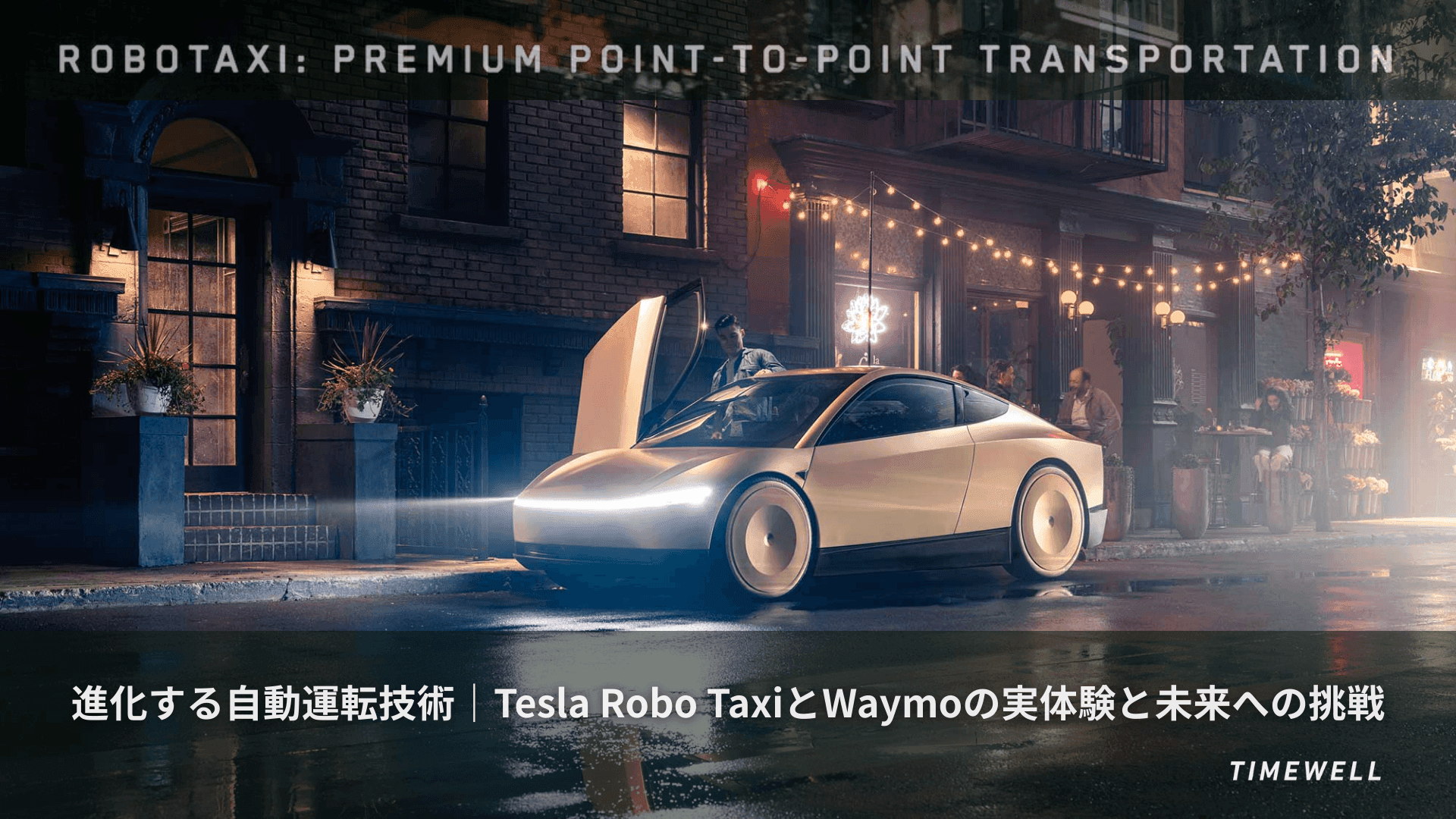
Austin, Texas has become an unlikely laboratory for the future of transportation. Both Tesla and Waymo operate autonomous taxi services there — in geofenced areas, under different operational frameworks, with different technical philosophies. This article examines what each experience is actually like, based on direct observation.
Topics:
- Tesla Robotaxi: the ride experience and operating system
- Waymo: the fully driverless experience
- Competitive dynamics and the longer-term picture
Looking for AI training and consulting?
Learn about WARP training programs and consulting services in our materials.
Part 1: Tesla Robotaxi — Supervised Autonomy in Practice
Getting In
Tesla's Robotaxi service launched in Austin in June 2025. The booking process runs through a dedicated app. Riders select a destination within the geofenced area; the vehicle navigates to the pickup point autonomously.
What distinguishes the current deployment: a safety monitor sits in the front seat, watching the system operate. This isn't a limitation exclusive to Tesla — it reflects the regulatory and operational reality of early commercial deployment. The safety monitor is present but passive unless intervention is needed.
Before the ride begins, the monitor performs a brief identity verification through the app. Once complete, the vehicle proceeds entirely under software control.
What the Ride Feels Like
The in-cabin display shows the current route, upcoming turns, and a real-time visualization of how the system perceives the surrounding environment — other vehicles, pedestrians, lane markings. The vehicle handles turn signals, lane changes, and navigation naturally. The integration is seamless enough that moments of automated decision-making blend with what you'd expect from a human driver.
One incident during testing: the map briefly showed an incorrect route, and the system immediately corrected via a turn signal and directional change. Adaptive recovery from momentary navigation uncertainty — not a failure mode, an operational reality handled without human intervention.
Rear entertainment is integrated: YouTube, Spotify, and other content accessible via touchscreen during the ride. Tesla's approach here is intentional — the in-vehicle experience is designed as a product feature, not an afterthought.
Safety and Improvement Architecture
The current model reflects careful balance. Safety monitors provide a backstop while the system accumulates operational data from real urban environments. Musk's statement that safety monitors will eventually be removed was framed around statistical confidence thresholds — once the data supports it, the safety architecture changes.
Tesla's continuous software update model is central to how improvement works: learnings from Austin feed into system updates that deploy to the global fleet overnight. This velocity of improvement is structurally different from hardware-dependent improvement cycles.
Part 2: Waymo — No Driver, Full Autonomy
The Driverless Difference
Waymo's service in Austin integrates directly with the Uber app. When matched with a Waymo vehicle, the passenger receives no human driver — the experience is genuinely driverless from start to finish.
The vehicle used is primarily a Jaguar I-PACE equipped with Waymo's sensor suite: LiDAR units, cameras, and radar. The hardware is visible — sensor arrays on the roof, front, and rear are clearly not factory-original. The interior is configured for passenger comfort with informational displays rather than driver controls.
A voice greeting uses the rider's name. Safety features are explained: cameras record during rides for safety purposes only, not for other uses. The transparency is deliberate.
Driving Character
Waymo's driving style is noticeably conservative. Near stop signs and intersections, the vehicle slows substantially. Pedestrian clearance distances are wide. The system errs toward caution, creating a ride that feels calibrated around minimizing any possible conflict — which is appropriate for a system that cannot call on a human to override.
One noted edge case: on arrival, the vehicle selected a route that required a wide loop rather than stopping at the most convenient position. The behavior was unexpected by conventional taxi standards but not dangerous — algorithmic path selection optimizing for something other than direct egress.
The Experience Calculus
Riding in a vehicle with no human present is experientially different from riding with a human driver or with a safety monitor present. There's a quiet to it. The absence of driver behavior — no phone, no conversation, no distraction — contributes to a sense of calm predictability.
Waymo's interface and operational protocol are polished in ways that reflect years of iterative development. The company has been accumulating real-world driverless miles longer than any competitor.
Part 3: Competitive Dynamics
Where Tesla Has Structural Advantage
Tesla's mass production capability is the asset Waymo cannot match. Waymo has roughly 1,000 vehicles deployed across its operational cities. Tesla's manufacturing capacity can produce that many vehicles in a day. If Tesla reaches operational confidence to remove safety monitors from its robotaxi fleet, the potential fleet size scales differently than anything Waymo has built.
The camera-only approach is cheaper per vehicle. LiDAR adds cost that compounds across large fleets. If Tesla's software can deliver equivalent safety performance using only cameras — a contested but not dismissed claim — the unit economics of large-scale deployment favor Tesla significantly.
| Dimension | Tesla | Waymo |
|---|---|---|
| Sensor approach | Camera-only | LiDAR + camera + radar |
| Vehicle cost | Lower | Significantly higher |
| Current fleet scale | ~31 vehicles in Austin | ~1,000 across 5 cities |
| Safety monitor | Present (testing unsupervised) | None — fully driverless |
| Weekly rides | Undisclosed | 450,000+ |
| Scale potential | Very high | Constrained by unit cost |
Where Waymo Has Current Advantage
Operational experience at scale. 450,000 rides per week across five cities is a real data asset. Waymo has operated driverless (not supervised) in San Francisco and Phoenix for years. The regulatory relationships, public acceptance learning, and incident response experience that comes from that operational history is not easily replicated.
Both Systems Are Still Learning
Both services occasionally produce unexpected routing decisions. Both show the gap between "mostly works in normal conditions" and "handles every edge case reliably." That gap is the remaining challenge — and it's being closed through accumulated operational data, not through any single breakthrough.
The competitive question is not which company has the better autonomous driving technology today. It's which company can accumulate real-world operational data at scale, incorporate learnings into system updates, and achieve unsupervised deployment across a large enough fleet to establish network effects. On that dimension, Tesla's manufacturing capacity and existing FSD fleet are asymmetric advantages.
Summary
Tesla and Waymo represent different answers to the same challenge:
- Tesla: massive manufacturing scale, lower hardware cost, supervised safety model transitioning toward unsupervised
- Waymo: genuinely driverless today, multi-sensor redundancy, significant operational experience
For business leaders: autonomous vehicle deployment is not a future event. It is a 2025 operational reality in Austin, expanding through 2026. The logistics, delivery, and urban mobility implications for businesses that plan around human driver costs are real and near-term. The companies building competitive strategy now will be better positioned than those who wait for autonomy to be "mature."
Reference: https://www.youtube.com/watch?v=We2ZD0-IXPM
TIMEWELL AI Consulting
TIMEWELL supports business transformation in the age of AI agents.