This is Hamamoto from TIMEWELL.
Supersonic Aviation Is Back — and Regulators Need to Catch Up
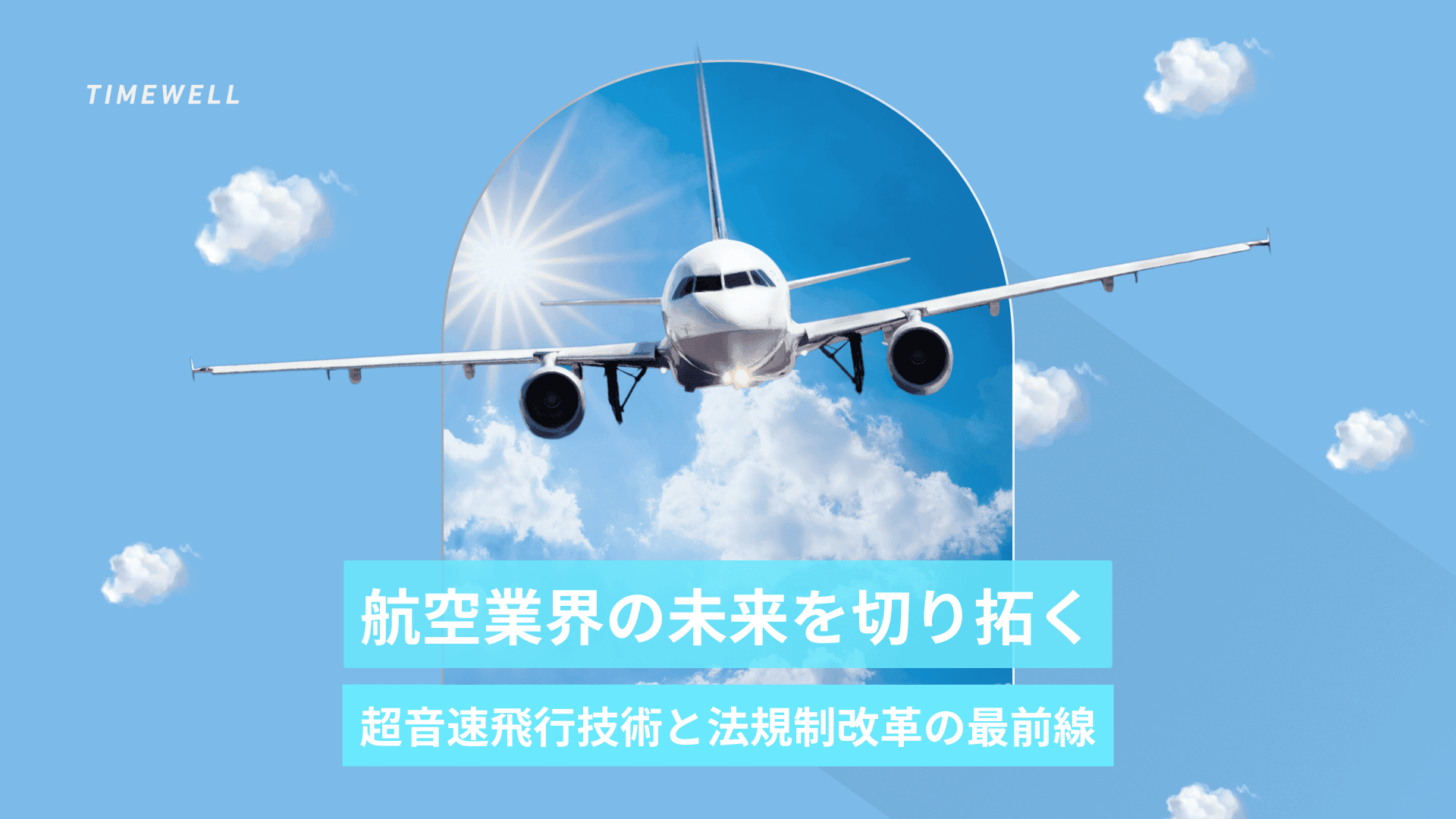
The aviation industry's most disruptive potential has been sitting dormant for decades, held in place by a 1973 US regulation banning overland supersonic flight. But new test results are changing the picture. The XB-1 prototype has demonstrated supersonic flight without detectable sonic boom at ground level — and the technical case for regulatory reform is now in place.
Topics:
- The regulatory barrier — how a 1973 rule held back supersonic aviation
- The technology breakthrough — XB-1, sonic boom suppression, and what's now possible
- International competition and strategic applications — the race against China, defense, and VIP transport
Looking for AI training and consulting?
Learn about WARP training programs and consulting services in our materials.
Part 1: The Regulatory Barrier
The 1973 Rule
In 1973, the US Federal Aviation Administration banned overland supersonic flight due to the sonic boom problem — the disruptive pressure wave that reaches the ground when an aircraft exceeds the speed of sound. The Concorde's commercial viability was limited to transatlantic routes as a direct result. US domestic supersonic aviation has been effectively impossible for over 50 years.
The rule made sense in 1973 based on the technology available then. Supersonic aircraft of that era produced unavoidable sonic booms. The regulation was a reasonable response to a real problem.
The problem: the regulation was written for 1973 technology and has not been meaningfully updated since. New aircraft design, engine control systems, and flight management software have changed what is physically possible.
Why Reform Matters Now
The practical result of unchanged regulation: US companies developing supersonic aircraft cannot test or commercialize their technology over US territory. They develop elsewhere, test elsewhere, and bring revenue elsewhere.
Meanwhile, China has announced its own supersonic commercial aircraft program — alongside its development of Boeing 737 and 787 clones. The competitive dynamics are clear: if the US does not reform its supersonic regulations, it cedes the market to competitors that face fewer domestic constraints.
The strategic argument for reform is not just commercial. Supersonic transport has direct national security applications — VIP transport, emergency response, rapid military logistics. A technology that cuts flight time in half has different implications for a presidential aircraft than it does for a commercial airline.
Part 2: The Technology — XB-1 and Sonic Boom Suppression
What XB-1 Demonstrated
The XB-1 — a prototype supersonic aircraft developed by Boom Supersonic — completed test flights demonstrating supersonic operation without detectable sonic boom at ground level. This is the technical milestone that changes the regulatory argument.
The achievement was not inevitable. The sonic boom suppression comes from a combination of:
- Airframe shape optimization — reducing the pressure wave generated by the aircraft at supersonic speeds
- Engine control systems — managing thrust and engine operation to minimize acoustic impact
- Flight management software — adjusting flight path and altitude to prevent the pressure wave from reaching ground level
What makes this particularly significant: the development team was small (approximately 50 engineers) and the capital requirement was roughly one-tenth of traditional large aerospace programs. This is not a Boeing-scale project. It is a demonstration that advanced supersonic development can be done lean, fast, and at a fraction of historical cost.
The Development Timeline
Specific milestones announced:
- This year: full-scale engine test runs
- Following year: first production aircraft manufacturing begins
- 2027: aircraft rollout
- 2028: test flights
- End of 2029: passenger service launch
The production facility is planned for North Carolina — a compact, high-efficiency manufacturing line designed for speed to market rather than the traditional aerospace production model.
The Economic Case
Supersonic travel's market is not mass commercial aviation. It is business travel, government transport, and high-value time-sensitive movement where the cost premium is justified by flight time reduction.
New York to London in 3.5 hours instead of 7. Tokyo to Los Angeles in 6 hours instead of 12. For executive travel, diplomacy, and emergency response, these time reductions have direct economic and strategic value.
Part 3: International Competition and Strategic Applications
China's Aviation Push
China is advancing on multiple aviation fronts simultaneously: licensed production of large commercial aircraft (737 and 787 equivalents), development of its own commercial aircraft (COMAC C919), and supersonic aviation development.
The commercial aviation market is the one where China has a structural advantage — its domestic market provides guaranteed volume. But the supersonic segment, where technological capability and regulatory environment matter more than scale, is still open.
If the US updates its supersonic regulations to reflect current technology and the FAA creates a framework for commercial supersonic service, US companies can establish market position before Chinese competitors reach commercial readiness. If the US does not act, the runway is clear for Chinese supersonic commercial aviation to establish global presence first.
Defense and VIP Applications
The defense applications of supersonic transport are direct. A supersonic VIP transport aircraft would cut the travel time of the US President, senior officials, and military commanders by approximately half. For response to rapidly developing situations — diplomatic crises, military operations, disaster response — the time advantage is strategic, not just convenient.
Current presidential transport aircraft (the 747-based Air Force One) is optimized for range and communications capability, not speed. A supersonic alternative does not replace it — it adds a capability that currently does not exist.
What the Regulatory Path Looks Like
The technical case for reform now exists: demonstrated supersonic flight without surface-detectable sonic boom. The regulatory steps required:
- FAA review of the 1973 ban in light of current technology
- Development of performance-based standards for sonic boom at ground level (rather than blanket speed restrictions)
- ICAO coordination for international routes and standards
This is not fast — regulatory reform in aviation is measured in years. But the test flight data provides the evidence base that makes reform possible. The decision is now political and regulatory, not technical.
Summary
The supersonic aviation industry has reached the technical milestone that changes the regulatory argument:
- XB-1 demonstrated supersonic flight without detectable sonic boom at ground level
- The 1973 FAA regulation was appropriate for 1973 technology — it is not appropriate for current technology
- The development cost and team size demonstrate that supersonic aviation no longer requires traditional aerospace-scale investment
- China is developing competing supersonic capability; US regulatory inaction creates market risk
- Defense and VIP transport applications have direct strategic value beyond commercial aviation
- The 2029 passenger service timeline is ambitious but supported by a specific milestone sequence
For business leaders: the implications extend beyond aviation. The regulatory update process for supersonic flight is a case study in how technical progress gets blocked by rules written for an earlier era — and how that blocking eventually breaks. In your own industry, identifying where 1973-era rules are constraining current technology is worth doing.
Reference: https://www.youtube.com/watch?v=CGQvXGJVHgY
TIMEWELL AI Consulting
TIMEWELL supports business transformation in the age of AI agents.