This is Hamamoto from TIMEWELL.
Building a Society Where Everyone Can Live Their Own Life
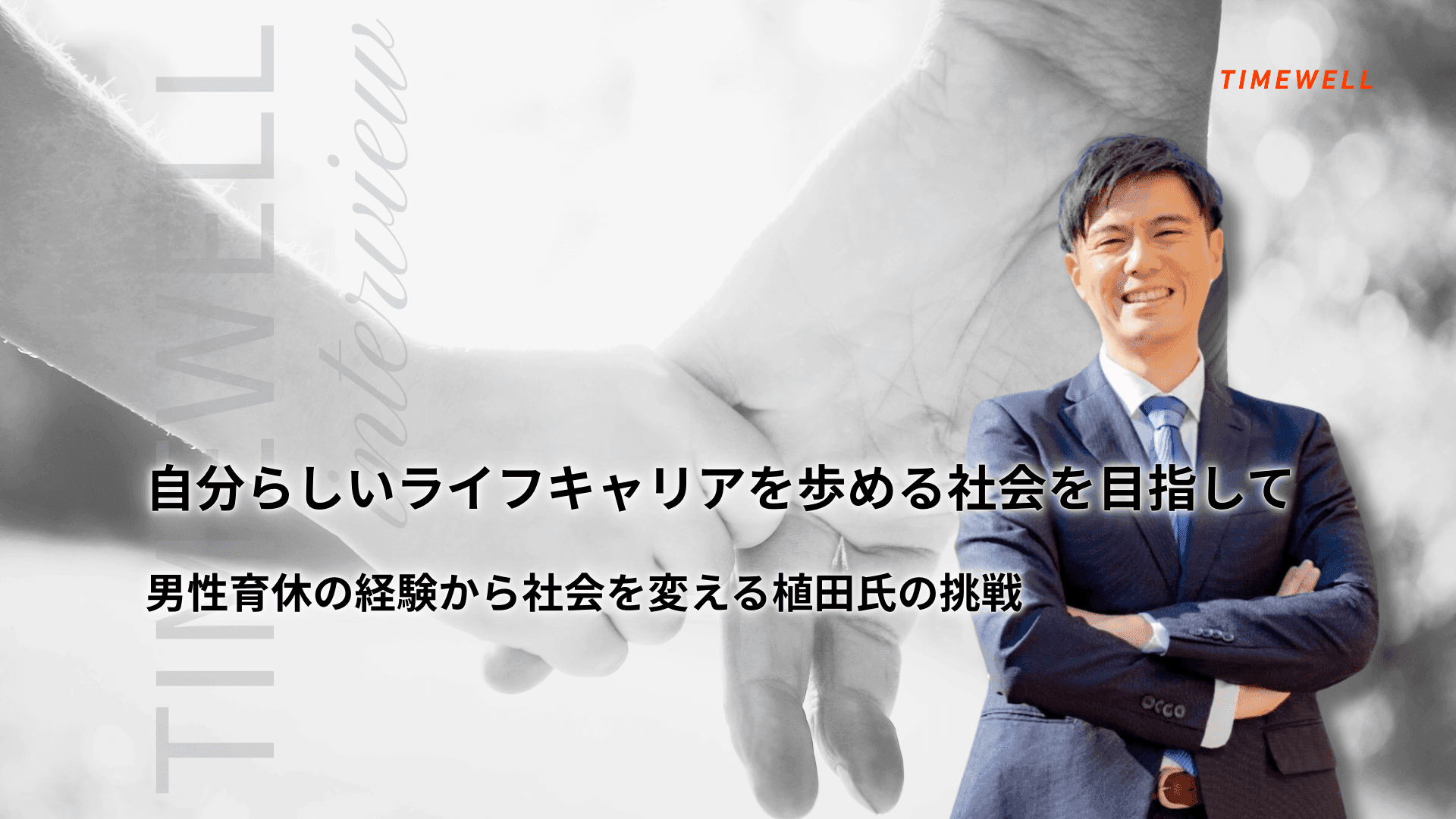
"Work-life balance" and "authentic career" are phrases that appear frequently in workplace discussions — but the gap between those ideals and everyday reality remains wide for many people. Takaya Ueda has built a career around closing that gap, drawing on his own experience of burnout, recovery, and the unexpected clarity that came from taking a year of paternity leave.
This interview covers Ueda's path from mechanical engineer to independent advocate, what he learned about himself during leave, and what he is building for other working parents.
Profile: Takaya Ueda
Representative, WorkFamily Plus (WF+) Director, NPO Ikyu Hiroba (Kinki/West Japan Representative)
Born 1990 in Nagoya. Studied mechanical engineering, then joined a major chemical manufacturer as an engineer. Achieved company-wide recognition for process improvements generating hundreds of millions of yen in value. Also served in the labor union executive, focusing on work-life balance and workplace culture. Took a full year of paternity leave — and recognized what he calls "the true value of paternity leave." Left the company to share that experience and support others navigating work and family. Received the CHANGE Award from One Japan's new business development program for his work on paternity leave. Now delivers lectures and training programs at companies and municipalities. Father of two.
Looking for AI training and consulting?
Learn about WARP training programs and consulting services in our materials.
Part 1: Where the Passion Came From
— To start, could you tell us about yourself and what you're working on?
Ueda: The mission that drives everything is creating a society where people can live a life that genuinely suits them. Practically, that means delivering lectures and training to companies and local governments on male paternity leave, dual-career households, and supporting women's professional growth. I try to bring personal experience and data together — to give both organizations and individuals concrete reasons to think differently about how they work and live.
— What in your background led you here?
Ueda: Two things from early on. First, I had this vague image of throwing a baseball with my son in the park someday. I don't know exactly where it came from — maybe I was imagining what kind of father I wanted to be. A desire to be present for family was always there, even before I had one.
Second, I loved comedy as a kid. The back-and-forth between manzai performers — making people feel better through conversation — was something I admired. Talking to an audience and helping someone with what you say: I wanted that experience.
Those two things turned out to be the foundation of what I do now. They're connected to wanting to share something valuable about work and family with as many people as possible.
Part 2: What Breaking Down Taught Him
— What actually pushed you to make the change? And what shifted when it did?
Ueda: I failed at balancing work and family. When our first child was born, I kept prioritizing work — childcare was essentially handled by my wife. Then one day she collapsed and needed emergency surgery. While I was preparing myself for the worst, I kept thinking: "What have I been doing with my time? If something happens to her, I'll regret this for the rest of my life." When she recovered, I promised myself I would be more present for the family.
After that I tried harder — but then our second child was due around the same time as a promotion. Everything got busier. I was arriving at the office before the family woke up and coming home just in time for the kids' bath. Then working until late at night after they were asleep. Gradually, I stopped feeling enjoyment in anything.
That's when I hit a mental wall. I was close to losing both myself and my family. I took parental leave as a last resort.
The leave let me actually understand what my wife had been doing alone. And for the first time, we could be honest with each other — about work, about the family, about what kind of life we both wanted. I came back to myself through that.
Experiencing my wife's perspective, and having the space to talk about what kind of life we wanted together — that recovery made me think: "I don't want other fathers to go through what I went through."
The True Value of Paternity Leave
— What was it like when you first decided to take leave?
Ueda: Honestly, I was at a breaking point. I just needed to stabilize the family and myself. But taking the leave showed me what I now call "the true value of paternity leave."
I describe it with a suitcase metaphor. Before leave, my internal suitcase was packed with immediate work concerns and deadlines — there was no room for anything about family or the future. When work left the suitcase, I had space to reflect on my career, to think about the future with my family.
A major life event like a birth is a real opportunity to think about the life you want to live — together. That's what I believe the leave period actually offers.
— What moment from that time has stayed with you most?
Ueda: The most significant was the conversation with my wife and what we figured out together. But two other things stood out.
One: watching my second child grow up. I'd had no time to slow down before — I remember barely noticing when the first could suddenly crawl. Being present for the second's development was something genuinely good for both of us.
The other: on a family trip, I was suddenly overwhelmed and couldn't stop crying. At that moment I understood: "This is what makes me happy." I had been focused on promotions, on not falling behind my peers at work. But in that moment I realized — that might have been someone else's definition of success. Not mine.
Part 3: Building Something for Others
— What made you start giving lectures, and what do you want to communicate?
Ueda: Two things. First, the direct experience — I don't want other fathers to go through what I went through. Second, there weren't many people communicating about this from a father's perspective. I decided: if that person doesn't exist, I'll be that person — in my own words, from my own experience.
Everyone's ideal work-family balance is different. My goal is to give people the conditions to find their own version — and to provide the thinking frameworks and practical knowledge to get there, to both organizations and individuals.
Working with NPO Ikyu Hiroba
— What has participating in NPO Ikyu Hiroba given you?
Ueda: Ikyu Hiroba is roughly gender-balanced, and the membership spans parents in the thick of child-rearing, people whose children are grown, and a wide range of professions and generations. For a community focused on work-family balance, that level of diversity is genuinely unusual in Japan.
Working alone had its limits. Having people who share the same convictions keeps motivation high. Hearing different people's experiences keeps expanding my own perspective.
— You've been taking on new challenges — academic conferences, new initiatives in Osaka. What's driving that?
Ueda: I enjoy new challenges — that's part of my nature. But more than that, it's gratitude. My wife supported a decision that most people would find risky: leaving a stable company to work independently in a completely new field. I want to repay that. She tells me she's happiest when she sees me doing what I love with full energy. That gives me fuel.
— How have you gotten through the difficult stretches?
Ueda: I'm an engineer by background, not a diversity expert. There was real uncertainty about whether anyone would want to hear me speak — and there were plenty of times when nothing came of my outreach. But I kept saying "I want to give lectures" to people around me, and eventually others started supporting me. The people who showed up and helped me gain experience — I'm here because of them.
Summary: What Keeps Him Going
— What are your goals going forward?
Ueda: Ultimately, I want to increase the number of people who are able to live a life that genuinely fits them. Not just paternity leave — workplace environment, relationships, anything that contributes to a fuller life. I want to create conditions where that kind of life is easier to find and live.
For that, I'm building engineering skills through WARP — learning programming and product development. I want to use games and apps to reach people in more accessible ways.
— What's your advice for someone who wants to make a change but can't take the first step?
Ueda: Start by acknowledging yourself. The fact that you're thinking about it, that you're struggling with it — that's already something meaningful. What you're going through now will become experience that can help someone else facing the same thing later.
Keep saying what you want to do, to the people around you. Someone will show up to support you — it always happens. Treasure those connections, and start with what you can do from where you are. Let's keep going.
Interview Summary:
- Mental health breakdown from trying to balance work and childcare was the catalyst for taking leave
- The true value of paternity leave is creating the mental space to think about the life you actually want — as a family
- Meeting diverse people at NPO Ikyu Hiroba expanded both his motivation and his perspective
- The foundation for continuing to challenge himself: family support and doing what he genuinely loves
- Using WARP to build engineering skills for new ways to share his work
Ueda's message to those who are struggling: your experience right now — the difficulty, the hesitation — is material that will help someone else later. Believe that, take the first step, and keep going.
Learn more about TIMEWELL's WARP program (the entrepreneurship and technical skills program Ueda participates in) at the link below.