This is Hamamoto from TIMEWELL.
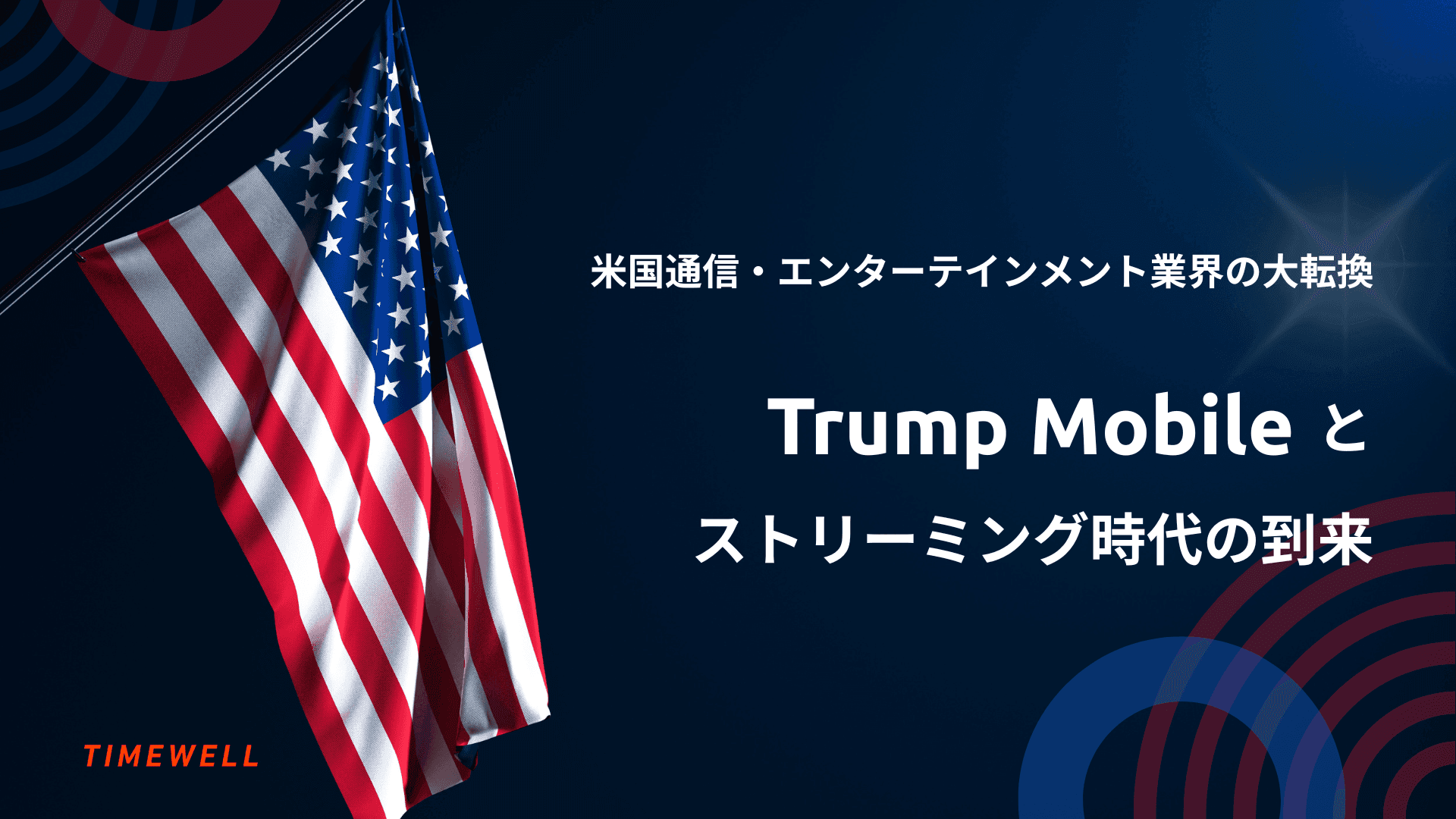
The US telecom and entertainment industries are in the middle of a genuine transition. The traditional carrier model faces sustained pressure from MVNOs, streaming has decisively taken the audience from cable and broadcast, and regulatory changes are reshaping how platforms handle advertising and crypto. This article covers three interconnected developments and their implications for business leaders.
Topics:
- Trump Mobile and the MVNO market
- Streaming's takeover of the TV audience
- Regulatory moves: FCC, WhatsApp ads, Reddit, stablecoins
Part 1: Trump Mobile and the MVNO Market
What Trump Mobile Is
MVNO — Mobile Virtual Network Operator — describes companies that lease network capacity from major carriers to offer their own branded mobile service without building independent infrastructure. Trump Mobile entered this market as a brand licensing play as much as a telecom service: the Trump Organization's name on a phone plan and a device.
Trump Mobile offers a single plan, the "47 Plan," running on T-Mobile's network. A companion device, the T1 Phone 82, was announced — but reviewers noted the specifications closely mirror commodity Chinese-manufactured Android phones already on the market. The Trump Organization claims the device will eventually be manufactured in the United States; the "Made in America" framing carries legal and definitional ambiguity that consumers should evaluate carefully.
The Competitive Problem
Trump Mobile enters a crowded field. Mint Mobile, Smart Mobile, and other MVNOs have already established positions on price, service quality, and brand identity. For Trump Mobile to compete on something other than brand, it needs hardware quality and service reliability that, at launch, have not been clearly demonstrated.
The business model carries a structural risk: when a product's primary differentiator is its brand association with a political figure, it is simultaneously highly attractive to a specific segment and a liability with others. The addressable market is defined as much by political identity as by communication needs.
For the broader MVNO market: Trump Mobile's entry signals continued maturation. The US now has a sufficient number of MVNOs competing on enough dimensions — price, brand, network, service experience — that the market can support products aimed at niche identity groups.
The Strategic Observation
The MVNO model has become accessible enough that virtually any brand with a loyal audience can attempt a telecom offering. The question for each entrant is whether loyalty translates to switching behavior and whether the underlying service quality sustains retention once the novelty wears off.
Looking for AI training and consulting?
Learn about WARP training programs and consulting services in our materials.
Part 2: Streaming's Takeover of TV
The Numbers
Nielsen data has confirmed what the industry expected: streaming viewership has, for the first time, exceeded cable and broadcast television viewing. The trend is structural, not cyclical.
YouTube alone holds approximately 12.5% of total viewership share — a figure that has grown approximately 120% over four years. Netflix has grown 27% in the same period. The counter-trend: cable and broadcast viewership continues declining.
The advertising consequence is direct. The audience that advertisers most want to reach is watching YouTube and Netflix, not cable. Traditional television's ad inventory is becoming less valuable as its audience shrinks; streaming platforms' inventory is becoming more valuable as their audiences grow.
What the Shift Means for Advertisers
Streaming platforms offer something linear TV never could: individual-level targeting. Advertisers can reach specific audiences based on viewing behavior, interest signals, and demographic data rather than making statistical inferences from program context.
Fast channels (free, ad-supported streaming) are growing fastest — and they are absorbing the most price-sensitive former cable subscribers. For advertisers previously dependent on cable reach, fast channels offer a path to that audience at a lower CPM than traditional broadcast, with better measurement.
Max (formerly HBO Max) has begun using AI to automatically extract compelling clips from content and generate trailers customized to individual viewer profiles. This is the direction: advertising that is generated and targeted at the content level, not the channel level.
The Remaining Tension
Streaming's growth does not resolve the fragmentation problem. An audience that once watched three major networks and a handful of cable channels now needs five to seven subscriptions to access equivalent content. That fragmentation creates both subscription fatigue for consumers and inventory coordination challenges for advertisers. The next phase of the streaming market — likely consolidation — will determine which platforms establish durable advertising scale.
Part 3: Regulatory Moves
FCC Reconstitution
Olivia Britt Trusty's confirmation as an FCC commissioner restored the body to three members — enough to make significant decisions. Republicans now hold a 2-1 majority. This has implications for spectrum policy, network neutrality, and the regulatory treatment of large platform companies. The precise direction will emerge through rulings, but the partisan balance is now set.
WhatsApp Advertising
Meta is introducing advertising into WhatsApp — a platform that built its identity on private, ad-free messaging. The user experience change is significant: WhatsApp's value proposition has always been a clean separation from the ad-driven engagement mechanics of Facebook and Instagram. Whether Meta can introduce advertising without eroding the trust differential that makes WhatsApp distinctive is an open question.
The business rationale is clear: WhatsApp has massive global user volume, particularly in markets where the primary Facebook and Instagram products are less dominant. Monetizing that user base through advertising is the logical next step in Meta's revenue diversification.
Reddit's AI-Driven Ad Placement
Reddit has begun testing a format where AI extracts user comments and posts and places them adjacent to advertisements — presenting community voice as a credibility signal for adjacent ads. The commercial logic: user-generated content that validates or relates to an advertised category provides authentic social proof in a format that paid media cannot replicate.
The privacy and community ethics concerns are genuine: users did not generate content in anticipation of having it placed in ad contexts. Reddit will need to navigate the line between contextual relevance and perceived appropriation.
The Genius Bill (Stablecoin Regulation)
New legislation establishing a regulatory framework for stablecoins and stable crypto assets has passed — creating clear rules around asset backing, transparency, and operational standards for stablecoin issuers. For the broader crypto market, clearer regulation reduces uncertainty for institutional participants and creates a more defensible foundation for USD-denominated stablecoin products.
The significance: the US has largely watched crypto markets develop without applying the regulatory frameworks that govern comparable financial instruments. The Genius Bill is a step toward treating stablecoins as financial products subject to consumer protection and systemic risk standards.
Summary
Three distinct developments, one shared dynamic: the US media and communications ecosystem is being restructured simultaneously by brand strategies, audience behavior, and regulatory action.
Trump Mobile:
- MVNO entry primarily as brand play; product quality not yet demonstrated
- The MVNO market is mature enough to absorb identity-based brand entrants
- "Made in America" claims require scrutiny
Streaming:
- Nielsen confirms streaming has overtaken cable/broadcast for the first time
- YouTube growth is the headline number; fast channels are the fastest-growing segment
- Advertising is following the audience, creating permanent pressure on linear TV inventory
Regulation:
- FCC at three members, Republican majority — setting up active rulemaking
- WhatsApp advertising challenges the platform's core trust proposition
- The Genius Bill creates a framework for stablecoin regulation that the market needed
For business leaders: the media shifts are not a future trend — they are the current reality. Advertising strategies built on cable television reach are losing their foundational assumptions. And the regulatory changes across FCC, WhatsApp, and crypto will create both compliance requirements and competitive opportunities in the quarters ahead.
Reference: https://www.youtube.com/watch?v=LcjUkzmkI4U
TIMEWELL AI Consulting
TIMEWELL supports business transformation in the age of AI agents.