From TIMEWELL
This is Hamamoto from TIMEWELL Inc.
Bitcoin Is Establishing Itself in Financial Markets — and Investors Are Asking How Best to Get Exposure
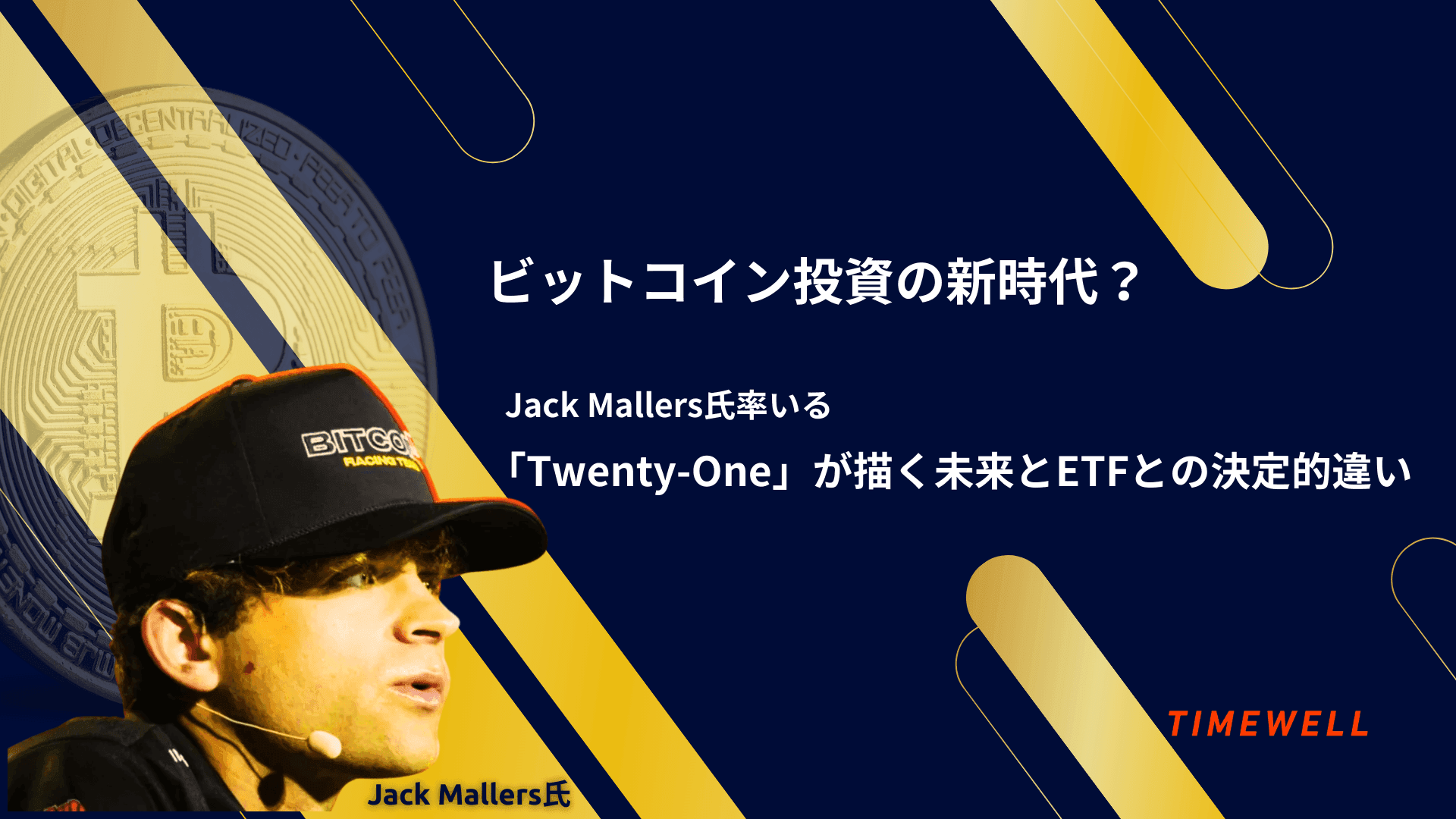
As Bitcoin cements its place in financial markets, investor interest has shifted to finding the optimal way to gain exposure. Aggressive Bitcoin acquisition strategies by companies like MicroStrategy have attracted significant attention, and the approval of spot Bitcoin ETFs was welcomed by the market as a more accessible investment vehicle. But a new movement has emerged — one that is not satisfied with these existing options and is proposing an entirely new approach. That movement is "Twenty-One," a new company co-founded by Jack Mallers, also known as the CEO of Strike. Drawing on more than a decade of collaboration with the Tether Group, Mallers has declared his ambition to build a "pure-play Bitcoin company" — one that does not merely hold Bitcoin, but builds Bitcoin-related businesses and grows its Bitcoin holdings on the balance sheet through the resulting cash flows. This is a fundamentally different proposition from companies that have pivoted from other businesses or are purchasing Bitcoin using profits from unrelated industries.
This article draws on an interview with Jack Mallers to examine the background to Twenty-One's founding, its distinctive business model, and the advantages it holds over existing Bitcoin investment vehicles — particularly ETFs.
The Background and Vision Behind Twenty-One's Founding — Why a "Pure" Bitcoin Company? New Metrics BPI/BRR and the CEO's Role — A Strategy to Maximize Shareholder Value Denominated in Bitcoin The Balance with Strike, Fundraising, and Differentiation from ETFs — The Unique Value That Twenty-One Offers Summary: A New Option for Bitcoin Investment — The Potential of Twenty-One
Looking for AI training and consulting?
Learn about WARP training programs and consulting services in our materials.
The Background and Vision Behind Twenty-One's Founding — Why a "Pure" Bitcoin Company?
The new company Jack Mallers has launched, "Twenty-One," is not simply a Bitcoin holding vehicle. Behind its founding lie a deep involvement in Bitcoin since its early days, a clear critique of existing market options, and a powerful vision for the future. To answer the question "Why a pure Bitcoin company, and why now?", it helps to trace the origins of the venture.
Mallers describes the Tether Group — his co-founders — as partners he has worked alongside for more than ten years. They have been active together since the era when Bitcoin had only a small community of enthusiastic supporters, deepening their collaborative relationship through initiatives such as their work in El Salvador. It is this long-standing trust that formed the foundation for Twenty-One.
One of the direct catalysts for the founding was the aggressive Bitcoin acquisition strategies being pursued by publicly listed companies, beginning with MicroStrategy under Michael Saylor. These companies' actions demonstrated the potential of Bitcoin as a corporate asset, and provided significant inspiration to Mallers and his team. Over several years of observation, however, that inspiration evolved from admiration to the recognition of a concrete "opportunity" and "gap" in the market.
The "gap" Mallers identifies is a certain dissatisfaction with existing Bitcoin-related listed companies. Many of these companies originally operated in entirely different businesses — selling video games or medical devices, for example — before "pivoting" to Bitcoin purchases and sometimes changing their names. These are cases where a Bitcoin strategy was adopted retroactively. In contrast, Mallers concluded that what was needed was a "Bitcoin-only company" — one established from the start for Bitcoin, and dedicated entirely to Bitcoin.
Twenty-One aims to combine "the credibility of a large corporation with the growth potential of a startup." It seeks to be a company with sufficient capital to compete at scale in the market, while still having significant room to grow. And most critically, it must be a pure Bitcoin business. Twenty-One's mission is to develop Bitcoin products, generate Bitcoin cash flows, and as a result deliver growth in "Bitcoin per Share" to shareholders.
Not Simply Riding Market Trends — Building an Entirely New Bitcoin-Centric Economy
This is not simply riding market trends — it is a strong expression of the will to build an entirely new economy and market centered on Bitcoin. Rather than merely providing Bitcoin exposure within the existing financial system, the goal is to place Bitcoin itself — its value and its adoption — at the core of corporate activity. Mallers speaks powerfully about his ambition for Twenty-One to become the "best vehicle" through which investors can gain Bitcoin exposure in public markets. This "purity" is the foundation of Twenty-One's unique value proposition — setting it apart from existing pivot-type companies and from ETFs. For investors who believe in Bitcoin's future, it offers something beyond mere price correlation: the expectation that corporate value will grow alongside the growth of the Bitcoin economy.
New Metrics BPI/BRR and the CEO's Role — A Strategy to Maximize Shareholder Value Denominated in Bitcoin
Twenty-One does not simply hold Bitcoin — it aims, as an operating company, to actively enhance corporate value, specifically in Bitcoin-denominated terms. To help the market understand this unique strategy and signal a clear commitment to shareholders, the company has introduced two new metrics: "BPI (Bitcoin per Share)" and "BRR (Bitcoin Return Rate)." These present a Bitcoin-centric evaluation framework distinct from the conventional EPS (Earnings per Share) used in equity markets.
In the interview, when asked "What does your day-to-day job as CEO look like?", Jack Mallers answered clearly: "Growing our Bitcoin per Share." This is framed as the CEO's primary responsibility to Twenty-One's shareholders — whom he describes as thinking of in the same way as customers.
Understanding BPI in Concrete Terms
To understand this commitment concretely, consider the concept of BPI. Suppose that at a given point in time, one share of Twenty-One represents 0.005 BTC in value (the company's Bitcoin holdings on the balance sheet divided by shares outstanding). Mallers' goal is to continuously increase this number — to 0.006 BTC, 0.007 BTC — through corporate activity. In other words, simply by continuing to hold Twenty-One shares, shareholders can increase the amount of Bitcoin they indirectly own. This vision is grounded in an intensely Bitcoin-centric philosophy: the goal is not just for the stock price to rise in fiat currency terms, but for shareholders to "become wealthier in Bitcoin terms."
To realize this BPI growth, Twenty-One pursues multifaceted activities as an operating company.
Developing Bitcoin Products: Developing and providing new services and products related to Bitcoin, establishing revenue streams.
Generating Bitcoin Cash Flows: Aiming to generate the revenues (cash flows) from these products and services in Bitcoin.
Leveraging Capital Markets
Leveraging Capital Markets: Using capital raised in public markets and through other means creatively to further accumulate Bitcoin on the balance sheet.
Mallers sees the steady growth of BPI through these activities as his job — and he wants the market to evaluate Twenty-One not by conventional fiat-based metrics, but by this Bitcoin-based measure. "We are not here necessarily to beat the market. We are here to build a new market, to change the current reality where the world has not yet adopted Bitcoin in the way we believe it will, and to accelerate that adoption." These words signal the company's ambitious goals.
The core value that Twenty-One promises shareholders comes down to the following:
BPI (Bitcoin per Share) Growth: Aiming to continuously increase the amount of Bitcoin each share represents through the company's business activities and capital strategy.
BRR (Bitcoin Return Rate)
BRR (Bitcoin Return Rate): A metric showing the rate of BPI growth, serving as a benchmark for investors to measure Bitcoin-denominated returns.
Growing Assets Denominated in Bitcoin: Providing shareholders who hold Twenty-One stock with the experience of increasing their actual Bitcoin holdings — not just their fiat-currency valuation.
The BRR (Bitcoin Return Rate) can be thought of as showing how quickly this BPI is growing. This enables investors to evaluate how efficiently Twenty-One is delivering Bitcoin-denominated value to shareholders.
These new metrics and the CEO's clear commitment demonstrate that Twenty-One is not merely a Bitcoin vault, but a dynamic entity that creates value within the Bitcoin economy and returns it to shareholders. Investors will evaluate this company not just by fiat currency price movements, but by the new measure of BPI growth.
The Balance with Strike, Fundraising, and Differentiation from ETFs — The Unique Value That Twenty-One Offers
While Jack Mallers is embarking on a new challenge as CEO of Twenty-One, the trajectory of the payments app "Strike" that he has long led also commands attention. The interview addressed this point directly. Mallers stated unequivocally that he will serve as CEO of both Strike and Twenty-One. This means his energy and commitment will flow toward multiple entities in the service of a larger goal: the development of the Bitcoin ecosystem.
Strike itself is a highly successful business. Mallers revealed that Strike is "extremely profitable" — with EBITDA margins exceeding 20% and gross profit margins reaching 85%. Even more impressive is that this high profitability is being achieved with just 75 employees. Measured by gross profit or net profit per employee, Mallers is confident that Strike ranks among the most efficient companies in the Bitcoin industry. This success was spoken of with gratitude toward employees, investors, and customers alike. Mallers views his life's purpose as "helping Bitcoin get the chance to change the world for the better" — and he sees Strike and Twenty-One as separately contributing to that purpose. In other words, Strike's success will not undermine Twenty-One's foundation; rather, the two will work as two wheels driving Bitcoin adoption forward together.
On fundraising — a core element of Twenty-One's growth strategy — Mallers is clear about his intention to raise as much capital as possible and deploy it into acquiring Bitcoin. However, there is one absolute rule: "It must always be accretive." Specifically, any fundraising must result in an increase in BPI (Bitcoin per Share); any raise that would dilute BPI will not be undertaken. The commitment to ensuring that "shareholders become wealthier in Bitcoin terms by holding Twenty-One stock" is repeatedly emphasized as the CEO's top priority. For this reason, the company plans to raise capital from diverse sectors and markets, seeking innovative approaches to integrate Bitcoin into the traditional financial system, while offering strong equity in public markets.
Currently Trading Under the CEP Ticker
Currently, Twenty-One shares are trading under the ticker symbol "CEP" through a SPAC (Special Purpose Acquisition Company) with Cantor Fitzgerald. If the merger is completed successfully, the ticker symbol will change to "XXI." While specifics of how individual investors can participate were not addressed, since the shares are targeting public market listing, retail investors are expected to be able to trade the stock after listing.
Perhaps the most important point of comparison is with spot Bitcoin ETFs, which have appeared in recent years. ETFs have made Bitcoin access easier for investors, but Mallers argues that Twenty-One offers a different kind of value. An ETF (such as IBIT) provides "static exposure" to Bitcoin through that security. The amount of Bitcoin represented by each unit of an ETF fundamentally does not change (aside from expense ratio deductions). Investors gain or lose based on Bitcoin price movements, but the ETF itself is not actively growing its Bitcoin holdings.
Twenty-One, by contrast, is an "operating company." The team, led by CEO Mallers, works daily — through corporate activities including product development, cash flow generation, and strategic capital raising and Bitcoin purchases — to grow the Bitcoin on the balance sheet and thereby raise BPI. Shareholders are not merely expecting correlation to Bitcoin price movements; they are investing in the possibility that the amount of Bitcoin represented by their shares will grow through the company's own activities. "When a shareholder receives a press release saying 'Twenty-One's BPI has grown from 0.005 to 0.006,' they can feel: my Bitcoin exposure has grown; my assets have grown in Bitcoin terms." This is a dynamic value proposition unique to an operating company — one that ETFs cannot offer. Of course, this is currently an "intention," not a guarantee of the future — but Mallers clearly believes this model will open a new frontier for Bitcoin investment in public markets.
Summary: A New Option for Bitcoin Investment — The Potential of Twenty-One
Jack Mallers' new company "Twenty-One" stakes an ambitious vision that sets it apart from conventional Bitcoin-related companies and ETFs. Rather than simply holding Bitcoin, it aims to engage as a "pure Bitcoin company" in product development and cash flow generation, returning those results to shareholders in the form of BPI (Bitcoin per Share) growth. This is a proposal for a new investment paradigm in which investors pursue not just fiat-currency valuation but becoming "wealthier in Bitcoin terms."
The introduction of new metrics BPI and BRR, the CEO's strong personal commitment to BPI growth, the potential synergies from also leading Strike, and the fundraising strategy grounded in the principle of never diluting BPI all suggest that Twenty-One is not merely a speculative vehicle but an operating company aimed at long-term value creation.
The contrast with spot Bitcoin ETFs is particularly clear. Against the "static exposure" that ETFs provide, Twenty-One aims to offer "growing exposure" — actively increasing Bitcoin holdings through corporate activity. This can be an attractive option for investors who want to invest in both Bitcoin's future potential and the execution capability of a company leveraging it.
Still in the Vision Stage
Of course, this is still at the vision stage, and actual business execution and market assessment remain ahead. However, the passion of Jack Mallers — who has been deeply involved in the Bitcoin ecosystem since its early days — combined with the partnership of the Tether Group and a clear strategy, gives a genuine sense of new possibilities for Bitcoin investment. When the day comes that Twenty-One appears in public markets under the ticker "XXI," the question of how investors evaluate it, and what impact it has on the Bitcoin market as a whole, will be well worth watching. For business professionals as well, Twenty-One's moves should offer important insights for thinking about asset management strategy and industry trends.
Reference: https://www.youtube.com/watch?v=F_qqMQpaCAc
Related Articles
- The Reality of a Working Mother Returning from Two Maternity Leaves — And How Her Work Philosophy Changed | TIMEWELL
- Before Taking Paternity Leave (Part 2): Three Absolute Must-Dos for Taking Leave During a Busy Season
- A First-Class Architect Who Stays Close to the Job Site — Finding My Own Path as the Fifth-Generation Leader of a Construction Company