From TIMEWELL
This is Hamamoto from TIMEWELL.
Looking for AI training and consulting?
Learn about WARP training programs and consulting services in our materials.
The Fragility of the Everyday
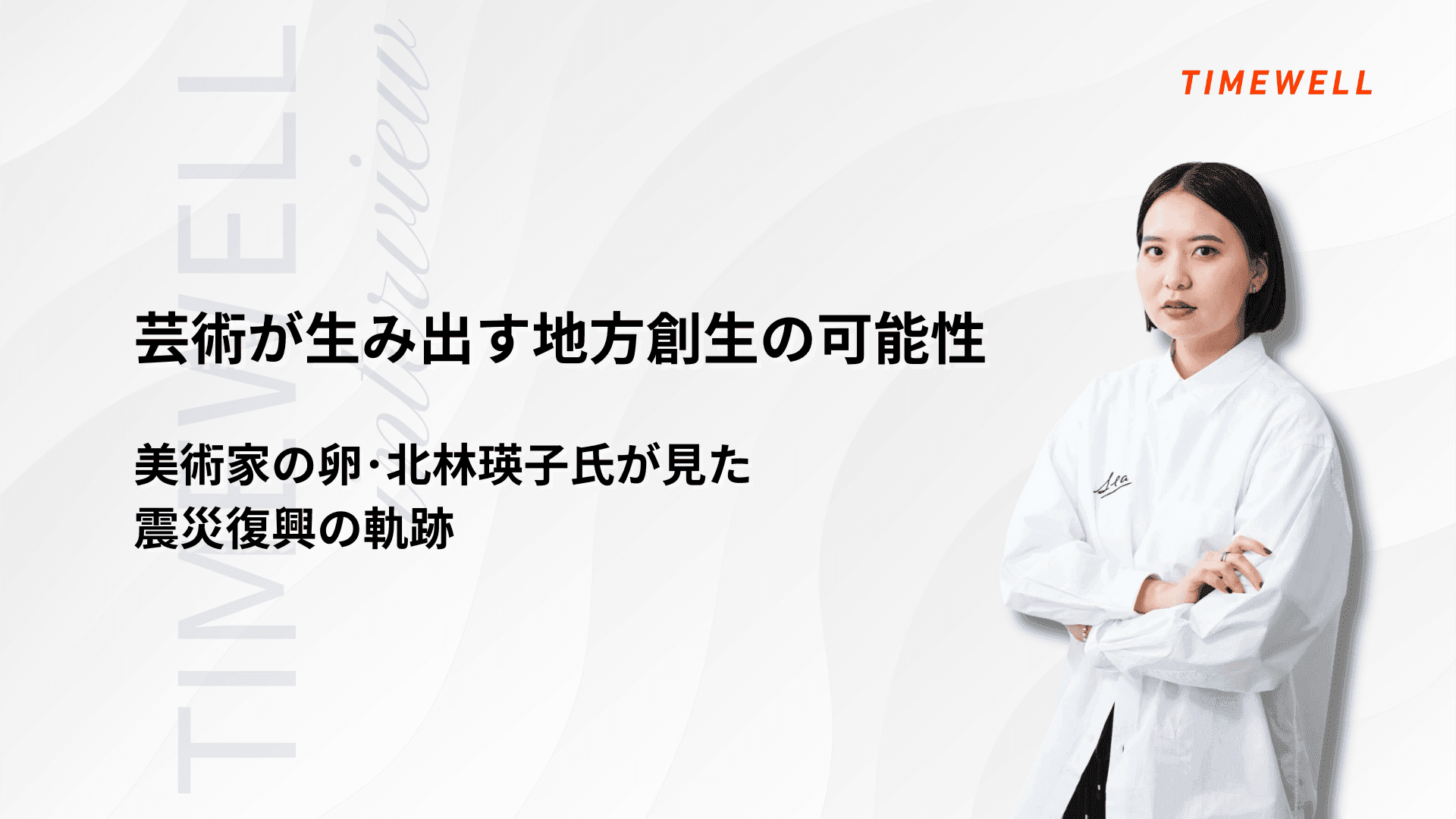
Whether or not you have experienced the loss of something precious in a disaster, none of us can be sure when the things we take for granted might vanish. Eiko Kitabayashi, an emerging artist, visited the Noto Peninsula one year after the earthquake as part of TIMEWELL's Noto recovery initiative. She was confronted with the sight of a community reduced to rubble. Though left momentarily speechless, she was deeply moved by the people pressing forward with hope and determination. She channeled what she witnessed into a work of art called "Flower." This article explores, through Kitabayashi's visit and creative process, the preciousness of everyday life and the transformative power of art.
Joined Sekisui Chemical Co., Ltd.'s Housing Division as a technical professional in 2019, working on urban development planning and residential projects. Currently with the New Business Promotion Division / Innovation Promotion Group. In parallel, she studies design and art at Musashino Art University's correspondence program in Design Information Studies. Her work Phantom was exhibited at the National Art Center Tokyo's "Contemporary Artists in Action" exhibition. She creates installations and graphic works themed around space and environment.
— Could you start by introducing yourself, including what drew you to studying art?
Kitabayashi: My name is Eiko Kitabayashi. Partly influenced by my mother, who is an architect, I work at Sekisui Chemical Co., Ltd., which operates a housing business. I previously worked in single-family home design, and now I'm in the New Business Promotion Division, where I work on innovation-related projects. I've always had a strong interest in making things, and I currently attend an art university alongside my work, studying design.
— You're working in new business development. What led you to choose "Noto" as the theme for your work?
Kitabayashi: The work is themed around Noto, but the reason I went there in the first place was work — I visited as part of my new business responsibilities.
There's another layer to it, though. When the Great East Japan Earthquake happened, my father invited me to go volunteer with him. But I was in high school at the time, and I was afraid — afraid of facing death, afraid of stepping into a reality so different from my own everyday life. I couldn't take that first step. That inability to go has stayed with me somewhere in the back of my mind ever since.
— How did you first learn about TIMEWELL's Noto recovery initiative?
Kitabayashi: I've always been interested in regional revitalization. Growing up in Mie Prefecture, I felt the gap between rural regions and Tokyo quite acutely. Then friends from TIMEWELL — Hayashi-san and Tanke-san — invited me to join. I visited one year after the earthquake, and recovery was still very much in progress. There were still areas of rubble, and there were moments when I simply couldn't hold back tears.
— What specific experiences did you have on the TIMEWELL-organized tour?
Kitabayashi: We listened to local residents share their stories, shared meals, and talked. What surprised me most was how much more positive and energetic everyone was than I had imagined. It made me question my own worries — I was the one who came away feeling encouraged.
— That's a remarkable reversal to experience in a disaster-affected area.
Kitabayashi: It really is. They've found a way to turn the earthquake into an opportunity — though I need to be careful how I phrase that. What I mean is, they're facing forward. That forward-facing energy is probably why people are drawn there and new communities are forming. Of course there is grief and suffering too, and I wanted to engage with that honestly.
— Tell me about the artwork "Flower" — its form and the intent behind it.
Kitabayashi: When I visited the Noto Peninsula and witnessed the devastated streets and the marks left by the tsunami, I felt an inexpressible sense of loss. A landscape that had been ordinary until just recently had become rubble in front of my eyes. And yet, it was precisely because of that devastation that the sight of people living forward with such strength moved me so deeply. I expressed that through "Flower."
Flowers sprout in the sunlight, bloom beautifully, and eventually wither and fall. But they leave seeds behind, continuing the chain of life. That fragile yet powerful cycle overlapped in my mind with the image of people striving toward recovery.
— There seems to be careful attention to detail in the materials and form.
Kitabayashi: I used ordinary copy paper as the primary material. It's something everyone uses in daily life, and I thought that was right for expressing the everyday. I tried many different materials, but in the end, for expressing the ordinary, the most fitting choice was something close at hand. A piece of plain paper transformed into the shape of a flower takes on a new life. Within that transformation, I embedded a message of rebirth after disaster. Each individual flower was carefully crafted and then combined to create one large sculptural form. The flower's shape is continuous, curving like a pulse — that, too, was an intentional expressive choice.
— Did the process of making the work reveal anything new to you?
Kitabayashi: Through the process, I was struck again by my own powerlessness and by how difficult it is to truly "express" something.
Can flowers really communicate something about the earthquake? And is it even right for someone with no personal connection to Noto to represent that experience? I wrestled with those questions.
But what matters most as a creator is leaving something in the viewer's heart. I became even more committed to making work that stays in the memory and sparks new conversations and ideas. Receiving so many different thoughts and reactions from people who saw the piece was itself a tremendous reward. For me, this work didn't end with "completion" — it felt more like a starting point, a new beginning for what to create next.
Art Has Limitless Potential — It Starts with Attention to the Everyday
— How do you see the future of art and regional revitalization?
Kitabayashi: Above all, I feel that continuing to express myself is the most essential thing. To keep that going, I want to keep visiting places like Noto and sharpening my sensibilities. I also want to nurture connections with other artists and create an environment where we can inspire one another.
As for art and regional revitalization — I feel the potential is truly limitless. Whether painting, sculpture, music, or film, creative expression takes many forms. I believe that art rooted in a specific place can generate new value that is uniquely that community's own.
— Finally, do you have a message for the readers of this article?
Kitabayashi: I think that in the unremarkable scenery and events of daily life, important messages are hiding. A day may come when something precious is suddenly taken from you — that was the realization I came away with from Noto. Perhaps the things we overlook in the busyness of everyday life hold the true meaning of our lives.
Take out your earphones, lift your eyes from your phone, and really look at what's in front of you. Hold onto the colors, shapes, and feelings you find there. I believe that small, accumulated steps eventually build into something larger, and that something larger changes the world.
Eiko Kitabayashi's unassuming presence and the quiet conviction behind her words left a deep impression. An earthquake — a disaster that in Japan can strike on any ordinary day — shattered the ordinary. How do we process and move through loss through art? Her work and personal experience offered a glimpse of an answer.
When confronted by something that shakes our values and our sense of what life is for, what do we hold onto? Kitabayashi offered one response through art: re-recognizing the preciousness of "the everyday." Perhaps it is the accumulation of those small recognitions that leads us toward hope.
The resilience of the people she encountered in Noto, and the sincerity of her own expression, left us with a firm sense of possibility for the future.