From TIMEWELL
This is Hamamoto from TIMEWELL Inc.
"If Only I Had One More Hand" — "If Only I Had One More Thumb"
"If only I had one more hand." "If only I had one more thumb." Have you ever had that fleeting wish in daily life or at work? Technology that extends human physical ability — long depicted in science fiction films and animation — is now becoming reality.
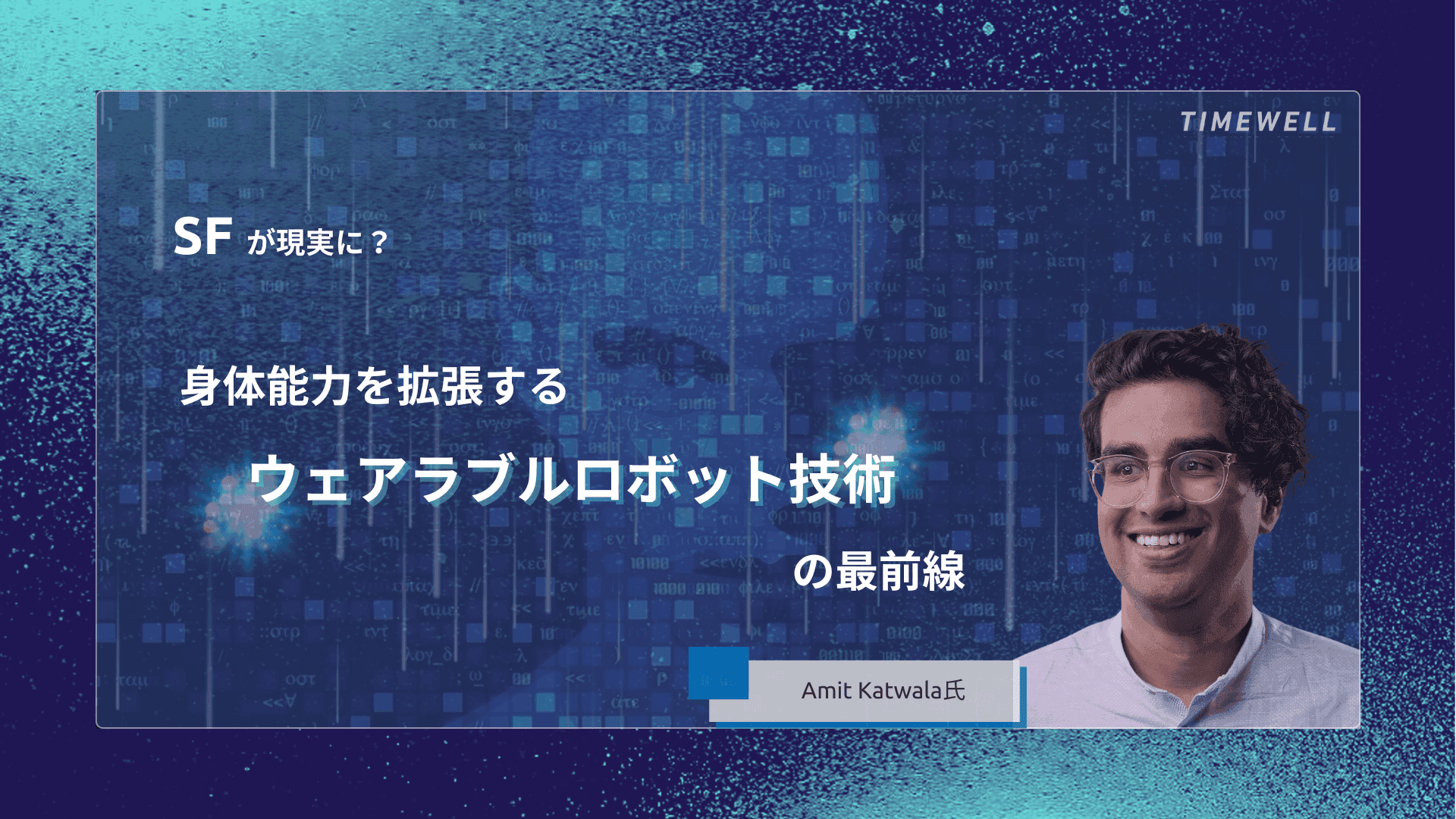
Amit Katwala, a writer and editor at WIRED, visited a research laboratory in Japan to experience exactly that frontier. What he witnessed was a series of remarkable wearable robots with the potential to dramatically expand human capability. Just how usable are these robots? How natural is their movement? Can they pick things up? And above all — can wearing them turn you into a "superhuman"?
In this article, through Amit's experiences, we dive deep into two innovative human augmentation technologies developed at the University of Tokyo and Cambridge University: a wearable robot arm and a "Third Thumb." We explore the potential of these technologies to transform how we work and live, and ultimately what it means to be human — as well as their possible applications in business.
The University of Tokyo's Wearable Robot Arm — A Challenge to Expand Human Ability Through the Fusion of Tradition and Innovation Cambridge University's "Third Thumb" — Opening New Body Sensations and Dexterity How Does the Brain Accept a New Body? The Neuroscience of Human Augmentation and a View of the Future Summary
Looking for AI training and consulting?
Learn about WARP training programs and consulting services in our materials.
The University of Tokyo's Wearable Robot Arm — A Challenge to Expand Human Ability Through the Fusion of Tradition and Innovation
The first place Amit visited was the lab of Professor Masahiko Inami and his team at the University of Tokyo, where they are developing a wearable robot arm. The design philosophy behind this robot arm is said to have been influenced by Japan's traditional Bunraku puppet theater. In Bunraku, multiple puppeteers operate a single puppet in concert, producing complex and fluid movements that make the puppet appear to move of its own volition. This robot arm was likewise designed to extend human ability like a musical instrument and unlock new possibilities.
According to Professor Inami, the system is essentially an example of physical computing that amplifies "small copies of movements" and transmits them to the robot arm. Collision avoidance mechanisms are also built in, aiming for operability that is easy to understand intuitively.
Specifically, sensors embedded in a small device worn by the operator (the "puppet master") measure joint angles. That data is sent to a 3D model in a laptop, where the processed information precisely controls the large robot arm. The system consists of a backpack, a socket connecting the arm, motors in the arm body, and a wrist motor. Each joint is connected by carbon skeletal elements, playing a role similar to human bones — supporting the overall structure.
When Amit actually strapped on the robot arm, he first noticed its weight. The backpack he was wearing was substantial, and when he moved his body the robot arm followed — yet he describes it as surprisingly comfortable. In appearance he looked as if he had fused with a robot, and he couldn't hide his excitement: "The silhouette is supremely cool."
In a Demonstration Where Professor Inami Operated the Puppet Master to Move the Robot Arm
In a demonstration where Professor Inami operated the puppet master to move the robot arm, Amit experienced the strange sensation of the arm vibrating and his limbs moving independently of his own intentions. He could clearly hear the sound of the shoulder section vibrating while raising and lowering the arm, and the sound of the motors operating — giving him a vivid sense of how much force was required to lift that much mass. The sound was mechanical yet somehow biological, like an animal purring in its throat. The experience of shaking hands with himself was a uniquely unusual one.
Next, a test was conducted to see whether he could feel in this robot arm the ability to know one's own limb positions without looking — "proprioception." With eyes closed, Professor Inami moved the robot arm, and Amit had to identify which arm was moving and how. At first the upper left arm moved up and down, then the lower right arm, then both arms — and Amit was able to perceive these movements through bodily sensation. From the tilt of his body and vibrations in his shoulders, he could infer which specific arm was moving. For example, when his body tilted right and he felt a vibration in his right shoulder, he concluded the lower right arm was moving. When both arms moved, the roughly 4kg of additional weight destabilized his body, and he noticed himself unconsciously trying to counter-balance.
Next, Amit tried operating the controller himself. In contrast to the robot arm's substantial weight, the controller was remarkably light — the gap surprised him. As a result, he was initially very cautious, and he noted that having someone else operate it actually felt safer. When operating himself, the possibility of accidentally hitting his own face with the robot hand from a sudden hand movement made him naturally more deliberate.
Finally, the ability of the robot arm to actually pick up objects was tested. Amit's role was to "cooperate" with the robot to pick things up. The first challenge was a soft toy bird — a clear success. Next, a ball test requiring both hands (robot arms) involved several attempts and eventually succeeded. The most difficult was a sequence of tasks: picking up a pen, handing it to the robot, removing the cap, and having the robot write something. Precisely grasping the pen proved difficult, and there were many failures. In the end, getting to the point of actually writing characters was not achieved, and he wrapped up with a joke: "Artists, it seems your jobs are safe from robots for now." Overall, however, he was deeply impressed, concluding that with practice he would be able to use it far more skillfully.
Professor Inami Shared the Following Vision for Future Applications
Professor Inami shared the following vision for future applications of this robot arm.
Superhuman Sports: Creating a new type of sport played while wearing this kind of robot arm.
Medical Support: Assisting medical surgery — for example, holding instruments in place of a surgeon's hands during an operation.
Rehabilitation: Teaching how to move an arm via remote instructions from a distant location or computer, or supporting rehabilitation.
Skill Acquisition
- Skill Acquisition: Assisting in acquiring martial arts and other new skills.
Overall, Amit was deeply impressed by the robot arm's performance, concluding that with practice it would become possible to use it far more effectively. The experience at the University of Tokyo gave him a vivid sense of the enormous potential that human augmentation technology holds.
Cambridge University's "Third Thumb" — Opening New Body Sensations and Dexterity
After his stimulating experience in Tokyo, Amit headed to Cambridge — closer to home in the UK — in search of the next human augmentation technology. What he found there was the "Third Thumb," developed by Dani Clode and the team at the Cambridge University Plasticity Lab. Literally an extra thumb attached to the hand, what kind of changes does this innovative device bring to our body awareness and motor skills?
Dani Clode Is a Researcher Specializing in Augmentation and Prosthetic Design
Dani Clode is a researcher specializing in augmentation and prosthetic design. The "Third Thumb" she developed has a surprisingly simple yet refined structure. There is a main body portion fitted onto the hand, from which a finger 3D-printed in flexible material extends. This finger is pulled by wires driven by two motors mounted on the wrist — approximately the same position as a wristwatch — and moves with dexterity. The motors and control PCB are wirelessly connected to pressure sensors mounted around the ankle and inside shoes, with an interchangeable battery design. In other words, the "Third Thumb" is controlled by toe movements — an intuitive yet novel operating method. The sound Amit heard from the motors as he operated it gave him the impression of "a tiny robot, or a Star Wars droid."
Amit promptly tried the "Third Thumb" on and experienced operating it. Pressure sensors are positioned beneath both big toes, and pressing each toe controls different movements of the "Third Thumb." Pressing the left big toe curls the finger; pressing the right big toe produces a different movement. The motion is extremely smooth, and Amit exclaimed "This is really cool!" Particularly noteworthy is the proportional control: because the speed and strength of the "Third Thumb's" movement changes in proportion to how hard the toes press, an extremely wide range of control is possible — from delicate operation to fast, powerful movement. "Press slowly and gently for delicate control. Press fast and it moves fast. It's pretty powerful," Amit noted in surprise at its responsiveness and strength. In practice, when he gripped his palm with the "Third Thumb," it was visible that considerable pressure was being applied.
Having understood the operating method, Amit went on to attempt various tests of the Third Thumb's capabilities.
According to the research team, people typically become functionally capable within the first minute, but acquiring finer motor skills requires about a week of practice. The first test was "full grip" — the goal being to pick up an object using only the "Third Thumb" without using other fingers. This was performed as a basic exercise.
Next, "Holding Multiple Balls"
Next, "holding multiple balls." This test involves holding as many balls as one hand can grasp, then using the "Third Thumb" to grasp additional balls — testing the ability to extend hand function. Amit attempted four balls, which proved somewhat challenging.
Then the "peg test." This tests the coordination of the normally unconscious movement of bringing the whole hand into the correct position while using the third finger. "I never think about how important it is to bring the whole hand to the right position," Amit noted, describing the difficulty.
The final challenge was the "Jenga test." A highly coordinated task requiring simultaneous gripping of two Jenga blocks — one with two regular fingers and the other with a finger and the "Third Thumb" — and stacking them. Amit rated this test "extremely difficult — an 11 out of 10." In particular, without tactile feedback from the "Third Thumb," it was impossible to tell how hard he was gripping, leading him to rediscover the importance of proprioception that he had learned in Tokyo. He noted that synchronizing its movement with his own thumb was extremely tricky.
Through these tests, what Amit felt was that the "Third Thumb" still did not feel like a natural part of his own body. He described it as "like holding something with tongs," emphasizing that conscious and careful operation was required. When his hand was in a position far from his body, it was particularly difficult to accurately gauge the position of the "Third Thumb," and correctly orienting the hand toward the target object was itself a challenge. This experience suggests how important not only visual information but also body sensation and proprioception are for effectively utilizing a new body part.
How Does the Brain Accept a New Body?
How does the brain accept a new body? Human augmentation and neuroscience: a view of the future.
Wearable robot arms and the "Third Thumb" — these human augmentation technologies may not only physically improve our physical abilities but also affect the brain that controls them. In Cambridge, Amit also spoke with Professor Tamar Makin, a specialist in cognitive neuroscience, and participated in an actual experiment on what changes in brain activity result from using the "Third Thumb."
The experiment involved Amit, inside an fMRI (functional magnetic resonance imaging) scanner, operating the "Third Thumb" and moving his own fingers and toes. Professor Makin's team is researching whether using devices like the "Third Thumb" enables participants to achieve more than the hand is capable of, by operating the body in entirely new ways they have never experienced before.
The scan results were very interesting. When Amit was moving his own fingers, the brain's "hand area" was observed to be actively responding. This was the expected result. However, when he was operating the "Third Thumb" (that is, moving his toes), the "hand area" showed almost no activity. What was active instead was the "foot area." This clearly demonstrates that to control the "Third Thumb," the brain was using foot muscles rather than hand muscles.
Professor Tamar Makin Explained the Coordination
Professor Tamar Makin explained the coordination between the motor cortex (the area that controls movement) and the somatosensory cortex (the area that receives sensory information from touch and muscles). These areas work in coordination to enable smooth motor control. In particular, the "hand area" occupies a very important position in the brain and closely coordinates with many other brain areas. The "hand area" also has good connectivity with the "foot area," which is thought to be one of the reasons why the intuitive design of controlling the "Third Thumb" with the toes works well. "Design it cleverly, design it intuitively, and you can create technology that is plug-and-play," Professor Makin noted.
Learning to control the "Third Thumb" was the most difficult part, but in the future, could these robotic limbs be connected via a chip implanted directly in the brain? Professor Makin acknowledges that we are still in the very early stages of that field, but emphasizes that what matters is "proof of concept." Humans are accustomed to five-fingered hands, but the limits in using additional fingers or arms are ultimately the limits of human imagination. She said powerfully that there are multiple ways to incorporate additional body parts into our bodies, brains, and cognitive awareness, and there is no reason not to redesign the world to better utilize these technologies.
Amit concluded his reporting by noting that while the experience did not leave him feeling an immediate need for an extra arm or thumb, he would give the idea of a world where "becoming superhuman" is as easy as putting on a backpack a "three thumbs up" — humorously wrapping up. This experience demonstrates that human augmentation technology is not merely science fiction's pipe dream but an approaching reality. It holds immeasurable potential — for rehabilitation and support for people with disabilities, as a substitute for dangerous work, or for creating entirely new forms of artistic expression and sport. From a business perspective as well, these technologies may generate new markets and services, and could become a catalyst for dramatically transforming existing industry structures.
The University of Tokyo's wearable robot arm and Cambridge University's "Third Thumb." The human augmentation technologies that Amit Katwala experienced hold the potential to profoundly shake our view of the body and the limits of human ability. The multifunctional arm inspired by traditional Bunraku puppet theater is expected to find applications in assisting human movement, acquiring new skills, medicine, and even entertainment. Meanwhile, the foot-operated "Third Thumb" aims for body function expansion at a more everyday level, also shedding light on the neuroscientific question of how the brain recognizes and controls a new body part.
These Technologies Are Still in Development
These technologies are still in development, and there are no shortage of challenges to address — improving operability, implementing tactile feedback, and more. However, as Professor Inami and Professor Makin point out, the limits of these technologies may lie not in the technology itself but in our imagination. The brain is surprisingly flexible, and through appropriately designed interfaces, it has the ability to recognize and utilize new body parts as extensions of the self. In the future, more intuitive control systems — and even technologies like direct brain-computer interfaces (BMI) — may appear, and the possibility of body augmentation as depicted in science fiction cannot be dismissed.
Of course, advances in human augmentation technology come with ethical and social challenges as well. Where does the human end and the machine begin? Is inequality in access to technology acceptable? Society as a whole will need to search for answers to these questions. Amit's experience foreshadows a future in which technology affects not only our physical abilities but also our self-perception and the nature of society. The world where body function can be extended as easily as putting on a backpack may no longer be a distant dream. When that day comes — what kind of "human beings" will we be? The answer depends on the technology development ahead, and the choices we make ourselves.
Reference: https://www.youtube.com/watch?v=2BsZfResnbk
Related Articles
- The Reality of a Working Mother Returning from Two Maternity Leaves — And How Her Work Philosophy Changed | TIMEWELL
- Before Taking Paternity Leave (Part 2): Three Absolute Must-Dos for Taking Leave During a Busy Season
- A First-Class Architect Who Stays Close to the Job Site — Finding My Own Path as the Fifth-Generation Leader of a Construction Company