From TIMEWELL
This is Hamamoto from TIMEWELL Inc.
Looking for AI training and consulting?
Learn about WARP training programs and consulting services in our materials.
Has Any Actor Brought Such Intellectual, Cold, and Irresistible Allure to the "Villain"?
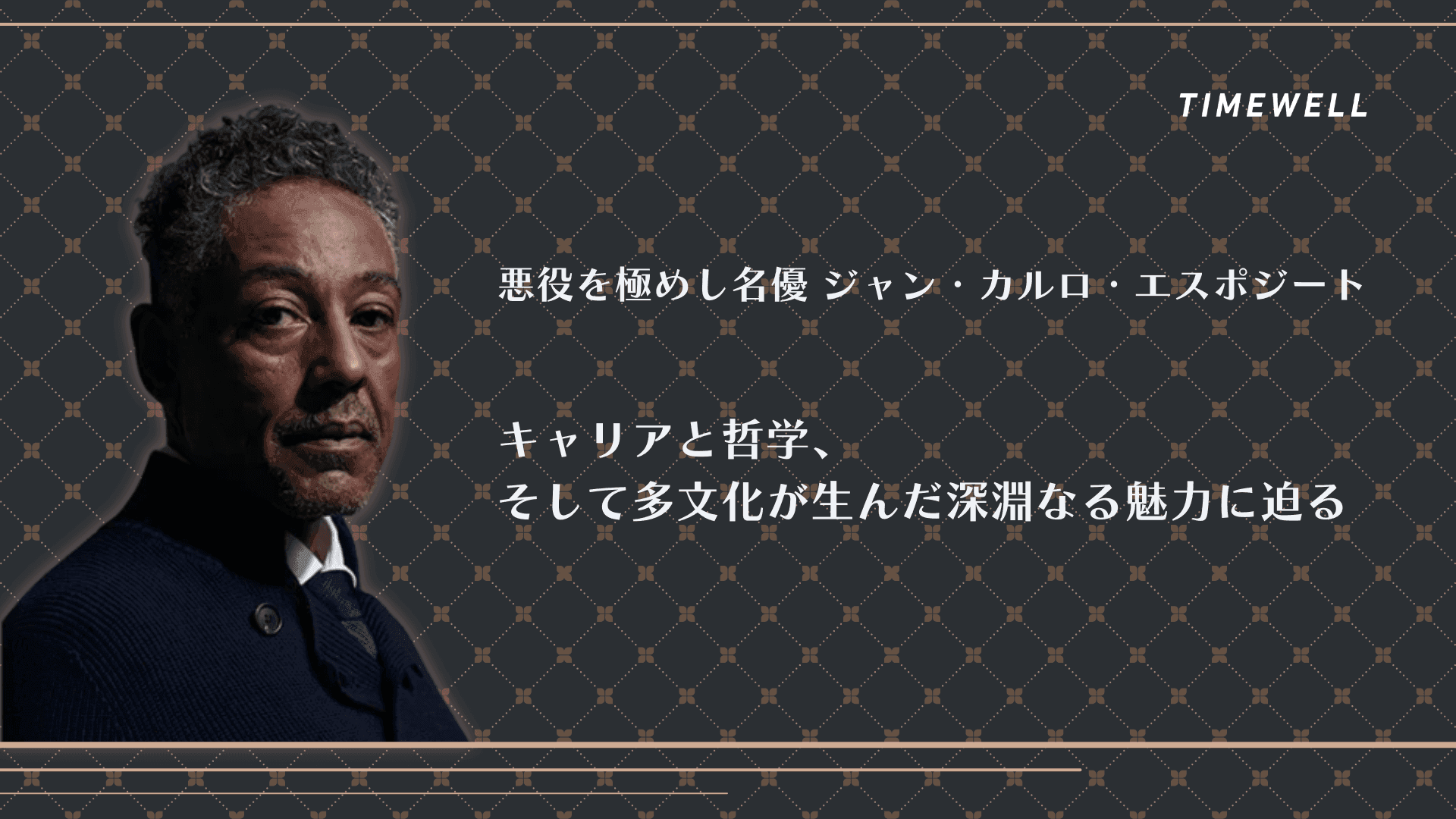
Has any actor brought such intellectual, cold, and irresistible allure to the role of a "villain" in modern film and television? "Giancarlo Esposito" — hearing that name, many will picture the cold-blooded drug kingpin Gustavo "Gus" Fring from the drama Breaking Bad. The characters he plays often leave deep marks on the viewer's psyche, bringing intense tension and depth to every story. Yet behind that charismatic villain persona lies a rich multicultural background, a firmly held acting philosophy developed over a long career, and a deeply human private self.
In this article, using Giancarlo Esposito's own words from his Wired Autocomplete Interview as a guide, we take a deep dive into his journey as an actor, his passion for building characters, and his many-faceted appeal as a person. Going beyond the label of "villain actor," we explore the secrets of how he built the position he holds today, how he continues to captivate audiences worldwide. What emerges from his words is not simply a success story, but the sincere figure of an artist dedicated to art and filled with profound insight into life.
A Talent Nurtured by Multiculturalism: Giancarlo Esposito's Origins and Path to Acting Into the Depths of Villainy: From Gus Fring to the Latest Villains — Character Building and Philosophy Versatility Beyond the Screen: Director, Voice Actor, and Giancarlo Esposito as a Human Being Summary A Talent Nurtured by Multiculturalism: Giancarlo Esposito's Origins and Path to Acting
To truly understand Giancarlo Esposito as an actor, his origins and the trajectory of his growth are essential context. His identity cannot be contained within any single culture or nationality — multiple roots, European and American, Italian and African American, are intricately interwoven, forming his rich humanity and distinctive perspective. When asked "Where do I come from?", he tells the story of his birth. His mother was an African American opera-nightclub singer; his father was a carpenter and stagehand from Naples, Italy. The two met at the Teatro di San Carlo in Italy, and Giancarlo was born in Denmark while his mother was performing alongside Josephine Baker at a supper club in Copenhagen. But his earliest memories are strongly tied to Italy — particularly Rome, where his father worked at an opera house and served as a kind of manager for his mother, and the family toured venues across Europe. Experiences at renowned theaters like the La Scala in Milan surely also nurtured his artistic sensibilities from a very young age.
His Language Acquisition Reflects That Multicultural Environment in Full
His language acquisition reflects that multicultural environment in full. The first language he encountered was a bit of German in Hamburg, where his parents were working. Italian filled the household, courtesy of his Neapolitan father. Then, after moving to America, English. But his young brain became saturated with multiple languages and at one point couldn't process them all, leading him to speak what he humorously describes as "gibberish." This experience not only formed a foundation for later playing diverse roles, but may also connect to his inclination to seek communication across language and cultural barriers. Furthermore, as he built his career, he revealed that as an actor with African American roots he initially found it difficult to get those roles — so he began learning Spanish to broaden his range. This was not merely acquiring language skills but an expression of his will to face his own identity and open up his possibilities as an actor. He proudly describes himself as "Italian and African American," treasuring both heritages.
The beginning of his acting career was, perhaps surprisingly, driven by economic hardship. Around age eight, after his parents' divorce, he and his brother were watching television in a basement apartment in Yonkers, New York where the family was living in poverty. A commercial featuring a child of color for the first time flashed on screen — and he felt it instantly: "I can do that!" "If even kids like us who were eating only frankfurters and beans with grits and ketchup could do this, we could have a better life." That powerful desire drove him forward, and his mother took the brothers to agent Ernest McLendon. Just two weeks later, he auditioned for the Broadway musical Maggie Flynn, starring Jack Cassidy and Shirley Jones — and got the part. This would be the opening curtain on an acting career spanning 58 years. This episode demonstrates not simply that he was talented, but his fierce will and determination to take his future into his own hands in the face of adversity. Young as he was, he found in acting the power to change his life and the joy of self-expression.
Starting his career as a stage actor, he accumulated years of experience in theater. But rather than stopping there, he sought new challenges and decided to move his activities into the world of film and television. It was not merely a change of field — it involved a major decision to transform his acting style. In contrast to the large expressiveness of the stage, screen performance demands something more delicate and internal. "Smaller, more condensed expression. Thoughts in your head that the audience can't read — 'What is he thinking?'" He understood that this transition would require effort. He took acting classes, deepened his self-analysis, and continued searching for the form of expression most suited to the medium of film. This spirit of inquiry and refusal to fear change are what grew him from a stage actor into a versatile actor capable of breathing life into complex characters on screen. His career has been a continuous process of self-transformation and learning — and the deep insight and expressiveness cultivated through that process led him to iconic roles like Gus Fring.
Into the Depths of Villainy: From Gus Fring to the Latest Villains
Into the Depths of Villainy: From Gus Fring to the Latest Villains — Character Building and Philosophy
There is no question that what brought Giancarlo Esposito's name before the world was his role as Gus Fring in Breaking Bad. He himself immediately answers the question "What is Giancarlo Esposito most famous for?" with "Playing the drug world's kingpin, Gustavo Fring, in Breaking Bad" — a role that became a milestone in his career. Gus Fring is a man who outwardly appears to be a community-minded businessman while covertly building a ruthless drug empire. His calm, calculated demeanor, and the explosive violence he occasionally displays, left a powerful impression on viewers, cementing him as one of the most memorable villains in television history.
The influence of Gus was enormous — and it made itself known in unexpected ways in everyday life. An airplane story he told is a perfect symbol of this. Heading to the restroom, the woman standing in front of him noticed who he was, literally froze, and pressed herself against the wall. In a state of shock, she said: "You... you... you... please, Gus, go ahead." Esposito was surprised but gentlemanly: "No please, ladies first." But she absolutely refused: "No no no no, please go ahead!" He ended up going first, and when he came out she was still there, pressed against the wall. He said "Thank you" and went on his way. This episode speaks to just how deeply Gus Fring had been inscribed in people's minds and how his presence had extended its reach into the real world. For an actor, this is the highest compliment — and an event that brought home anew just how powerful a character can be.
Somewhat surprisingly, however, Esposito himself initially resisted the question "Do you like playing villains?" "I am a dramatic actor," he identified himself, and disliked being pushed into a specific category. But in the 24 hours of reflection before the interview recording, he came to an honest admission: "Okay, I love playing villains." He finally acknowledged that he is powerfully drawn to the villain. The turning point was the legendary actor James Cagney. When he saw Cagney in the finale of the film White Heat — standing atop an oil tank with a machine gun, shouting "Top of the world, Ma!" — Esposito was stunned: "This man is having so much fun!"
From This Experience He Awakened to the Complexity and Appeal of the Villain
From this experience he awakened to the complexity and appeal of the villain. His thinking on what makes a villain compelling can be summarized in these points:
Complicated: Multi-faceted, impossible to describe in simple good-versus-evil terms.
Interesting: The audience is drawn to the motivation and backstory behind why they do evil.
Someone We Don't Know
Someone we don't know: Their inner world and true intentions are wrapped in mystery, provoking curiosity.
Drive the story: Often as the counterpart to the hero, they become the central presence that brings tension and dynamism to the narrative.
Electric and exciting: They radiate a charisma and dangerous allure that makes you unable to look away.
In for a penny, you're in for a pound: In playing the role, half-measures are not allowed — total commitment to the character is required.
He Acknowledges That Villains Are the Counterpart of Heroes
He acknowledges that villains are the counterpart of heroes — some may even have good intentions, but many do not — while emphasizing that their existence enriches stories and holds the power to captivate audiences. This deep understanding of and affection for the villain is the source that gives his Gus Fring, and the many memorable villains he has played since, both conviction and humanity.
His villain repertoire goes well beyond Gus Fring. In the game Far Cry 6, he played Anton Castillo, the dictator of a fictional Caribbean island nation called Yara. "A leader of a small Latin American country, a dictator, a very interesting man," as he describes him — Castillo is also drawn as a compelling villain with a complex background and belief system. He also played "The Dentist" in the game Payday 2. In the anime Cyberpunk: Edgerunners, he provided the voice of fixer Faraday — "to give life to that man in that anime influenced by Japanese animation culture within American culture, it was a truly wonderful project," he said, pursuing the appeal of villainy in voice acting as well. His appearance in a Netflix Wednesday promotional video was an experience he thoroughly enjoyed — playing freely and with abandon, a character he described as "Castilla-style, very large and wonderful" within Jenna Ortega's Wednesday world. More recently, he appeared in the Netflix drama The Residence. Called "Knives Out in the White House," in this work he plays AB Winter, the Chief Usher of the White House — discovered as a corpse in the opening of the story, but playing an important role in the suspense drama swirling with complex relationships. Through these diverse villains, Giancarlo Esposito has continued to explore the many facets of the concept of evil, offering audiences new surprises and excitement.
Versatility Beyond the Screen: Director, Voice Actor, and Giancarlo Esposito as a Human Being
Giancarlo Esposito's Talent Is Not Confined to Performing in Front of the Camera
Giancarlo Esposito's talent is not confined to performing in front of the camera. He has been active as a director alongside his acting career, having made two feature films. "Directing has also changed my life," he says. The director's position allows him to engage with a story from a perspective different from that of an actor. "More personal stories, stories about people who live everyday lives — the kind of people who don't usually get targeted in movies." Through directing, he satisfies his inner urge as a storyteller and burns with passion for depicting people in greater depth. His words — "I plan to make more films. Come see them in theaters!" — convey a strong desire for creative activity. It is not hard to imagine that the experience of digging into a character's inner world as an actor also feeds into the work of constructing the full story as a director and breathing life into its characters.
His rich expressiveness is also on full display in his voice acting work. "Part of voice acting requires a great deal of imagination," he says. The ability to deeply understand and express a character's inner world — cultivated through his career — is a major strength in voice acting, where a character must be created with voice alone. "If there is something I want you to nurture, it's imagination." He emphasizes the importance of working your imagination to its fullest inside the voice recording booth. "Sometimes I close my eyes and follow the character's journey." In many cases it is not a matter of laying his voice over images on a screen — he first creates the voice, and animators then draw to match it. This is testament to the fact that his vocal expressiveness has the power to shape the character itself. "From my Broadway acting days, I know how to use my voice well. I love voice acting and will continue doing it until I die." His voice carries a resonance and depth cultivated through years on the stage, which gives characters like Faraday in Cyberpunk: Edgerunners their distinctive presence. His affection for anime runs deep — "I find anime very interesting," he says, showing interest in the cosplayers he encounters at Comic Con as well.
In sharp contrast to the intense characters he plays on screen, when asked the candid fan question "Is Giancarlo Esposito a good person?", he smiles and answers: "Yes, I am a good person." He acknowledges his own integrity while also noting "I might not be the same tomorrow as I am today — and that's fine," showing a flexible view of human beings as always changing and growing. But at its foundation is a firm belief: "I believe people are fundamentally good. That is my philosophy of life." He is aware that he is not the entirety of the characters he plays, and speaks of loving life and people in his real life. He also mentions his experience appearing in the comedy film Nothing to Lose and reveals the desire to try his hand at romantic comedies going forward. "I am thinking about how to make a romantic comedy where somewhat more mature characters appear." Strong as his villain image is, his inner world also harbors an interest in depicting the subtleties of human relationships and warmth.
Essential to Describing His Humanity Are His Four Daughters
Essential to describing his humanity are his four daughters (Shayne, Kale, Syr, and Ruby). "They changed my life. They changed my way of thinking and habits I inherited from my father." Now in their twenties, he expresses gratitude for the way his relationship with them has helped him grow into a "real man." The bonds of family have surely nurtured the depth of his humanity, also enriching his expressiveness as an actor.
One of the early important works in his career is Spike Lee's Do the Right Thing. In this film he played Buggin Out — the young man who questions why there are no photographs of Black people on the pizzeria wall. "I love Spike Lee. I love this film," he says, reflecting that participating in the project "was a very special experience." He quotes the line from the character played by Ossie Davis in the film's finale who says to Spike Lee's character "Always do the right thing," emphasizing the universal message this film carries. He watched it again in the Netherlands about five years ago and felt that its power had not diminished at all — expressing respect for the long friendship with Spike Lee and what he represents. This work demonstrates that he is an actor who actively engages with socially meaningful projects, posing questions through his performances.
He also mentions the meme "We are not the same" — born from a scene in Breaking Bad — as a distinctly modern phenomenon. "I get this meme sent to me five times a day from acquaintances." He himself seems to enjoy the phenomenon, saying "I'm happy it came from a very organic place where people know me." This is proof that his influence extends not only to traditional media but to internet culture as well.
So how did he acquire such "fame"? To the question "How do you become famous?", he offers a simple answer: "If you love what you are doing, you won't work a single day in your life." He says he didn't aim for stardom or celebrity — he simply committed himself relentlessly to his work, the act of performing. Through the highs and lows of his career, he has always tried to remain himself and understand his connection to the work he is engaged in. "That's probably why I became famous," he says. Furthermore, he defines himself not merely as an actor but as a "storyteller." "I think my true calling was to tell stories and move people's consciousness from one place to another." This deep conviction is what makes him not merely a craftsman of acting technique, but an artist who resonates deeply in the hearts of audiences.
Giancarlo Esposito
Giancarlo Esposito. His trajectory as an actor is not simply a success story. A multicultural background — born in Denmark, raised in Italy, building a career in America. Overcoming economic hardship and stepping into the world of theater at age eight. The spirit of inquiry that moved from stage to screen and continued to reinvent itself. The fateful encounter with Gus Fring in Breaking Bad and a deep insight into and love for the villain. A talent extending into directing and voice acting. And the integrity of a man who loves his four daughters and speaks of his trust in life and people.
The many words he spoke in the Wired interview tell of how passionately and sincerely he has engaged with his work. "If you love what you are doing, you won't work a single day in your life." "My true calling is to be a storyteller." These words testify that rather than merely playing roles, he is trying to deliver something to people's hearts through stories. By deeply understanding the complexity and appeal of villains and embodying that on screen, he has caused us audiences to question the boundaries of good and evil and reflected the many-sided nature of humanity.
In Gus Fring's cold gaze, in Buggin Out's questioning in Do the Right Thing, and in the new characters he will surely play going forward — the soul of that rare storyteller Giancarlo Esposito lives on. His journey continues. We will never be able to take our eyes off the stories he weaves, and the profound depth of his appeal. His existence reminds us anew that great acting is not merely technique, but art backed by deep human understanding and life experience.
Reference: https://www.youtube.com/watch?v=RnHJFfxCQAg
Related Articles
- The Reality of a Working Mother Returning from Two Maternity Leaves — And How Her Work Philosophy Changed | TIMEWELL
- Before Taking Paternity Leave (Part 2): Three Absolute Must-Dos for Taking Leave During a Busy Season
- A First-Class Architect Who Stays Close to the Job Site — Finding My Own Path as the Fifth-Generation Leader of a Construction Company