From TIMEWELL
This is Hamamoto from TIMEWELL Inc.
Looking for AI training and consulting?
Learn about WARP training programs and consulting services in our materials.
Parkinson's Disease — One of the Fastest-Growing Neurological Disorders in the World
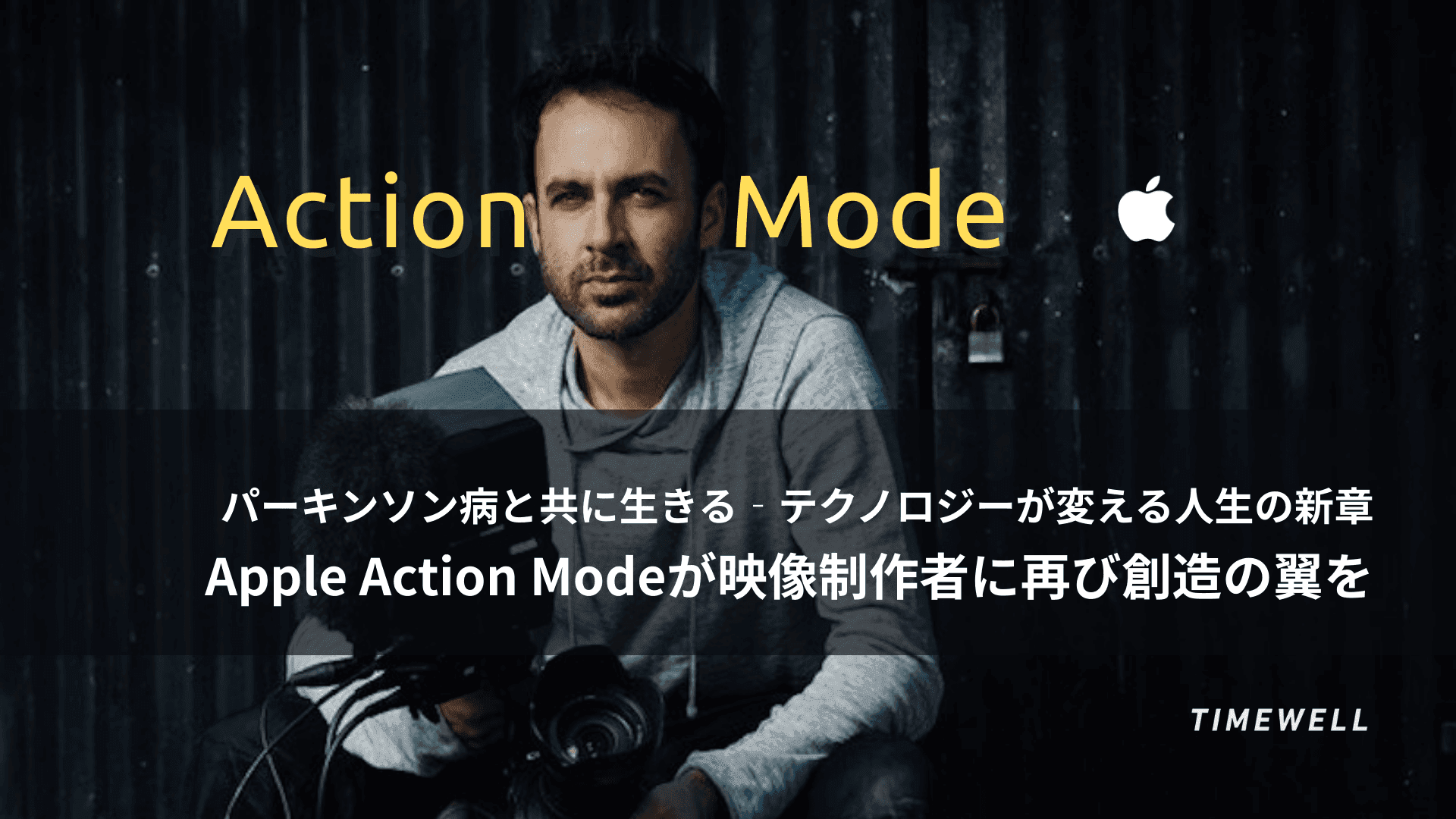
Parkinson's disease is one of the fastest-growing neurological disorders in the world, with more than 10 million people living with it today. In one video, Brett Harvey — a creator who has loved cameras for over 30 years — is shown being forced to say goodbye to filmmaking, the passion that defined him, because of trembling hands. Diagnosed at 37, his career as a videographer was in crisis. But a breakthrough in technology brought a turning point, and what seemed lost began to shine again.
In this article, through the moving story of Brett Harvey — a videographer diagnosed with Parkinson's disease who deepens his bonds with family and reclaims his creativity through Apple's innovative image stabilization technology, Action Mode — we explore a new perspective on living with illness and the possibilities that technology opens up. We delve into the truth of how, even in the face of hardship, an attitude of refusing to give up brings new meaning to life.
Early-Onset Parkinson's Disease: The Turning Point That a Diagnosis at 37 Brought to His Life Family and Everyday Life — Warm Bonds and Challenges of Living With Parkinson's Disease The New Door Technology Opens: How Action Mode Brought His Creativity Back Summary: A New Chapter of Life With Parkinson's Disease Early-Onset Parkinson's Disease: The Turning Point That a Diagnosis at 37 Brought to His Life
Parkinson's disease, as one of the fastest-growing neurological disorders in the world, is lived by more than 10 million people today. This number is not mere statistics — it encompasses the story of each and every life, and early onset in particular is an event that overturns a person's entire life plan from the ground up.
When Brett Harvey was diagnosed with Parkinson's disease at age 37, he described it as "almost impossible to explain, doesn't make sense." Because the statistical probability of developing Parkinson's disease at 37 is extremely low — and feelings of "this is wrong, it can't be me, why me" simply washed over him. This question of "why me" is a deep cry against the absurdity of life — a fundamental questioning of one's identity.
In the Video, the Process of Brett's Hands Trembling
In the video, the process of Brett's hands trembling around a camera — and the joy he had found in filmmaking over a lifetime gradually slipping away — is depicted in vivid, unsparing detail. The skills and sensibility built over decades collapsed in an instant, and it felt as though he had been thrown into a new challenge. The days of excitedly framing the world through a lens had transformed into days of fighting his own body.
Brett Harvey's identity begins with "I am a videographer, a writer, director, and editor" and continues with "what I love above all else is playing with cameras." For someone who had walked alongside cameras for 30 years, the camera was not merely a tool — it was an extension of self-expression and the language through which he conversed with the world. Yet the reality that "because of hand tremors, I can no longer do that" threatened the very meaning of his existence.
The impact of Parkinson's disease is not limited to physical suffering. The questions that arise in the heart — "why me?" — the anxiety about the future, the sense of loss for a dream that seemed on the verge of disappearing — are immeasurable. And at the same time, these agonies are a blow not only to the person themselves, but to the family members and friends who support them. A diagnosis sends shock waves that everyone must face together.
As Brett himself describes it, the trembling of his hands became a part of his life, and as the world of film he had once freely expressed in quietly drew its curtain, he had to "slowly say goodbye to what he loved." The process of "slowly, but surely, coming to accept it" carries a cruelty unique to chronic illness — not sudden loss, but gradually losing what you could once do, a little more every day. Each day losing a little more of what you used to be able to do means being forced through a continuous process of grieving.
In This Way, the Effects of Parkinson's Disease Touch Every Dimension of a Person
In this way, the effects of Parkinson's disease touch every dimension of a person — identity, work, dreams, and the entire outlook on the future. To face that suffering requires not only seeking medical help, but the resolve to confront the darkness within — along with continuous effort to find new meaning and value in one's life.
Family and Everyday Life — Warm Bonds and Challenges of Living With Parkinson's Disease
The scene where Brett talks about ordinary everyday moments with his son Dexter reflects the warmth that family brings and the flexible attitude of accepting the reality of living with illness. Dexter pays no mind to his father's trembling hands — responding naturally when asked about them: "Yeah, Daddy shakes." Those innocent words have become an irreplaceable light of hope for his father.
About his relationship with Dexter, Brett says: "Playing with Dexter is not something I'd call a hobby, but it really is like a hobby. I love it. I really, really love it." The conflict between describing the time spent with his child as a "hobby" and the deep love he feels for those moments intertwine with each other.
For Dexter, his father's trembling is "completely normal" — "he is completely used to my trembling, doesn't react at all." For example, when other children ask about the trembling, Dexter answers "Yeah, my dad shakes." When his father hears this reply, he thinks inwardly "You're alright, Dexter" — and draws new perspective and courage from that exchange.
About Their Daily Life Together, He Speaks With Deep Affection
About their daily life together, he speaks with deep affection. When playing with Dexter — "the light is beautiful and I'm outside with him and I'm thinking 'Oh, I wish I could film this if I could, but I can't'" — this description captures the tension between the filmmaker's instinct to record the beauty of a moment and the reality of not being able to.
The day Dexter first rode a bicycle had special meaning. Beyond the simple fact of "Dexter rode a bike for the first time," this was an important milestone in the child's growth — a precious moment a parent wants to preserve forever. It was in trying to capture that bike ride with his son that Brett discovered new possibilities in camera technology. A stabilized camera exceeded what he had previously been able to do with any other approach, becoming a step toward reclaiming the passion he thought he had lost. "Yesterday was the first time I used Action Mode," he said — with joy, and the sense of expectation that his beloved filmmaking might once again become possible.
Brett conveys that through the footage of family captured with his camera, "these moments give me such energy and courage in fighting the disease" — that even amid his own suffering, he is finding a bright hope for the future. The videos watched as a family carry precious moments of shared family history and memory, and this footage is not simply a record but a precious inheritance passing down love and bonds to the next generation. For a father who had been unable to film due to Parkinson's disease, the meaning of being able to leave these images is immeasurable.
The New Door Technology Opens: How Action Mode Brought His Creativity Back
"Yesterday Was the First Time I Used Action Mode"
"Yesterday was the first time I used Action Mode" — this meeting with technology, beginning with that single sentence, became a life-changing turning point for a videographer with a 30-year career. Action Mode, an innovative image stabilization technology, was not simply a new feature — it offered the possibility of recovering lost ability and once again engaging in creative activity.
The simplicity of use was also a crucial factor. Just "tap Action, tap Record" — the ability to shoot professionally stable footage with just two easy operations is an extremely important factor for a Parkinson's patient for whom tremors make complex operations difficult. With the technical complexity removed, he could concentrate on the creative act of filming itself.
There is detailed psychological description of filming Dexter's first bicycle ride. "When he first came riding toward me and I was filming him, what I was thinking about was just that he was riding a bicycle. I wasn't actually thinking much about what I was filming." These words show how the fact that the technology became invisible allowed him to concentrate on the human experience itself.
The words "come on, son, come on" are those of a father — not as a cameraman, but as a pure parent watching over and cheering on his son's growth. This speaks to the way Action Mode doesn't simply correct hand tremors but liberates the person filming from technical worry, allowing them to immerse in an emotional experience.
Brett compared Action Mode to previous image stabilization technology: "I've used cameras with image stabilization, and this surpasses all of them." This evaluation from a videographer with 30 years of experience across various professional equipment clearly demonstrates Action Mode's technical superiority. The expression "surpasses all of them" — not simply "good" — means this technology has an innovation that sets it apart from existing solutions.
Specific Filming Scenarios Made Possible by Action Mode:
• Specific Filming Scenarios Made Possible by Action Mode:
Recording the historic moment of son Dexter's first bicycle ride
A filming experience in which he can concentrate on his subject without worrying about trembling
The expression "a chance to capture raw, real emotion" expresses the essence of the value that Action Mode provides. In filmmaking, what matters most is not technical perfection — it is capturing the truth and feeling of that moment. Parkinson's disease tremors were impeding this essential purpose, but Action Mode removed that barrier.
The Emotion in the Single Word "Unbelievable"
The emotion in the single word "unbelievable" is not simply amazement at technology. It is the emotion of an ability that was thought lost coming back — the joy of once again being able to engage in creative activity. This feeling speaks to how important adaptive technology is for people with disabilities. Action Mode makes it possible to record these precious moments without being hampered by Parkinson's symptoms.
"These are the most meaningful memories of my life." This recognition demonstrates that the value of footage lies not only in technical quality but in the emotions and memories it contains. Action Mode made it possible to record these precious moments without the symptoms of Parkinson's disease getting in the way.
"What was wonderful about yesterday was that it made me feel like I could film something again." These words express the essence of the hope that technology brings. The revival of the possibility of "being able to film again" carries a meaning beyond simply being able to resume a hobby. It means reclaiming one's identity and rediscovering life's purpose.
"He's coming right at me!" — this excitement-filled exclamation is an expression of the vitality and joy of that moment, clearly demonstrating that the feeling stolen by Parkinson's disease has been called back to life by technology.
"For someone like me who has been using cameras for 30 years, having it become an option again is life-changing." These words cut to the heart of this story. "Parkinson's disease takes away many options, but Action Mode offers the possibility of recovering a lost option. It is not simply a binary of 'can' versus 'cannot' — it means recovery of the freedom and dignity of being able to 'choose.'"
The Benefits That Technological Progress Brings — This Case Offers Important Insights
The benefits that technological progress brings — this case offers important insights. For people with disabilities, technology is not simply a convenient tool but something that demonstrates the possibility of compensating for lost abilities and dramatically improving quality of life. Technology like Action Mode can be a new hope not only for people with Parkinson's disease but for people with various motor function disabilities.
The fact that creative activity in the form of filmmaking became possible again has a significant impact not only on the professional dimension but on mental health as well. Creativity is one of the essential human needs, and being able to express it is connected to a sense of purpose and self-realization. Action Mode has proven that this essential human need can be met even when living with illness.
Summary: A New Chapter of Life With Parkinson's Disease
"My advice to someone who has been diagnosed with Parkinson's disease is that it is not the end — it is simply the beginning of a new chapter." This powerful message encapsulates the philosophy of hope that runs through this entire story. The perspective of reframing the shocking event of a diagnosis not as the end of life but as the beginning of a new story is an important guide for everyone living with chronic illness.
"Do Not Give Up
"Do not give up. Because if you give up, Parkinson's disease wins. We cannot let Parkinson's disease win." This resolve is not empty sentiment. It is a practical philosophy of living — backed by actual action, the use of technology, family support, and the accumulation of small daily victories.
The most important lesson this story teaches is that a Parkinson's diagnosis does not define everything about a life. Yes, illness brings many difficulties. Diagnosis at 37 years old, the crisis of a 30-year career, the sense of loss at no longer being able to handle the cameras he loved, anxiety about the future. But these trials were simultaneously opportunities for new discovery and growth.
The importance of the role family plays cannot be overstated. Dexter's pure acceptance, and the deep bonds the whole family recognizes. These elements combined to transform a personal trial in the form of illness into an opportunity for the whole family's growth and solidarity.
The encounter with technology — specifically Apple's Action Mode — became not only the key to recovering lost ability but to opening new possibilities in life. "For someone like me who has used cameras for 30 years, having it become an option again is life-changing" — these words prove the transformative power that adaptive technology holds.
Living With Parkinson's Disease Is Certainly Not Easy
Living with Parkinson's disease is certainly not easy. But this story demonstrates that with the right support system, innovative technology, and an indomitable spirit, it is possible to lead a meaningful and full life.
Finally, this videographer's story is an encouragement not only to people with Parkinson's disease but to everyone facing difficulties. Unexpected turning points in life do not necessarily mean endings — they hold the possibility of new beginnings. With family love, technological progress, and a heart that refuses to give up, any trial can be overcome. This is the message of hope that one videographer living with Parkinson's disease has passed on to us.
Reference: https://www.youtube.com/watch?v=hEalzEnT70k
Related Articles
- The Reality of a Working Mother Returning from Two Maternity Leaves — And How Her Work Philosophy Changed | TIMEWELL
- Before Taking Paternity Leave (Part 2): Three Absolute Must-Dos for Taking Leave During a Busy Season
- A First-Class Architect Who Stays Close to the Job Site — Finding My Own Path as the Fifth-Generation Leader of a Construction Company