This is Hamamoto from TIMEWELL.
Introduction
There are professionals who spend years in a medical specialty, watching a specific failure point in patient care play out again and again, and eventually decide they cannot watch anymore. Yukihiro Ishida is that kind of founder.
After 19 years as a clinical engineer specializing in hemodialysis — watching diabetic patients lose their feet and their lives — he encountered a group of ASEAN healthcare professionals in 2022 who told him the same problem was devastating their communities. He reoriented his career to address it.
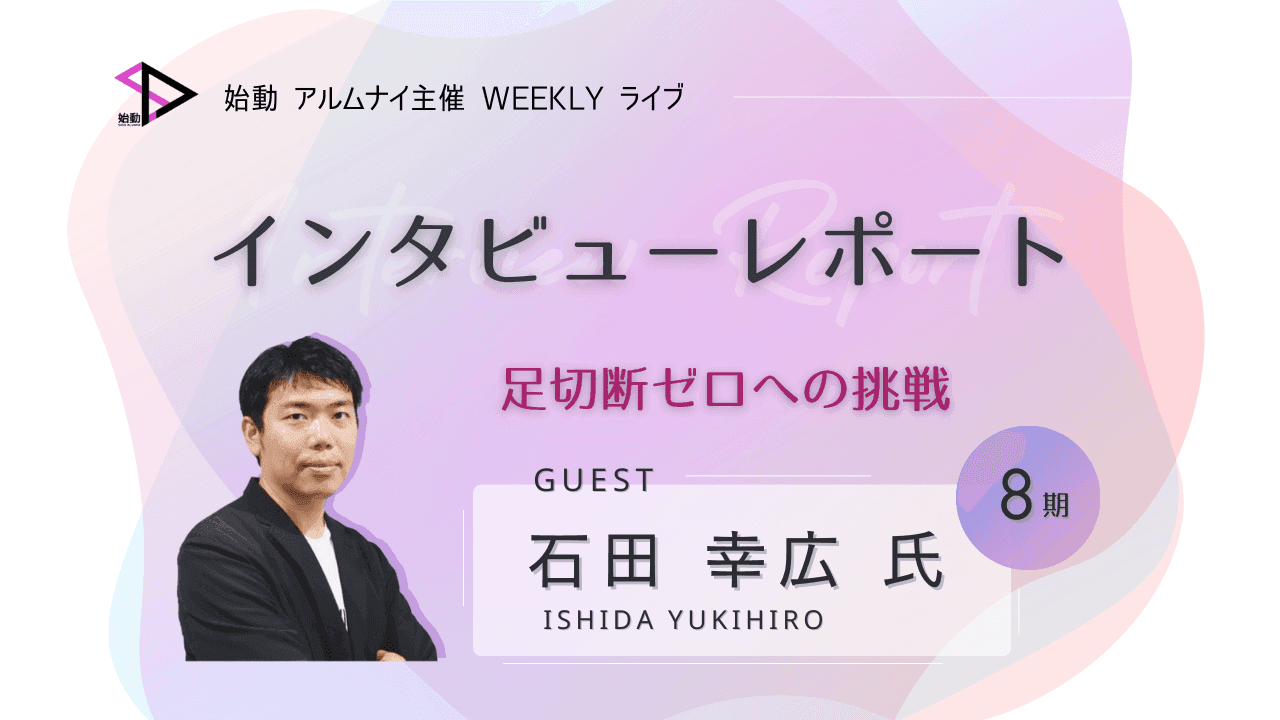
This interview covers how he built Second Heart (operating the Steplife platform), what he learned — and struggled with — in the Shido entrepreneur accelerator program, and where he is taking the business globally.
The Problem: 10,000 Amputations Per Year in Japan. Over a Million Globally.
Can you describe the clinical reality that led you to this work?
I worked as a clinical engineer for about 19 years, specializing in hemodialysis. Roughly half of hemodialysis patients are end-stage diabetics, so I spent a long time watching the progression of severe diabetes.
One of the outcomes I saw repeatedly was foot amputation. When blood sugar control fails over time, neuropathy develops — the nerves in the feet deteriorate and sensation is lost. A patient with no foot sensation can step on a nail, cut their foot, develop a wound and not feel it. The wound isn't noticed until infection has set in and tissue death has begun.
The familiar stories in the ward: patients who walked in leaving a trail of blood and didn't know why. Patients with foreign objects embedded in their feet they hadn't noticed for days. By the time the wound is discovered, the infection may have spread enough that the foot can't be saved.
There are approximately 10,000 foot amputations per year in Japan alone from this cause. Globally, the commonly cited figure is about 1 million major amputations per year — "major" meaning the foot or more. Some researchers now put it at closer to 2 million, given how fast the global diabetic population has grown. Every 20 to 30 seconds, somewhere in the world, someone loses a foot to diabetic complications.
What happens after amputation?
This is what people don't realize: amputation doesn't lead to rehabilitation and a return to normal life. The five-year mortality rate after diabetic foot amputation is cited at around 70%. In my experience with actual patients, most are gone within a year.
When you lose a foot, you lose mobility. When you lose mobility, you lose social participation. When you lose social participation, wellbeing collapses — physically, mentally, and socially. The decline accelerates. The amputation is often not just a physical event; it initiates a cascade that shortens life substantially.
This is the outcome I was watching, repeatedly, for nearly two decades.
Looking for AI training and consulting?
Learn about WARP training programs and consulting services in our materials.
The Pivot: What an ASEAN Delegation Said in 2022
What shifted your thinking toward building a business?
In June 2022, about 20 healthcare professionals from the Philippines, Malaysia, and Indonesia visited a company I serve as a director. We had been looking at whether we could export respiratory monitoring devices to ASEAN — we assumed that air quality issues in developing economies would translate to high respiratory disease prevalence.
So I asked them: "What are your most pressing healthcare challenges?" I expected respiratory disease to come up.
Their response caught me off guard. "Forget respiratory. The problem we desperately need help with is people losing their feet. Diabetic foot amputations. Can you do something about that?"
I had spent 19 years working with exactly this problem. I had done foot care, observed amputation surgeries, watched vascular interventions on diabetic feet. I had been focused on the individual patient in front of me, not the global scale of the issue.
That moment reframed everything. The problem I knew — the problem I'd watched play out thousands of times — was a global problem that no one was attacking at scale from a systems perspective. That was when I decided to build a business around it.
Second Heart and Steplife: What the Platform Does
What has Second Heart built?
Our core product is Steplife — a remote foot monitoring app and system. The patient photographs their feet regularly; those images are transmitted to their healthcare provider, who can track the condition over time and catch deterioration early.
A critical feature: Steplife is not classified as a medical device under Japanese regulatory standards. We verified this with the PMDA (Pharmaceuticals and Medical Devices Agency). This allowed us to launch without the multi-year medical device approval process. Our eventual goal is medical device classification, but launching as a non-device tool first let us get into the market, gather data, and build relationships.
Beyond the monitoring app, we're developing VR-based patient education for diabetes — helping patients understand the progression of diabetic neuropathy in ways that static educational materials don't communicate effectively. We've also developed diabetic-friendly socks — footwear that doesn't create pressure points or restrict circulation — which we provide to patients as a care gesture, not just a product.
The Shido Program: Frustration Before Clarity
You participated in the Shido entrepreneurship accelerator as an 8th cohort member. How was the experience?
Honestly, during the program I felt like I wasn't progressing. I came in with the same basic framework I started with. I'd hit a wall.
The program brought in mentors, instructors, and senior participants who had built substantial things. When I listened to them, I felt like I needed to incorporate everything they said — if someone successful says X, then X must be right. I was absorbing advice from every direction and trying to include it all.
The result was that I lost track of what I actually believed about my own business. By the time of the Silicon Valley pitch selection — the major milestone in the middle of the program — I wasn't satisfied with what I'd prepared. I gave a presentation that didn't reflect what I actually wanted to build. I didn't make it to Silicon Valley.
I watched my cohort go, and I felt genuinely frustrated. Not just disappointed — frustrated in the way that comes from not knowing what went wrong.
How did you eventually find your footing?
The program had a final domestic stage after the Silicon Valley cohort returned. There was a selection process for the DEMO DAY — the national pitch event. The deadline for submitting was approaching. Until one hour before the deadline, I wasn't sure whether to submit at all.
I submitted. Got selected. Stood on the DEMO DAY stage.
For the first time in the program, I felt confident in what I was presenting. Not because the business had changed dramatically — because I'd stopped trying to build someone else's version of my business and returned to what I actually understood and believed.
What's the lesson you'd share with someone considering the program?
The value of the program isn't always visible while you're in it. A lot of what I encountered — the frameworks, the feedback, the conversations with people who'd built things — took time to actually absorb. It wasn't useful in real time. It was useful months later, when I was working through a specific problem and a piece of advice I'd heard suddenly clicked.
The people who go through the program are genuinely impressive. That becomes clear in retrospect, even if it isn't obvious in the moment.
If you have something you want to build — something you've identified as genuinely important — and you don't know how to structure the path forward, the program is a legitimate option. It won't hand you certainty. But it will put you in proximity to the right questions and the right people at the right time.
The connections from the program continue to have value long after the formal sessions end. You feel accountable to the people you've met. That accountability is its own kind of fuel.
Global Strategy: ASEAN First, Then India
Where is Second Heart headed internationally?
The origin of this business was a conversation with ASEAN healthcare professionals — so returning to ASEAN with a working solution is the core mission, not just an expansion opportunity.
The immediate plan: apply for a Malaysian entrepreneur visa. The structure of the program allows existing companies to apply as established entities and receive a five-year visa — longer than the one-year visa available to brand-new applicants. Once approved, the plan is a dual-location life: Japan and Malaysia, with Malaysia as the ASEAN hub.
From Malaysia, the expansion sequence would cover Singapore, Indonesia, the Philippines, Vietnam, and Thailand. These are the markets with the largest diabetic populations and the most acute shortage of accessible foot care infrastructure.
India is a parallel target. The diabetic population in India is over 100 million — one of the largest concentrations globally. We've already connected with podiatric specialists there; in fact, an Indian foot specialist recently purchased 50 pairs of our diabetic socks directly. That's a small signal, but it's a concrete one.
Beyond India, Bangladesh and Pakistan represent major opportunity: Bangladesh reportedly has diabetic prevalence above 30% of the population. These are countries where the gap between the scale of the problem and the availability of solutions is enormous.
On Persisting Through Uncertainty
What would you say to someone who is at the stage of wanting to start but not yet sure of the path?
Keep going. Keep building something visible.
My experience was that I struggled through most of the Shido program without knowing if anything was landing. I built slowly, without confidence that the business would become real.
But when it started to take concrete form — when there was something others could point to — people started to acknowledge it. That acknowledgment doesn't come until there's something real to acknowledge.
The most important thing is not to quit before you reach the point where the work speaks for itself. That point is further away than it feels while you're struggling. But it comes if you keep building.