From TIMEWELL's Hamamoto
This is Hamamoto from TIMEWELL.
Looking for AI training and consulting?
Learn about WARP training programs and consulting services in our materials.
Coordinating Internships and Side Jobs
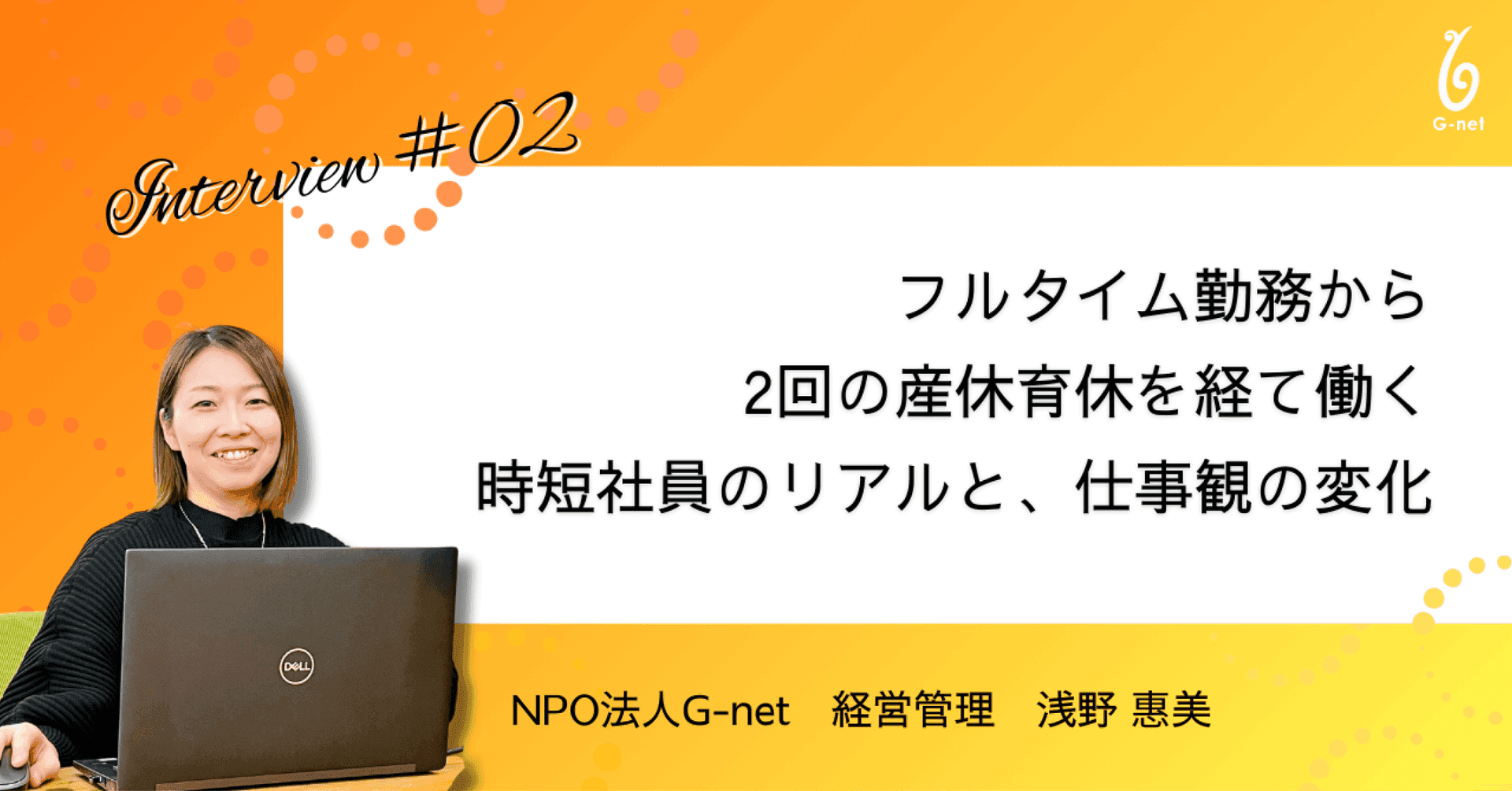
NPO G-net coordinates internship placements for university students and side-job arrangements for working professionals, channeling that energy into community development and talent cultivation. The organization actively promotes diverse work styles as a core part of its mission, and today many staff members work non-full-time arrangements — including reduced hours, side jobs, or dual roles. We spoke with Asano-san, who joined G-net as a full-time employee, took two rounds of maternity and parental leave, and continues to work there today on reduced hours — asking her how her outlook on work has changed and how she manages the balance with parenting.
Asano-san joined G-net in 2014, at age 24, as a career-change hire. She took maternity and parental leave for her first child in 2018 and her second in 2021. Today she works four days a week for 22 hours total, fully remote, while raising children aged 2 and 6. With a flex schedule, her hours shift day to day, but she generally works from about 9:30 a.m. to 4:00 p.m.
"This morning I had a nursery observation session starting at 9:30, so I went there first and managed to get home by 10:30 to start work. On days like today, when the kids have something going on, I don't need to take paid leave — I just say 'I'll be stepping out for an hour' and that's it. That's what I love about flex scheduling."
Her current responsibilities span corporate back-office work, HR and recruiting, secretariat operations, and event management. In April 2024 she was set to become team leader of the management team she belongs to, while keeping the same 22-hour-per-week schedule. "I have some anxiety about it, but I've decided from the start not to try to do everything on my own. I plan to rely on other leaders and team members and do what I can within my capacity. G-net is an organization that supports diverse work styles, so I trust it to accommodate someone like me — and I want to be a living example of that."
Life Events Arrived Earlier Than Expected, and Her Role Evolved Accordingly
A Proposal at 25 — One Year After Joining G-net
One year after joining G-net, Asano-san received a marriage proposal at age 25. She and her then-fiancé had open conversations about what mattered most to each of them going forward. "As we aligned on our values, I was honest about wanting to keep working the way I had been, even after getting married." That led to two full years of immersing herself in work — and also became a motivation to produce visible results before the life events of childbirth and child-rearing inevitably arrived.
Those results materialized in the form of being selected as a representative case in a program called the "SME Management Innovation Program." At the time she was working as a "coordinator" connecting university students with companies, and the companies she managed were selected twice as outstanding project examples — an experience that gave her a deep sense of achievement.
"Coordinator work is endlessly deep, and you can keep refining it forever. But that experience made me want to take on new roles and challenges."
Right around that time, she became pregnant with her first child. When she returned from parental leave, she was offered a role in the secretariat and management team — a new step she accepted, and one she has pursued ever since.
"I feel fortunate that I was able to take on new roles and types of work — coordinator, secretariat for the 'Furusato Concurrent Employment' initiative, launching the online campus 'Tsunagaru Campus,' HR — at each stage of my life."
Four Out of Five Are Raising Children
Four out of five team members are raising children — and yet the management team has made sure no task becomes irreplaceable.
The management team Asano-san belongs to has five members. Four have children, and one holds a side job. Everyone works under time constraints, with team members working between 15 and 30 hours per week. No one works full-time.
What the team holds dear is making sure there are no tasks that "only this one person can do." Each member's workload is understood not just by the team leader, but by everyone on the team. "For a team of parents to function, granular information-sharing is essential. We communicate constantly about small things — 'My kid seems a bit under the weather, I might be out tomorrow,' or 'I have something coming up next week that'll keep me busy, so I should push this task forward now.' We make sure everyone shares the same picture."
I Used to Be a Lone Wolf
"I work in a team now, but back when I was a coordinator, it was the complete opposite — I was the type who wanted to do things my own way because I could get results. My thinking changed dramatically because of our current team leader. She also has two children and works reduced hours, and she had a clear sense of the problem: 'It's strange that an organization promoting side jobs and dual roles would be hard to work in for anyone who isn't full-time.' She proactively drove the improvements the team needed to function — building rules, introducing information management tools. I resonated deeply with her mindset and working style. It had a big influence on me."
"Within the constraint of 22 hours per week, you simply can't do everything perfectly on your own. Balancing parenting and work has helped me make peace with that, in a good way. I still give it everything I have, but I try not to put myself down when something doesn't get done — telling myself 'it's because I'm not capable.' Since I started relying on the team when I need to and approaching work as something we do together, I no longer have to carry it all alone."
The Winds Are Favorable
The times are on our side — and we're building a better workplace ourselves.
In the aftermath of the pandemic, many companies adopted fully remote work and flex scheduling, and it feels like the tailwinds for "working comfortably" are stronger than ever. "For me personally, being able to work fully remote is what made it realistic to consider having a second child."
And just as the management team's experience shows, a better workplace is something you can build yourselves. "The process of figuring out better ways of working together is hard, but it's also kind of fun. I'm about to take over as the new team leader, and I want to preserve the supportive environment our current leader built — and keep improving on it."
G-net has the systems and structures in place to make balancing parenting and work feasible, but what stands out even more is the warmth colleagues show toward those on parental leave. "When I was anxious, the organization's culture — the feeling that 'you belong here, and that's okay' — truly saved me. Even if someone has to take time off because a family member is sick, or because of a personal commitment, everyone covers for each other with an 'I'd want the same' spirit. When a colleague comes back from parental leave, people genuinely say 'We've been waiting for you!' That kind of culture is deeply rooted at G-net."
In an era of diverse work styles, the right balance between parenting and work looks different for everyone. What matters is whether you feel at peace with the choice you've made. At G-net, because the organization encourages side jobs, dual roles, and reduced hours, each staff member gets to choose a way of working they can genuinely stand behind. We'd love to hear about the work style that works for you — please tell us when we meet. G-net is looking for people who want to give their all to both parenting and work.
Interested? Reach Out Here
Interested? Please feel free to reach out!
This interview article was produced by the online assistant service "TIMEWELL."