Hello, this is Ryuta Hamamoto from TIMEWELL.
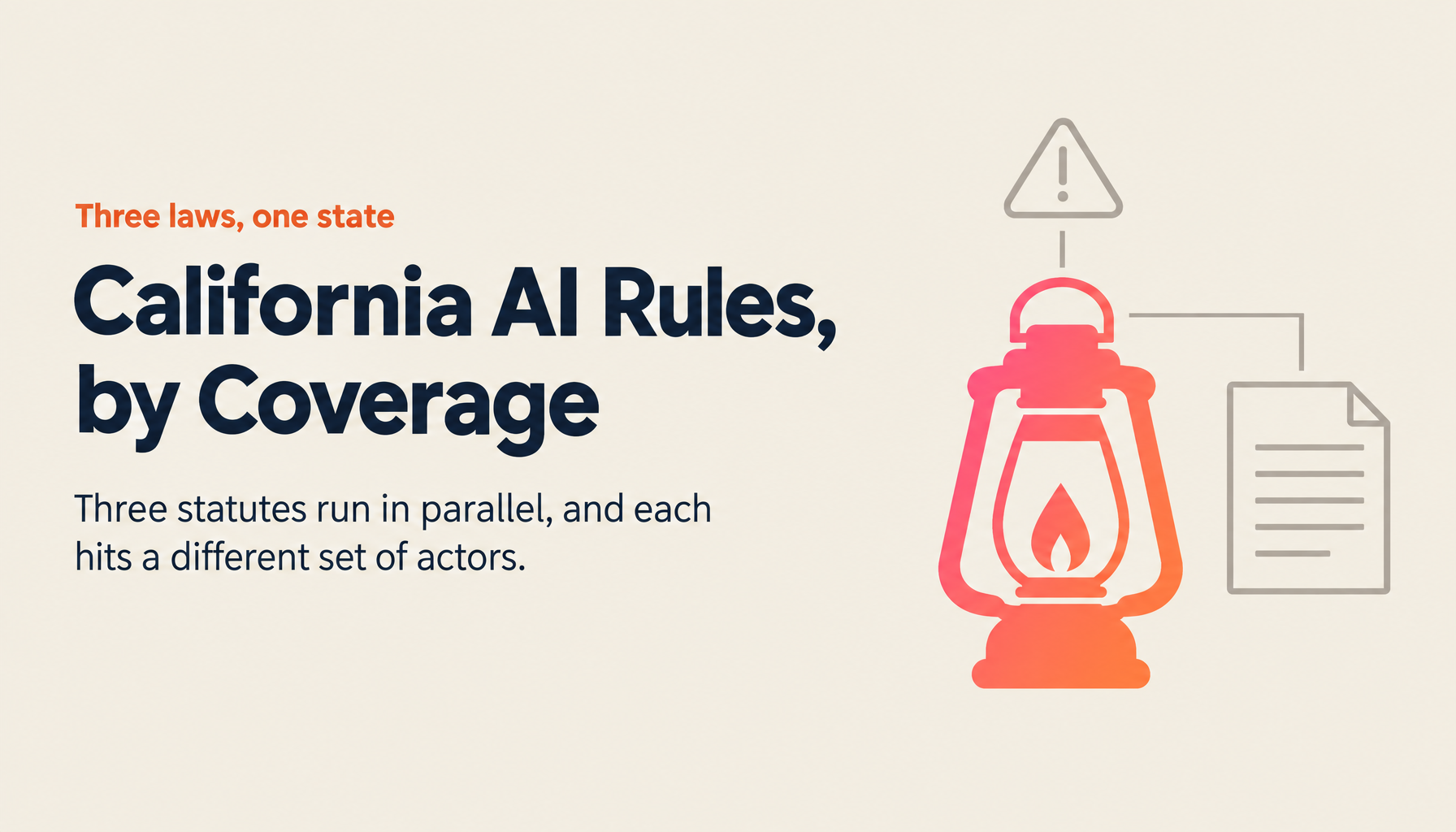
If you treat "California AI regulation" as one law, implementation will fail. In practice, three different statutes run in parallel in the same state. Different targets. Different timelines. Different duty weights.
- SB 53 (TFAIA): transparency for frontier model developers
- AB 2013: training-data disclosure for generative AI providers (and it is retroactive)
- SB 942 (delayed and expanded by AB 853): watermarks for image, video, and audio generation
I keep seeing the same failure mode. Legal teams get handed "California AI regulation" as one blob, then lose six months sorting which statute and which section applies. In my observation, about 80% of Japanese companies do not initially recognize the three-layer structure.
This piece walks the three layers by "who is covered," so ML engineering leads and legal can move from today.
TL;DR
- SB 53 effectively targets 5–8 companies, but its "Frontier AI Framework" becomes a de facto benchmark document for other frontier developers
- AB 2013 applies retroactively to all generative AI released on or after January 1, 2022—the biggest Japanese-company trap
- SB 942 was delayed by AB 853 to August 2, 2026, with platform detection duties added for January 1, 2027
- While a violation continues, SB 942 counts each day as a separate violation, so cumulative fines grow fast
- Industry response is telling: Anthropic actively supports, OpenAI acquiesces, xAI sues—useful stance references for Japanese firms
SB 53 (TFAIA): for frontier model developers
Formal name: Transparency in Frontier Artificial Intelligence Act. Signed by Governor Gavin Newsom on September 29, 2025; effective January 1, 2026. Enforcement by Attorney General Rob Bonta; critical incident reports go to the Office of Emergency Services (OES).
Coverage: developers of frontier models trained with 10²⁶ FLOPs (integer or floating-point operations) or more. Only large frontier developers with over $500 million annual revenue carry the heavy duties. A two-tier design. In practice: OpenAI, Anthropic, Google DeepMind, Meta, Microsoft, xAI, NVIDIA, Amazon, Apple, Tesla AI units. About 5–8 firms.
Duties for large frontier developers:
- Publish a Frontier AI Framework: standards and industry best practices, catastrophic risk assessment methods, mitigations
- Critical safety incident reporting: within 15 days of discovery to OES; within 24 hours if there is imminent public danger
- Quarterly internal-use summaries: catastrophic risk assessment summaries for internal use submitted to OES
- Whistleblower protection: no rules or contracts that block employee reporting; no retaliation
"Catastrophic risk" is defined as a foreseeable, material single event causing more than 50 deaths or serious injuries, or more than $1 billion in property damage. CBRN weapons assistance, large-scale cyber attacks without human oversight, autonomous behavior that evades developer control. Low-probability, high-impact scenarios.
Fines: up to $1 million per violation; willful repeated violations can reach damages on the order of $10 million per violation. Enforcement is civil suit by the state AG.
I read SB 53 as a lightweight lesson from SB 1047 (vetoed). Kill-switch requirements, annual third-party audits, and 72-hour incident reporting were stripped out. The statute focuses on transparency and governance process. That is why Anthropic supported it and the industry largely found it "drinkable." It may become a design model for future rules.
AI Security training, taken seriously
A 2-day intensive course fully aligned with OWASP, NIST, ISO/IEC 42001, and METI. Take it as executives, practitioners, or both.
AB 2013: "retroactive to 2022" is the biggest trap
AB 2013 (Generative AI: Training Data Transparency Act) requires publishing a high-level summary of training datasets for generative AI systems on the web. Signed September 28, 2024; effective January 1, 2026. Enforcement via the state AG under UCL and related tools.
The item Japanese companies miss most: retroactivity to all generative AI systems released or substantially modified on or after January 1, 2022. Early ChatGPT, Claude 1, early Gemini, Llama 1–3, Stable Diffusion XL, Midjourney v4–v6. All in scope. Japanese models offered in the US market (ELYZA, rinna, PFE PLaMo, cotomi, and others) can also be covered.
Eleven disclosure items. Concrete enough that building data cards can take months:
- Dataset provenance / owner
- How the dataset advances the intended purpose
- Number of data points (ranges/estimates allowed)
- Types of data
- Whether copyright-, trademark-, or patent-protected data is included
- Whether purchased / licensed
- Whether personal information (CCPA 1798.140(v)) is included
- Whether collective consumer information is included
- Whether cleaned, processed, or modified—and for what purpose
- Collection period and first training-use date
- Whether synthetic data is used, and functional necessity / purpose
Honestly, items 5 (copyrighted data) and 11 (synthetic data) are the heaviest for Japanese firms I work with. Stating whether third-party news was used in training, or whether synthetic data padded the set, requires full internal fact-finding. You often start with a data-pipeline inventory before any public disclosure.
On December 29, 2025, xAI sued in federal court arguing AB 2013 is unconstitutional: Fifth Amendment Takings (forced disclosure of trade secrets), First Amendment (compelled speech), Due Process (vagueness of "high-level"). On March 4, 2026, Judge Bernal denied the preliminary injunction motion1. Trade-secret theory is possible in principle, but xAI's claims were too generalized and abstract. Litigation continues; for now AB 2013 enforcement is not stayed.
OpenAI and Anthropic did not sue and have already published AB 2013 disclosures. The three-way split—Anthropic actively supports, OpenAI acquiesces, xAI sues—is a microcosm of stance choices Japanese companies will face.
SB 942: violations that stack every day
SB 942 (California AI Transparency Act) sets watermark duties for image, video, and audio generative AI. Originally effective January 1, 2026. AB 853 delayed it to August 2, 2026 and added detection duties for major platforms (January 1, 2027)2.
Two coverage layers:
- Covered providers: image/video/audio generative AI with over 1 million monthly users, publicly accessible in California (OpenAI DALL-E, Google Imagen/Veo, Adobe Firefly, Stability AI, Midjourney, Runway, ElevenLabs, Suno, Udio, and others)
- Large online platforms: social, search, messaging, and file-sharing platforms with over 2 million monthly unique users (Meta, X, YouTube, TikTok, Reddit, LinkedIn, Google Search, and others)
Text-only LLMs are out of scope. Operationally critical. Chat-only ChatGPT or Claude is not covered by SB 942. Add character-image generation or speech synthesis and you enter scope immediately.
Three duties:
- Manifest disclosure (visible label): clear, hard-to-remove labels on AI-generated image/video/audio when the user requests them
- Latent disclosure (latent watermark): embed provider name, system name/version, creation time, AI-generated portions, unique identifier as metadata (C2PA Content Credentials, etc.)
- AI detection tools: free, publicly accessible detection tools on the web
Fine is $5,000 per violation, but each day of continuing violation is a separate violation. One product non-compliant for 30 days: $150,000. For a year: over $1.8 million. Looks lighter than SB 53's $1 million cap, but ongoing gaps (for example, missing detection tools) make SB 942 heavier in practice.
Adobe's standard use of C2PA Content Credentials across Firefly and other products is the industry reference. Japanese providers of image, video, or audio generation should treat C2PA investment as the practical answer.
One comparison table for all three layers
| Dimension | SB 53 TFAIA | AB 2013 | SB 942 (+AB 853) |
|---|---|---|---|
| Layer | Frontier model developers | Generative AI providers generally | Image/video/audio providers + large platforms |
| Size threshold | 10²⁶ FLOPs & >$500M revenue for heavy duties | None (all generative AI) | >1M monthly users / >2M (platforms) |
| Media | Any modality | Any modality | Image, video, audio only (text excluded) |
| Retroactivity | On new / substantially modified release | All systems from Jan 1, 2022 | From release date forward |
| Effective dates | Jan 1, 2026 | Jan 1, 2026 | Aug 2, 2026 / Jan 1, 2027 |
| Core duties | Safety framework, transparency reports, 15-day reporting, whistleblower protection | Web publication of training-data summary | Visible + latent watermarks, detection tools |
| Fines | Up to $1M per violation | None explicit (UCL) | $5,000 × days |
| Approx. entities | 5–8 firms | Hundreds to thousands | Tens of providers + platform tier |
Most Japanese companies sit only in layer two (AB 2013). Adding image or audio services pulls in layer three. Layer one Japanese firms are effectively zero as of May 2026, though SoftBank–Sony–Honda–NEC-type coalitions could enter later.
Three implementation steps for Japanese companies
What to do concretely. The three steps I use with legal and ML leads:
Step 1: SB 53 applicability self-assessment. Estimate training FLOPs with the Kaplan et al. 2020 industry formula 6 × parameters × tokens. Example: 1T parameters × 15T tokens ≈ 9 × 10²⁵ FLOPs (below threshold); 2T × 25T ≈ 3 × 10²⁶ FLOPs (above). If consolidated group revenue exceeds $500 million, "large" status may attach via the parent even if a subsidiary alone does not.
Step 2: AB 2013 dataset documentation. Add a "Training Data" section to English model/system cards; table all 11 items per dataset. Because of retroactivity, inventory every model from January 2022 onward. Industry practice is forming that vendor names may be redacted while still meeting disclosure. Case law is still pending.
Step 3: SB 942 watermark implementation. Images: C2PA Content Credentials (industry standard). Video: C2PA plus steganography. Audio: acoustic watermarks in the ElevenLabs style. Detection tools: an "Is this AI-generated?" page with URL or file upload.
Run these in lockstep with US federal dynamics (US federal AI policy) and the EU AI Act (EU AI Act application timeline and the Digital Omnibus). "California only" always creates rework later.
Where this sits in WARP SECURITY
TIMEWELL's WARP SECURITY uses California SB 53, AB 2013, and SB 942 as a flagship case in the "US state AI risk patchwork" among five scenario drills.
Executive track: case study on Anthropic support, OpenAI acquiescence, and xAI litigation. Judgment axes when your firm faces a similar stance choice. Strategy, not statute reading.
Operator track: hands-on on AB 2013 dataset docs, SB 53 frontier AI frameworks, and SB 942 C2PA implementation against participants' own models and products. Anthropic Frontier Compliance Framework, Adobe Firefly metadata, and trade-secret protection after the xAI ruling.
Even a one-day map of the three layers materially speeds legal–ML dialogue.
Where SB 942's delayed date meets the EU AI Act
SB 942's delayed date of August 2, 2026 falls on the same day as the general date of application of the EU AI Act (Regulation (EU) 2024/1689, Article 113, second paragraph). One caveat matters here: reading that day as "the entire EU AI Act now applies" is wrong.
What starts on August 2, 2026 is Chapter IV transparency obligations (Article 50), Chapter III Section 5 (Articles 40–49: harmonised standards, conformity assessment, CE marking, registration), and the European Commission's power to impose fines on general-purpose AI (GPAI) model providers (Article 101), among others. GPAI-related fines run up to €15 million or 3% of worldwide annual turnover, whichever is higher; breaches of the prohibited practices in Article 5 run up to €35 million or 7% of worldwide annual turnover, whichever is higher (Regulatory framework for AI (European Commission)).
The substantive high-risk AI obligations do not start on that day. Under the amending Regulation (EU) 2026/1744 (the Digital Omnibus; adopted July 8, 2026, published in OJ L 2026/1744 on July 24, 2026, in force July 27, 2026), Chapter III Sections 1–3 apply to Annex III high-risk AI (Article 6(2)) from December 2, 2027 and to Annex I product-embedded high-risk AI (Article 6(1)) from August 2, 2028. The authorised representative duty (Article 22), value-chain obligations (Article 25), deployer obligations (Article 26), and the fundamental rights impact assessment (Article 27) start on the same dates. The transitional rule for systems already placed on the market (Article 111(2)) was also changed to track the Chapter III application dates rather than a single fixed date.
One related deadline: for AI generating synthetic content that was already placed on the market before August 2, 2026, the newly added Article 111(4) requires compliance with Article 50(2) by December 2, 2026. The substantive duties in Article 50(1)–(6) were not amended, and Article 50 still applies from August 2, 2026.
So California watermark duties and EU transparency duties stand up together on August 2, 2026, with the high-risk workstream landing on later dates. Treating US state law and EU law in silos invites rework. AB 2013's training-data and personal-information themes also connect to Japanese reform; see Personal Information Protection Act 2026 amendment.
Summary
- California AI regulation is a three-layer structure: SB 53, AB 2013, and SB 942. Treating them as one always fails
- SB 53 effectively targets 5–8 firms, but frameworks become industry benchmarks
- AB 2013 is retroactive to all generative AI from January 2022. That is the largest Japanese-company trap
- SB 942 delayed by AB 853 to August 2, 2026; text-only LLMs out of scope
- Industry stance split (Anthropic / OpenAI / xAI) is a useful reference for Japanese firms
- Implementation: FLOPs self-check → data cards → C2PA adoption
In 2026 California became the de facto US AI-regulation front-runner. As the federal government leans deregulatory, California's relative influence rises. Get this right and you can reuse the design for other US states, the EU, and Japan. California work is an investment.
References
- SB 53 Transparency in Frontier AI Act - California Legislature
- AB 2013 Generative AI Training Data Transparency - California Legislature
- SB 942 California AI Transparency Act - California Legislature
- Anthropic is Endorsing SB 53 - Anthropic
- Anthropic Frontier Compliance Framework SB 53
- California Enacts Landmark AI Transparency Law - White & Case
- JETRO: California enacts first-in-nation frontier AI safety disclosure law SB 53