Hello, this is Ryuta Hamamoto from TIMEWELL.
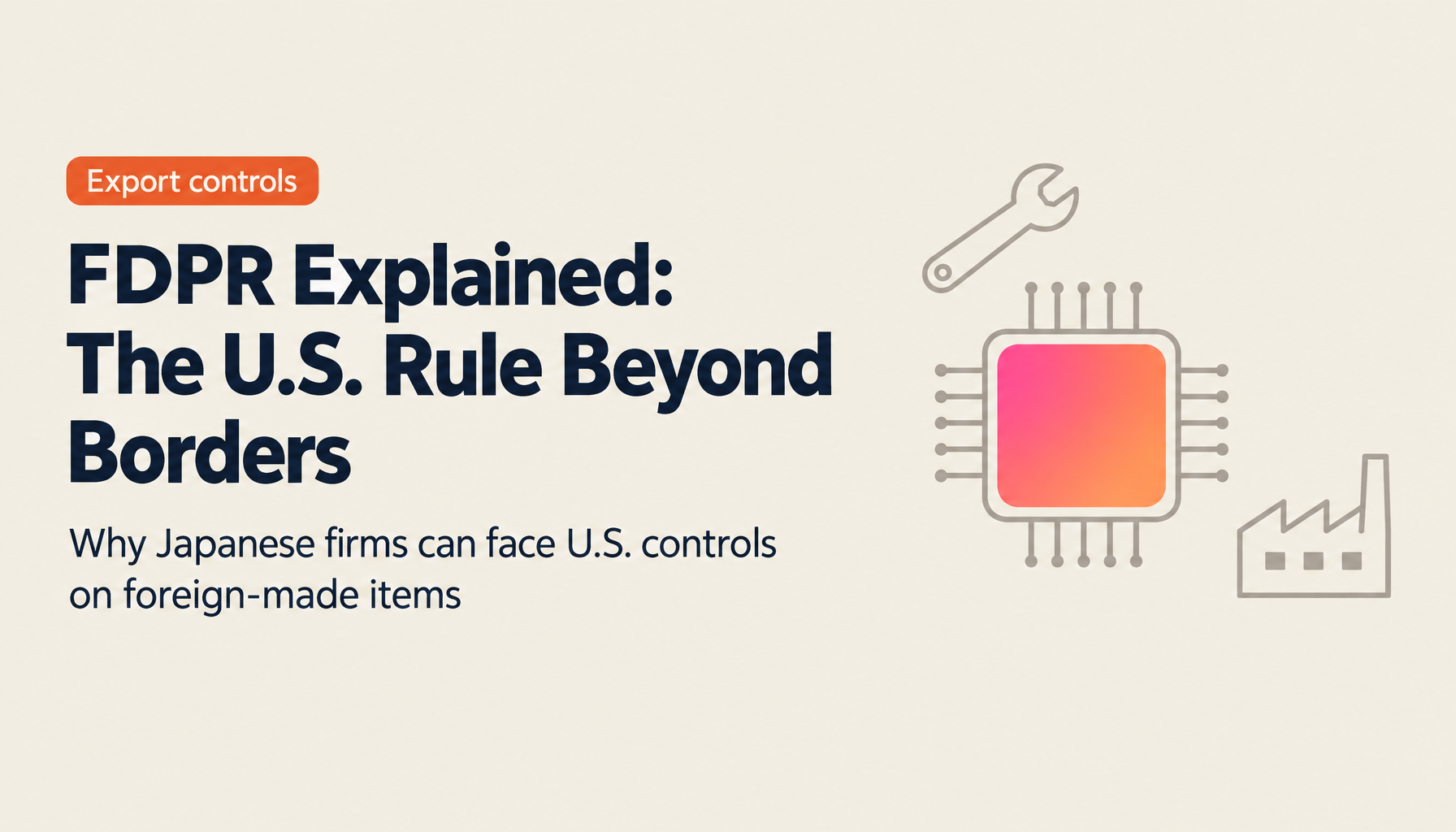
“We made it in a Japanese plant, with Japanese staff, for a Japan-domestic deal. Why do U.S. export controls still matter?” Export-control teams hear that question constantly. The answer is usually the Foreign Direct Product Rule (FDPR).
FDPR is how the United States extends the Export Administration Regulations (EAR) beyond U.S. territory. Since the 2020 Huawei-related Entity List expansions and associated FDPR measures, it has been a core tool of U.S. China- and Russia-related export-control policy, with expanding reach almost every year. Semiconductor manufacturers, equipment makers, trading houses, and logistics providers in Japan are all in scope. Entity List placement is a regulatory designation under U.S. rules; it is not a moral judgment on a company.
In the field, teams still confuse FDPR with the similar-but-different de minimis rule, or assume “no U.S. parts means we are safe.” Below I rebuild FDPR from first principles, contrast it with de minimis, compare major FDPR variants, and flag the patterns where Japanese companies get caught.
What you will learn
- Basic FDPR structure and why extraterritorial reach works
- The essential difference between de minimis (“content ratio”) and FDPR (“U.S. tools/recipes”)
- Differences among Entity List FDPR, Advanced Computing FDPR, Russia/Belarus FDPR, Footnote 5 FDPR, and AI Diffusion FDPR
- December 2024 HBM controls, May 2025 AI Diffusion rescission, and other recent moves
- Why fully domestic Japanese transactions can still trigger FDPR
- Practical lessons from the published Seagate $300 million settlement on “knowledge”
- Five steps for your compliance system
Three terms first (FDPR / de minimis / direct product)
1. EAR (Export Administration Regulations)
U.S. Commerce Department BIS rules (15 CFR Parts 730–774). Unlike a purely “goods leaving Japan” frame under Japan’s FEFTA, EAR can also pull in items made outside the United States via FDPR and de minimis.
2. Direct product
A foreign-produced item made directly with U.S. technology or software. Statute language uses “Foreign-Produced Item.” FDPR brings those direct products into EAR scope.
3. de minimis
Latin for “of minimal importance.” In export control, if U.S.-origin content in a foreign item exceeds a value threshold (generally 25%; 10% for terrorism-supporting destinations), the whole foreign item is treated as subject to the EAR. Completely different logic from FDPR.
FDPR (“U.S. tools”) vs de minimis (“content ratio”)
| Dimension | de minimis | FDPR |
|---|---|---|
| What it looks at | How much U.S. content is physically built into the product (value share) | Whether U.S. technology/software/equipment was used upstream in production |
| Threshold | >25% U.S. content (or >10% for certain destinations) | Not a percentage—fact of production with specified ECCNs |
| Calculation | Value-based ratio | Yes/No |
| Typical example | Japanese server containing U.S. GPUs | Semiconductor made on U.S. lithography/process tools |
| Path into EAR | Content | Production process |
In one line:
- de minimis asks “what share of U.S. stuff is inside?”
- FDPR asks “were the tools/recipes U.S.?”
Critical fact: you can fail FDPR even with zero U.S. content under de minimis. “We do not use U.S. parts” is not a free pass if production tools trigger FDPR. That is still the most painful blind spot I see at Japanese manufacturers.
FDPR application generally checks three elements (exact conditions vary by FDPR type):
- Product Scope — is the item itself under specified CCL ECCNs?
- Technology/Software Scope — were specified U.S. tech/software/equipment used in production?
- Destination/End-User Scope — specified countries or Entity List parties?
All three aligning typically means a BIS license is required.
Replace siloed classification work with AI.
METI's FY2024 data shows 52% of foreign exchange law violations stem from classification errors. Download the TRAFEED product catalog covering features and rollout.
Five major FDPR variants
FDPR lives in §734.9 across multiple paragraphs. Which paragraph applies changes the conditions.
1. Entity List FDPR (§734.9(e))
Applies to Entity List parties carrying specific footnotes:
- Footnote 1: Huawei-related (expanded August 2020)
- Footnote 3: Military end users
- Footnote 4: Advanced-computing-related Chinese entities (October 2022; 28 parties)
- Footnote 5: Semiconductor manufacturing equipment-related Chinese entities (December 2024; 16 added)
Entity List listing alone is not enough—listing plus the relevant footnote drives FDPR.
2. Advanced Computing FDPR (§734.9(h))
Created 7 October 2022 for advanced AI semiconductors, server-class GPUs, related design data, etc. Destinations expanded beyond China/Macau (from October 2023) to a wider set including parts of the Middle East, Africa, and Central Asia (44 countries + Macau). Currently one of the broadest FDPR variants affecting AI chip supply.
3. Russia/Belarus FDPR (§734.9(f))
Created 24 February 2022 after Russia’s invasion of Ukraine; also covers Belarus, Crimea, and occupied Ukrainian territories. Scope is extremely wide—essentially all CCL items—so even commercial semiconductors can need licenses and help block third-country diversion.
4. Footnote 5 FDPR (December 2024)
Semiconductor manufacturing equipment-related FDPR linked to HBM controls (details below).
5. AI Diffusion FDPR (in force January 2025 → rescinded May 2025)
First framework treating AI model “weights” as controlled (new ECCN 4E091). Rescinded after four months under the Trump Administration—rare in EAR history.
Traditional National Security FDPR (§734.9(b) etc.) also remains the classic base using CCL D/E group technology for military end-use related items.
Footnote 5 FDPR and December 2024 HBM controls
On 5 December 2024, BIS tightened semiconductor controls in three big ways:
- HBM added to the CCL as ECCN 3A090.c
- Entity List Footnote 5 created for 16 SME-related Chinese parties, with a new FDPR bite
- SME controls expanded for etch, deposition, lithography, and related process tools
For Japanese SME and component makers, the practical questions became: “Do we manufacture our tools with U.S. equipment/tech/software?” and “Do we supply Footnote 5 parties?”
AI Diffusion FDPR (Jan 2025 → May 2025 rescission)
On 13 January 2025, the late Biden Administration put the Framework for Artificial Intelligence Diffusion into force, controlling AI model weights. On 13 May 2025, BIS under the Trump Administration announced rescission—after only four months.
Rescission is not free-for-all AI exports:
- AI Diffusion Rule is out: direct control of model weights is not currently enforced under that framework
- Advanced Computing FDPR remains: hardware controls (H100, H200, B200, etc.) stay in force
File-level model export rules were pulled back. The chips that run AI still need Advanced Computing FDPR compliance.
Patterns that catch Japanese companies
Pattern 1: Japan production on U.S. tools, sales to Entity List parties
Most Japanese fabs use tools from ASML, Applied Materials, Lam Research, KLA, Tokyo Electron, and others. Chips made on U.S. tools often meet Technology/Software Scope under §734.9, so Footnote 1/4/5 destinations can pull the transaction into FDPR even when manufacture, staff, and contracting are all “Japan domestic.”
Pattern 2: SME makers selling tools to Footnote 5 parties
If Japanese equipment embeds U.S. control software or components, sales to Footnote 5 parties can trigger FDPR. Japan also added its own semiconductor-equipment controls (23 items, July 2023), so dual FEFTA + EAR compliance is standard.
Pattern 3: Trading houses/logistics missing Russia diversion via third countries
Russia/Belarus FDPR’s broad product scope means Japan → Central Asia → Russia routes can still be in scope. “Knowledge” includes what you knew or should have known—skipping end-user diligence is itself a problem.
| Sector | Main risk |
|---|---|
| Logic/memory manufacturing | U.S. tools + Footnote 1/4/5 or Chinese AI chipmakers |
| SME manufacturers | CCL-controlled tools + U.S. tech content |
| Materials (photoresist etc.) | Often de minimis-first; FDPR if developed with U.S. tech/software |
| Components (HDD/SSD etc.) | Settlements show even HDDs can raise FDPR diligence issues |
| Trading / logistics | Entity List and Russia-destination diligence |
Violation risk and the published Seagate settlement
- Civil penalty: up to roughly $360,000 per violation (periodically adjusted) or twice the transaction value, whichever is higher
- Criminal: up to $1 million; individuals up to 20 years imprisonment
- Denial Order: ban on EAR-related dealings—often the worst operational outcome
- Entity List designation of the company itself
- Multi-year audit obligations
April 2023 Seagate settlement — $300 million civil penalty
A widely cited enforcement matter: Seagate Technology settled with BIS in 2023. The following reflects BIS-published settlement facts. (Listings and enforcement records are regulatory classifications and enforcement history—not a judgment of corporate worth.)
- Subject: Huawei-related FDPR matter
- Period: August 2020–September 2021
- Volume: ~7.4 million HDDs, ~$1.1 billion value, 429 shipments
- Civil penalty: $300 million (among the largest single BIS civil penalties)
- Multi-year audit and a five-year Denial Order (suspended)
The practical lesson is how far FDPR “knowledge” pushes supply-chain and ultimate-destination diligence. Intent is less decisive than whether the situation was knowable. Even ordinary commercial deals need visibility and destination controls.
Operation Gatekeeper
Since 2024, BIS has accelerated semiconductor and AI-related enforcement under Operation Gatekeeper and shares information with METI. Reputation damage, customer cutoffs, and market reaction can exceed the fine itself. That is industry consensus after this settlement class of cases.
Five practical steps
Step 1: Inventory production tools
List manufacturing-country and ECCNs for tech/software embedded in lithography, etch, deposition, inspection, and other critical tools.
Step 2: Classify your products under ECCNs
EAR99 vs 3A090-class specific ECCNs changes FDPR analysis completely.
Step 3: Screen customers (end users)
Entity List + Footnotes 1/3/4/5; restricted destinations (certain China contexts, Russia, Belarus, etc.). For trading-house deals, push to ultimate destination.
Step 4: Document transaction flows
What product, which tools, to whom—systematically. Documentation quality drives findings and mitigation if BIS investigates.
Step 5: Track rule changes continuously
FDPR has been rewritten yearly since 2020. Watch Federal Register, BIS releases, and JETRO analyses; update internal policy on a schedule.
Managing all of this only in Excel and Word hits limits fast. TIMEWELL’s TRAFEED (service catalog PDF) automates product, customer, and destination screening and supports Entity List, restricted-country, and FDPR triage end-to-end, aligned with METI criteria for Japan–U.S. dual compliance.
FAQ
Q1. Can purely domestic Japan-to-Japan deals trigger FDPR?
Yes, if the product is CCL-controlled, production used specified U.S. tech/software/equipment, and the ultimate destination (or known re-export path) is an Entity List or restricted end use/destination—even when contracting is domestic.
Q2. Check de minimis or FDPR first?
Both. Run de minimis value tests, then still run FDPR production-origin Yes/No checks. Clearing de minimis does not clear FDPR.
Q3. Does one U.S. tool always trigger FDPR?
Not by itself. The tech/software associated with the tool must fall under the relevant D/E group ECCNs for that FDPR variant. Many leading-edge SME tools do, so advanced logic/memory lines need extra care.
Q4. Does Russia FDPR matter for China destinations?
Not directly, but broad product scope plus knowledge of diversion through third countries can still apply. End-user diligence remains mandatory.
Q5. After AI Diffusion rescission, are AI exports “safe”?
No. Model-weight rules under that framework were rescinded; Advanced Computing FDPR on AI semiconductors remains strict.
Q6. How do we decide if our item is FDPR-controlled?
Sequence: product ECCN → production tech/software/tool ECCNs → Entity List status → restricted destination. When unclear, consider CCATS classification requests or counsel.
Q7. Will FDPR keep expanding?
Trend continues: 2020 (Huawei) → 2022 (Russia, Advanced Computing) → 2024 (HBM, Footnote 5). Narrow-but-deep FDPR expansions remain likely.
Latest developments as of July 2026
FDPR response is no longer only a U.S. legal problem; it interacts with Japan’s economic-security policy. At the 16th Japan–India annual summit on 2 July 2026, both sides issued a joint declaration covering semiconductors, critical minerals (rare earths), clean energy, ICT (submarine cables), and pharmaceuticals, with roughly ¥2 trillion of investment (Japan–India summit joint press conference (Prime Minister’s Office, 2 July 2026)). Operational detail is still thin as of July 2026, but rewiring semiconductor and minerals supply among trusted partners will only raise the stakes of tracking production origin—exactly what FDPR asks. See also Japan–India summit and economic security.
Summary
- FDPR pulls foreign-made items produced with U.S. technology or software into EAR scope
- de minimis looks at content ratio; FDPR looks at production tools and recipes
- Main families: Entity List, Advanced Computing, Russia/Belarus, Footnote 5, AI Diffusion (rescinded May 2025)
- Japan-domestic deals can still be in scope when U.S. tools are used
- The published $300 million settlement shows business-continuity-level impact
- Practice: tool inventory, then ECCN classification, customer screening, documentation, and continuous rule tracking
FDPR is no longer a large-company-only topic. If I had to pick one checklist item this week, it would be a production-tool inventory for your critical process steps. Any Japanese manufacturer using U.S. tools, and any trader or logistics provider in the export chain, should treat FDPR as must-do.
Related articles
- BIS Affiliates Rule practical impact
- Operation Gatekeeper — BIS enforcement and Japanese company risk
- Huawei Ascend — AI semiconductor controls and Japan’s supply chain
For AI-assisted export-control operations, see TRAFEED
TRAFEED is an export-control AI platform that automates Entity List, restricted-country, and FDPR screening end-to-end, aligned with METI criteria for Japanese companies managing FDPR and broader EAR compliance.
For implementation discussions, contact us.
References
Primary law
- eCFR: 15 CFR §734.9 — https://www.ecfr.gov/current/title-15/subtitle-B/chapter-VII/subchapter-C/part-734/section-734.9
- BIS §734.9 page — https://www.bis.gov/regulations/ear/part-734/section-734.9/foreigndirect-product-fdp-rules
- Federal Register: FDP Rules Organization (3 Feb 2022) — https://www.federalregister.gov/documents/2022/02/03/2022-02302/foreign-direct-product-rules-organization-clarification-and-correction
- Federal Register: Advanced Computing FDPR expansion (5 Dec 2024) — https://www.federalregister.gov/documents/2024/12/05/2024-28270/foreign-produced-direct-product-rule-additions-and-refinements-to-controls-for-advanced-computing
- Federal Register: AI Diffusion Framework (15 Jan 2025; rescinded May) — https://www.federalregister.gov/documents/2025/01/15/2025-00636/framework-for-artificial-intelligence-diffusion
BIS publications
- BIS Seagate settlement press release (April 2023) — https://www.bis.gov/node/20250
- BIS Huawei Entity List expansion (August 2020) — https://www.commerce.gov/news/press-releases/2020/08/commerce-department-further-restricts-huawei-access-us-technology-and
- BIS advanced computing press release — https://www.bis.gov/press-release/commerce-strengthens-export-controls-restrict-chinas-capability-produce-advanced-semiconductors-military
- BIS AI Diffusion rescission (13 May 2025) — https://www.bis.gov/press-release/department-commerce-announces-rescission-biden-era-artificial-intelligence-diffusion-rule-strengthens
JETRO / Government of Japan
- JETRO: Trump Administration export-control policy (2025) — https://www.jetro.go.jp/biz/areareports/2025/5bcb3ce1fb629799.html
- JETRO: U.S. export controls (August 2021) — https://www.jetro.go.jp/ext_images/_Reports/01/e95620416cd2f8d3/20210031.pdf
- JETRO: Practical response to U.S. economic-security measures (April 2023) — https://www.jetro.go.jp/ext_images/_Reports/01/dedae9f21f1fbbcb/20230003_02.pdf
- JETRO Security Trade Control Quick Guide (January 2024) — https://www.jetro.go.jp/ext_images/world/security_trade_control/pdf/guide/202401_v2.pdf
- METI recent security trade control trends (December 2024) — https://www.meti.go.jp/policy/anpo/daigaku/seminer/r6/meti4.pdf
- CISTEC on U.S. China-related export controls — https://www.cistec.or.jp/service/uschina/52-20221011.pdf
Law firm / think tank
- Atlantic Council: FDPR – Is Russia the next Huawei? — https://www.atlanticcouncil.org/blogs/econographics/foreign-direct-product-rule-is-russia-the-next-huawei/
- CSET: BIS 2023 Update Explainer — https://cset.georgetown.edu/article/bis-2023-update-explainer/
- Sidley Austin: Advanced Computing controls — https://www.sidley.com/en/insights/newsupdates/2023/10/new-export-controls-on-advanced-computing-and-semiconductor-manufacturing
- Covington & Burling: AI Diffusion Framework — https://www.cov.com/en/news-and-insights/insights/2025/01/us-department-of-commerce-establishes-export-control-framework-limiting-the-diffusion-of-advanced-artificial-intelligence-and-expands-and-clarifies-advanced-computing-controls
- ArentFox Schiff: December 2024 Chip Controls Summary — https://www.afslaw.com/perspectives/alerts/summary-biss-december-5-2024-chip-controls