Hello, this is Hamamoto from TIMEWELL. Today I have a tech-related service to introduce.
...or so you might expect. But this time I'm changing things up a bit. The topic is investment contracts. That might sound like a surefire way to put you to sleep. But this is actually a story big enough to determine Japan's future.
The trigger was a YouTube video published by attorney Kazumasa Miyashita titled "Investment Contract Design Principles for Global-Standard Startups." Miyashita is the managing attorney of IGPI Law Firm and also serves as deputy chairman of the Japan Association of Corporate Directors. The video offers a practitioner's breakdown of the "Key Considerations for Healthy Venture Investment Contracts in Japan — Supplementary Edition," which the Ministry of Economy, Trade and Industry (METI) published in September 2025. And it is riveting.
How can a video about contracts be riveting?
What this video makes clear is that the reason Japanese startups can't win globally is not technology or talent — it's the rules of investment. And those rules are so peculiar by global standards that they've been called "Galapagos." METI's new rules represent a genuinely serious attempt to end this state of self-imposed isolation.
This article breaks down the content of the new rules and the social context behind why this conversation is happening now — explained clearly enough for anyone who isn't familiar with startups or investment.
The Unknown "Twist" in the History of Japanese Venture Investment
To understand why this METI rule change can truly be called a "game-changing move," you need to know a bit of history — the peculiar path that Japanese venture capital (VC) has traveled.
The Three "Bubble" Booms
Japan's first private VC was founded in 1972. Kicking off with Kyoto Enterprise Development, eight VC firms were established in quick succession the following year. This was Japan's "First Venture Boom." JAFCO (then Japan Associated Finance Co.), the oldest and largest VC that still exists today, also came into being at this time. [10]
But the reality was a continuous struggle. Back then, the infrastructure for raising funds from investors and organizing them into a fund was not yet in place. VCs had no choice but to invest in private companies using only a small amount of their own equity and borrowings from parent companies. It takes years for an investee to grow, go public, and generate profit. Many VCs became unviable.
The turning point came in 1982. Referencing the American "limited partnership" model, Japan organized its first "investment partnership fund." This is a structure in which funds are raised from multiple investors and combined into a fund from which investments are made into startups. With this new fundraising path open, more than sixty VC firms were established between 1983 and 1986, and the "Second Venture Boom" arrived.
Then in the late 1990s, a series of IPOs rode the wave of the IT bubble, producing the "Third Venture Boom." However, a report from the Japan Business Federation points to a shocking reality about the true nature of these booms:
Over these thirty years, there were three venture booms — but the main actors were venture capital firms and publicly listed companies, not a genuine wave of new company formation. A true venture boom should mean active founding of new venture companies, but in reality, the so-called startup rate was declining throughout this period... [10]
In other words, even as VCs and stock markets appeared to be thriving, the broader movement of people actually starting new companies was progressively dying out. This deep, structural "twist" was the true nature of what afflicted Japan's venture ecosystem.
Why "Nurturing Investment" Never Took Hold
Why didn't a genuine founding boom take off in Japan? Why did VCs become entities that invested mainly in companies just before going public, rather than nurturing early-stage companies? There are two primary reasons.
The first is how VCs were established. Most Japanese VCs were founded as subsidiaries of banks or securities firms. "Rotation hiring" — where employees dispatched from parent companies cycle out every few years — was the norm. The structure made it difficult to develop specialists who could commit to long-term growth of investees and engage deeply with their management.
The second is a lack of exit strategies. At the time, the only means for a startup to provide a return on investment in Japan was an IPO. And the criteria for those IPOs were extremely strict — the average time from founding to listing was thirty years. The typical VC fund has a ten-year lifespan. If it takes thirty years, there's no prospect of recovery within the fund's term from investing in a brand-new company. As a result, VCs inevitably tilted toward a business model of making short-term investments in "later-stage" companies just before listing, and immediately selling the shares once listed to lock in gains.
Taking high risks to target big returns, supporting companies at their founding and nurturing them — that is supposed to be the fundamental role of venture capital. But Japanese VCs ended up confined to low-risk, low-return investment more akin to bank lending. This structural "twist" was the root cause of Japanese startups failing to grow large. And METI's Supplementary Edition takes direct aim at this structure.
Why Is the Government Betting So Heavily on "Startups" Right Now?
The Long Tunnel Called the "Lost Thirty Years"
Why has startup support become such a national priority? The background is Japan's long economic stagnation, known as the "Lost Thirty Years," which began with the collapse of the bubble economy.
At the end of 1989, the Nikkei Stock Average recorded an all-time high of 38,915. But immediately after, stock prices plummeted. Land prices fell as well, and many companies and banks were saddled with massive non-performing loans. This was the bursting of the bubble.
The problem was what came after. Rather than fundamental structural reform, the government and the Bank of Japan resorted to fiscal spending and monetary easing as symptomatic treatments. They postponed painful reforms and effectively "kept on life support" low-productivity companies that should have exited the market. [11]
As a result, Japan's economic metabolism stagnated and industrial competitiveness declined. Even when companies made profits, they accumulated them as internal reserves rather than raising wages or making capital investment — fearful about the future. Consumer spending cooled, and the economy fell into a state of contracting equilibrium.
Over the same thirty years, while American stock prices rose roughly ninefold, Japanese equities languished for decades. That has since changed: the Nikkei Stock Average now sits far above its bubble-era peak of 38,915 yen, closing at a record 69,404 yen on June 16, 2026, and briefly touching 70,020 yen intraday. [16] GDP that was once the world's second largest fell to fourth in 2023, overtaken by Germany. In the IMD World Competitiveness Ranking, Japan ranked number one for four consecutive years from 1989 to 1992 and sank to an all-time low of 38th in 2024 — recovering to 30th out of 70 economies in the 2026 edition, up five places year on year. [15] Share prices and rankings have rebounded, but the structural problem — the absence of a next growth engine — has not been solved.
Lessons from Singapore's Rise
In stark contrast, Singapore has achieved remarkable economic growth over these same thirty years. In terms of per-capita GDP, Singapore was at roughly the same level as Japan in the 1990s but has now surpassed Japan by more than double.
Singapore's success has multiple factors, but at its core is government-led thorough "selection and concentration." By keeping corporate taxes low and attracting companies and talent from around the world, while identifying promising growth sectors and pouring in generous subsidies and support programs, Singapore has consistently advanced.
The intensity of commitment to startup support in particular is extraordinary. For example, the "Startup SG Founder" program provides Singaporean citizen entrepreneurs with a grant of S$50,000 (approximately ¥5.8 million) and extensive mentoring by specialists. [12] Furthermore, a special visa called "EntrePass" is issued to talented foreign entrepreneurs and investors, allowing them to bring their families — drawing talent from around the world as a matter of national policy.
Looking at Japan, the attempt to protect "everything broadly and thinly" has arguably resulted in being unable to win in any sector globally. Singapore's example suggests that for a nation to grow with limited resources, painful "choices" are indispensable.
Finding the Next "Source of Income"
With population decline and aging advancing rapidly, the government is driven by an intense sense of crisis: without finding a new growth engine — a successor to the manufacturing and automobile industries that once supported Japan's economy — this country will truly sink. Creating and nurturing startups with the power to generate new markets through innovative technology and business models, and capture wealth from the world, is considered the final trump card for Japan's economic revitalization.
Taking on AI-driven work? You do not have to do it alone
WARP is a hands-on program for people who want to build with AI themselves, from training through implementation support.
What Is a Startup, and Why Is the Government So Serious About Supporting Them?
A startup is a company that aims to grow rapidly in a short period, based on an innovative idea or technology. Unlike opening a new ramen shop, startups seek to open up markets with products and services that don't yet exist, aiming to grow tenfold or a hundredfold in just a few years. Google, Amazon, and Apple all began as startups from garages and university dormitories.
Why is the government so serious about supporting them?
The answer is simple: Japan's economy needs a new engine. Manufacturing — which supported the high-growth era — has matured, and the population keeps shrinking. For Japan to remain prosperous going forward, there is no choice but to create new industries and nurture companies that can earn internationally. Startups are the designated bearers of that expectation.
In November 2022, the Kishida administration formulated a five-year startup cultivation plan. The plan set the ambitious goal of scaling up investment in startups to ¥10 trillion by fiscal 2027 and producing 100 unicorn companies — companies with a market capitalization of $1 billion (approximately ¥150 billion) or more that are not yet publicly listed. [1]
Three and a half years after the plan was formulated, the number of startups has grown from approximately 16,100 in 2021 to approximately 25,000 — 1.5 times the original number. University-launched startups have also grown from 3,305 in 2021 to 5,074 in 2024, and notably, about 57% of that increase has come from regions outside Tokyo. The base is definitely broadening. [2]
The problem, however, is height. The number of unicorn companies has gone from 6 in 2021 to 8 as of 2025 — far from the target of 100. Total fundraising was ¥885.7 billion in 2021 and ¥874.8 billion in 2024 — essentially flat. Against the ¥10 trillion target, we haven't even reached 10% yet. [2]
The number has grown. But companies that have grown large enough to compete globally are nearly nonexistent. This is the greatest challenge facing Japan's startup ecosystem today.
The Real Reason Japanese Startups Don't Grow Large
Why have GAFAM-scale tech giants not emerged from Japan? GAFAM refers collectively to Google, Amazon, Facebook (now Meta), Apple, and Microsoft.
There is no single answer to this question. But when you trace it to its roots, you arrive at two structural problems: how money flows and the rules of investment.
Drastically Insufficient Risk Money
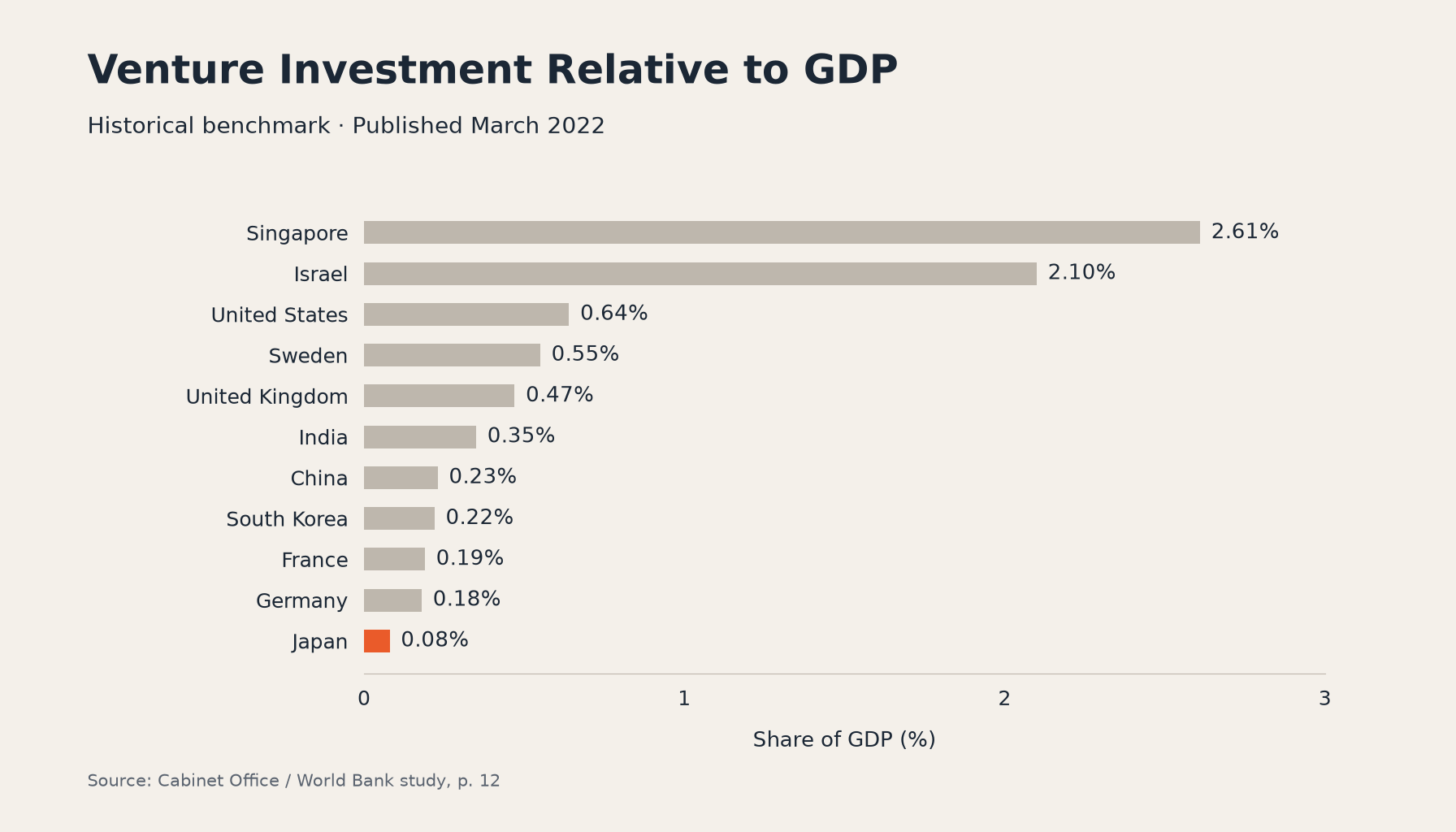
First, the money. Let's look at how much venture investment is made relative to a country's economic scale:
| Country/Region | Venture Investment as % of GDP |
|---|---|
| Singapore | 2.61% |
| Israel | 2.10% |
| United States | 0.64% |
| Sweden | 0.55% |
| United Kingdom | 0.47% |
| India | 0.35% |
| China | 0.23% |
| South Korea | 0.22% |
| France | 0.19% |
| Germany | 0.18% |
| Japan | 0.08% |
Source: METI Council for Science, Technology and Innovation Materials [3]
Japan sits at 0.08% — one-eighth of the United States. Less than half of France and Germany. Compared to Singapore, less than one-thirtieth.
Attorney Miyashita noted that these numbers "tell the story of a country not deploying enough of its earning power into venture investment" — that "Japan is completely failing to practice ambidextrous management at a national level." [4] Earning from existing businesses while simultaneously investing in new ones — standard thinking in corporate management — simply isn't happening at the national level.
The result shows clearly in the number of unicorn companies:
| Country | Number of Unicorn Companies |
|---|---|
| United States | ~690 |
| United Kingdom | 55 |
| France | 31 |
| Singapore | 15 |
| South Korea | 13 |
| Japan | 8 |
Source: METI Startup Ecosystem Status Materials [2]
Japan's unicorns include names like Preferred Networks, SmartHR, Sakana AI, and GO — excellent companies all. But compared to America's 690, the gap is two orders of magnitude.
The "IPO as Goal" — A Device That Stops Growth
With insufficient capital, most Japanese startups target an early IPO. But in Japan, IPO has become the goal rather than the starting line.
The median fundraising amount for Japanese startups at IPO is only a few hundred million yen — roughly the same as what is raised in the Series A round during the early growth phase. [4] Listing with amounts far too small for the large-scale investments needed to compete globally. The unfortunate phrase "IPO as goal" was born from this reality.
Why does this happen? One reason is the structure of Japanese VC funds. Funds have a lifespan — they must produce returns within roughly ten years. As a fund approaches maturity, the VC pressures investee companies to go public soon. Startups, even without having grown sufficiently, end up listing at small scale to fit the VC's timeline.
According to the Venture Enterprise Center white paper, in Japan between 2019 and 2023, approximately 70% of VC investment recovery was via stock listing. [5] This is in stark contrast to the United States, where M&A accounts for the majority of investment recovery.
The Structural Distortion of the Growth Market
The recipient of these small-scale listings is the Tokyo Stock Exchange's Growth Market.
The Growth Market is designed for high-growth-potential emerging companies — it has the rare global characteristic of allowing listing even with small revenues and profits. This in itself is not bad, but the problem lies in the market's investor composition.
In the Growth Market, individual investors account for over 50% of both trading and holding. [6] Compared to the Prime and Standard markets, institutional investors — who monitor corporate growth from a long-term perspective — have a thin presence.
With fewer institutional investors, share prices become more prone to short-term volatility based on trending topics and individual speculation. Companies grow hesitant to make bold growth investments, preoccupied with quarterly metrics. The strategy of digging into deficits in order to invest in the future is poorly rewarded in Japan's Growth Market.
The TSE is aware of this problem and will raise the Growth Market's listing maintenance standard from the current "¥4 billion in market capitalization ten years after listing" to "¥10 billion five years after listing." The new standard applies from the end of the first fiscal year that falls on or after March 1, 2030. [7] [17] This effectively says "no" to small-scale listings — which itself tells you how serious the problem has been.
The "Deemed Liquidation Clause" as an M&A Obstacle
The structure biased toward IPO has been further reinforced by the "deemed liquidation clause" in investment contracts. [13]
This clause provides that even without an actual dissolution or liquidation of the company, in cases where control of the company transfers to another party through M&A (merger or acquisition), investors may recover their invested principal on a priority basis as if the company had been liquidated.
On the surface this seems like a rational clause to protect investors. And indeed, in an era when M&A was not yet common, it played an important role in preventing founders from selling the company cheaply and leaving VCs who invested later holding the bag.
But as times changed and M&A became established as an important exit strategy for startups, this "deemed liquidation clause" began to stand out as an obstacle to M&A.
For example, suppose a startup is acquired for ¥5 billion. If a VC invested ¥1 billion under "1x participating" terms, the VC would first recover ¥1 billion on a priority basis, and the remaining ¥4 billion would be distributed among founders and other shareholders. But what if the acquisition price was ¥1 billion? The VC could take everything, leaving nothing — not a single yen — for founders and other shareholders.
This gives founders no incentive to agree to M&A. Instead, it produces the perverse structure of avoiding M&A and pushing for an IPO even when that isn't ideal. As a result, Japan has seen M&A volume and value lag behind overseas, contributing to a stagnation of the overall startup ecosystem.
The "Residual Asset Distribution Priority" That Over-Protects Investors
What foreign investors find most puzzling is the handling of "residual asset distribution priority rights" in Japanese investment contracts. This is the right to receive remaining assets on a priority basis ahead of other shareholders when a company dissolves and liquidates. VCs investing in startups typically receive "preferred shares" carrying this priority right rather than common shares.
The priority right itself is commonly used globally to protect VCs who take on investment risk. The problem is the terms.
The preferred shares used by Japanese VCs have almost always carried a "1x participating" condition. This means:
- When the company liquidates, the VC first recovers the invested amount (1x) on a top-priority basis.
- If assets still remain after that, the VC also participates in distributing the remaining assets proportionally alongside other shareholders.
In other words, double-layered, extremely generous protection. For example, suppose a VC invested ¥1 billion and the company liquidates for ¥5 billion. The VC recovers ¥1 billion first, and the remaining ¥4 billion is shared between the VC and other shareholders (founders, etc.) according to their shareholding ratios. For the VC, this is an extremely favorable condition that minimizes downside risk while still targeting upside gains.
This "residual asset distribution priority" was, in fact, a troublesome quirk.
Galapagos Clauses That Turn Away Overseas Investors
If there isn't enough money domestically, attract it from abroad — that's the natural thought.
But here was the greatest wall: Japan's unique investment contract practices, the so-called "Galapagos clauses."
Attorney Miyashita explains this problem clearly in his YouTube video. When overseas VCs consider investing in Japanese startups, they get turned away at the stage of formal review of investment contract terms — before even getting to substantive due diligence on technology and people.
What specifically is the problem? There are three main issues.
The first is the stock repurchase right. This is the right for investors to demand that the company or founder repurchase the invested shares if, for example, the startup fails to IPO within the period specified in the contract. No such practice exists in America. [5]
Startup investment is a high-risk, high-return world where if one out of ten investments is a big hit, you're doing well. If entrepreneurs are required to personally buy back shares when they fail, the entrepreneur loses personal assets and may never be able to start over. From foreign investors' perspective, innovation cannot emerge from a system that doesn't allow for failure.
The second is personal joint and several liability for founders. This is a clause making founders personally jointly liable with the company in the event of contract violations — contrary to the foundational modern legal principle that a company and its individual officers are separate legal entities. Inconceivable outside Japan.
The third is the "IPO best efforts obligation." Having a clause in the investment contract requiring the company to make maximum efforts toward listing effectively forecloses M&A as an option and forces startups into a one-track IPO path.
One American VC executive put it this way:
Investment contracts containing terms that differ from global standards carry too much risk for us to invest. [5]
The fact that contracts are drawn up only in Japanese is also a major barrier for English-speaking investors. The cost of accurately assessing the risks of a contract written in one of the world's most difficult languages is simply too high to make it worth considering. That was the reality.
The Five-Year Startup Plan and the Policy Turning Point
Having read this far, many of you are probably thinking: Japan's startup scene is in serious trouble. The government shares that sense of urgency.
The Five-Year Plan of the Kishida Administration
In November 2022, the Kishida administration approved the Five-Year Startup Cultivation Plan in cabinet. [1]
| Goal | Target | Deadline |
|---|---|---|
| Investment in startups | ¥10 trillion scale | By fiscal 2027 |
| Number of unicorn companies | 100 | Future target |
| Number of startups created | 100,000 | Future target |
At the time the plan was formulated, startup investment was approximately ¥820 billion. The plan aimed to multiply that by more than ten in five years — an extremely bold goal. The plan was built on three pillars — people, funding, and business — incorporating diverse measures including enriched entrepreneurship education, expanded angel tax incentives, and overseas expansion support.
From Broadening the Base to Creating Height
In the first three years of the plan, the number of startups steadily increased. However, as we saw, the number of unicorn companies sits at eight, and fundraising is flat. The base has broadened, but no height has emerged. Putting it plainly, that's the assessment.
In METI's December 2025 materials, the theme for the second half of the five-year plan is clearly stated: creating and sustaining height. [2]
| Direction | Content |
|---|---|
| Expanding growth capital | Promoting M&A and secondaries — secondaries being secondary transactions of unlisted shares |
| Becoming a global ecosystem hub | Building an environment to attract overseas investors and talent |
| Growth of deep tech | Supporting fields requiring large-scale investment such as AI, drug discovery, and GX |
| Forming regional ecosystems | Moving away from Tokyo concentration |
Expanding growth capital and becoming a global ecosystem hub come first. Attracting large amounts of foreign capital and nurturing startups to grow large has become the top policy priority.
Then, on May 20, 2026, the Startup Policy Promotion Subcommittee of the Japan Growth Strategy Council adopted the "All-Out Startup Creation Package," which reinforces the five-year plan over its remaining period through fiscal 2027. It rests on three pillars: scaling up startups, supporting deep-tech startups, and creating and nurturing startups that carry regional economies. The package is candid about where things stand: while the number of startups and university-launched startups has grown steadily, "the number of unicorns and the amount of funding raised remain far from the targets of the five-year plan." [18]
Then, on May 20, 2026, the Startup Policy Promotion Subcommittee of the Japan Growth Strategy Council adopted the "All-Out Startup Creation Package," which reinforces the five-year plan over its remaining period through fiscal 2027. It rests on three pillars: scaling up startups, supporting deep-tech startups, and creating and nurturing startups that carry regional economies. The package is candid about where things stand: while the number of startups and university-launched startups has grown steadily, "the number of unicorns and the amount of funding raised remain far from the targets of the five-year plan." [18]
The Decisive Difference in Phase-by-Phase Capital Supply Between Japan and the US
Why is growth capital so strongly emphasized? Comparing phase-by-phase capital supply between Japan and America makes the reason immediately clear:
| Investment Phase | Japan | United States |
|---|---|---|
| Seed (early founding) | 17% | 9% |
| Early (early growth) | 70% | 33% |
| Later (late growth) | 9% | 68% |
Source: METI Startup Ecosystem Status Materials [2]
Japan's investment is concentrated in seed and early, with later at a mere 9%. In America, later accounts for 68%.
Japanese startups are supported up to the point of being born, but drastically lack capital to grow large — like abundant support up to birth, but no funding for raising a child to adulthood.
Capital needed in the later stage runs from tens of billions to hundreds of billions of yen. Japanese VCs alone cannot supply capital at this scale. That's why Japan needs large overseas VC funds to enter. And for that, the Galapagos clauses that are turning away overseas investors must be abolished.
It is within this context that METI's Supplementary Edition was born.
METI's New "Supplementary Edition" Rules — A Game-Changing Move
In September 2025, METI formulated the "Key Considerations for Healthy Venture Investment Contracts in Japan — Supplementary Edition." [8]
Looking back at this guideline's history briefly: the first edition was established in 2018, revised in 2022, and this is the third update, the Supplementary Edition.
The biggest difference from previous editions is that governance and global compatibility — two perspectives — have been greatly strengthened. It goes beyond merely explaining contract clauses, incorporating thinking for designing startup growth itself.
Point 1: Explicitly States That Stock Repurchase Rights Should Not Be Included
The biggest impact of the Supplementary Edition was this single statement.
In previous guidelines, the wording on stock repurchase rights was something like "should be applied restrictively" — somewhat ambiguous. The nuance was roughly: we're not saying don't use them, but be conservative.
The Supplementary Edition changed this to "should not be included." [5] [8] A clear negation.
The significance of this change is immeasurable. When overseas VCs consider investing in Japanese startups, the first thing they check is the content of existing investment contracts. The moment they see a stock repurchase right, Japan is categorized as having investment practices that differ from global standards, and removed from consideration.
By METI explicitly stating "should not be included," if this clause disappears from newly executed investment contracts going forward, the barrier to entry for overseas investors will drop substantially.
Point 2: Explicitly Names M&A and Secondaries as Rational Options
On the topic of startup investment exits, the Supplementary Edition states:
M&A and secondary transactions of unlisted shares between shareholders are also rational options and may be preferable for the issuer. [5]
Until now, IPO was effectively the only exit in Japan — as noted, approximately 70% of VC investment recovery was via IPO.
But looking at the world, M&A is far more common as a startup exit. In America, the majority of startups enter the fold of large companies through M&A, and grow even larger from there.
As attorney Miyashita notes in his Japan Association of Corporate Directors proposal, M&A was the driving force behind GAFAM's growth. [4] Taking Google as an example, its major businesses outside its search engine — YouTube, Android, Google Maps, DeepMind — were all businesses acquired from startups. Google has achieved platform-style expansion by stacking various startup businesses on top of itself.
The quintessential success story is the 2006 YouTube acquisition. At the time, YouTube was barely eighteen months old, burning cash, and carrying a mountain of copyright infringement litigation risk. Google acquired it for $1.65 billion — approximately ¥200 billion at the time. At the time, many media outlets and experts called it "crazy" and "an overpayment." [14]
But what was the result? Google connected YouTube's massive traffic to its advertising system and developed it into the world's largest video platform. Today YouTube is one of the revenue pillars of Alphabet, Google's parent company, with an enterprise value said to be more than 100 times the acquisition price. If Google hadn't made that "crazy" decision, today's YouTube might not exist.
Japan's large companies often struggle with PMI — Post Merger Integration — when acquiring startups. That's why M&A hasn't spread, keeping startups locked into the IPO-only track. To break this vicious cycle, METI has officially recognized M&A as a rational option.
Point 3: Co-Creating Governance in Step with Growth Stage
Another major feature of the Supplementary Edition is the idea of thinking about governance together with investment contracts. Governance refers to the mechanisms for monitoring corporate management and guiding it in the right direction.
Attorney Miyashita cites Greiner's model of corporate growth in his video. The theory proposed by management scholar Larry Greiner in 1972 holds that companies go through five stages in the course of growth, facing different crises at each stage. [9]
For example, a founding-stage company grows through the founder's charisma and creativity — but as the organization grows, a leadership crisis arrives. After overcoming that through organizational systematization, an autonomy crisis comes next. Each crisis must be overcome through an evolution in management approach.
The Supplementary Edition applies this thinking to startup governance:
| Growth Stage | Governance Characteristics | Required Change |
|---|---|---|
| Seed | Founder is both shareholder and manager. Bold, rapid decision-making | Founder's vision takes priority |
| Early | Capital from VCs. Establishment of board of directors | Participation of independent outside directors, introduction of oversight function |
| Mid to Later | Entry of overseas investors. Large-scale fundraising | Strengthening board composition, separation of ownership and management |
| Pre-IPO to Post-IPO | Accountability to public markets | Transition to monitoring board |
What is interesting here is the Japan-America comparison.
In Japan, it is overwhelmingly common for founders to continue as CEO even after IPO. Initial shareholders maintain high shareholding ratios, and boards tend to combine oversight and execution functions.
In America, CEO transitions in step with growth stage are not uncommon. Even if the founder is an excellent visionary, once the organization has grown large, the baton is passed to a professional executive skilled in managing large organizations. The board includes many outside directors and investor directors, with the oversight function clearly separated from management.
What the Supplementary Edition proposes is reframing governance not as a formal requirement for listing, but as a mechanism for sustainably increasing corporate value — with investors and management creating, through dialogue, the governance optimal for that company's growth stage.
Point 4: Preparing Investment Contracts in English and Aligning with Global Standards
While not directly referenced in the Supplementary Edition, the Japan Association of Corporate Directors' 2023 proposal argued that investment contracts should be prepared in English in accordance with global standards. [4] A model English-language investment contract was also published in July 2023.
This may look minor, but it's a significant change. If contracts are in English and prepared in the format familiar to Silicon Valley VCs, overseas investors can quickly and accurately assess the risks of existing investment contracts — eliminating the enormous cost of translating Japanese-language contracts and checking each Japan-specific clause one by one.
Attorney Miyashita advocates for a "glocal growth investment model" modeled on the Nordic example. [4] Local VCs support the founding stage, and from the early stage onward, global top funds like Founders Fund, Accel Partners, Andreessen Horowitz, and Sequoia come in. Their massive capital and global business networks are borrowed to send Japanese startups into the world.
Because Nordic countries have small domestic markets, their startups design their businesses with global markets in mind from the outset. A clear division of roles between domestic VCs and global VCs has been established, with a collaborative model. Japan aspires to follow this example.
The Shock of "S&P 495": America Without GAFAM Looks Like Japan
Here is one startling fact to share.
It is said that the performance of "S&P 495" — the S&P 500 minus the five GAFAM stocks — is roughly the same as Japan's TOPIX. [4]
In other words, the overwhelming strength of the American economy stems from a handful of giant tech companies called GAFAM. And all of these companies were originally startups — and they achieved non-linear growth not just by themselves, but by successively acquiring promising startups.
Conversely, if even one or two GAFAM-scale companies emerged from Japan, the picture of Japan's economy could change entirely. For that, the capital and rules needed to help startups grow large are indispensable. METI's Supplementary Edition is attempting to lay precisely that foundation.
My View on the True Meaning of This Change
From here, allow me to share some personal thoughts as Hamamoto of TIMEWELL.
Honestly, I don't think the Supplementary Edition alone will change everything. Changing the rules, if not accompanied by the people and mindset to use them effectively, will amount to nothing but a drawing on paper.
But the reason I feel strong hope in this movement is that the structure of the problem has finally been correctly recognized.
Until now, startup support in Japan has focused on broadening the base — let's increase the number of entrepreneurs, let's provide subsidies, let's build incubation facilities. That itself is correct. But no matter how many seeds you sow, if the soil for growth isn't in order, large trees won't grow. The problems of investment rules and market structure — the soil itself — have, for the first time, been seriously addressed.
And in fairly forceful language — "should not be included" regarding stock repurchase rights. I think this reflects a strong sense of crisis within METI that the status quo is unacceptable.
As an aside, what I feel from being positioned in the startup world is that the technical capabilities and ideas of Japanese entrepreneurs are in no way inferior to the rest of the world. If anything, the precision of manufacturing and the ability to deeply understand customer challenges are major strengths of Japanese entrepreneurs.
What was lacking was the mechanism to make those strengths bloom at global scale. The Supplementary Edition is trying to change the fundamental core of that mechanism. That's why I'm watching this movement closely — and why I wanted as many people as possible to know about it, which is why I wrote this article.
How Will Japan's Future Change with This Rule Change?
If this change proceeds smoothly, how will Japan's startup ecosystem change? Here is my thinking.
Increased Growth Capital from Inflowing Overseas Money
If Galapagos clauses are abolished and investment contracts align with global standards, large overseas VC funds will find it easier to enter the Japanese market. If funds like Sequoia Capital, Andreessen Horowitz, and Tiger Global — which make investments of tens to hundreds of billions of yen per deal — start investing in Japanese startups, the structural problem of later-stage capital shortages should begin to resolve.
A Leap in Deep Tech
With sufficient growth capital available, Japanese startups will be able to compete globally in deep tech fields requiring large-scale R&D investment — AI, quantum computing, drug discovery, space, and GX (Green Transformation, the structural industrial shift toward a decarbonized society).
Japanese startups with world-class technology, like Preferred Networks and Sakana AI, already exist. If sufficient capital is supplied to them, there is real potential for Japanese-origin global tech companies to emerge.
Industrial Renewal Through M&A Activation
If M&A becomes established as a rational option, the relationship between Japan's large companies and startups will also change. Large companies acquire startups and scale them using their own resources. Startups, no longer locked into IPO, can choose the partner that will most accelerate their growth.
This will also have the effect of promoting Japan's overall economic renewal. Large companies incorporate new technology and business models, transforming themselves in the process. If such a virtuous cycle emerges, escaping the Lost Thirty Years may not be a dream.
And signs of that are already beginning to appear. In 2021, US payment giant PayPal acquired Paidy — Japan's leading "buy now, pay later" (BNPL) service — for ¥300 billion. This was one of the largest M&A deals for a Japanese startup in history, a testament to a global tech giant's high assessment of Japan's fintech market potential. Paidy's success proved that Japanese startups can be evaluated at a global level and become targets for large-scale M&A.
Enhanced Safety Net for Entrepreneurs
If stock repurchase rights and joint and several liability are abolished, the risk of startup failure will be substantially reduced. If the fear that failure means the end of your life disappears, more talented people will step up to challenge entrepreneurship.
In Silicon Valley, failure is said to be a badge of honor. Entrepreneurs who fail once and use that experience to achieve great success in their next venture are not uncommon. If such a culture takes root in Japan, the depth and richness of the startup ecosystem should grow dramatically.
Conclusion: The Future of This Country, Visible Through Investment Contracts
Thank you for staying with me through a long article.
What I wanted to convey is that METI's new Supplementary Edition rules are not merely a technical discussion about contracts. They are part of a sweeping national shift in direction — to end the self-imposed isolation of Japan's startup ecosystem and attract talent and capital from around the world.
Let me organize the key points one more time:
| Challenge | Supplementary Edition Response | Expected Effect |
|---|---|---|
| Stock repurchase rights | Explicitly stated "should not be included" | Elimination of barriers to entry for overseas investors |
| IPO-biased exit structure | Explicitly names M&A and secondaries as rational options | Diversification of exit means, more flexible growth strategy |
| Uniform governance | Recommends dynamic governance design in step with growth stage | Sustained improvement of corporate value |
| Domestically closed investment practices | Promotes alignment with global standards | Inflow of overseas capital, internationalization of the ecosystem |
Changing the rules alone won't produce GAFAM from Japan overnight. But if the soil changes, so does the size of the trees that can grow in it.
What struck me most from Attorney Miyashita's video was the phrase "optimizing the ecosystem as a whole." Rather than investors and entrepreneurs each maximizing their own interests, the goal is to build the optimal mechanism for the entire ecosystem. That shift in thinking, I believe, is the starting point for Japanese startups to compete in the world.
If those of you who read this article could sense, through the seemingly inaccessible topic of investment contracts, the great possibility of changing Japan's future — then writing this was worthwhile.
What You Can Do From Where You Stand
In closing, I'd like to think about what each of us can do in the face of this great wave of change.
If you are a startup founder, or are considering starting a company:
The Supplementary Edition is a powerful tailwind for you. Rules that let you engage with overseas investors on equal footing are being established, and M&A has become a realistic option. There is no longer any need to set a "small IPO" as your goal. Envision a world-scale market from the start, and draw a big vision. When choosing investors, please look not merely for sources of capital, but for partners who share your vision and aim to grow together with you.
If you work at a large company:
Your company is not immune to this change either. As the limits of "do-it-yourself" become clear, collaboration with startups and M&A are becoming important survival strategies. As someone responsible for open innovation — bringing startup technology and culture into your organization — or as a head of new business development, please keep your antennae high. When your company's resources and a startup's agility combine, you may see chemical reactions you never imagined.
If you are an investor, or are considering starting angel investing:
Japan's startup market is now at its very dawn. As globally standard rules permeate, there may be temporary disruption. But looking long-term, the potential for large-scale growth is real. Remember the S&P 495 shock. America without GAFAM resembles today's Japan. I hope more and more investors will have the courage to believe that the next GAFAM will emerge from Japan — and invest in the future.
And if you are simply a business professional without any particular role in this story:
The future of this country is not shaped only by politicians and a handful of elites. The accumulation of what information we encounter each day, what we think about it, and how we act creates the atmosphere of society. Rather than giving up and thinking "Japan won't change anyway," starting a forward-looking conversation about "what if we did this differently" — I can think of nothing that would make me happier if this article could be even a small catalyst for that.
Let's make the future of this country more interesting, together.
Hamamoto, TIMEWELL Inc.
References
[1] Cabinet Secretariat. (2022, November). Five-Year Startup Cultivation Plan. https://www.cas.go.jp/jp/seisaku/atarashii_sihonsyugi/
[2] METI Innovation and Environment Bureau. (2025, December 2). Current Status of the Startup Ecosystem and METI's Efforts. https://www.fsa.go.jp/policy/pjlamc/roundtable/01.pdf
[3] METI Council for Science, Technology and Innovation, Innovation Ecosystem Expert Committee Materials.
[4] Miyashita, Kazumasa. (2023, September 12). Proposal for Enhancing Japan's Venture Ecosystem. Japan Association of Corporate Directors. https://www.jacd.jp/news/column/column-opinion/230912_post-295.html
[5] Blackbox. (2025, December 26). New rules for "Foreign Funding for Startups" revise Japan's unique practices. https://www.blackboxjp.com/news/new-rules-for-foreign-funding-for-startups-revise-japans-unique-practices
[6] Nikkei. (2025, May 27). No Institutional Investors — Growth Market Companies Uneasy About Tightened Listing Standards.
[7] Tokyo Stock Exchange. (2025). Future Measures for the Growth Market. https://www.jpx.co.jp/equities/follow-up/
[8] METI. (2025, September). Key Considerations for Healthy Venture Investment Contracts in Japan — Supplementary Edition. https://www.meti.go.jp/policy/newbusiness/startup_investment_agreement_guidelines/startup_investment_agreement_guidelines.html
[9] Foundor.ai. (2025, January 17). Greiner Growth Model: Five Phases of Business Growth. https://foundor.ai/ja/blog/greiner-growth-model-guide
[10] Keidanren Research Institute for the 21st Century. (2001, December). History and Current State of Japanese Venture Capital. https://www.keidanren.or.jp/pri/storage/pdf/thesis/011212_21.pdf
[11] Toyokeizai Online. (2020, March 27). The Essence of the "Lost Thirty Years." https://toyokeizai.net/articles/-/325346
[12] JETRO. (2024, March 1). Singapore's Startup Support Measures. https://www.jetro.go.jp/biz/areareports/special/2024/0301/106a86a4daf713ba.html
[13] AZX Law Firm. (2022, January 13). What Is the Deemed Liquidation Clause? https://www.azx.co.jp/knowledge/2807
[14] Medium. (2024, May 5). Google's Successful Acquisition of YouTube. https://medium.com/@davidsehyeonbaek/googles-successful-acquisition-of-youtube-797bc6e2461d
[15] IMD. (2026, June). World Competitiveness Ranking 2026 (70 economies; Japan ranked 30th). https://www.imd.org/centers/wcc/world-competitiveness-center/rankings/world-competitiveness-ranking/ / Booklet: https://imd.widen.net/content/soqks0qkhi/pdf/Booklet_WCY_2026.pdf
[16] Nikkei. (2026, June 16). Nikkei Stock Average posts a record close of 69,404 yen for a second straight day. https://www.nikkei.com/article/DGXZQOUB160KO0W6A610C2000000/
[17] Tokyo Stock Exchange, Listing Department. (2025, September 26). Overview of the Revision of the Growth Market Listing Maintenance Standards (Japanese). https://www.jpx.co.jp/equities/follow-up/mklp770000007pzz-att/t13vrt000000c1r3.pdf
[18] Startup Policy Promotion Subcommittee, Japan Growth Strategy Council, Cabinet Secretariat. (2026, May 20). All-Out Startup Creation Package (Japanese). https://www.cas.go.jp/jp/seisaku/nipponseichosenryaku/startup/startup_package.pdf
![Inside Elon Musk's Mind: The Grand Plan Rewriting Humanity's Future [Part 1]](/images/columns/elon-musk-master-plan-part1/cover.en.png)
![Inside Elon Musk's Mind: The Grand Plan Rewriting Humanity's Future [Part 2]](/images/columns/elon-musk-master-plan-part2/cover.en.png)