Hello, this is Hamamoto from TIMEWELL.
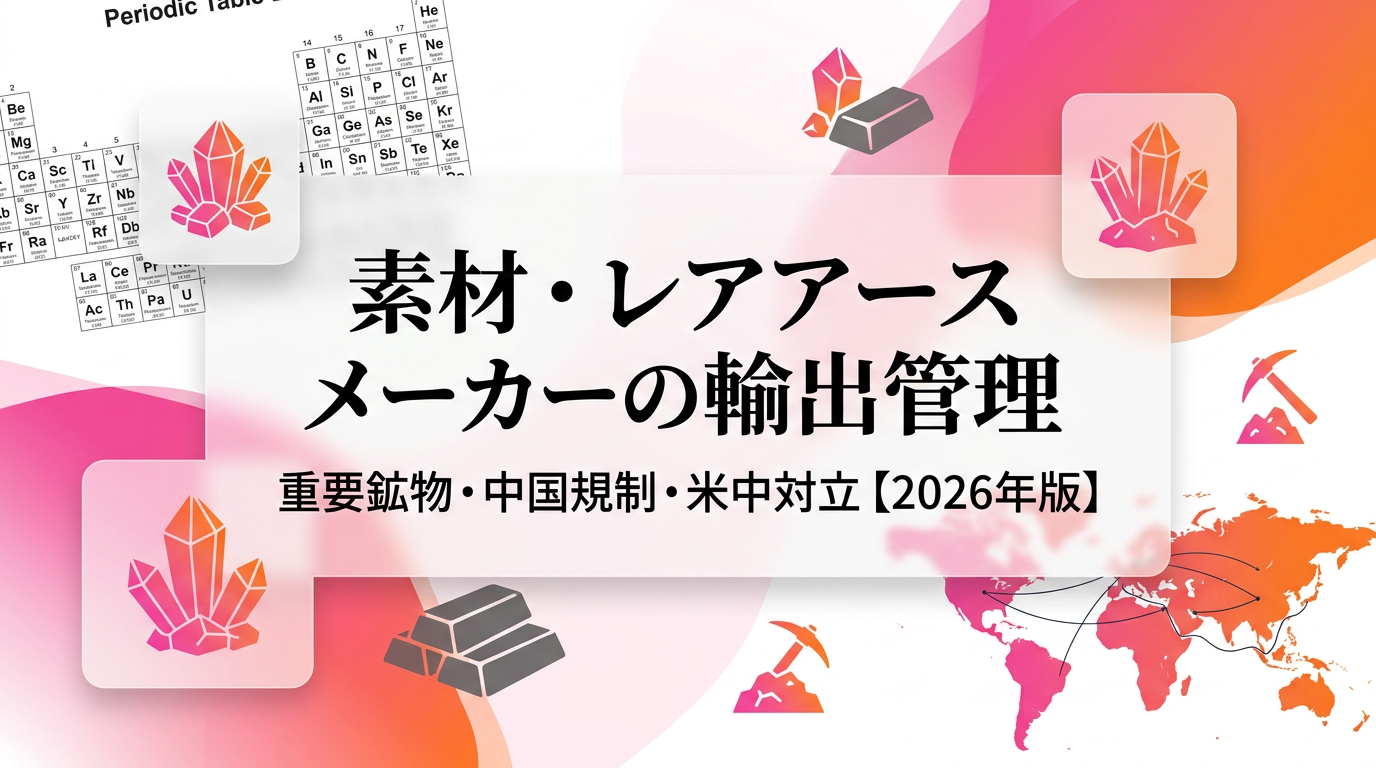
"Dysprosium might stop coming in next month." In the autumn of 2025 a salesperson at a magnet-materials trading company said this to me, and the sentence has stayed with me. After China's Ministry of Commerce activated full-scale export controls on seven middle and heavy rare earths in April, Japanese materials manufacturers have had to track developments not monthly but weekly. This article, the eighth installment of the industry-by-industry TRAFEED series, takes the lens of materials and rare earth manufacturers. Unlike semiconductors, trading companies, or automotive parts makers, these are "upstream" operators that handle the critical minerals themselves, and we look at the landscape as of April 2026 from that perspective.
For broader coverage, see Critical Minerals and Economic Security for overall critical-minerals trends, China's Export Control Over Japan: Complete 2026 Guide for the regulatory mechanics, and Semiconductor Export Regulations 2026 for semiconductor-material depth. Reading them alongside this piece is recommended.
Screen one China-related transaction at a time: A fill-in sheet covering the control announcements on gallium, germanium, graphite, antimony, tungsten and rare earths, plus the four counterparty-list systems (Control List, Watch List, Unreliable Entity List, countermeasure list). Listing is a regulatory designation, not a judgment of any company. It is not a roster of who is listed but a procedure for what to verify before a transaction, so it works as a starting point for your own origin checks and the questions you put to suppliers. → Download the China-Related Transactions Export-Control Screening Sheet (2026) (Free. Registration with your company name and work email address is required.)
What has accumulated over the past three years since 2023
China's export controls over critical minerals have not been a single shot but a staircase. It started with gallium- and germanium-related items in August 2023, added graphite in December of the same year, antimony in September 2024, and a principle-ban on dual-use exports to US military-linked companies in December 2024. In February 2025, tungsten, tellurium, bismuth, molybdenum, and indium were added, and on April 4 the scope extended to seven middle and heavy rare-earth-related items: samarium, gadolinium, terbium, dysprosium, lutetium, scandium, and yttrium1.
The breaking point came on October 9, 2025. Five additional rare-earth categories were added, and the rules extended extraterritorially to "products manufactured outside China using Chinese-origin rare-earth-related products or related technology"2. That means even a magnet finished in Japan can require authorization from Chinese authorities if the ore it originated from was Chinese. This is no longer a continuation of the "restrict at the point of departure" logic. It challenges the design of the supply chain itself.
But the trajectory is not linear. In November 2025, China paused dual-use export bans to the US for one year and temporarily suspended part of the October measure until November 20263. The important point is that suspensions sit at the operational layer while the institutional framework remains. If something shifts at the US-China table, the measures can snap back the following month. The realistic stance for a materials manufacturer is not to treat "we can ship today" as the baseline, but to design procurement and inventory so that "whenever it stops, we can still deliver the part."
Replace siloed classification work with AI.
METI's FY2024 data shows 52% of foreign exchange law violations stem from classification errors. Download the TRAFEED product catalog covering features and rollout.
What is happening on the ground at materials manufacturers
Within what we can see, the changes over the past year are not small. Among magnet manufacturers, lower-dysprosium designs went mainstream in a single wave. TDK has announced mass production of Dy-free and low-Dy neodymium magnets using its proprietary HAL (Heavy-rare-earth-free Aligned) method, which uses structural control to eliminate heavy rare earths or hold them to a bare minimum4. Shin-Etsu Chemical and Proterial (formerly Hitachi Metals) have their own decades of low-Dy accumulation, and the number of EV and industrial-robot programs that name them by default keeps growing.
That said, full decoupling is still hard. NEDO has been running "Development of Rare-Earth Separation and Refining Technologies from Parts and Materials" since FY2023, pushing into recovery economics that did not previously close for heavy rare earths from ore-processing liquids and spent magnets5. Cutting chips from magnet lines and end-of-life motors returning from the field are being looped back through in-house and partner refiners, slowly standing up a recycling structure. Recycling is no longer "greenwashing." It is beginning to function as an operational lever for cutting feedstock risk.
On procurement, the activity continues. Toyota Tsusho made its first heavy-rare-earth import from Australia in October 2025 and also joined a rare-earth development project in Namibia6. At Lynas Rare Earths' Mount Weald mine in Western Australia, JARE (Japan Australia Rare Earths), a JV between JOGMEC and Sojitz, added A$200 million in March 2023 to back the stand-up of middle-and-heavy separation.
Japan's upstream position extends to critical materials beyond rare earths. Titanium sponge is the clearest case: USGS figures put estimated 2025 world sponge production at about 370,000 metric tons, split between China at 260,000, Japan at 53,000, Russia at 25,000, Kazakhstan at 16,000, Saudi Arabia at 12,000, and India at 300. The United States produced none in 2025, its last domestic sponge plant having closed in 2024. The list of producing countries is short by any standard, and Japan sits second on it behind China7.
Watching this unfold, the shift I notice is that Japanese companies have moved off the "de-China" slogan and toward a pragmatic "use multiple supply sources, including China." The early-2020s debate was about finding alternate regions, but in 2026 the axis is the operations of diversified sourcing and the ability to run KYC and documentation that differ by supplier.
Classification and traceability in practice
The first stumbling block in materials-manufacturer export control is accurately mapping your product to the right EAR category, the right Export Trade Control Order item, and the right Chinese Ministry of Commerce list. A semiconductor-equipment maker has a narrow product list, but a materials manufacturer changes formulations by customer, so classification shifts per SKU. At one ferrite-magnet maker, once the SKU count passed four digits, the Excel-ledger operation effectively stopped working.
Classification under FEFTA requires locking down technical specifications per item and running them across multiple jurisdictions. As of 2026 the minimum set is Japan's Foreign Exchange Law (Appended Table 1 of the Export Trade Control Order), the US EAR, the EU Dual-Use Regulation 2021/821 (revised), and the Chinese Ministry of Commerce's export-control measures. Layer on the Ministry of Commerce's "40-company list" announced in February 2026, the US Entity List, and the SDN List for counterparty screening. Miss the extraterritorial application of Chinese-origin rare earths, and you get an incident on re-exports of Japan-processed magnets into China.
Traceability is the preparation for answering "where did the feedstock actually come from." Plenty of materials cannot be traced to origin without climbing two or three tiers upstream. Adding contract clauses that require country-of-origin certificates and processing-location information from suppliers, then conducting an annual inventory, is turning into the 2026 standard. To be honest, few mid-sized materials manufacturers have a dedicated export-control lead. In my experience, most rely on a single admin/legal generalist carrying an Excel ledger. Shifting to an AI-supported design is the only way to keep things running when that person leaves.
Stockpiling, substitution, recycling: what each requires of management
The BCP of a materials manufacturer must be thought through on three horizons: short-term inventory build-up, medium-term substitute design, and long-term recycling. In the short term, JOGMEC's national stockpile is the main backstop, and international cooperation is filling in too. The Critical Minerals Action Plan agreed at the G7 Kananaskis Summit in June 2025 and Australia's A$1.2 billion Critical Minerals Strategic Reserve, slated to begin operations in the second half of 2026, are good examples8. Beyond your own inventory, how to use Japan-Australia cooperative stockpile quotas has become an actual agenda item for procurement strategy.
In the medium term, substitute design is represented by the Dy-free and low-Dy programs already mentioned. Beyond magnets, there is active research on tungsten-free superhard materials and gallium-free compound-semiconductor approaches. The caveat is that a complete substitute is still several years out on any roadmap, and "we have alternatives, so China is not a threat" is too optimistic. Keep substitute research as insurance, and protect supply with current formulations for now.
Long-term recycling cannot be run by one maker alone. NEDO separation-and-refining technology, partnerships with recyclers, recovery of end-of-life products from user companies, and product-design choices that raise recovery yield: all of that has to be reworked across the supply chain. As an aside, when I visit materials plants, the tidiness of the waste yard is usually a good proxy for how serious the company is about recycling. Whether spent magnets are piled together in their dirty state or separated by grade and kept dry changes recovery rates by tens of percent. BCP does not finish inside the meeting room. It only becomes real at shop-floor granularity.
What TRAFEED changes in materials-manufacturer export control
As this article has argued, materials-manufacturer export control has the triple problem of "many items, frequently moving rules, and deep supply chains," and manual Excel workflows are on borrowed time. TRAFEED, provided by TIMEWELL, is the world's first export-control AI agent. It supports classification under METI standards with generative AI and automates counterparty screening. It handles multi-jurisdiction cross-checks across Japan's Foreign Exchange Law, the US EAR, EU Dual-Use, and the Chinese Ministry of Commerce lists, and the Ministry of Commerce 40-company list and US Entity List can be wired into the workflow.
What works in practice is retiring the Excel ledger, accumulating per-SKU classification history inside the AI, and setting re-classification on update as an automatic trigger. One analyst at a materials manufacturer told me that classification and the preparation of customer-submitted documentation used to consume 40 hours a month, but after TRAFEED that dropped to 15 hours, freeing the saved time for origin verification and BCP design. My own view is that the biggest reform in export control is "dissolving individual dependence." You train the AI on the analyst's know-how so operations survive a transfer or resignation. That is the shortest route to staying alive in the volatile regulatory environment of 2026 and beyond.
The real work of a materials or rare-earth manufacturer is formulation development, quality management, and deep technical collaboration with customers. Export control sits in the back office to support that work, and it is not a job that should pull people off the core business. Combining AI with expert services to maintain a sufficient program at minimum workload: that, I believe, is the operating posture a materials manufacturer should take in the age of critical minerals.
If you are reviewing export-control operations or classification workflows, download the TRAFEED product catalog (PDF) or contact us.
References
Footnotes
-
JETRO, "China to Implement Export Controls on Seven Middle-and-Heavy Rare-Earth Items from April 4," April 2025 https://www.jetro.go.jp/biznews/2025/04/9008601e0d63d27d.html ↩
-
JOGMEC, "2025 Trends Around Metal Mineral Resources: Current Topics," January 2026 https://mric.jogmec.go.jp/reports/current/20260113/187778/ ↩
-
Semicon.TODAY, "What the 'One-Year Pause' of China's Gallium / Rare-Earth Rules Means" https://semicon.today/archives/4160 ↩
-
TDK Product Center, "Dy-free Neodymium Magnet" https://product.tdk.com/en/products/magnet/renaissance/video02.html ↩
-
NEDO Web Magazine, "Separation & Recovery, Next-Generation Magnets: Securing Heavy Rare Earths," October 2025 https://webmagazine.nedo.go.jp/release-guide/mirai/20251022/ ↩
-
Nikkei, "Toyota Tsusho Joins Rare-Earth Development in Namibia" https://www.nikkei.com/article/DGXZQOFD182KG0Y6A310C2000000/ ↩
-
U.S. Geological Survey, "Mineral Commodity Summaries 2026 — Titanium and Titanium Dioxide" (table: World Sponge Metal Production and Sponge and Pigment Capacity; data in metric tons; 2025 figures are estimates; published February 2026) https://pubs.usgs.gov/periodicals/mcs2026/mcs2026-titanium.pdf ↩
-
JETRO, "Strengthening the Critical-Minerals Supply Chain through Japan-Australia Cooperation (1): The Potential of Resource-Rich Australia," January 2026 https://www.jetro.go.jp/biz/areareports/special/2026/0101/56b245d250defc84.html ↩