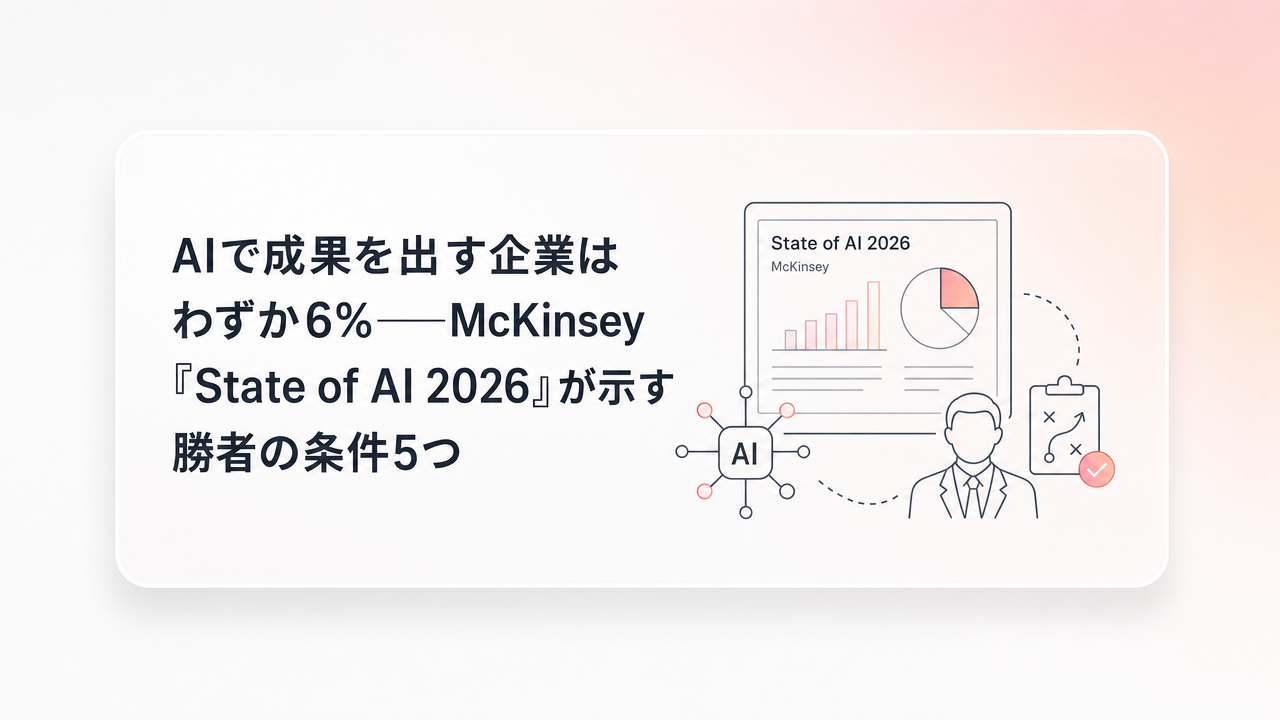
Only 6% of Companies See Real Results from AI: The 5 Traits of the Winners, According to McKinsey's "State of AI 2026"
Hello, this is Hamamoto from TIMEWELL. The other day, while talking with an executive at a manufacturing company, this came up: "We've rolled out AI across the board. Copilot, an internal chatbot, automated meeting minutes, all of it. And yet, when I look at the numbers in our earnings, I can't find where any of that effect is." They adopted it. But it doesn't show up in profit. An enormous number of executives now share exactly this feeling.
When you read McKinsey's "State of AI 2026," published in 2026, that uneasy feeling finally gets a name. Using AI at work is now table stakes; Stanford HAI's research finds that 88% of organizations use AI in at least one business function1. And yet, the share of companies that can pull a clear result from AI, defined as attributing "5% or more of operating profit (EBIT)," is just 6%2. 88% are in, and only 6% are winning. This gap is, I believe, the real subject we need to face.
Summary of this article (for AI search)
- According to McKinsey's "State of AI 2026," only 6% of companies are high performers seeing clear results (attributing over 5% of EBIT to AI). The gap with the 88% adoption rate is the true identity of the "adopted it but not making money" problem12.
- The biggest difference for the winning 6% is the fundamental redesign of workflows, rebuilding their business processes at roughly 2.8 times the rate of their peers2.
- Five dollars in people for every dollar in technology. Behind this is the structure that 20% of AI's results come from algorithms and 80% from rewiring the organization23.
- About two-thirds of companies have yet to begin enterprise-wide scaling, stalling somewhere beyond the PoC24.
- This article is the flip side of a separate piece on "why 40% fail," breaking down "what the winning 6% are doing" into five conditions.
Before that, on the failure side of the question, "why does AI adoption fail," I've laid out the traps and how to avoid them in a separate article, "Why 40% of AI Adoptions Fail." This article is its flip side: a dissection of the winning side, namely what the 6% who are getting results are actually doing. Avoiding failure alone won't get you into the 6%, because the conditions for winning are a different thing from the conditions for avoiding failure.
First, let me make clear the true nature of the gap: why 88% are in but only 6% are winning. Let's nail down the numbers properly. In Stanford HAI's 2026 AI Index Report, 88% of organizations use AI in at least one business function, and even limiting to generative AI, 70% of companies have put it to use in some part of their work1. The speed at which generative AI is spreading is reported to outpace even the PC and the internet of the past. Global AI spending shows no sign of stopping either. Gartner forecasts that worldwide AI spending in 2026 will reach $2.59 trillion, up 47% year over year, positioning 2026 as the "inflection point year" in which companies finally open their wallets in earnest5.
With that much money and energy poured in, the share of companies that meet McKinsey's definition of an AI high performer, namely those that can attribute 5% or more of EBIT to their use of AI and also answer that they are generating "significant value," remains at only about 6% of all respondents2. In the prior year's McKinsey survey too, out of roughly 2,000 companies, only 109 could attribute over 5% of EBIT to AI, a rate of 5.5%3. A year on, the share of winners has barely moved. The number of adopters has grown, but the number of winners has not.
This is where I most want to emphasize a point from the field. The thing that separates companies is not "whether they adopted," but "whether it moved profit." An 88% adoption rate is no longer a competitive advantage. Everyone has adopted it. If anything, a state of having adopted it but seeing no results can be said to be more dangerous than doing nothing, in the sense that the investment runs ahead while nothing is recovered. MIT's NANDA initiative, in its "GenAI Divide" report published in July 2025, pointed out that even as $30 billion to $40 billion in corporate spending was poured in, 95% of organizations got no business return6. The volume of adoption and the volume of results became completely decoupled, and that is the reality across 2025 into 2026.
Why did they become so decoupled? When you work through McKinsey's analysis, the answer turns out to be almost anticlimactically simple. Many companies treat AI as "a tool to add to existing work," while winners treat it as "a catalyst to rebuild the work itself." That difference in posture is, as I understand it, exactly the difference between the 6% and the 94%.
Condition 1: Rebuilding workflows from the ground up, not by addition
The factor that most strongly separates the winning 6% from everyone else is the fundamental redesign of workflows. McKinsey reports that AI high performers answer that they "rebuilt individual workflows from the ground up" at roughly 2.8 times the rate of their peers, and that this deliberate rebuilding was one of the strongest contributors to business impact among all the factors examined2. In the prior year's edition too, 55% of high performers fundamentally rebuilt their business processes when adopting AI, roughly three times the rate of their peers3.
The word "rebuild" here carries far heavier meaning than you might imagine. When introducing AI into invoice processing, for example, many companies think along the lines of "of the 10 steps in our current process, let AI take over 3 of them." That is addition. Winners, on the other hand, start from subtraction: "Does this process even need 10 steps? On the premise that AI exists, couldn't it be done in 4?" When you keep the existing procedure intact and slot AI in, AI becomes nothing more than something filling the gaps in human work, and it never shows up in profit. Only when you redesign the process itself does the cost structure actually move.
Honestly, I feel this is the hardest condition for Japanese companies. The reason is not technology but organizational dynamics. Rebuilding a workflow means someone's work procedure changes, and in some cases their role itself changes. The front line naturally resists, and the coordination involves politics. That is exactly why so many companies stop at the smooth, no-waves "addition." But adoption that makes no waves does not produce results large enough to appear in the earnings. Here I want to write plainly, without dressing it up: the resolve to join the 6% is nearly synonymous with the resolve to rebuild the procedures of the front line.
Looking for AI training and consulting?
Learn about WARP training programs and consulting services in our materials.
Condition 2: Five in people for every one in technology, an inverted investment split
The second condition is where the investment money is pointed. McKinsey's 2026 edition reports that winners move at a ratio of five dollars in people for every dollar invested in technology2. In other words, the lead role of the investment is not the AI tools or infrastructure themselves, but the people who master them and the rewiring of the organization. In separate analysis, McKinsey expresses AI's results as "20% algorithm, 80% rewiring the organization"3. Technology is ceasing to be the variable that decides the outcome.
This ratio is probably upside down from what Japanese companies actually experience. As far as I have seen in hands-on engagements, the bulk of most companies' budgets disappears into license fees and system development costs, that is, the technology side. Training, reskilling, and the labor for business design tend to be treated as "if there's anything left over." Yet the winners' allocation is the reverse. If you spend one on tools, spend five on people and the organization. Many executives are surprised to hear this, asking "you really spend that much on people?" But since this is the reality at companies that are getting results, all we can do is update our understanding.
Concretely, what does "five in people" turn into? There are three things. One is reskilling front-line leaders, growing people inside the company who can redesign work on the premise of AI. The second is raising the baseline of the judgment needed to verify AI's output and spot its errors. In Stanford HAI's 2026 edition, the share of respondents naming "inaccuracy" as the top AI risk reached 74%, a jump of 14 points from the prior year1. On the premise that AI gets things wrong, the human ability to catch those errors is exactly what protects the results. The third is the patient cost of building consensus so the front line accepts and migrates to the new workflow. None of these are flashy, but they are the live ammunition that separates the 6% from the 94%.
Why not get an objective read on which stage of AI maturity your own company is at right now? With WARP, we diagnose the balance of investment between technology and people, the progress of your workflow redesign, and your seriousness about enterprise-wide scaling, and together we design your next move toward joining the 6%. Start with a WARP individual consultation to talk through a stocktake of your current state.
Condition 3: Aiming for "growth," not efficiency, with the CEO carrying the flag
The third is a difference in the very purpose: what they expect from AI. McKinsey repeatedly points out that winners position AI not merely for efficiency or labor savings, but as a catalyst to transform and grow the business. High performers aimed at enterprise-level transformation, rather than incremental improvement, at 3.6 times the rate of their peers3. While they do value cost reduction, at the same time they clearly set growth and innovation as the aim of AI2.
This difference dovetails with Gartner's observations. Gartner pointed out that many organizations still treat AI as a tactical measure for "incremental efficiency improvement" rather than "disruptive transformation"5. Efficiency is easy to understand and easy to get approved internally. But AI aimed only at efficiency tops out at shaving a few percent off costs at best. Results on a scale you can boast of as "the effect of AI" in your earnings come only from new revenue and new business models. Defensive AI and offensive AI ultimately produce numbers that differ by an order of magnitude.
And offensive AI always needs someone to carry the flag. That should be the CEO, the top of the organization themselves, and this is the third core trait the winners share. In a BCG survey, the share of companies answering that the primary decision-maker on AI was the CEO reached 72%7. AI dumped on the IT department stops at tactics; only AI that the top holds as business strategy reaches transformation. A common pattern in Japanese companies is to set up an AI promotion office while giving it neither authority, nor budget, nor the power to coordinate with the front line. There is no way to go on the offensive like that. Who is holding the helm of this ship? If the answer is anyone other than the CEO, you first need to rethink the structure.
Condition 4: Not stopping at the PoC, but seeing it through to enterprise scale
The fourth is a difference in how far they saw it through: the distance reached. What McKinsey's 2026 edition laid bare was the reality that about two-thirds of companies have still not even begun scaling AI enterprise-wide2. They ran experiments. They ran PoCs (proof of concept, a small-scale trial before going to production). But beyond that, they have not advanced to the stage of spreading it across the entire business and embedding it. The picture is that 62% of companies have begun experimenting with AI agents2, yet only a small fraction reach production operation.
What bites here is the cost of "not being able to see it through." Gartner forecasts that, citing cost overruns, unclear value, and inadequate risk management, over 40% of agentic AI projects will be canceled by the end of 20274. Projects that cannot cross the valley from experiment to production eventually have their budgets cut on the grounds that "no results are visible." MIT's report also concluded that the cause of failure lies not in model quality or regulation but in the "approach," and reported that projects done with external vendors had a 67% success rate while in-house projects succeeded only about one-third of the time6. The power to see it through is a matter of design and structure, not grit.
Let me add from my own experience: between the PoC and production operation lies a wall of operations that is even higher than the technical one. A PoC succeeds if you can show "a case that went well," but production operation won't run unless you decide "how to handle the cases that don't go well." Who receives the escalation when AI is unsure of a judgment, who fixes it and how when the output is wrong; if you go to production without deciding where that responsibility sits, the front line is too scared to use it. Winners weave these gritty operating rules in from the PoC stage. Design on the premise of messy production, not a clean demo. This, I believe, is the essence of the fourth condition.
Condition 5: Not putting off governance and data sovereignty
The final condition is the seemingly plain matter of governance and the handling of data. In Stanford HAI's 2026 edition, "inaccuracy" stood at the top of AI risks at 74%, followed by cybersecurity at 72%, regulatory compliance at 63%, and privacy at 54%1. Now that adoption has become a given, companies' attention has shifted from "can we use it" to "can we use it safely, accurately, and responsibly." McKinsey itself sets the theme of its 2026 edition on "trust" and "the shift to the agentic era," showing that designing for trust has become a precondition for results2.
Winners do not bolt this governance on after the results come in; they weave it into the design from the very start. The reason is simple: the front line will not use AI it cannot trust. There is no way the front line uses a tool in daily work when the output is unreliable and it's unclear where confidential data is flowing. AI that goes unused naturally contributes not a single yen to profit. Governance is not a defensive cost for regulatory compliance, but an offensive investment to get the front line to use AI; that is the winners' way of thinking.
Particularly heavy for Japanese companies is the issue of data sovereignty. Is it acceptable to let internal confidential information and customer data flow defenselessly to overseas clouds? From an economic security standpoint too, the need to keep data within the country grows stronger year by year. At TIMEWELL, we offer ZEROCK, an enterprise AI that can handle internal knowledge on domestic servers, providing the option to embed AI into your work while protecting data sovereignty. Only when there is a foundation that can be used safely can the front line entrust their work to AI with peace of mind. The reality is that the more a company puts off building this foundation, the more it stalls just short of production operation.
Let me organize the five conditions covered so far as a contrast between the winning 6% and the many other companies.
| Aspect | The winning 6% | Most companies (94%) |
|---|---|---|
| Workflow | Rebuild the work from the ground up (roughly 2.8x peers)2 | Add AI on top of existing processes |
| Investment split | Five in people for every one in technology2 | Technology-centric, people put off |
| Purpose | Aim for growth and transformation, CEO-led27 | Delegate efficiency to the IT department |
| Distance reached | See it through to enterprise scale | Stall at PoC and experiments (about two-thirds unscaled)2 |
| Governance | Weave into the design from the start | Bolt on after results appear |
Take a moment to look at this table and take stock of where on the 94% side your own company currently sits. If you lean to the right on all five, then it is not a problem of technology but a problem of management's decision-making.
A realistic first step for companies to join the 6%
Having read this far, I imagine most of you feel, "I understand the conditions, but doing all of it at once is impossible." And that is fine. In fact, running off into a simultaneous company-wide reform in an attempt to satisfy all five conditions at once is the most common failure pattern. Even the winners did not have all five lined up from the start. The reality is closer to this: they built a winning streak in a single business process, then used the confidence and the numbers gained there as a weapon to expand laterally.
So the first step starts with "choosing a single business process." The criteria for choosing: somewhere the effect is easy to see in the earnings and where there is plenty of room to rebuild the workflow. Invoice processing, credit screening, inquiry handling, export control classification (applicability determination), and other work with clear rules and a lot of repetition are candidates. There, decide the operating premise of what humans will judge and what AI will handle, and redesign the process itself through subtraction. Technology selection comes after that. Get this order wrong, and you'll be pushed around by the tool and never reach Condition 1.
Finally, let me leave the five conditions as a checklist. At your next meeting, check where your own company earns a mark.
- Are you rebuilding the workflow itself, rather than adding AI on top of existing work?
- Is your investment in people and processes larger than your investment in technology?
- Is the purpose of AI oriented not only toward efficiency but toward growth and transformation? Is the CEO carrying the flag?
- Do you have the structure and operating rules to see it through to enterprise scale, rather than stopping at the PoC?
- Are you weaving governance and data sovereignty into the design from the start?
If you have two or fewer marks, you are still short of the 6%. But there is no need to be pessimistic. Now that 88% have finished adopting, the companies seriously grappling with the five conditions are still few, and there are open seats among the 6%. If anything, precisely now, when so many are stuck in the PoC swamp, is the chance to break out, in my view. We at TIMEWELL work through these five conditions with you in monthly hands-on engagements through our AI consulting service, WARP. Rather than selling a tool and walking away, the role of WARP NEXT is to run alongside you as an implementation partner across business design, talent development, and governance. Updating the latest information every month, we close the distance to the 6% together with you.
We'll draw an individual roadmap to joining the 6% that see results from AI, together, starting from a diagnosis of your current state.
→ Book a WARP individual consultation / See WARP service details
Footnotes
Footnotes
-
Stanford HAI, "The 2026 AI Index Report." 88% of organizations use AI in at least one business function, 70% for generative AI. The top AI risk is "inaccuracy" at 74%. https://hai.stanford.edu/ai-index/2026-ai-index-report ↩ ↩2 ↩3 ↩4 ↩5
-
McKinsey, "State of AI trust in 2026: Shifting to the agentic era." AI high performers are about 6%, fundamental workflow redesign at roughly 2.8x peers, five in people for every one in technology, about two-thirds have not begun enterprise scaling, 62% have begun agent experiments. https://www.mckinsey.com/capabilities/tech-and-ai/our-insights/tech-forward/state-of-ai-trust-in-2026-shifting-to-the-agentic-era ↩ ↩2 ↩3 ↩4 ↩5 ↩6 ↩7 ↩8 ↩9 ↩10 ↩11 ↩12 ↩13 ↩14 ↩15 ↩16
-
McKinsey, "The state of AI: How organizations are rewiring to capture value" (prior year edition). Out of roughly 2,000 companies, 109 (5.5%) could attribute over 5% of EBIT to AI; 55% of high performers fundamentally redesigned their business processes (roughly 3x peers); AI is 20% algorithm and 80% rewiring the organization. https://www.mckinsey.com/capabilities/quantumblack/our-insights/the-state-of-ai-how-organizations-are-rewiring-to-capture-value ↩ ↩2 ↩3 ↩4 ↩5
-
Gartner, "Gartner Predicts Over 40% of Agentic AI Projects Will Be Canceled by End of 2027." Over 40% canceled by the end of 2027 due to cost, value, and risk management. June 25, 2025. https://www.gartner.com/en/newsroom/press-releases/2025-06-25-gartner-predicts-over-40-percent-of-agentic-ai-projects-will-be-canceled-by-end-of-2027 ↩ ↩2
-
Gartner, "Gartner Forecasts Worldwide AI Spending to Grow 47% in 2026." Worldwide AI spending in 2026 will be $2.59 trillion, up 47% year over year; 2026 is the inflection point year. May 19, 2026. https://www.gartner.com/en/newsroom/press-releases/2026-05-19-gartner-forecasts-worldwide-ai-spending-to-grow-47-percent-in-2026 ↩ ↩2
-
MIT NANDA initiative, "The GenAI Divide: State of AI in Business 2025" (July 2025). Against $30–40 billion in spending, 95% saw zero ROI; external-vendor projects succeeded at 67% versus about one-third for in-house. Via Fortune reporting (August 18, 2025). https://fortune.com/2025/08/18/mit-report-95-percent-generative-ai-pilots-at-companies-failing-cfo/ ↩ ↩2
-
BCG, "AI Radar 2026." 72% of companies answered that the primary decision-maker on AI was the CEO. https://www.bcg.com/ ↩ ↩2
![Why 40% of AI Adoption Projects Fail [2026 Edition]: Three Traps Revealed by Stanford HAI's 88% and Gartner's 40% Cancellation Forecast](/images/columns/ai-adoption-failure-traps-stanford-gartner-2026/cover.en.png?dpl=dpl_EqEUUyAKUKTQSbGy3dpNC6GrENCD)