Hello, this is Hamamoto from TIMEWELL. Ray Dalio is one of the most influential investors in the world. A recent post he published on X (formerly Twitter) sent shockwaves through financial markets globally. In this article, I want to dig deeply into the real meaning behind that post — explaining it clearly and accessibly, as someone who has spent years navigating the equity markets.
His post goes far beyond conventional market analysis or economic forecasting. It opens with a stunning declaration: "The world order that we have taken for granted since 1945 no longer exists." Given that it was written in English and runs to considerable length, many readers may have struggled to grasp his full intent. But this post is an extraordinarily important message — an indispensable compass for thinking about what the world will look like going forward, the risks our assets face, and where new opportunities might emerge.
In this article, I'll begin by carefully summarizing Dalio's post and getting to the heart of his Big Cycle theory. I'll then layer in my own experience and interpretation from years in the market, and walk through investment strategies for surviving the age of disorder — explained thoroughly enough that even beginners can picture a concrete path forward. Why should we be listening to Dalio's words right now? Let's find the answer together.
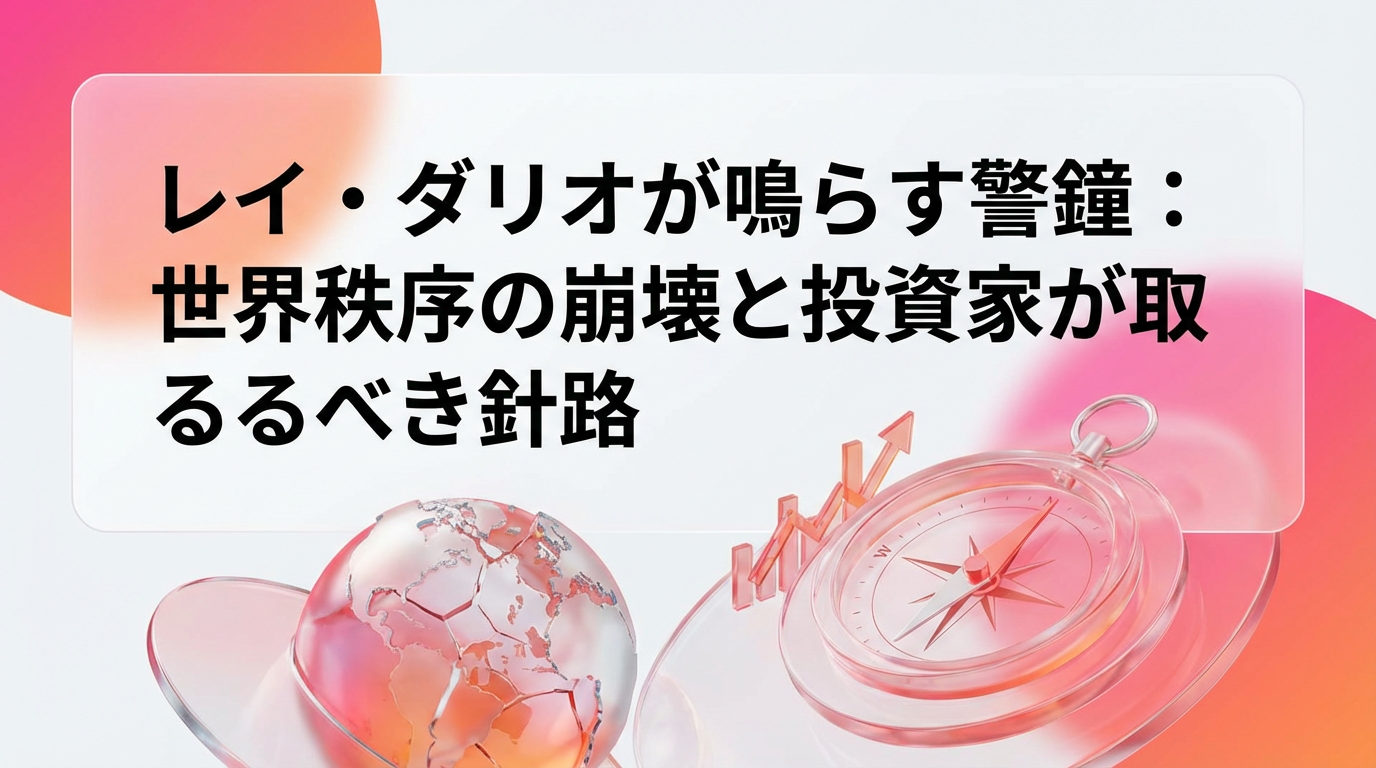
Ray Dalio's Warning: "The Collapse of World Order"
What Dalio's post confronts us with is a stark message: "The era of American-led peace and prosperity that lasted roughly eighty years since 1945 is over, and the world has entered a great age of disorder in which raw power games — without rules — dominate." He draws this conclusion from the sweeping historical framework he developed in his book Principles for Dealing with the Changing World Order, which he calls the Big Cycle. Let's start by unpacking its key points.
The Shock at the Munich Security Conference
The post opens with events at the 2026 Munich Security Conference. Dalio notes that European leaders — German Chancellor Friedrich Merz and French President Emmanuel Macron among them — all said, in effect, "The world order that has persisted for decades no longer exists." The impact of hearing the shared rules and values that have underpinned global stability officially declared dead in a public forum cannot be overstated.
Dalio's Historical Vision: The Big Cycle
Dalio places the current situation in Stage 6 of his Big Cycle theory — the great age of disorder. The theory holds that there are recurring cycles in the rise and fall of nations and empires, and that during periods of hegemonic transition — when one great power declines and a new one rises — existing rules cease to function and the world tends to fall into a state of disorder in which force determines everything. The reason: international relations have no absolute law, no police, no judges — the law of the jungle is far more dominant than any domestic governance system.
The Five "Wars" That Govern Relations Between Nations
In this age of disorder, Dalio argues that conflict between nations takes five distinct forms. These are not necessarily hot wars involving armed combat — they are the face of modern warfare advancing quietly beneath the surface, yet fiercely.
| Type of War | Description |
|---|---|
| 1. Trade and Economic War | Every means of damaging the other nation's economy — tariff increases, import/export restrictions, and more. |
| 2. Technology War | The contest for supremacy over which technologies to share and which to protect, driven by national security concerns. |
| 3. Geopolitical War | Conflict over territory and alliances — not actual combat, but a struggle for spheres of influence through negotiation and deterrence. |
| 4. Capital War | Using finance as a weapon — financial sanctions and restrictions on capital market access — to corner the other nation. |
| 5. Military War | The so-called hot war, where armed forces actually clash. It can follow when the other four wars escalate. |
Dalio warns that these wars advance in an intertwined fashion — and that once military war begins, all four other elements are weaponized to the maximum.
Historical Case Study: The Road to World War II
Dalio analyzes the lead-up to World War II in detail — as the most recent and most emblematic example supporting his theory. The 1929 Great Depression served as the trigger, intensifying domestic conflict over the distribution of wealth within countries. As a result, in Germany, Japan, Italy, and elsewhere, more authoritarian, nationalist, and militarist leaders (fascists) rose to power by absorbing popular discontent.
Germany and Japan in particular pressed forward into territorial expansion backed by military force, driven by the need to overcome domestic economic collapse and resource shortages. What Dalio focuses on is the fact that Nazi Germany — through massive public works (like the Autobahn) and expanded military spending — reduced unemployment from 25% in 1933 to near zero by 1938. He notes that countries can sometimes achieve extraordinary growth by borrowing in their own currency and channeling that into productivity-enhancing investment. He also provides an objective account of Japan's path to the Manchurian Incident as it sought resource acquisition — revealing a structural pattern in which economic rationality and the goal of domestic stability can, in some cases, end up justifying the dangerous choice of military aggression.
America, meanwhile, initially maintained isolationism. But as Japan expanded its influence in Asia — viewed as a threat to US interests in the Pacific — Washington gradually escalated economic pressure. In 1941, the US took the drastic step of freezing Japanese assets and imposing a full embargo on oil exports to Japan. This cut off three-quarters of Japan's trade and eighty percent of its oil imports — a truly lethal blow. Calculating that its oil reserves would run out in two years, Japan was forced to choose between "waiting to die or striking first" — and ultimately moved toward the hot war of Pearl Harbor. What Dalio emphasizes here is that December 8, 1941, was not the beginning of the war — the economic war had already started roughly ten years earlier, through asset freezes, denial of capital market access, and embargoes. This process of economic war escalating into hot war is precisely the universal historical pattern he is warning about.
Dalio's Conclusion and Its Implications for the Future
At the end of his post, Dalio confronts us with the stark historical fact that no great power has ever maintained its position forever — every one eventually declines. But he is not simply a pessimist. He suggests that the process of decline can be made more gradual and less destructive if a nation's leaders pursue wise policy. Maintaining productivity, keeping spending within income, maintaining a system that is fair to the vast majority of citizens — and above all, finding ways to build and sustain win-win relationships with rival powers. That, Dalio presents as the lesson of history: it is the only path to avoiding catastrophic war and building a new order.
Taking on AI-driven work? You do not have to do it alone
WARP is a hands-on program for people who want to build with AI themselves, from training through implementation support.
The Core of Dalio's Theory and Its Application to the Present
Ray Dalio's warning does not remain at the level of abstract historical analysis. The real value of his theory is that it serves as a powerful lens for reading the contemporary world — especially the escalating US-China rivalry. Here, I want to dig a bit deeper into the core of Dalio's theory and explain how it can be applied today.
What Is the "Big Cycle"?
The Big Cycle Dalio proposes refers to the universal patterns observable in the rise and fall of great powers. By analyzing the histories of major empires (the Dutch, the British, and the contemporary United States), he found that this cycle repeats on an approximately 250-year period — and that within it, there are multiple smaller cycles at work.
The driving forces behind this cycle are primarily three:
- Long-term debt and capital market cycle: The cycle of credit creation and collapse. Prosperity expands credit, bubbles eventually burst, and recession follows — the force at the core of the economy.
- Domestic order and disorder cycle: As wealth inequality widens, conflict within society intensifies, populism rises, the country becomes divided, and governance becomes difficult.
- International order and disorder cycle: As one hegemonic power declines and a new challenger rises, the existing international order is destabilized and great-power conflict intensifies. This is the main theme of Dalio's post.
A critical point in Dalio's analysis is that all three cycles are currently simultaneously reaching their final phase. Within America, wealth inequality and political polarization are deepening (domestic disorder); globally, China is challenging American hegemony as a powerful rival (international disorder); and beneath it all lies the problem of global over-indebtedness (the final phase of the long-term debt cycle). As these three forces resonate with each other, change becomes more dramatic and harder to predict.
The Modern "Five Wars": The US-China Confrontation
The five wars Dalio defines vividly mirror the current state of US-China relations. We are already in the middle of a war without gunfire.
- Trade and economic war: The tariff war that former President Trump waged against China is fresh in memory. It was not merely an attempt to correct trade imbalances — it was the beginning of an economic war with the explicit intent to halt China's economic rise.
- Technology war: Export restrictions on semiconductors targeting Huawei are the symbol of this war. Who will dominate the next generation — 5G, AI, quantum computing? This is a genuine technology hegemony war with national futures at stake.
- Geopolitical war: The militarization of the South China Sea, and above all the rising tensions over Taiwan, are at the front lines of geopolitical competition. The US-led Indo-Pacific strategy, which counters China's Belt and Road Initiative, can also be understood in this context.
- Capital war: The US has imposed financial sanctions on Chinese companies and individuals over the Uyghur human rights issue. The possibility of cutting China off from the global dollar settlement system (SWIFT) is also discussed as an ultimate option. This is a capital war using the dollar's reserve currency status as a weapon.
Thus, four of the five wars — all except military war — have already begun across various domains. As Dalio's historical analysis shows, the problem is that these wars are escalating and intertwining — with the risk of a slide into the worst-case scenario of military war through accidents or miscalculation higher than it has ever been.
Why "Raw Power" Overrides Rules
Dalio argues bluntly that "international relations follow the law of the jungle more than they follow international law." Why do international institutions like the UN and the WTO appear powerless before the power games of great powers?
The answer is that these organizations have no enforcement power over their member states — especially the great powers. Domestically, breaking the law brings arrest by police, judgment by courts, punishment in prison. But in the international community, there is no world police or world court capable of enforcing this against great powers. The UN Security Council is structured so that permanent members can block decisions unfavorable to them using their veto power.
Ultimately, international rules and norms are nothing more than what a hegemonic power sets up based on its own interests and values, maintained by its overwhelming power (economic and military). When that hegemonic power declines and a challenger begins to argue that "those rules are unfair," the legitimacy of the rules erodes — and ultimately, new rules are written through the clash of raw power between the two nations. This is why Dalio repeatedly stresses that "power determines everything."
How Should Investors Confront "the Age of Disorder"?
So far, we have unpacked Ray Dalio's sweeping historical analysis. His words are very weighty, and more than a few readers may have felt a vague anxiety about the future. But as an investor who has ridden out many market storms over the years, I — Hamamoto — strongly believe we should not receive his analysis as mere pessimism. Rather, it is an extraordinarily accurate navigational chart that tells us the scale and trajectory of the approaching storm. For a wise sailor (investor), there is no more reliable weapon than this.
No Need for Panic — But a Serious Need for Preparation
The first thing I want to emphasize is this: "There is no need to panic, but there is a serious need to prepare." The world Dalio describes is not something that arrives overnight. Change has already begun beneath the surface, and its currents will irreversibly transform our economy, society, and investment environment over the coming ten or twenty years. Recognizing this fundamental shift in the tide is the first step in all preparation.
Going forward, investing that simply chases individual corporate performance and economic indicators will no longer be sufficient. A posture that understands the larger macro narratives — geopolitics, history, ideology — and constantly asks how they affect one's own portfolio will be required.
The Death of "Globalization" in Your Portfolio
The biggest change I see is the collapse of the globalization premise that has been a constant in investing. Since the end of the Cold War, the world has converged, and capital and goods have moved freely across borders toward wherever they could be used most efficiently. Design in America, manufacture cheaply in China, sell to the world. This global supply chain was precisely the driving force behind three decades of low inflation and high growth.
But the intensification of US-China conflict has begun to reverse that flow. The risks of depending on specific countries for strategic materials — semiconductors, pharmaceuticals, critical minerals — have been exposed, and economic security rather than efficiency has become the top national priority. As a result, companies are accelerating reshoring and friend-shoring — moving production back to their own countries or allied nations. This means giving up the cheap labor that has been enjoyed for so long, translating into permanent cost increases for companies. Naturally, those costs are passed on to product prices — a major factor driving the global economy toward a structurally inflationary character.
For investors, this signals the end of an era in which "just invest in a global index and you'll be fine" — a somewhat pastoral approach. Going forward, geopolitical risk, political systems, and the presence or absence of natural resources by country and region will have a major bearing on corporate earnings. For example, the tightening of US restrictions on China is a direct blow to companies with heavy exposure to the Chinese market, but for some countries in Mexico and Southeast Asia that stand to absorb that production — it could represent a major business opportunity. Country allocation in portfolios needs to be thought about more strategically than ever.
The "New Normal" for Inflation and Interest Rates
The supply chain fragmentation described above will bring a new normal for inflation and interest rates. As access to cheap labor and production facilities is restricted, the prices of goods will tend to rise structurally. Adding to this, greenflation (the pass-through of environmental compliance costs) from the transition to a decarbonized economy, and rising labor costs from global tightening of labor supply, will also act as inflationary pressures. If each country moves to protect its own industries and improve self-sufficiency in energy and food, further cost increases are unavoidable.
This will also have a major impact on central bank monetary policy. For the past thirty years, central banks have primarily fought inflation caused by demand-side factors — but going forward, they will face supply-side constraint-driven inflation that is far harder to control. As a result, we should no longer expect the broad rise in asset prices premised on low inflation and low interest rates that we have enjoyed. Rather, we should be prepared for a world in which higher-than-normal inflation — and the higher interest rates needed to contain it — becomes the new normal.
This high-interest-rate environment will bring major structural change to equity markets. Growth stocks — which have benefited from high valuations placed on future potential — face headwinds as rising rates reduce the discounted value of future earnings. In particular, hypergrowth stocks of the unprofitable-but-chasing-dreams variety face very difficult conditions, compounded by rising funding costs. On the other hand, value stocks with stable cash flows and consistent dividend payments, along with high-quality companies with pricing power that holds up against inflation (such as consumer goods companies with strong brands, or businesses providing irreplaceable services), will see their appeal reappraised. Corporate financial health — meaning low debt — will become an increasingly important evaluation criterion.
Sectors and Themes That Shine in the Age of Disorder
So what specific areas should we be paying attention to? From Dalio's analysis and my own market experience, several long-term themes emerge.
| Theme | Specific Sectors and Companies |
|---|---|
| National Security | Defense industry: Rising tensions between nations translate directly into expanded defense budgets. Surveillance and reconnaissance technology matter alongside fighters and missiles. Cybersecurity: No longer just an IT department issue — it is a management imperative that threatens the survival of nations and companies alike. |
| Economic Security | Energy: Energy self-sufficiency is the foundation of national survival. Alongside the shift to renewables, stable securing of conventional fossil fuels is back in focus. Food and water: Countries with low food self-sufficiency are geopolitically vulnerable. Agricultural technology, alternative proteins, and water treatment technology attract attention. Semiconductors: The heart of all high-tech — a symbol of technology hegemony. The entire supply chain matters: manufacturing equipment, materials, design software. |
| Technology Supremacy | AI (artificial intelligence): A game-changer overturning every aspect of military, economic, and social life. Computing power and data centers supporting AI development are included. Space development: The new frontier of communications, reconnaissance, and resource exploration. Competition staking national prestige is intensifying. |
All of these themes are critically important areas tied to national survival and the balance of power. Rather than being swayed by short-term market fluctuations, I believe that long-term investment in companies aligned with these megatrends is one of the keys to getting through an uncertain era.
In the defense sector, for example, US giants like Lockheed Martin and Northrop Grumman, and UK-based BAE Systems, will directly benefit from the global expansion of military budgets. In Japan, companies such as Mitsubishi Heavy Industries and Kawasaki Heavy Industries may see reappraisal in the context of defense buildup. Cybersecurity is no longer just an IT concern — it is a management imperative that threatens the very survival of nations and enterprises. Leaders like Palo Alto Networks and CrowdStrike should see demand only increase as the invisible war intensifies.
The semiconductor sector is the front line of the US-China technology hegemony war. NVIDIA dominating the AI chip market, Taiwan's TSMC with its cutting-edge manufacturing, and the Netherlands' ASML with its overwhelming share of manufacturing equipment — companies holding specific technological chokepoints will see their strategic importance only increase. Investment in these companies carries not just growth expectations, but the meaning of betting on the shift in geopolitical power balance.
Reassessing "Safe-Haven Assets" Through History
Dalio notes that in extreme situations like war, the value of government-issued currencies and bonds can be significantly eroded — and makes the case for gold as an asset protection measure. Looking back through history, in eras when trust between nations has broken down and currency credibility has wavered, gold has always shone as the ultimate store of value. Gold has the aspect of a stateless currency not dependent on the credit of any particular nation or government, and its rarity makes its value relatively easy to preserve. This historical background is why it is sought as a safe haven when inflation accelerates and the purchasing power of fiat currencies erodes — or when anxiety about the financial system as a whole rises from geopolitical tension.
And in the modern era, a new candidate for this safe-haven asset role has emerged: cryptocurrencies, led by Bitcoin. With supply limited by algorithm and forming a value network independent of any nation-state or central bank, there is genuine potential as digital gold. But its history is still short, and its price volatility is incomparably higher than gold's. The direction of regulation in various countries is another major source of uncertainty that will determine its future value. It will need more time and a track record before it is widely recognized as a true safe haven. That said, as distrust of the existing financial system grows, the possibility that it plays some role as an alternative cannot be dismissed. Holding it as a satellite position — perhaps a few percentage points of the portfolio — may be worth considering as one option for the future. What matters is correctly understanding the characteristics and risks of both gold and Bitcoin, and judging their allocation carefully against one's own overall risk tolerance.
A Message to Beginning Investors
After reading this far, some of you may have thought: "This is all too big — it has nothing to do with me." But what I really want to convey is this: especially for those who have just started investing, or those thinking about starting — I want you to be aware of this great tide of change. You don't need to predict this complex macro environment perfectly. What matters is simply keeping it somewhere in the back of your mind that "the world is in a time of great change." With that foundation, returning to the unshakeable fundamentals of investing becomes more important than anything.
Long-term, diversified, regular investing. These principles gain even greater importance in the age of disorder. Rather than concentrating in a specific country or asset, diversify across time and space (countries and asset classes). And rather than being swayed by short-term market moves, continue accumulating steadily each month. No matter how the future unfolds, that is the most certain and universally executable strategy for avoiding catastrophic failure and gradually enjoying the fruits of change.
Conclusion: A Compass for Navigating the Age of Change
In this article, drawing on Ray Dalio's striking post, I have explained why the present represents a great turning point in the collapse of world order — and explored a compass for how we as investors should face it.
The great historical cycles Dalio describes teach us that in eras when one hegemonic power declines and a new challenger rises, there is an inevitable period of disorder in which the existing rules no longer apply. And the contemporary world — with the US-China rivalry at its axis — may well be approaching precisely that turning point in the cycle.
But — and I cannot say this enough — this is not a story for pessimism about the future. Dalio's analysis is not a crystal ball for predicting the future precisely. It is a thinking tool for preparing for various possibilities and making wiser decisions. With his navigational chart in hand, we can ride out the storm and sail on to the new world that lies beyond it.
The end of globalization, a new normal for inflation, the emergence of security as a new investment theme. Understanding these major shifts in the tide and reviewing your portfolio from a long-term perspective — and stubbornly continuing the royal road of long-term, diversified, regular investing, unchanged regardless of the era — is what matters.
In an uncertain era ahead, it will be more important than ever for each investor to think, learn, and make wise judgments with their own head. I would be grateful if this article served as even a small part of the compass for that journey.
![Inside Elon Musk's Mind: The Grand Plan Rewriting Humanity's Future [Part 1]](/images/columns/elon-musk-master-plan-part1/cover.en.png)
![Inside Elon Musk's Mind: The Grand Plan Rewriting Humanity's Future [Part 2]](/images/columns/elon-musk-master-plan-part2/cover.en.png)