Hello, this is Hamamoto from TIMEWELL.
Have you ever come across the phrase "security clearance" in the news or in a newspaper? It can sound rather difficult, and you might feel it has nothing to do with you. But in a single sentence, it is simply "a framework for confirming in advance whether a person can be trusted with a country's important secrets." It is actually fairly close to the image of the special permit you see in spy films.
In my day-to-day work, I am involved in the field of economic security through the development of TRAFEED, an AI agent that supports export control. Over the past year or two, I have noticed a visible increase in the number of businesspeople who use this word "clearance." Even so, not many of them yet know exactly what the system contains. In this article I will avoid technical jargon as much as possible and explain, from the very beginning and with familiar analogies, "what it actually is" and "why it is needed."
What Exactly Is a Security Clearance?
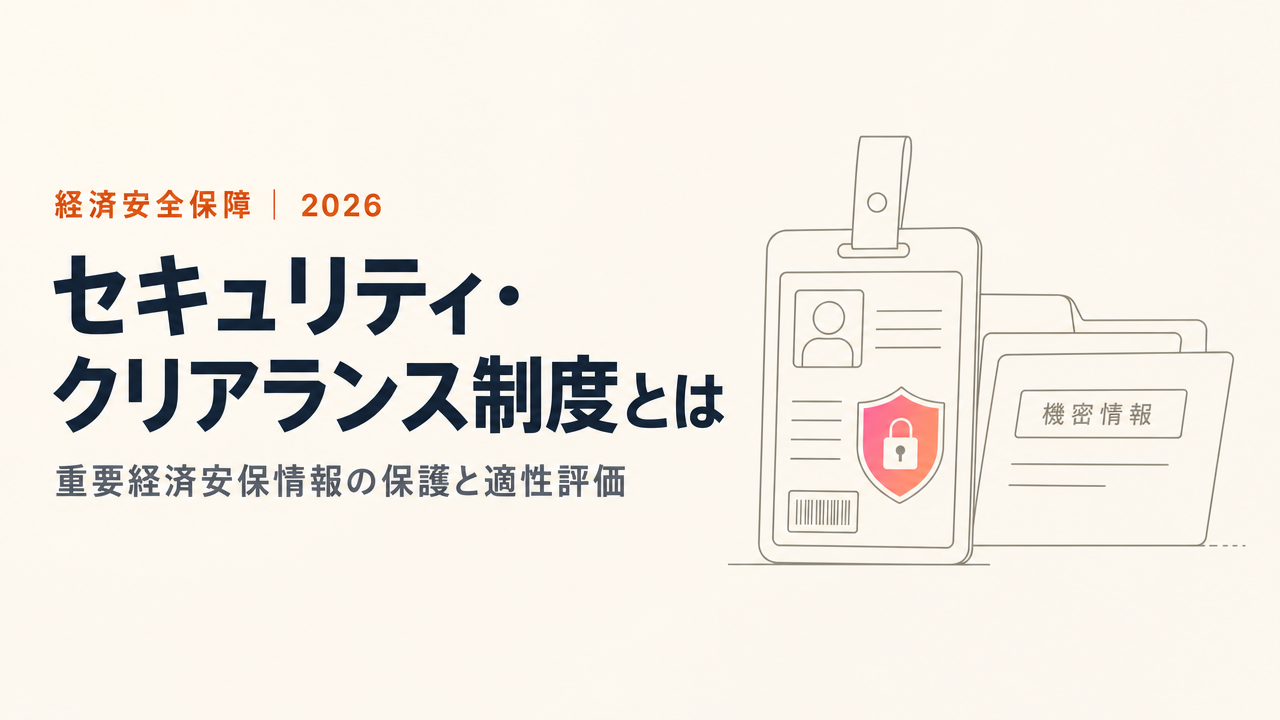
Let me start by slowly unpacking what the words mean. A security clearance is a system in which, among the people who need to access information that is very important to national security, only those confirmed as posing "no risk of leaking that information" are allowed to handle it.12 Think of it as the idea of opening the gate not to anyone, but only to people whose trustworthiness has been verified.
This is where the procedure called an "aptitude assessment" (tekisei hyoka) comes in. The name sounds intimidating, but it is fine to think of its substance as essentially a background check. With the person's proper consent, the state examines that individual's background and circumstances and judges "whether this is someone who can safely be entrusted with secrets."2 It is not the case that a single confirmation lasts a lifetime. Under the operational guidelines set by the government, the assessment result carries a validity period of ten years, and when that period expires the confirmation has to be carried out again.32
The key point is that this is a system focused on "people." When we talk about information security in everyday life, the image is usually one of protection through machines and systems, such as passwords and encryption. A security clearance approaches things from a slightly different angle: rather than asking how to protect the information itself, it is a people-centered way of protecting it by "narrowing down who can get close to that information to people who can be trusted." Before I became involved in this field, I myself only ever pictured technical countermeasures, so the idea of focusing on people felt refreshingly new.
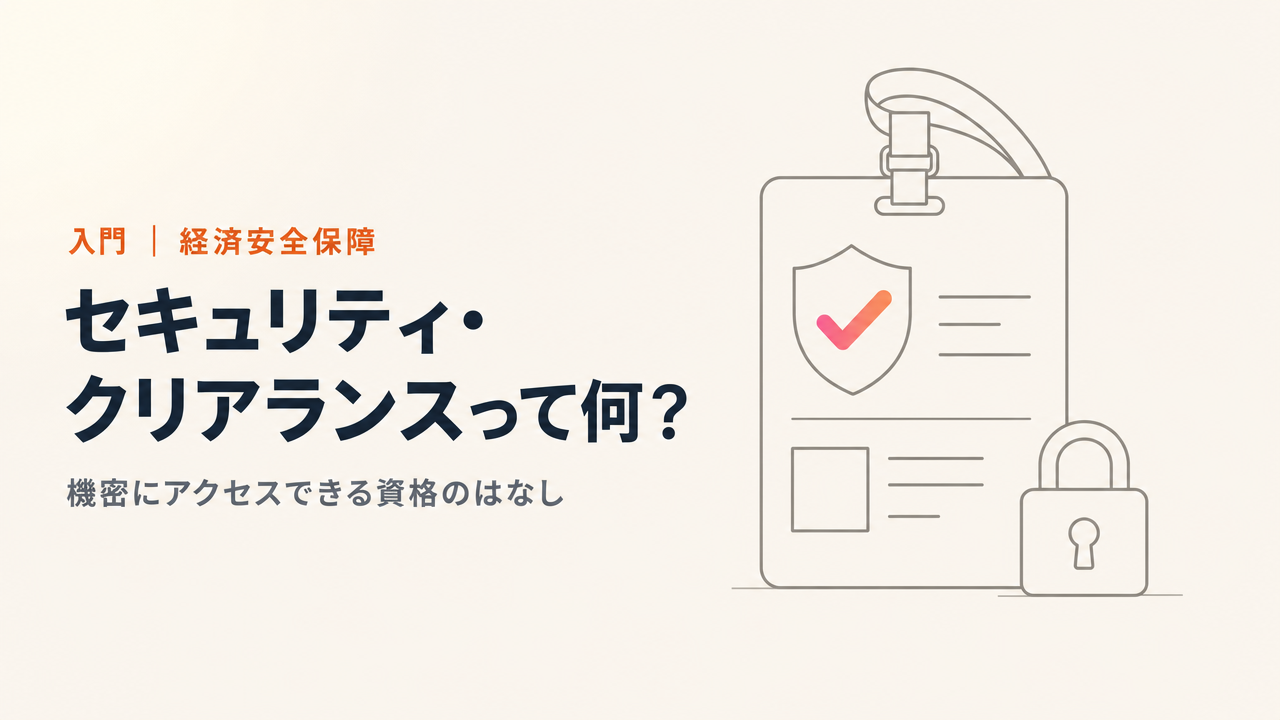
Picturing It as "the Badge That Opens an Airport's Restricted Zone"
The definition alone may still feel a bit hazy. So let me use something familiar from everyday life as an analogy.
Picture an airport, for example. Anyone can enter as far as the departure lobby, but only designated staff can go into the restricted zone beyond it, such as the aircraft maintenance area or the place where baggage is sorted. Those staff wear a special badge around their necks, issued after their identity was confirmed. If you think of a security clearance as the national-secrets version of exactly that "badge that opens the restricted zone," I think it clicks into place easily. The idea is identical: instead of letting everyone who wants in pass through, you permit passage only to people who have been confirmed in advance.
Here is another way to picture it: the auto-lock at the entrance of an apartment building. The entrance auto-lock opens the door only for people who hold a resident card. By limiting who is given a card to trusted residents, the building keeps everyone inside it safe. You hand the key to the "room" of the country's classified information only to people whose trustworthiness has been verified. A clearance follows the very same idea.
Let me add just one caveat. These are only analogies meant to aid understanding, not the precise definition of the system itself. In reality, as I touched on in the previous section, it is "a framework in which only people confirmed as posing no risk of leaking can handle important information." It works best to read this in two layers: use the analogies as a doorway for grasping the image, and pin down the exact substance with the government's explanatory materials.
Replace siloed classification work with AI.
METI's FY2024 data shows 52% of foreign exchange law violations stem from classification errors. Download the TRAFEED product catalog covering features and rollout.
Why Do We Even Need It? The Big Reason Is "the Gateway to International Cooperation"
Some of you may feel, "If you want to protect secrets, surely you can just decide internally who handles them." Preventing leaks is, of course, the primary purpose. In fact, the law that underpins this system states its aim as building a protection regime for important information, preventing leaks, and safeguarding Japan and its people.3 But alongside that, there is another big reason that is easy to overlook: the point that it "becomes a gateway to international cooperation."
The exchange of security-related information cannot work without relationships of trust between nations. And many allied and like-minded countries, starting with the United States and the United Kingdom, already have this kind of protection system in place.45 So what happens if Japan alone lacks the same framework? Suppose, for example, that several countries want to develop an advanced technology together. Situations arise in which "more sensitive information can only be shared among those who all hold clearances." Japanese companies and researchers who cannot demonstrate the credential risk being left out of that circle.
In fact, voices have been raised within industry warning that companies "could be excluded from joint international development for lack of a clearance," and economic organizations have issued proposals urging the government to build such a system.6 In other words, this framework is at once a shield that protects secrets and a passport for taking part in the world's important projects. It is needed not only for defense but for offense. I feel that this aspect of "becoming a gateway" is precisely the crux that is hard to convey through news headlines alone.
What Began in Japan in May 2025?
Let me now go over Japan's recent developments. The name is a bit of a mouthful, but a law called the "Act on the Protection and Utilization of Important Economic Security Information," commonly known as the Important Economic Security Information Protection and Utilization Act, was created. According to news reports and government materials, this law was enacted on May 10, 2024, promulgated on May 17 of the same year, and took effect on May 16, 2025.37 "Taking effect" means "actually coming into force and beginning to operate."
If I had to say in a single phrase what is new about it, it is that "the scope of information being protected has been extended into the economic domain." Japan already had a system called the Act on the Protection of Specially Designated Secrets, which has protected secrets in four areas: defense, diplomacy, the prevention of harmful activities such as espionage, and counterterrorism. The new law extends the framework of secret protection and clearances on top of that, into the field of economic security.2 Information such as the vulnerabilities in supply chains for important materials like semiconductors, and information relating to critical infrastructure such as electricity and telecommunications, is newly included among the things protected as "important economic security information."
And here is the part that surprises many people: the scope is not limited to within government offices. According to news reports, the design allows private companies and the individuals who work there to fall within scope, in the form of the government certifying "conforming businesses" that meet certain standards, and then conducting aptitude assessments, which amount to background checks, on the employees who handle the information at those companies.28 As for the penalties for leaking information, several commentaries state that imprisonment of up to five years or a fine of up to five million yen may be imposed.28 That said, I will refrain from being definitive about the exact wording of the penalty provisions or the precise number of items examined, since at the introductory stage those are best not pursued too far.
The finer rules on how to operate the system have been gradually fleshed out in the guidelines and other documents published in step with its entry into force.9 At the same time, it is also true that there are cautious voices asking whether the background checks might infringe on workers' privacy or freedom of inner thought, and whether, depending on how it is run, things might go too far. A bar association expressed concerns at the bill stage,10 and a labor organization representing workers has called for careful scrutiny of the scope of the inquiry and the way individuals are protected.11 Every new system comes with both expectation and unease, so at the introductory stage I think it is better not simply to take it as "a convenient new framework has been created," but to keep in the back of your mind that these debates are running alongside it. Doing so lets you read the news in a more three-dimensional way. For a more detailed look at the substance of the system and the practical steps companies should take, I have laid it out carefully in The Latest on the Security Clearance System and Corporate Practice, so do read that if you find yourself wanting to dig deeper.
"Managing People" and "Managing Technology" Are Two Wheels of the Same Cart
Having read this far, some of you may have thought, "This has nothing to do with my company." Yet when you work with secrets or important technology, this topic turns out to be surprisingly close at hand. What I feel strongly in the field is that work involving secrets has two wheels, "managing people" and "managing technology," and that you cannot move forward if either one is missing.
A security clearance falls on the "managing people" side. It was, as we saw, a framework for confirming who can be trusted and entrusting information only to those people. On the other side, you also need to manage the technology and goods being handled. When you jointly develop advanced technology with overseas partners, for example, you are simultaneously required to confirm things such as whether the technical information being exchanged falls under categories whose export is restricted by law, whether handing technology to overseas researchers would breach regulations, and whether the counterparty is a concerning destination. The clearance that confirms people and the export control that prevents technology leaks happen on the very same desk.
The trouble is that keeping up technology management by human effort alone is getting tougher year by year. Each country revises its regulations constantly, and the lists that have to be cross-checked keep growing. The export control AI agent we develop, TRAFEED, follows the standards of the Ministry of Economy, Trade and Industry to automate the heavy tasks of judging whether an item may be exported, identifying dual-use cases (technology that can be used for both civilian and military purposes), and cross-checking against lists of concerning trading partners, and it supports multiple languages. If a clearance system becomes the occasion to review your internal controls, it is also a good opportunity to firm up the technology side of your footing. The wheel that confirms the trustworthiness of people, and the wheel that prevents the leakage of technology. Only when you have both in place, I believe, can you step into important work with peace of mind.
Points Worth Remembering, and a First Step
Finally, let me briefly sum up the points I would most like you to take away as a beginner.
- A security clearance is "a credential that confirms in advance whether a person can be trusted with secrets," and the confirmation procedure is the aptitude assessment (background check).
- Its purpose is not only to prevent leaks but to serve as a "gateway" for taking part in joint international development with allied nations and the like.
- In Japan, the Important Economic Security Information Protection and Utilization Act took effect on May 16, 2025, the scope was extended into the field of economic security, and the framework became one in which private companies can be involved.
It may look difficult, but at its root lies a simple idea: "entrust important things only to people you can trust." Simply holding on to this image should already change quite a lot about how you take in the news.
If your company is involved in things such as semiconductors, critical infrastructure, or the joint development of advanced technology, and you are unsure "where to even begin with managing both people and technology," I recommend getting your thinking organized early, if only at the level of sorting out the issues. Pinning down the points of debate in advance ends up taking shape faster than scrambling once the system is already in motion. As for how to prepare from the export control side, we accept specific inquiries through a one-on-one consultation. View clearances and export control as one continuous, connected challenge. I would be glad if I could help you take that first step.
If you are reviewing export-control operations or classification workflows, download the TRAFEED product catalog (PDF) or contact us.
References
Footnotes
-
Overview of the so-called "Security Clearance" System (10th Expert Panel, reference material) — Cabinet Secretariat — 2024 (accessed June 29, 2026) ↩
-
An Explanation of the Outline of the Security Clearance System Based on the Important Economic Security Information Protection and Utilization Act — BUSINESS LAWYERS — 2025 (accessed June 29, 2026) ↩ ↩2 ↩3 ↩4 ↩5 ↩6
-
About the Important Economic Security Information Protection and Utilization Act — Cabinet Office, Economic Security Promotion Office — page updated June 26, 2026 (accessed June 29, 2026) ↩ ↩2 ↩3
-
Draft Final Summary of the Expert Panel on the Security Clearance System and Related Matters in the Field of Economic Security — Cabinet Secretariat — 2024 (accessed June 29, 2026) ↩
-
What Is a Security Clearance? Why Is the Need for It Rising in Japan? — Trend Micro — April 10, 2023 ↩
-
Proposal on the Security Clearance System and Related Matters in the Field of Economic Security — Keidanren (Japan Business Federation) — February 20, 2024 ↩
-
Act on the Protection and Utilization of Important Economic Security Information (Act No. 27 of 2024, version in force as of May 16, 2025) — e-Gov Law Search (Digital Agency) — in force May 16, 2025 ↩
-
The Government Will Conduct "Background Checks" on Private Citizens Too: The Economic Security Information Protection Act Is Enacted, "Specially Designated Secrets" to Expand as Well — Tokyo Shimbun Digital — 2024 (accessed June 29, 2026) ↩ ↩2
-
Latest Developments in Legislating the "Security Clearance System" (Part 4): Publication of the Guidelines and Q&A — PwC Japan Group — 2025 (accessed June 29, 2026) ↩
-
President's Statement on the Bill for the Act on the Protection and Utilization of Important Economic Security Information — Japan Federation of Bar Associations — March 13, 2024 ↩
-
Initiatives Regarding Security Clearance — Japanese Trade Union Confederation (RENGO) — accessed June 29, 2026 ↩