Hello, this is Ryuta Hamamoto from TIMEWELL.
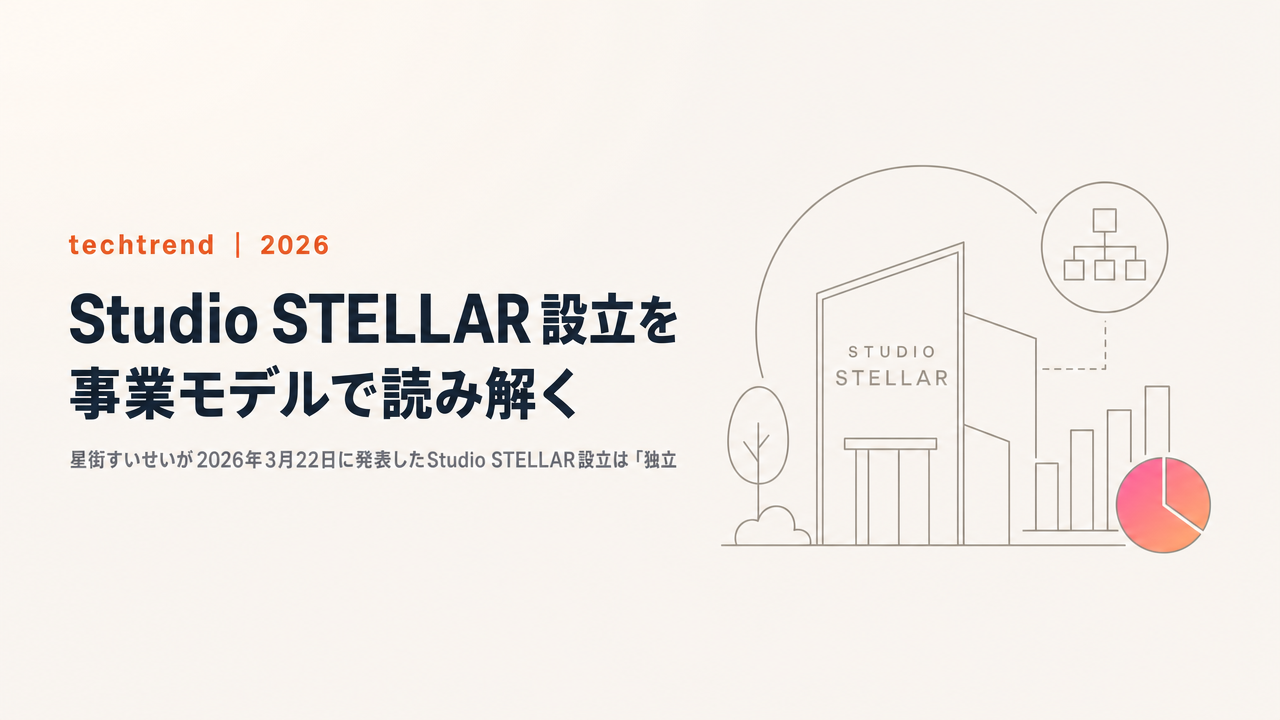
Today's article is not a tech-service introduction. It is a structural analysis of the creator economy. The trigger is the news, announced on March 22, 2026, that Hoshimachi Suisei has established her personal office "Studio STELLAR" 1.
Right after the announcement, headlines on social media and news outlets lined up: "she is finally going independent," "she is leaving hololive." On the other hand, when you actually read the official release carefully, the phrase "not independence but coexistence" is repeated 2. I have been bothered for a while by why so many commentary pieces split on exactly this point.
This article is not an emotional fan piece. I want to read the founding of Studio STELLAR as one business model. The role split between IP ownership and talent management, the positioning of an external partner, the design of community operations: my goal is to extract a frame that companies who already work with creators, or who plan to, can actually apply. I think this is not only a story for the VTuber industry.
What was actually announced on March 22, 2026
Let me line up the primary sources. The announcement comes from COVER Corporation, and the press release is titled "Establishment of Personal Office Studio STELLAR to Strengthen Hoshimachi Suisei's Artist Activities" 1. The same content appears on the hololive Production news page 3 and on PR TIMES 4.
The timing of the announcement was the day of an acoustic live event marking Suisei's 8th anniversary 5. The personal office was announced from the stage during that anniversary live.
The disclosed structure can be summarized as follows.
| Item | Details |
|---|---|
| Name of personal office | Studio STELLAR |
| Purpose | Strengthening artist activities |
| Relationship with hololive | Activities as an affiliated VTuber continue; COVER Corporation's support also continues 6 |
| Talent management | NERD Inc. (Co-CEOs Masaki Takahashi and Sota Daio) 1 |
| Official X account | @ST_STELLAR_info 7 |
The line that is easiest to overlook is "COVER's support continues" 6. Read plainly, the press release does not describe Studio STELLAR as a unit cleanly carved out and detached from COVER. COVER continues to run alongside, while solo artist business operations shift toward the personal office. That is the actual structure.
Media interpretations split here as well. coki framed it explicitly in its title as "not independence but coexistence," organizing the news as a new structure that runs in parallel with hololive 2. PANORA stayed neutral and reported that "VTuber Hoshimachi Suisei announces the establishment of her personal office Studio STELLAR," carefully avoiding the word "independence" in the body 5. MoguLive summarized it as "while COVER's support continues, solo activities move to independent operation," using the word independent but emphasizing that support continues 6.
In other words, "independence vs. coexistence" is not a question of phrasing; it is a question of structure. The contour of Studio STELLAR comes into focus only when you separate, business by business, which legal entity bears responsibility.
Take AI-driven development all the way to production
WARP is a hands-on program for teams who want more than headlines. Former enterprise DX and data strategy leads work alongside you until it runs.
Decomposing the "coexistence, not independence" structure
This is the core of the article. What does Studio STELLAR take on, and what does it not? Based on the official release and related coverage, here is one hypothesis model that organizes the role split by business area. Note that this division is a model built from what can be inferred from public materials. Not every detail has been disclosed. Please read the table below as a structural framework for understanding, not as a definitive contractual map.
| Business area | Likely lead | Notes |
|---|---|---|
| Solo artist music production and releases | Studio STELLAR / NERD | Strengthening artist activities is the office's stated purpose 1 |
| Solo lives and concert planning | Studio STELLAR / NERD | Designed to speed up decisions on overseas and large-scale shows 2 |
| Solo merchandise sales and fan club operations | Studio STELLAR | Direct fan contact moves to the personal office side 6 |
| hololive-affiliated streams, collaborations, group activities | COVER Corporation (hololive Production) | Continues inside the existing IP and team 1 |
| Ownership of the "Hoshimachi Suisei" character and IP | COVER Corporation | Affiliation is preserved per the press release 3 |
| Brand, operational infrastructure, streaming platform | COVER Corporation | Support is explicitly stated to continue 6 |
Looking at this division, what Studio STELLAR has secured is best read as "operational rights for the solo artist business." On the other side, what has not been pulled away from COVER is the hololive VTuber character IP, group planning, the streaming infrastructure, and the long-built relationship between fans and COVER itself.
Why was "coexistence" chosen? My reading is that solo artist activity and hololive VTuber activity, while their fan bases and business logics partly overlap, fundamentally require different decision-making speeds. Solo album production, overseas tours, hall- and dome-scale live negotiations, new costumes and stage production, collaboration product development: all of these need long-range planning on a six-month to one-year horizon, plus a high-frequency stream of smaller judgments. Group collaborations and events, on the other hand, depend on the schedule of all of hololive and on coordination between members.
If you stuff both into the same operating body, one side tends to drag the other's tempo down. Trying to push a solo dome plan forward stalls group coordination; prioritizing a group anniversary event pushes a new solo album back. Conflicts of that kind are easy to imagine. The coexistence model is best understood as resolving this conflict structurally rather than negotiating it case by case.
There is also a fan-side reason. Fans do not have to give up either "Suisei the character" or "Suisei the artist." Koubo even touches on a Tokyo Dome show plan 8. If you want to scale solo activity and continue group activity at the same time, splitting the operating body is a natural choice.
NERD Inc. as an external management partner
There is one more important piece spelled out in the official release: talent management is handled by NERD Inc. 1. The disclosed Co-CEOs are Masaki Takahashi and Sota Daio.
What is structurally important here is that "Studio STELLAR the personal office" and "NERD the management company" sit side by side with different roles. Translated into business logic, the structure is roughly three layers.
- IP ownership and brand stewardship: COVER Corporation
- Operating entity for the solo artist business: Studio STELLAR
- Day-to-day talent management execution: NERD Inc.
Why three layers? My read is simple: each player brings the function it is already strong at. COVER has a massive track record as an IP holder in the VTuber business and owns the hololive brand and fan base. Studio STELLAR is newly created as the vessel that runs Suisei's solo artist activities end-to-end. And the day-to-day management work (schedule control, contract negotiation, external partner conversations, deal filtering, overseas operations) is left to NERD as a specialist firm.
I think this structure is genuinely instructive as a model for any company partnering with creators or domain specialists.
For example, when launching a business that puts an external specialist forward as the public face, the most common failure modes are either "trying to absorb everything in-house" or "outsourcing the whole thing to the partner." The first slows decisions and erodes the specialist's discretion. The second weakens the link between the specialist and the host business, and the brand floats. The Studio STELLAR model structures the middle ground. By assigning the brand and IP, the operational rights for the new business, and the day-to-day management work to different entities, it maximizes the decision speed and the depth of expertise on each side.
This is not limited to the creator economy. SaaS companies designing ambassador programs, consulting firms with star talent, media companies signing long-term anchor writers: the same three-layer structure applies in all of them.
A structural shift in the creator economy: the office model in the VTuber 2.0 era
Stepping back, let me organize the change that Studio STELLAR symbolizes.
Until now, creator office models have largely fallen into two categories. The first is the agency-managed model. As with conventional talent or idol agencies, the office holds the contract, schedule, revenue split, and brand management for the affiliated talent in one centralized hand. The second is the fully independent model, in which a creator launches their own sole proprietorship or company and operates without an agency in between. This is common among parts of the YouTuber world and among independent streamers.
For a long time, a wide gray zone has stretched between these two. The agency-managed model tends to be slow on decisions and modest on the talent's revenue share. The fully independent model offers no IP or brand backbone, so the creator carries the full risk of overseas expansion and large-scale projects alone. Especially in domains like VTubing, where character IP and operational infrastructure (streaming platforms, 3D studios, music production, merchandise distribution, overseas localization) sit at the center of competitiveness, "fully independent from day one" has been structurally hard.
Studio STELLAR can be read as one answer to that binary.
| Model | Decision speed | IP / infrastructure inheritance | Revenue split | Capacity for large projects |
|---|---|---|---|---|
| Agency-managed | Slow | Strong | Agency-led | Strong |
| Fully independent | Fast | Built from zero | Talent-led | Weak |
| Studio STELLAR-style (coexistence) | Optimized per area | Inherited from COVER | Split per area | Strong |
The strength of the coexistence model is that it lets you split the business structure area by area. Group activity and character IP rely on COVER's team and existing systems; the solo push runs on Studio STELLAR's faster decision loop. The model's leverage gets larger precisely in the "heavy and fast" judgment zones: overseas tours, dome-scale lives, collaboration products, expansion onto international streaming platforms.
Yumu Mochizuki commented from an idol-business perspective that "running solo and group in parallel is hard, but it can work if the structure is decomposed cleanly" 9. I agree. The decision speed of an individual artist and the IP stewardship of a group fundamentally need to run on different rhythms. That is one of the destinations the creator economy has been heading toward.
The important point here is that this story does not close as a special case for Hoshimachi Suisei. For popular VTubers inside and outside hololive, for streamers with long careers, for artists with an independent streak, I expect the question to stop being "leave or stay" and start being "which business areas should sit with which entity." Whether or not we call it VTuber 2.0, the office's role is shifting from "an organization that holds everything" to "a federation of layered functions split by business area." Studio STELLAR will be remembered as a textbook example of that shift.
Community operations and platform choice: the TIMEWELL BASE perspective
Finally, let me look at the Studio STELLAR launch through the lens of community operations. For business readers, this is the layer closest to day-to-day operating decisions.
When solo fan club operations move to the personal office side, what changes?
First, direct fan contact starts running at the speed of the personal office. Member-only content, presale slots, lottery rounds, member messaging, exclusive live streams, merch reservations: these cycles can move without going through coordination with a separate legal entity. On the surface this looks like a small thing. Measured month by month and week by week, it materially shortens the lead time from "idea" to "execution."
Second, the degree of freedom in monetization design goes up. Monthly subscriptions, annual plans, multi-tier memberships, premium plans bundled with merchandise: the experimentation lives entirely inside the personal office's risk-and-return profile. "Decisions about experiments get lighter" might be the more accurate way to put it.
Third, the content supply cycle synchronizes with the artist's own creative rhythm. Concentrated content drops before a live, campaign cadence around new releases, local fan campaigns during overseas tours: the talent's own judgment and the platform's operations sit much closer together.
This is exactly where community platform choice starts to matter. It is a decision both artists and companies tend to underweight.
Roughly speaking, the choices break down on these axes.
- Build a proprietary platform in-house, or run on a SaaS platform
- Discord-style chat community, forum-style accumulation community, or live-streaming-integrated community
- Unify monetization, ticketing, merchandise, and email delivery in one place, or stitch separate tools together
- Plan for multilingual support and global payments from day one, or accept a domestic-only optimization
Whichever you pick changes both the growth rate and the operational cost of the business significantly. Especially for artist or specialist offices where launch speed is decisive, whether the community foundation comes online in the first few months has a direct effect on momentum.
BASE, provided by TIMEWELL, is designed as an AI-native community platform. The structure lets a fan community page go live in 60 seconds, with the goal of removing the "weight" that artists, creators, specialists, consultants, educators, and other individuals or small offices feel when they try to launch a community business. Member management, content delivery, monetization, live-streaming integration, and AI-assisted community operations are designed to live inside a single platform.
As the creator economy is being unbundled away from the legacy office model, the choice of community platform stops being a tool selection and becomes a decision about business structure itself. Whether or not you adopt a Studio STELLAR-style configuration, if you want fan community to sit at the core of your business, this is a question worth thinking about. For a closer conversation, please reach out via /en/contact?product=base.
Closing
The launch of Studio STELLAR is not a binary choice between independence and staying. It is a structural design that splits responsibilities across business areas. I expect this announcement to be remembered as a textbook case showing that the creator economy has entered its next phase.
Footnotes
-
COVER Corporation, "Establishment of Personal Office 'Studio STELLAR' to Strengthen Hoshimachi Suisei's Artist Activities" (March 22, 2026) https://cover-corp.com/news/detail/c2026032201 ↩ ↩2 ↩3 ↩4 ↩5 ↩6
-
coki, "Personal Office 'Studio STELLAR' Established: Not Independence but 'Coexistence,' the Meaning of a New Structure Running in Parallel with hololive" https://coki.jp/article/column/73050/ ↩ ↩2 ↩3
-
hololive Production Official News https://hololive.hololivepro.com/news/20260322-01-381/ ↩ ↩2
-
PR TIMES Press Release https://prtimes.jp/main/html/rd/p/000001231.000030268.html ↩
-
PANORA, "VTuber Hoshimachi Suisei Announces Establishment of Personal Office 'Studio STELLAR'" https://panora.tokyo/archives/136277 ↩ ↩2
-
MoguLive, "While COVER's Support Continues, Solo Activities Move to Independent Operation" https://www.moguravr.com/suisei-hoshimachi-studio-stellar/ ↩ ↩2 ↩3 ↩4 ↩5
-
Studio STELLAR Official X https://x.com/ST_STELLAR_info (accessed 2026-05-02) ↩
-
Koubo, "Studio STELLAR Established, Toward a Tokyo Dome Show" https://koubo.jp/article/63628 ↩
-
Yumu Mochizuki X Post (Idol Business Perspective) https://x.com/you_your_yumu/status/2035940560670970012 ↩



![Implementation Patterns for AI x Customer Support | Latest Cases in Chatbots, Sentiment Analysis, and Churn Prediction [2026 Edition]](/images/columns/ai-customer-support-chatbot-sentiment-churn-2026/cover.png)