Hello, this is Hamamoto from TIMEWELL.
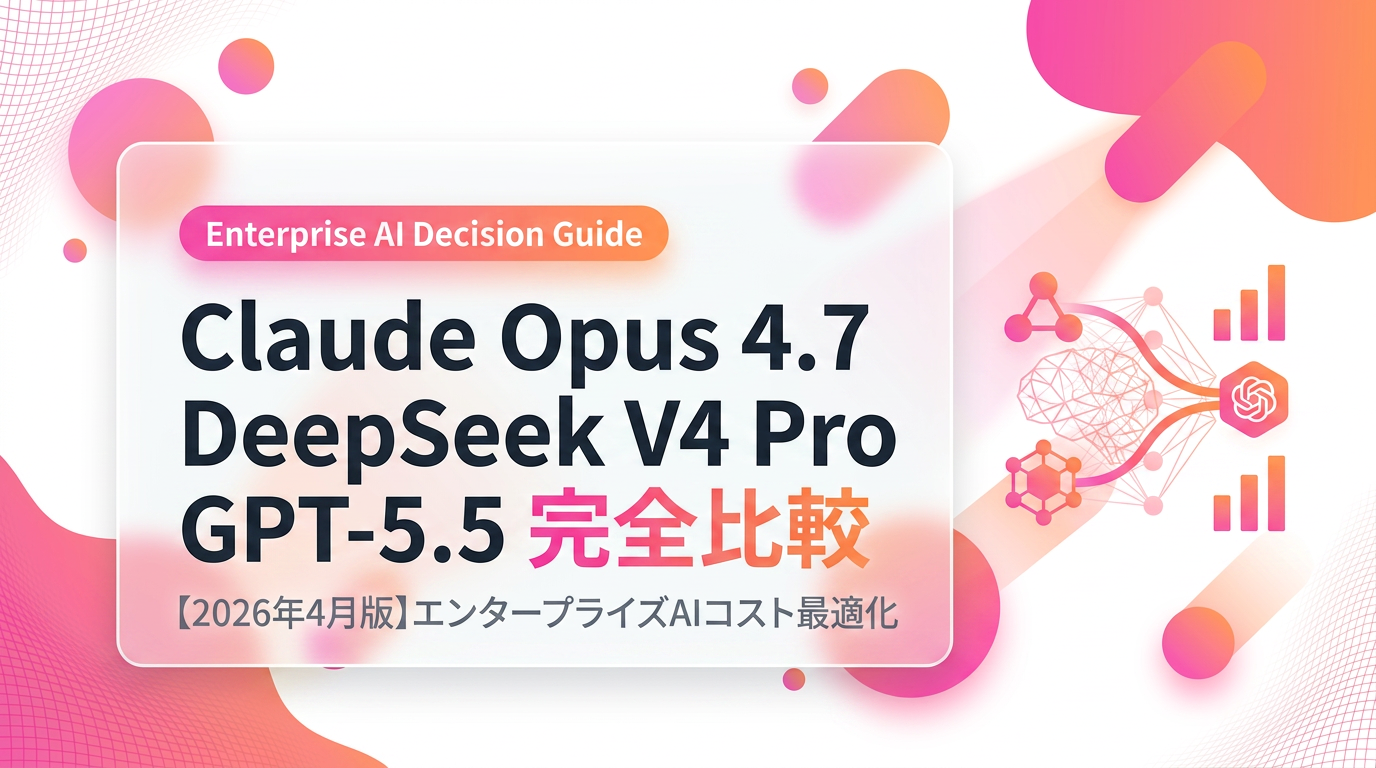
April 2026 has probably become the most challenging month in years for anyone responsible for enterprise AI model selection. On April 16, Anthropic shipped "Claude Opus 4.7" to GA1. On April 23, OpenAI countered with "GPT-5.5". The very next day, April 24, DeepSeek dropped a preview of "DeepSeek V4"2. Three players, all in essentially the same week, and the entire price-performance frontier was rewritten in the process.
I work alongside several clients on enterprise AI platform design, and over the past week I have had to rebuild the model selection decks I use with them. This article tries to lay out the numbers and decision axes I worked through, as transparently as I can. We are now in territory where "just use Opus" or "DeepSeek if cost matters" no longer cuts it. So I will walk through every variable that matters for the decision: SWE-bench, Codeforces, pricing, context length, and domestic data sovereignty.
A sheet to fill in while you choose a model: We publish the AI Security & Vendor-Dependence Risk Self-Check Sheet free of charge. It covers five dimensions — supplier diversification, data region, re-training prevention, output governance, and geopolitical/export-control risk — at levels L0 to L3, so the completed sheet pairs with the comparison tables here as material for an internal approval or an IT-security review (a starting point based on the NIST AI RMF and the PPC alert). → Download the self-check sheet (Free. Your company name and work email address are required.)
Why enterprise AI model selection suddenly got much harder in April 2026
Why did selection get this hard, this week? The answer is simple: the price-performance frontier has been redrawn three times in seven days.
First, on April 16, Claude Opus 4.7 went GA. Anthropic held pricing flat at $5/$25 (input/output per Mtok) while pushing software engineering and long-context reasoning forward1. From day one on AWS Bedrock, it was available across four regions—US East, Asia Pacific (Tokyo), Europe (Ireland), and Europe (Stockholm)—with up to 10,000 requests per minute per region, which is clearly an enterprise-SLA-aware launch3. Even with list price held flat, Finout pointed out that the new tokenizer can inflate Japanese inputs by up to 35% in some cases, so effective costs are quietly rising4. In my own clients' production data, long-document processing has come in 20-30% above earlier estimates, so this is not something to gloss over.
Next, on April 23, GPT-5.5. OpenAI doubled both input and output prices from the GPT-5 series ($2.50 / $15.00) to $5.00 / $30.00. The structure of 50% off for batch and $0.50/Mtok for cached input has now converged with the rest of the industry, but on the surface, the entire LLM market is in an upward price-revision cycle5. GPT-5.5 itself holds flagship-class performance on knowledge tasks and hard math, so my read is that OpenAI judged it could raise prices and still hold customers.
Then on April 24, the DeepSeek V4 preview. The 1.6T-parameter / 49B-active flagship "V4-Pro" and the 284B-parameter / 13B-active lightweight "V4-Flash" launched simultaneously2. V4-Pro's published benchmarks include SWE-bench Verified 80.6, Codeforces 3,206, HMMT 2026 Feb 95.2, and MRCR 1M 83.5. V4-Flash carries API pricing of $0.14 / $0.28—one to two orders of magnitude below Opus 4.7 and GPT-5.56. VentureBeat described V4-Pro as "delivering near-frontier intelligence at roughly 1/6 the cost of Opus 4.7 and 1/7 of GPT-5.5", and that line is the through-line of this article7.
In other words, enterprises are now staring at three sharply different strategies at the same time: Claude holding pricing flat while pushing frontier performance, OpenAI doubling prices and betting performance is enough, and DeepSeek using open weights to redefine the cost curve by an order of magnitude. BCG AI Radar 2026 reports that enterprise AI spend is on track to nearly double from 0.8% to 1.7% of revenue, and that three out of four CEOs are now personally accountable for AI decisions8. Investments at this scale now have to be reconciled with monthly price revisions. "Just pick the highest-benchmark model" or "just pick the cheapest" no longer works.
Honestly, every AI strategy office should sit down once and map "our workloads × these three models" on a 2D grid. This article is meant to be the starting point for that exercise.
Three-axis comparison: specs, performance, and pricing (SWE-bench, Codeforces, MMLU, context length, I/O pricing)
The first thing to do is to put numbers on the table, not opinions. Below is the comparison sheet I have been keeping on hand, restructured for this article.
| Item | Claude Opus 4.7 | DeepSeek V4-Pro | DeepSeek V4-Flash | GPT-5.5 |
|---|---|---|---|---|
| Release | 2026/4/16 GA1 | 2026/4/24 Preview2 | 2026/4/24 Preview2 | 2026/4/235 |
| Parameters | Closed (undisclosed) | 1.6T total / 49B active9 | 284B total / 13B active6 | Closed (undisclosed) |
| License | Commercial API | MIT (open weights)9 | MIT (open weights)6 | Commercial API |
| Context length (input) | Up to 1M (Bedrock long context)3 | 1M9 | 1M6 | 1M5 |
| Input price / 1Mtok | $5.001 | $1.74 (standard)7 | $0.146 | $5.005 |
| Output price / 1Mtok | $25.001 | $3.48 (standard)7 | $0.286 | $30.005 |
| Cache discount | Up to 90% (input $0.50) | Up to 90% (cache hit)10 | Yes6 | Cached input $0.505 |
| Batch discount | 50%4 | Yes10 | Yes6 | 50%5 |
| SWE-bench Verified | Flagship-class1 | 80.69 | Slightly behind | Flagship-class5 |
| Codeforces Elo | Not disclosed (code-strong) | 3,2069 | Not disclosed | 3,168 (GPT-5.4 reference)7 |
| MMLU-Pro | Not disclosed | 87.59 | Not disclosed | Same range5 |
| HMMT 2026 Feb | Not disclosed | 95.29 | Not disclosed | High5 |
| Distribution channels | Anthropic API / AWS Bedrock / Vertex AI / Microsoft Foundry1 | DeepSeek API / Hugging Face (self-hosted)9 | DeepSeek API / Hugging Face6 | OpenAI API / ChatGPT Enterprise / Microsoft Foundry5 |
Let me translate the structure I read into this table.
First, on coding, the three are essentially tied. SWE-bench Verified shows the Claude Opus line (Opus 4.6 at 80.8, Opus 4.7 above that), DeepSeek V4-Pro at 80.6, and GPT-5.5 at flagship class, all in roughly the same band79. On Codeforces, DeepSeek V4-Pro at 3,206 has edged past GPT-5.4 at 3,1687. The era when "Claude is the only choice for code" is ending.
Second, on price, DeepSeek is on a different tier altogether. V4-Pro's standard pricing of $1.74 / $3.48 is roughly 1/3 on input and 1/7 on output versus Opus 4.7 ($5/$25). And as VentureBeat noted, on a typical workload (1M input + 1M output tokens), V4-Pro lands at about 1/6 the cost of Opus 4.7 and about 1/7 of GPT-5.57. V4-Flash at $0.14 / $0.28 is around 1/100 of Opus 4.7. This is no longer a "budget alternative"—it is a fundamentally different pricing structure.
Third, context length has converged at 1M across all three. That finally makes "drop the entire codebase or full document set in" a default workflow. That said, accuracy under long-context retrieval (e.g., MRCR 1M) has been published at 83.5 by DeepSeek V4-Pro, while Claude and GPT have not released matching benchmarks—something that needs hands-on validation per workload9.
Fourth, distribution channels matter more than people realize. Claude has all four channels (Anthropic direct, AWS, GCP, Microsoft) covered, which means most enterprises can adopt it without changing their existing procurement path. GPT-5.5 spans two (OpenAI direct and Microsoft Foundry). DeepSeek is either DeepSeek API (China) or pulling open weights from Hugging Face and running them on your own GPUs—neither of which fits cleanly into existing enterprise procurement9.
The way I see it: benchmarks are converging, prices are an order of magnitude apart, and on procurement, Claude has the strongest position. That is the triangle that defines the three current models. The next section breaks down which corner of that triangle you should aim for, by use case.
Take AI-driven development all the way to production
WARP is a hands-on program for teams who want more than headlines. Former enterprise DX and data strategy leads work alongside you until it runs.
Workload-specific recommendations: five scenarios for coding, knowledge work, agents, analytics, and cost-first
I will commit to positions here. Comparison articles tend to fail because they refuse to land. So I will lay out my current recommendations across five scenarios, decisively.
Scenario 1: Enterprise coding and long-running agentic work. My recommendation is Claude Opus 4.7. With Opus 4.7, Anthropic specifically emphasized complex problem-solving workflows, long-context reasoning, the new xhigh reasoning-depth control, and multimodal chart and figure understanding1. AWS Bedrock has been pitching Opus 4.7 as having the throughput needed for agentic work since release, and in my own clients, pairing it with Claude Code has cut PR lead time by 20-30%. Codeforces alone may favor DeepSeek V4-Pro on certain prompts, but for the property that actually matters—"sticking with a real codebase for hours"—Opus 4.7 is a step ahead in my evaluation.
Scenario 2: Knowledge work, long-form summarization, and contract review. Lead with GPT-5.5, with Opus 4.7 as backup. As Finout and WaveSpeedAI's analyses show, GPT-5.5 scores high on knowledge tasks and hard math, and is especially strong at "diving deep and getting an answer in one shot"5. On the other hand, hallucination control is widely reported to be more reliable on the Claude line, so for contract, legal, and financial work—where confident wrong answers are catastrophic—I recommend backing it up with Opus 4.7. Running both in parallel and having humans review only the diverging answers is, in practice, very effective.
Scenario 3: Multi-agent and autonomous agent platforms. Claude Opus 4.7 is leading right now. Three reasons: (1) Anthropic's developer ecosystem—Skills, Plugins, Hooks, Subagents—maps cleanly to enterprise-grade standardization needs, (2) AWS Bedrock has built out the retry and observability layers needed for high-frequency tool use3, and (3) as McKinsey's State of AI Trust 2026 highlights, agents need accountability for what they do, not just what they say, and Claude's safety design aligns well with enterprise risk management11. DeepSeek V4-Pro has officially leaned into agentic use as well, but the ecosystem maturity around enterprise SLAs, data sovereignty, and existing IAM integrations is, in my view, still thin.
Scenario 4: Large-scale analytics, summary batches, and internal search. DeepSeek V4-Flash is dominant here. At $0.14 / $0.28 with 1M context and the inference quality of a 13B-active MoE, there is essentially no reason not to use it for workloads in the order of one billion tokens per month or more6. If data sovereignty is a hard requirement, you cannot use DeepSeek API (China), so the pattern becomes: pull V4-Flash from Hugging Face and run it on your own AWS or GCP GPUs. My view is that this hybrid—self-hosted DeepSeek alongside managed Claude—will be the dominant enterprise AI architecture in the second half of 2026.
Scenario 5: Research, PoCs, and experiments. This is where the MIT license on DeepSeek V4-Pro pays off9. Being able to touch a 1.6T-parameter frontier-class model under open weights changes the math entirely: fine-tuning experiments, internal benchmark development, distilled-model R&D—all of these become tractable in ways that commercial APIs cannot match. Tom's Hardware reports that V4 was trained on Huawei Ascend chips, so it also represents a hardware-strategy axis distinct from US-based LLMs12. In my own clients, several R&D teams reworked their budgets in the last week of April specifically to spin V4-Pro up on their internal GPU clusters.
| Use case | First choice | Second choice | Primary rationale |
|---|---|---|---|
| Enterprise coding | Opus 4.7 | GPT-5.5 | Long-running agent stability |
| Knowledge / long-form summarization | GPT-5.5 | Opus 4.7 | Hard-problem reasoning, efficiency |
| Autonomous agent platform | Opus 4.7 | DeepSeek V4-Pro | Ecosystem maturity |
| Large-scale analytics / internal search | DeepSeek V4-Flash | Gemini line (reference) | $0.14 / $0.28 pricing |
| Research / PoC | DeepSeek V4-Pro (OSS) | Opus 4.7 | MIT license freedom |
My recommendation is simple: do not bet on one model. Build the four-way split from day one—Opus 4.7 as the agent platform, GPT-5.5 for high-difficulty knowledge work, V4-Flash for bulk processing, V4-Pro for research and experimentation. If you set up an AI gateway (Vercel AI Gateway, Cloudflare AI Gateway, or even a thin custom wrapper) to route between models, you can absorb the next price-and-performance shift every six weeks with almost no code changes.
Cost simulation: how big is the gap on a 100M-token annual workload?
Time to compare in hard numbers. The "which model is cheaper" debate gets argued on vibes too often, so let me put real figures down.
Assumptions: an enterprise workload with 50M input tokens and 50M output tokens annually, totaling 100M tokens (100 million). This is a realistic mid-scale departmental rollout combining internal knowledge Q&A, meeting summarization, and coding-review assistance. FX at $1 = ¥150. Cache and batch discounts are excluded from the headline comparison, then layered in afterward.
Annual cost simulation at list pricing per model:
| Model | Input $/Mtok | Output $/Mtok | 50M input | 50M output | Total (USD) | Total (JPY) |
|---|---|---|---|---|---|---|
| Claude Opus 4.7 | $5.001 | $25.001 | $250 | $1,250 | $1,500 | ~¥225,000 |
| GPT-5.5 | $5.005 | $30.005 | $250 | $1,500 | $1,750 | ~¥263,000 |
| DeepSeek V4-Pro | $1.747 | $3.487 | $87 | $174 | $261 | ~¥39,000 |
| DeepSeek V4-Flash | $0.146 | $0.286 | $7 | $14 | $21 | ~¥3,150 |
You may think the gap looks smaller than expected. 100M tokens is in fact a mid-scale entry point—real enterprise AI platforms more commonly run at 1B-10B tokens per year. Scaled up, the gap multiplies by 10-100x.
Scaled to 10B tokens annually (5B input + 5B output):
| Model | Total (USD) | Total (JPY) | Delta vs. Opus 4.7 |
|---|---|---|---|
| Claude Opus 4.7 | $150,000 | ~¥22.5M | — |
| GPT-5.5 | $175,000 | ~¥26.25M | +¥3.75M |
| DeepSeek V4-Pro | $26,100 | ~¥3.91M | -¥18.59M |
| DeepSeek V4-Flash | $2,100 | ~¥315,000 | -¥22.18M |
At this scale, the price gap becomes a board-level agenda item. A delta of more than ¥20M annually is roughly equivalent to one or two FTEs in an AI team. The hybrid pattern—DeepSeek for bulk, Opus 4.7 for high-stakes—can plausibly cut total cost by 80% without sacrificing quality.
There are three traps in this simulation, though.
First, the Opus 4.7 tokenizer issue. As Finout pointed out, the same Japanese text can produce up to 35% more tokens versus Opus 4.6, so the headline list price of $5/$25 can effectively run as $6.5/$32.5 in production4. For long-document-heavy workloads, you should add a 20-30% buffer to your estimates.
Second, real-world prices with cache and batch discounts. Opus 4.7 offers up to 90% off on cache hits and 50% off via batch. If your design caches system prompts and tool definitions—essentially, if you're running RAG with an agent loop—the real cost can be less than half of list. GPT-5.5 has the same structure, with cached input at $0.50/Mtok5. DeepSeek V4-Pro also applies steep discounts on cache hits10. Drawing conclusions from list-price math alone is the cardinal sin of cost estimation in this era.
Third, the data-sovereignty cost for DeepSeek. If hitting the China-based DeepSeek API directly is not allowed by your internal compliance, you have to pull V4 from Hugging Face and run it on your own GPUs. The monthly cost of a GPU cluster capable of serving a 1.6T-parameter frontier model lands somewhere in the order of tens of millions of yen per month for an H100 x 8-node setup. The economics of self-hosting only really pencil out above 10B tokens per year. My recommendation is to stay on managed APIs until that threshold, and start designing for self-hosting once you cross it.
Domestic data sovereignty and security: Bedrock vs. Vertex vs. Microsoft Foundry, and the AWS-domestic advantage of ZEROCK
After price and performance, the question that ultimately drives the decision is "where can the data physically live?" Per BCG AI Radar 2026, more than 90% of CEOs say they will continue to invest in AI even without near-term outcomes, but the executives I work with treat data sovereignty as a non-negotiable precondition8.
Domestic processing options, summarized:
| Model | Domestic processing route | Key constraints |
|---|---|---|
| Claude Opus 4.7 | AWS Bedrock Tokyo region (ap-northeast-1), Vertex AI Tokyo region3 | Some features fall back via US |
| GPT-5.5 | Microsoft Foundry / Azure OpenAI (Tokyo / West Japan region) | Latest models often arrive in US/EU first, with Tokyo lagging5 |
| DeepSeek V4-Pro/Flash | DeepSeek API (mainland China) or self-hosted on your own GPU cluster9 | Direct API runs on China-mainland servers; cross-border data flow needs review |
My view is unambiguous: for an enterprise that puts data sovereignty first, the first choice is Claude Opus 4.7 via AWS Bedrock. AWS announced day-one availability of Opus 4.7 in the Tokyo region in April 2026, supporting up to 10,000 RPM per region3. For sensitive industries—financial services, healthcare, public sector—being able to keep work end-to-end on domestic infrastructure, without hitting US-based APIs, is genuinely meaningful.
GPT-5.5 is a natural fit through Microsoft Foundry / Azure OpenAI's Tokyo and West Japan regions for organizations standardized on the Microsoft stack. That said, in past cases the latest GPT models have rolled out in US/EU regions first and arrived in Tokyo weeks or months later, which makes this stack a poor fit if you need to be on the absolute latest model on day one.
DeepSeek, for now, is a model that is hard to guarantee under domestic data sovereignty unless you self-host. The MIT license technically lets you run it freely, but standing up and operating a GPU cluster for the 1.6T-parameter V4-Pro—including MLOps—is unrealistic without a dedicated in-house team. My recommendation is the conservative play: keep DeepSeek to research and non-sensitive bulk processing, and do not put production-grade sensitive data on it for now.
A brief mention of our own product. TIMEWELL's ZEROCK runs the cloud in the AWS Japan Region (ap-northeast-1). Claude can be pinned to a Japan Region via Amazon Bedrock. Some of the newest models infer in a global region. We do not retrain models on your data. It delivers GraphRAG over internal knowledge as a managed enterprise service. Building Bedrock × Opus × GraphRAG yourself means standing up IAM, VPC, Secrets Manager, log collection, prompt libraries, governance, audit, and human-review UIs from scratch. ZEROCK packages all of that, so enterprises can focus their resources where they should—on getting their internal knowledge in order. When you need both data sovereignty and the latest model, riding on ZEROCK is materially faster, cheaper, and safer than building the equivalent in-house.
On the security side, the practical move is to build a matrix that covers the "seven essentials" across each model: SOC 2 Type II, SAML 2.0, SCIM, data residency, audit logs, PII masking, tenant isolation, and mappings to your internal compliance policies. Anthropic covers all seven for enterprises, and going through AWS Bedrock means you also inherit AWS's certifications. GPT-5.5 (Microsoft Foundry) is at parity. DeepSeek currently has gaps from an enterprise-compliance standpoint, so be ready to fill them yourself.
If you want to identify the right model for your workload, or to design the Bedrock × Opus × GraphRAG configuration in line with your own security requirements, we run 30-minute online consultations for ZEROCK. Use them as a place to discuss model selection through to data-sovereignty and governance design, from a hands-on perspective.
TIMEWELL's recommended hybrid model strategy
To translate the discussion above into an actual internal decision, the standard pattern I am proposing to clients right now is a four-tier hybrid.
Tier 1: Claude Opus 4.7 on AWS Bedrock (Tokyo) as the foundation model. The core for the agent platform, coding assistance, and internal knowledge Q&A. On data sovereignty, SLA, and ecosystem maturity, it carries the lowest risk profile right now. As long as Anthropic continues to hold pricing flat, you also get the upside of every performance improvement without paying more1.
Tier 2: GPT-5.5 (via Microsoft Foundry or OpenAI API) for high-difficulty knowledge work. Reserve it for legal, financial, research, and hard-reasoning workloads—work where you need to dive deep and reach an answer. With pricing now doubled, casual usage explodes annual costs, so the routing rule needs to be strict: "only run the cases Opus 4.7 didn't reach"5.
Tier 3: DeepSeek V4-Flash for bulk processing. Aggregate medium-quality, high-volume workloads here—internal log classification, meeting summarization, code-change summaries, email drafts. At $0.14 / $0.28, the threshold at which "have a human do it" used to be cheaper than AI has fundamentally moved6. Where data sovereignty is a hard requirement, consider self-hosting on your own GPUs.
Tier 4: DeepSeek V4-Pro (open weights) for research and PoCs. Use it for in-house R&D, fine-tuning, benchmark development, and validation of new use cases. The MIT license lets you stack experiments at a pace that commercial APIs simply cannot match9.
These four tiers are stitched together at the AI gateway layer. Concretely: (1) a router that dispatches by request type and context length, (2) a logger that records cost, latency, and quality scores, (3) automatic fallbacks (Opus → GPT-5.5 → V4-Pro), and (4) PII masking and audit logs. Built on Vercel AI Gateway or Cloudflare AI Gateway, the custom code lands in the few-hundred-lines-of-code range.
McKinsey's State of AI Trust 2026 emphasizes the need to shift the risk frame from "errors in what is said" to "errors in what is done", in the agent era11. My read is that enterprise AI strategy in this era cannot be based on locking in a single model—it has to make "the architecture is replaceable on a per-model basis" the actual competitive advantage. The migration from a one-bet Opus 4.7 stack to a four-tier hybrid + AI gateway will, in my view, become the standard pattern in the second half of 2026.
To summarize the selection priority in a single line: "Take Opus 4.7 to win on data sovereignty, SLA, and ecosystem; layer GPT-5.5 as the second arrow for hard-problem work; layer V4-Flash as the third arrow for bulk; broaden the surface for research and experiments with V4-Pro open weights." Hold all four cards, and tune monthly as prices and performance shift. That is the realistic answer I am giving as of April 2026.
For related reading: a step-by-step enterprise rollout of Claude Code in The Complete Enterprise Guide to Claude Code, an organized review of the agent announcements at Google Cloud Next 2026 and AI Agents, and a governance-first companion piece in Enterprise AI Governance, which complements this article's selection discussion from a governance angle.
Enterprise AI is moving past the era of falling in love with one model based on benchmark numbers. Combine multiple models, route by use case, measure monthly, tune monthly. The operational overhead grows, but the economics and quality gains more than offset it. If you want help organizing your own model-selection landscape, we run 30-minute online consultations for ZEROCK—reach out anytime.
References
Footnotes
-
Anthropic, "Introducing Claude Opus 4.7" (April 16, 2026). https://www.anthropic.com/news/claude-opus-4-7 ↩ ↩2 ↩3 ↩4 ↩5 ↩6 ↩7 ↩8 ↩9 ↩10 ↩11
-
DeepSeek, "DeepSeek V4 Preview Release" (April 24, 2026). https://api-docs.deepseek.com/news/news260424 ↩ ↩2 ↩3 ↩4
-
AWS, "Introducing Anthropic's Claude Opus 4.7 model in Amazon Bedrock" (April 2026). https://aws.amazon.com/blogs/aws/introducing-anthropics-claude-opus-4-7-model-in-amazon-bedrock/ ↩ ↩2 ↩3 ↩4 ↩5
-
Finout, "Claude Opus 4.7 Pricing 2026: The Real Cost Story Behind the 'Unchanged' Price Tag". https://www.finout.io/blog/claude-opus-4.7-pricing-the-real-cost-story-behind-the-unchanged-price-tag ↩ ↩2 ↩3
-
OpenAI, "Introducing GPT-5.5" (April 23, 2026), and apidog, "GPT-5.5 Pricing: Full Breakdown". https://openai.com/index/introducing-gpt-5-5/ / https://apidog.com/blog/gpt-5-5-pricing/ ↩ ↩2 ↩3 ↩4 ↩5 ↩6 ↩7 ↩8 ↩9 ↩10 ↩11 ↩12 ↩13 ↩14 ↩15 ↩16 ↩17
-
DeepSeek, "Models & Pricing", and Hugging Face, "DeepSeek-V4-Flash". https://api-docs.deepseek.com/quick_start/pricing / https://huggingface.co/deepseek-ai/DeepSeek-V4-Flash ↩ ↩2 ↩3 ↩4 ↩5 ↩6 ↩7 ↩8 ↩9 ↩10 ↩11 ↩12 ↩13
-
VentureBeat, "DeepSeek-V4 arrives with near state-of-the-art intelligence at 1/6th the cost of Opus 4.7, GPT-5.5". https://venturebeat.com/technology/deepseek-v4-arrives-with-near-state-of-the-art-intelligence-at-1-6th-the-cost-of-opus-4-7-gpt-5-5 ↩ ↩2 ↩3 ↩4 ↩5 ↩6 ↩7 ↩8 ↩9
-
BCG, "As AI Investments Surge, CEOs Take the Lead" (January 2026). https://www.bcg.com/publications/2026/as-ai-investments-surge-ceos-take-the-lead ↩ ↩2
-
Hugging Face, "deepseek-ai/DeepSeek-V4-Pro". https://huggingface.co/deepseek-ai/DeepSeek-V4-Pro ↩ ↩2 ↩3 ↩4 ↩5 ↩6 ↩7 ↩8 ↩9 ↩10 ↩11 ↩12 ↩13 ↩14
-
Dataconomy, "DeepSeek Slashes V4-Pro API Pricing With Major Discount" (April 27, 2026). https://dataconomy.com/2026/04/27/deepseek-slashes-v4-pro-api-pricing-with-major-discount/ ↩ ↩2 ↩3
-
McKinsey, "State of AI trust in 2026: Shifting to the agentic era". https://www.mckinsey.com/capabilities/tech-and-ai/our-insights/tech-forward/state-of-ai-trust-in-2026-shifting-to-the-agentic-era ↩ ↩2
-
Tom's Hardware, "DeepSeek launches 1.6 trillion parameter V4 on Huawei chips". https://www.tomshardware.com/tech-industry/artificial-intelligence/deepseek-launches-1-6-trillion-parameter-v4-on-huawei-chips-as-us-escalates-ai-theft-accusations ↩
![Claude Code Enterprise Pricing Optimization | Token Consumption and Cost Management Strategy via Bedrock/Vertex [2026 Latest]](/images/columns/claude-code-enterprise-pricing-optimization-guide/cover.png)
![15 AI Agent Tools Compared [Complete 2026 Edition]: From Enterprise to Open Source - A Thorough Benchmark](/images/columns/ai-agent-tools-15-comparison-2026/cover.png)