Hello, this is Hamamoto from TIMEWELL. Inside the cavernous West Halls of Tokyo Big Sight, the queue snaked through the corridors and out into the open air long before the doors opened. SusHi Tech Tokyo 2026 brings together 770 startups from 54 countries. The fourth edition of Asia's largest innovation conference felt different the moment day one began.
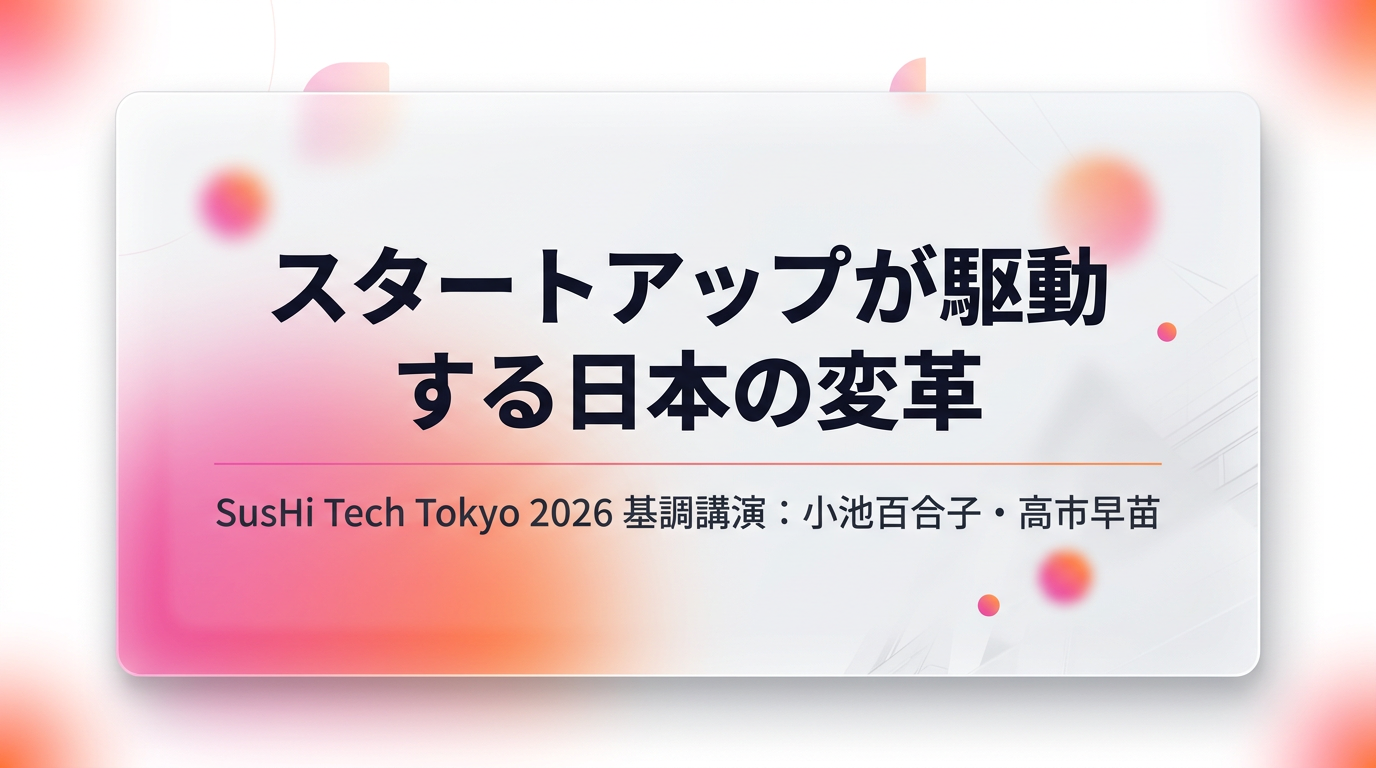
Taking the stage for the opening Special Keynote were Tokyo Governor Yuriko Koike and Japanese Prime Minister Sanae Takaichi. As the co-founder of TIMEWELL, and as someone who carries the vision of "building the world's number one infrastructure for challenge," I had to see this moment with my own eyes. How exactly were these two female leaders going to steer Japan's startup ecosystem from here? Their seriousness leaked out in every word they chose.
What Is SusHi Tech Tokyo 2026 — Asia's Largest Innovation Event by the Numbers
Let me start with a quick overview of the event itself. "SusHi Tech" is short for "Sustainable High City Tech" — a Tokyo-born concept of "realizing sustainable cities through high technology." The 2026 schedule runs three days: business days on Monday April 27 and Tuesday April 28, and a public day on Wednesday April 29 (a national holiday). The main venue is Tokyo Big Sight West Halls 1-412.
The scale is what stands out. A record 770 startups have set up booths, joined by overseas VCs, large enterprises, academia, and this year a mayoral-level summit called G-NETS. Last year more than 6,000 business meetings were closed on site, which signals that this is no longer a mere expo but a serious business creation platform3.
This year's focus areas are AI, robotics, resilience, and entertainment. By the fourth edition, you can finally feel that Tokyo's positioning as a "startup city" has become substantive rather than aspirational. The backdrop is Tokyo's "Global Innovation with STARTUPS" strategy, announced in 2022, which set bold "10x" KPIs over five years (10x the number of unicorns, 10x the number of founders, 10x the number of co-creation activities). Holding the event in this midpoint year carries the weight of having to show concrete results.
Overseas attendance is also conspicuous. France, South Korea, India, Singapore, the UAE — and this year Italy too — have set up national pavilions. The participating-country count of 54 is a sharp jump from last year's 45, and the conference's standing as a "global startup conference" linking Asia, Europe, and the Middle East has come clearly into focus.
Walking the venue, what you notice is the diversity of the floor itself. A robotics startup from Lyon next to a biotech team from Bengaluru next to a quantum-software company from Tel Aviv. Just five years ago, Japan's startup events tended to be domestic affairs that occasionally invited a token foreign delegation. The geography on the floor today is genuinely flat. Conversations on the booth aisles slip between Japanese, English, Korean, and French within a single ten-minute walk. That alone is a quiet but significant change in the landscape.
Governor Koike's Opening — The Intent Behind "SusHi Tech"
Governor Koike's speech began with her familiar, steady cadence. "Combine the SUS of Sustainable with the HI of High-Tech and you get the delicious word SUSHI" — that explanation is now in its fourth year. A line you'd expect to land flat from repetition felt different this year.
The reason, I think, is sheer scale. Looking out at a venue holding nearly 60,000 startup people, corporates, and city leaders, when she said "from Tokyo, we will gather the world's wisdom, paint a vision of the future, and put it into practice," the tentative feel of the early years was gone. Over four years, the Tokyo startup ecosystem has clearly stepped up a level.
She also touched on Tokyo's own initiative, Tokyo Innovation Base (TIB). Located in Marunouchi, TIB operates as a hub connecting startups, large companies, VCs, universities, and government. Visitor numbers have grown sharply in the roughly 18 months since it opened in 2024. The model — public sector providing a physical "place" so the private ecosystem accelerates — is, in my view, on par with Singapore's BLOCK71 or France's STATION F.
The phrase "Sustainable High City" itself carries weight. Climate response, well-being in an aging society, disaster resilience — these are the existential challenges of a city, and Tokyo is broadcasting to the world that it is "the city trying to solve them with high technology." Startups sit at the very front line of those decisions.
What I want to underline is that Governor Koike's framing has consistently been "the city is the first laboratory." Climate, aging, and resilience are not abstract policy targets — they are the daily reality of 14 million people who live in Tokyo. When that reality becomes the test bed for products, startups gain something more valuable than a grant: a real customer, a real failure mode, and a real iteration loop. The same applies in reverse for the city. By becoming a customer, the administration develops the muscle to understand and procure new technology. The first time I heard her say "Tokyo is the world's largest user of urban technology," I thought it was a slogan. After four years of watching the program develop, I now read it as an operating principle.
Looking for AI training and consulting?
Learn about WARP training programs and consulting services in our materials.
Prime Minister Takaichi's "Three Pillars" — Startup Support as Economic Security
Then Prime Minister Takaichi took the stage. She opened modestly with "I'm not as powerful as Governor Koike," but the moment she started speaking, the air in the room shifted4.
The figure that came out of her mouth was striking. "Japan's nominal GDP has grown 32% over the past two years." That sharply exceeds the prior 4% annual target. Using that figure as a foundation, the prime minister laid out three pillars of startup support.
The first pillar is scale-up support. Strengthen capital supply to growth-stage startups, and build a "circular ecosystem" where talent and know-how created at successful companies are reinvested. She also issued a clear statement of intent to attract outstanding founders and talent from overseas, making Tokyo the gateway to the global startup ecosystem. The structural problem in the background here is that average funding rounds for Japanese startups from Series C onward are only one fifth to one tenth the size of those in the US, China, or India. The number of seed and early-stage founders has grown, but few break the "growth wall" and connect to overseas investors or IPOs. That diagnosis is widely shared by VCs working on the ground.
The second pillar is deep-tech support. Support research and commercialization in foundational fields like quantum, semiconductors, and AI. What stuck with me most was the bold pledge to "lower the bar for government procurement." Strengthening SBIR (Japan's Small Business Innovation Research program), and creating channels for ministries to host PoCs and field trials, is something I have wanted to see for years. For Japanese deep-tech to clear the commercialization wall, government as an early customer matters decisively. The US SBIR program sees NASA and the DoD invest billions of dollars a year in deep-tech, and SpaceX and Palantir grew on the back of that engine. Whether Japan's version can really scale up to that level is the point I'll be watching most closely.
The third pillar is procurement by local governments. This sounds quiet but it works. Local startups can use local governments as their first customers. It's a structure people have asked for over the years that never quite moved. Amid endless debates about over-concentration in Tokyo, the question of whether local administrations can become the "first ten customers" of locally-born startups is critical. If this works, deep-tech spinning out of regional universities will have a credible new path: "raised in the region, sent out to the world."
It is also worth noting that the third pillar is the one that requires the most institutional plumbing to actually work. Local procurement in Japan is hemmed in by safe-harbor preferences for incumbents, fragmented bidding rules, and a cultural reluctance to take operational risk on a young company. Several mayors I spoke with at the event acknowledged this candidly. The signal from Prime Minister Takaichi matters less as a budget line and more as political cover — cover for risk-taking procurement officers who, until now, had no top-level mandate to choose a startup over a familiar incumbent. Whether that cover translates into a meaningful share of contracts within the next two years is, in my view, the most important leading indicator of whether the third pillar is real.
Author's Reflection — "Infrastructure for Challenge" Is Being Built at the National Level
What I felt most strongly in this keynote was that startup support has moved past the "cheerleading" stage and is being implemented as the operating system of national strategy. The "democratization of challenge" that TIMEWELL works on is, fundamentally, the work of building a foothold for individuals to take on challenges. Until now that foothold has been carried by individual accelerators, corporate partners, and VCs. With the prime minister's words, the government has explicitly declared that it will carry one corner of that foothold too.
That said, a few things deserve cool-headed reading. The 32% GDP growth figure is large, but the breakdown includes nominal growth driven by inflation. On a real basis, the assessment requires more caution. The extension of the "five-year startup development plan" is now entering the phase where the granularity of KPIs and execution is the real test. Slogans alone don't move anything.
Still, compared to my days at Panasonic running corporate intrapreneur support, the wind has clearly changed direction. Ten years ago, "I'm doing a startup in Japan" drew puzzled looks from students and parents alike. Today the prime minister calls startups the "growth engine of the nation." That is a shift in the very atmosphere of the era.
At TIMEWELL, in pursuit of "a society where anyone can take on challenges in their own way," we have been giving shape to "infrastructure for challenge" across multiple layers — career coaching, accompanying intrapreneurs inside large corporations, and connecting with academia as a specially appointed associate professor at Shinshu University. Now that the government has moved on national strategy, private players like us have to redefine our positioning. If we can't draw a clear line between what the government should do and what only the private sector can do, this rare tailwind will go to waste.
To put it bluntly, the things only the private sector can do are emotional and biographical. The government can hand out grant money and lower procurement walls, but it cannot sit beside a founder at 11 p.m. when a co-founder dispute is breaking the team apart. It cannot ask the pointed personal questions that surface what someone actually wants out of their career. Those moments are not a luxury — they are the load-bearing column of whether a person continues to take on challenges or quietly steps back. As policy delivers more capital and more procurement, the differentiation of private players will move further toward this softer, more human layer. That is precisely where TIMEWELL has been investing, and where I think the value of accompanying-style consulting is going to compound over the next decade.
Why the G-NETS Co-location Matters — Innovation as Urban Diplomacy
Another thing I personally see as critical at this year's SusHi Tech is the co-located G-NETS (Global Network of Tokyo Summit) mayoral summit. The world's innovation leaders and city leaders are gathered in the same place. This is not coincidence — it's a sign that a city's innovation capability is becoming an international diplomatic card.
Helsinki, Barcelona, Seoul, Montreal, Singapore — the world's startup hub cities no longer operate in isolation. They are being networked. If Tokyo can establish itself as a node in that network, that alone becomes a huge tailwind for domestic startups going abroad.
Take Barcelona's Smart City Expo, Helsinki's Slush, or Lisbon's Web Summit. All of these conferences were built up by city administrations leading the charge to brand their city as a "global startup hub," eventually becoming annual gathering points for entrepreneurs and investors worldwide. SusHi Tech is aiming to be exactly that, in Tokyo. Heading into year four, the traction is finally showing.
The interesting thing about Slush, in particular, is that it is essentially a student-run conference that grew under deliberate non-interference from city hall. Helsinki's role was to create the conditions, not to dictate the agenda. SusHi Tech's challenge in the next phase is to find its own version of that balance — strong public scaffolding, but enough room for private operators, founders, and even student volunteers to shape the texture of the event. If Tokyo can build that subtle balance, the conference will feel less like a government-organized expo and more like a city-wide festival of challenge. That is when international attendance starts to compound on its own.
I made a similar point in my report on the smart cities session: "human-centered AI cities" is a keyword that will shape how city operating systems are designed (please also read What Is a Smart City for Citizens? — Seoul, Barcelona, and Tokyo on the Frontier of "Human-Centered AI Cities"). The structure of cities partnering with cities to grow ecosystems is being assembled right under our feet, in Tokyo.
The Photo Op — Two Leaders Facing the Cameras
At the end of the session, Governor Koike and Prime Minister Takaichi stood together at the center of the stage and faced the cameras. There was no flashy production. But the very fact that two political leaders were photographed standing together in this domain — startup ecosystems, where the private sector is the protagonist — captured the change in Japan's startup environment.
While I watched that picture, I was rethinking what TIMEWELL should do. The policy tailwind is here. Corporate intrapreneur programs are clearly accelerating. Through my work as a specially appointed associate professor at Shinshu University, I feel green shoots emerging on the academia side too. The remaining homework is whether we can integrate all of this into "infrastructure" that pushes individuals to take on challenges. That is the question being asked of TIMEWELL.
The frontier of challenge is also picking up momentum from globally active independent talent. The discussion in Studio STELLAR and the Era of Independent Talent, and the questioning of society's own infrastructure for inclusion in Foreign Resident Symbiosis Policy, are continuous with the same current.
In Closing — What Will Happen in Tokyo Over These Three Days
SusHi Tech Tokyo 2026 has only just begun. This keynote is merely the prologue. Over the business days, hundreds of sessions, thousands of booths, and probably more than 10,000 business meetings will unfold. On the public day, ordinary citizens will get their hands on cutting-edge technology.
Japan's future innovation capability hinges on how many small sparks can be lit during the density of these three days. And how the private side cultivates those sparks. Prime Minister Takaichi's speech, as I read it, was a message that says: "The stage is set. Now run."
Let's run, with everything we've got. There is no other path. TIMEWELL will keep doing the unglamorous work of pushing the back of one person who wants to take on a challenge. I am quietly hoping, from the floor, that these three days of SusHi Tech Tokyo 2026 will be the moment that opens a new chapter for Japan's startup ecosystem.
Translating This into Corporate Strategy and New Business
If you want to translate these policy moves and urban implementation discussions into your own corporate strategy, new business, or AI rollout, TIMEWELL's AI consulting service WARP takes individual inquiries. How to convert the tailwind of "Startup Nation Japan" into your own scale-up plan, deep-tech commercialization, or partnership with local governments — you can start with a 30-minute online consultation.
Related Articles
- What Is a Smart City for Citizens? — Seoul, Barcelona, and Tokyo on the Frontier of "Human-Centered AI Cities"
- Studio STELLAR and the Era of Independent Talent
- Foreign Resident Symbiosis Policy
References
Footnotes
-
SusHi Tech Tokyo 2026 Official Site. https://sushitech-startup.metro.tokyo.lg.jp/ ↩
-
Tokyo Metropolitan Government. "Details of SusHi Tech Tokyo 2026." https://www.metro.tokyo.lg.jp/information/press/2026/03/2026032717 (2026-03-27) ↩
-
Yomiuri Shimbun. "SusHi Tech Tokyo 2026 to be held April 27-29." https://www.yomiuri.co.jp/economy/20260425-GYT8T00055/ (2026-04-25) ↩
-
YouTube. "Special Keynote — Expectations for Startups Driving Transformation and Growth." https://www.youtube.com/watch?v=m73hFcvcg_U ↩
![Management Strategy for an AI-Driven Society — Fujitsu CTO Takagi on the Reality of "Human-Centered AI x Corporate Transformation" [SusHi Tech Tokyo 2026]](/images/columns/ai-driven-society-fujitsu-takagi-2026/cover.en.png?dpl=dpl_GTagW71VKjD4VDo3w4ymrXrCfn1y)
![Who Drives Discontinuous Growth? Four Turning Points for Japanese Companies to Take Risk at the Next Level [SusHi Tech Tokyo 2026]](/images/columns/discontinuous-growth-japanese-risk-taking-2026/cover.en.png?dpl=dpl_GTagW71VKjD4VDo3w4ymrXrCfn1y)
![The Front Lines of European Agri-Food Innovation | How the EU Is Rebuilding Its Food System [SusHi Tech Tokyo 2026]](/images/columns/european-agri-food-innovation-2026/cover.en.png?dpl=dpl_GTagW71VKjD4VDo3w4ymrXrCfn1y)
![Green Intelligence and the Circular Future | A Realistic Path to 2030 Drawn by AI x Climate Tech [SusHi Tech Tokyo 2026]](/images/columns/green-intelligence-circular-future-2026/cover.en.png?dpl=dpl_GTagW71VKjD4VDo3w4ymrXrCfn1y)