![What Is the UFLPA (Uyghur Forced Labor Prevention Act)? The Rebuttable Presumption, the 12 High-Priority Sectors, and How Japanese Companies Should Respond [2026]](/images/columns/uflpa-forced-labor-guide/cover.png?dpl=dpl_FTx9dW3PCZpyy8WxThA4hsvCMeGU)
Hello, this is Hamamoto from TIMEWELL.
The UFLPA (Uyghur Forced Labor Prevention Act) is a law that presumes goods produced wholly or in part in the Xinjiang Uyghur Autonomous Region were "made with forced labor" and bars their import into the United States. It took effect on June 21, 2022.1
What makes this law formidable is not the import ban itself but the mechanism of "presumption." Ordinary regulations can only stop something once the authorities have proven a violation. The UFLPA works the other way around. Goods connected to Xinjiang are presumed from the outset to be forced-labor products, and it is the importer who wants to overturn that presumption who must assemble "clear and convincing evidence" to rebut it.12 The burden of proof is reversed onto the company. Once you grasp this point, you understand why complying with this law is such a heavy undertaking.
For manufacturers and trading companies that export to the United States, this article draws on primary sources to lay out how the mechanism works, how its scope has widened, how it differs from the EU regulation, and the practical steps for responding.
Before you assemble rebuttal evidence, find your own weak points: A fill-in self-check covering the UNGP/OECD six steps, the US UFLPA, EU CSDDD and German LkSG obligations, conflict minerals (3TG) and Japan's guideline. Its UFLPA section walks you item by item through screening against the Entity List and how much origin and production-process traceability evidence you actually hold. Use it with procurement and legal, or as the basis for answering the questionnaires your customers send you. → Download the Supply-Chain Due Diligence Self-Check Sheet (Free. Your company name and work email address are required.)
How It Works: The "Rebuttable Presumption" and Two Categories of Targets
The UFLPA's import ban covers two lines of targets.
| Target | Description |
|---|---|
| Region-based | Goods mined, produced, or manufactured "wholly or in part" in the Xinjiang Uyghur Autonomous Region |
| List-based | Goods produced by entities on the UFLPA Entity List (including entities located outside Xinjiang) |
As for how this is administered, the FLETF (Forced Labor Enforcement Task Force), chaired by DHS (the U.S. Department of Homeland Security), develops the list and the enforcement strategy, while CBP (Customs and Border Protection) detains shipments at the border. That is how the two divide the work.1
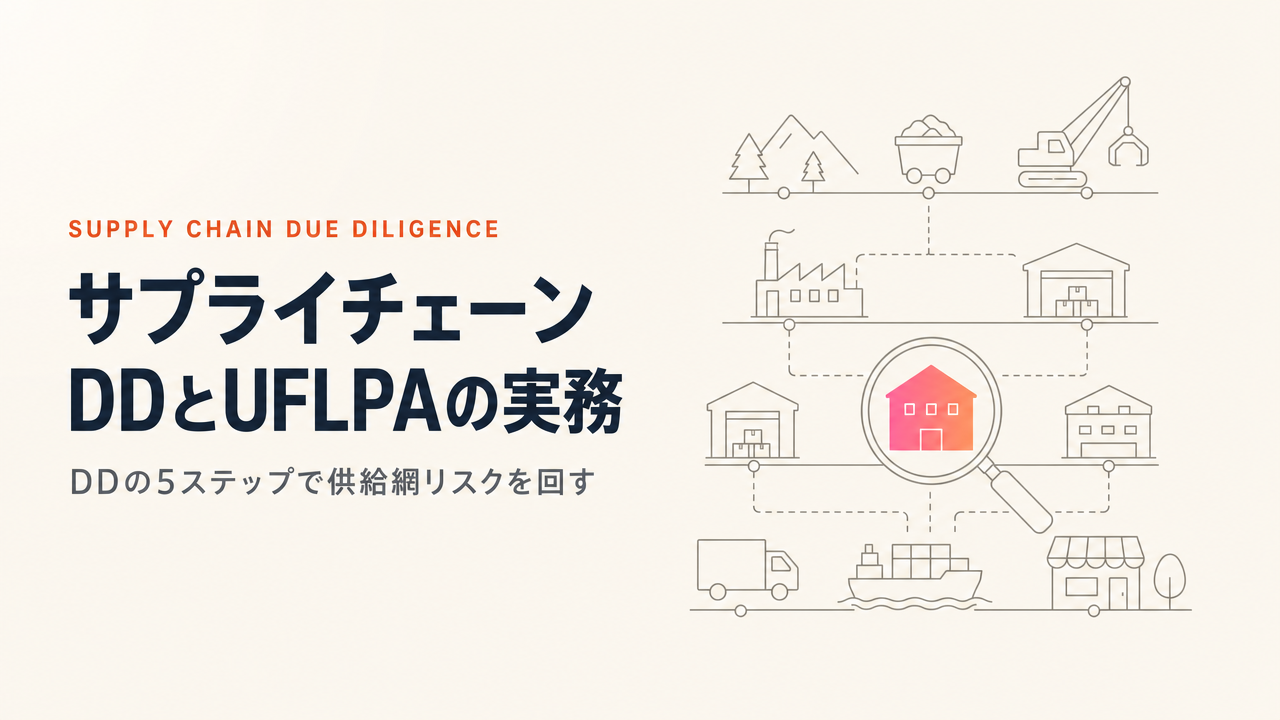
The words "in part" carry real weight in practice. Even if you do not source finished products from Xinjiang, you are within scope if raw materials or intermediate inputs are mixed in after passing through several tiers of transactions. Upstream materials such as cotton yarn, polysilicon, and aluminum ingots are the typical examples, and looking only at Tier 1 (your direct suppliers) will not give you the answer.
The Scope Now Reaches 12 Sectors: A Net Widening to Core Materials
The "high-priority sectors" on which the FLETF concentrates enforcement have expanded with each annual update to its strategy.13
| When Added | Sectors |
|---|---|
| 2022 (initial) | Apparel; cotton and cotton products; silica-based products (including polysilicon); tomatoes |
| July 2024 | Aluminum; PVC (polyvinyl chloride); seafood |
| August 2025 | Caustic soda; copper; lithium; red dates (jujube); steel |
The direction is clear. From the initial debate about "cotton and solar," the net has widened to the core materials of modern manufacturing: lithium, copper, steel, and aluminum. For Japanese companies that handle batteries, automotive parts, and electronics, the UFLPA is no longer a story about the apparel industry; it has become their own concern.
The Entity List is expanding rapidly as well. The additions on January 15, 2025 (37 companies at once, the largest single expansion since the law was enacted) brought the list to 144 entities, more than doubling it over the preceding year.14 Because the list will keep being updated, checking against it once is not enough; you need an operating routine that re-checks against it every time it changes.
Replace siloed classification work with AI.
METI's FY2024 data shows 52% of foreign exchange law violations stem from classification errors. Download the TRAFEED product catalog covering features and rollout.
Enforcement in Practice: Read the Numbers with Care
According to various analyses based on CBP's statistics dashboard, more than 16,000 shipments were subject to detention cumulatively from the law's entry into force through 2025, with the total value of affected shipments said to be in the billions of dollars.5 In fiscal year 2025 the number of detentions rose by 50 percent year on year, and enforcement is only intensifying.
There is one caveat when handling these figures, however. On January 28, 2026, CBP overhauled its dashboard and changed the method for counting cases.6 As a result, figures from 2026 onward cannot be compared directly with the past. When gauging the impact on your own company, I recommend checking CBP's latest dashboard directly.
The industries where enforcement is concentrated are electronics (including solar-related), apparel and textiles, automotive and aerospace parts, and batteries. Detentions of shipments dispatched from third countries other than China are also increasing, so the judgment that "we are fine because we do not import directly from China" no longer holds.5
How It Differs from the EU Regulation: The Design Is Reversed for the U.S. and the EU
Forced-labor regulation is not limited to the United States. The EU Forced Labour Regulation (Regulation (EU) 2024/3015) entered into force on December 13, 2024, and applies from December 14, 2027.7 Its design philosophy, however, differs greatly from the UFLPA's.
| Aspect | U.S. UFLPA | EU Forced Labour Regulation |
|---|---|---|
| Targeted region | Names Xinjiang plus the Entity List | Origin-neutral (names no specific country) |
| Presumption mechanism | Presumes forced labor; the importer rebuts | No presumption; the authorities investigate only after substantiating a "well-founded concern" |
| Burden of proof | On the importer | On the authorities |
| Status | Enforced since 2022 | Applies from December 14, 2027 (currently in the lead-up period) |
In other words, the U.S. side is already in the enforcement phase, while the EU side is in the preparation phase. That said, the supply-chain visibility required for EU compliance is almost the same work as UFLPA compliance, so getting your U.S. response done first will greatly reduce the burden when the EU rules start to apply.
How Japanese Companies Should Respond: Four Steps
The practical work can be organized into the following four stages.
- Map your supply chain. For goods you export to the United States, make the supply network visible not just at Tier 1 but all the way back to raw materials. The starting point is to identify the items into which materials from the 12 high-priority sectors (cotton, polysilicon, aluminum, lithium, copper, steel, and so on) could be mixed
- Check against the Entity List. Regularly cross-check your suppliers and their parent and affiliated companies against the list of 144 entities. Because the list is doubling on a yearly basis, checking is not a one-time task but presupposes an ongoing routine tied to updates
- Prepare your documentary evidence. Gathering it only after a detention is too late. Secure the traceability of documents you can use for rebuttal, such as certificates of origin, transaction records, shipping records, and audit reports, in normal times
- Contracts and structure. Build forced-labor exclusion clauses and an obligation to cooperate with investigations into your supplier contracts, and designate the responsible department within your company
Honestly, the center of gravity of this work is Step 2. You investigate your business partners and their capital relationships one company at a time, and re-check every time the list is updated. This is structurally identical to the business-partner due diligence we support with our export-control AI agent TRAFEED. TRAFEED is a service that starts from exports (classification and business-partner screening), but its mechanism for tracing the capital relationships and affiliates of your partners using a database of roughly 100 million corporate entities can also be applied to import-side supply-chain investigations like the UFLPA. We are also expanding its supply-chain risk investigation features, so if you are facing this challenge in your exports to the United States, please get in touch.
Summary
- The UFLPA "presumes" Xinjiang-related goods to be forced-labor products and places the burden of rebuttal on the importer. This is the biggest difference from ordinary regulations
- The high-priority sectors have expanded to 12 fields. With core materials such as lithium, copper, steel, and aluminum now in scope, it has become an issue for manufacturing as a whole
- The Entity List stands at 144 entities and has been growing at a pace that more than doubled it in a year. Checking presupposes an ongoing routine tied to updates
- The EU regulation applies from December 2027, but its design is reversed (the authorities bear the burden). Getting your U.S. response done first doubles as EU preparation
- The center of gravity of your response is due diligence on business partners and the supply chain. Preparing evidence in normal times is the lifeline of any rebuttal
References
Related Articles
- What Are Research Integrity and Research Security?
- What Is EAR99? How It Differs from an ECCN and from Not Being Subject to the EAR, and How to Confirm It
- TRAFEED | Export Control AI Agent
Footnotes
-
FLETF, "2025 Updates to the UFLPA Strategy" — USTR (August 19, 2025) ↩ ↩2 ↩3 ↩4 ↩5
-
DHS, "FLETF Adds Aluminum, PVC, and Seafood as New High-Priority Sectors" (July 9, 2024) ↩
-
Federal Register, "Notice Regarding the UFLPA Entity List," 90 FR 3899 (effective January 15, 2025; 37 entities added) ↩
-
Troutman Pepper Locke, "High-Voltage Enforcement: UFLPA Turns Up the Heat on Lithium-Ion and Energy Storage Imports" ↩ ↩2
-
CBP CSMS #67538179, "Forced Labor Statistics Dashboard Update" (January 28, 2026; counting method changed) ↩
-
Regulation (EU) 2024/3015 (EU Forced Labour Regulation) — EUR-Lex ↩