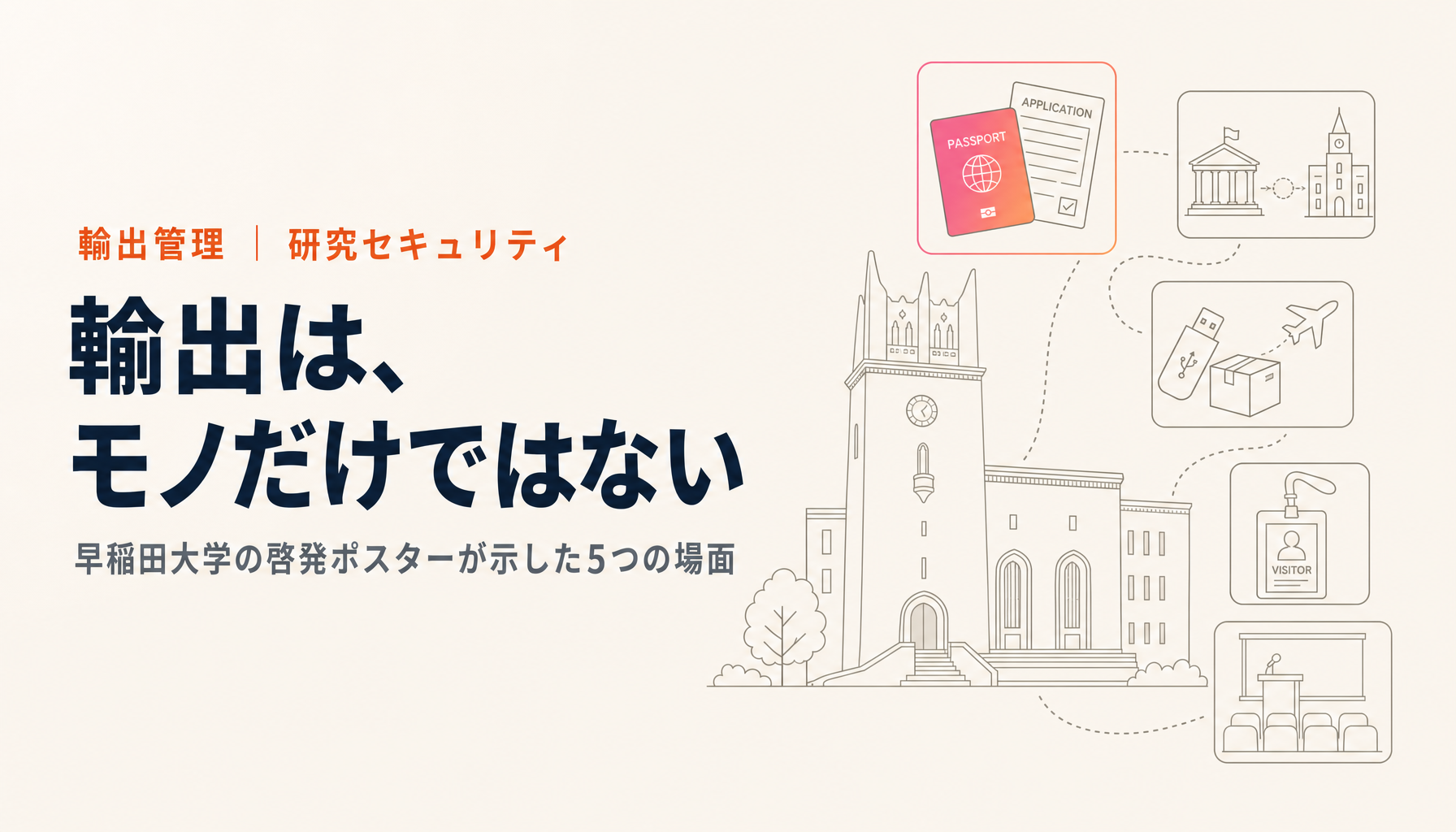
Hello, this is Ryuta Hamamoto from TIMEWELL. On 9 September 2026, Waseda University's security export control office published a poster1. The Japanese headline reads "Wait! That may be subject to security export control." The English version says "More Than Just Shipping Goods!" That single English line, to me, is the whole value of the poster. Export control is not only about sending things overseas. It comes up when you accept a person, when you run a joint research project, when you take data abroad, when you show a visitor around the lab, when you give a closed lecture. The poster is a warning that activities requiring legal procedures are mixed into ordinary campus life.
Honestly, this is an excellent piece of work. From where I sit, doing export control for a living, the gap that opens most easily on campus is exactly this "everything other than shipping" category. And Waseda is the university with the largest international student body in Japan: 5,541 students in the latest JASSO survey2. The institution that accepts more international students than any other has put student intake itself front and centre as an export control scene. That is not a small thing.
Starting from what the poster gets right, this piece walks through why export control is so easily mistaken for a shipping formality, how the "deemed export" rules and the specific-types approach clarified in 2022 actually work, what intake management looks like now that Japan hosts more than 400,000 international students, and the research security procedure manual that takes effect in fiscal 2026. If you would rather first check how far your own intake procedures go, our export compliance self-check is a quick inventory.
What the poster gets right: five scenes and the "protecting researchers" framing
First, the content. The image is on Waseda's site1; the structure goes like this. Three scenes on the top row, two on the bottom: "International intake (foreign students, researchers, etc.)", "Joint research and collaborations (foreign universities, corporations, etc.)", "Data, samples and equipment (carrying out and shipping overseas)", "Visitor management (facility tours for foreign researchers, etc.)" and "Conferences and exhibitions (handling non-public technical data, etc.)". Each has a bilingual heading and an illustration, and across the middle runs one sentence: "Your research activities may require procedures under the law." In the bottom right sits the cover of the university handbook, "Security Export Control 101: what every Waseda researcher should know", with a QR code and the instruction to check the handbook or website first.
Three things strike me as well judged. First, the choice of scenes. Four of the five are not about shipping anything. Intake, joint research, visitors, lectures: all daily life for a researcher, none of them obviously an export control matter. METI's April 2026 guide for faculty quotes a typical worry from academics: "I end up thinking export control is the export control officer's job, and I am not sure how far I should be involved"3. The poster cuts straight into that "not my job" reflex with "that may be subject".
Second, the poster does not draw conclusions. It says "may be", it says "may require procedures", and it sends you to the handbook and the website. It does not try to make the determination on a sheet of paper. An export control decision depends on three things, the technology, the counterparty and the end use, so the most a poster can do is make someone stop. Sticking to that role is the mark of a design by people who understand the practice.
Third, it is bilingual. Not only the Japanese faculty doing the accepting but also the international students and researchers being accepted can read it. When the people being managed understand the system, procedural friction falls. The same office issued a revised handbook in January 2026, updated its check sheets and classification forms in March, and announced METI's new faculty guide in April1. The poster sits on top of a sustained programme, not a one-off.
One more point on timing. METI's faculty guide is titled "Security trade control that protects researchers"3. The national message in 2026 is framed as protection, not enforcement. The guide warns that inappropriate technology transfer "not only raises legal liability but can damage the university's international credibility and stall joint research and student intake", and notes that from fiscal 2025 grants onward, the Grants-in-Aid for Scientific Research require confirmation of planned controlled-technology provision and of the management system before an award decision3. Compliance is now asked at the funding gate. I read Waseda's poster as a translation of that national direction into the language of the lab.
Export control is more than shipping goods: how deemed exports and specific types work
So why does accepting a student or running a joint project fall under export control? A plain-language walk through the mechanism.
The Foreign Exchange and Foreign Trade Act requires a licence from the Minister of Economy, Trade and Industry for transactions that provide controlled technology "from a resident to a non-resident", in order to prevent technology usable for weapons of mass destruction or conventional arms from leaking4. "Export" here does not mean only goods crossing a border. Explaining controlled technology, inside Japan, to a researcher visiting from a foreign university is legally provision to a non-resident, that is, an export. This is what people call a deemed export. Provision of technology includes not just handing over drawings or data but oral explanation, email, a USB stick, and online lectures and meetings4.
The resident and non-resident line is also where intuition fails. A foreign national who has been in Japan for six months or more is, in principle, a resident; conversely a Japanese citizen who leaves intending to stay abroad for two years or more becomes a non-resident4. So an international student past the six-month mark is legally a resident. That seems to open the argument that "resident to resident is outside the rules". And for a while, that was indeed a gap.
The specific-types approach, applied from 1 May 2022, closed it. Under the amended services notice, where the resident receiving the technology is in a state of strong influence by a non-resident, provision to that person is treated as provision to the non-resident4. There are three specific types. Type 1: a person who has an employment, mandate, contracting or similar contract with a foreign entity or foreign government and is subject to its direction or owes it a duty of care. Type 2: a person who receives, or has agreed to receive, money or other significant benefits from a foreign government amounting to 25 percent or more of annual income. Type 3: a person who takes instructions or requests from a foreign government regarding their conduct in Japan. METI's guidance is explicit that these apply "regardless of the resident's nationality (that is, a Japanese national can also fall under a specific type)"4.
Applied to campus, what does that look like? The guidance gives examples: a specific-type student "receiving research supervision from faculty", "taking part in a joint research project or technical discussion with another lab in the university", "attending a closed internal research seminar", or "attending a closed master's thesis presentation or research presentation" all fall within security trade control4. Supervision and thesis presentations, subject to export control. Read that and you see how precisely the poster's "that may be subject" lands.
Here is something I always want to add. Falling under a specific type does not mean the person is a security concern. A student on a foreign government scholarship, or a Japanese professor with a concurrent contract at a foreign university, can meet the definition as a matter of objective fact. If they do, you check whether the technology you plan to share is list-controlled and, if so, obtain a licence. As a procedure, that is all. Get this wrong and you create a lab culture that views international students with suspicion, which damages internationalisation far more than any paperwork. As I wrote in our introduction to university export control, the specific types are an assessment of the route the technology takes, not an assessment of the person.
Replace siloed classification work with AI.
METI's FY2024 data shows 52% of foreign exchange law violations stem from classification errors. Download the TRAFEED product catalog covering features and rollout.
Designing intake as entry, middle and exit in the era of 408,000 international students
Some numbers. JASSO's survey of international students for fiscal 2025 counts 408,069 as of 1 May 2025, up 71,361 or 21.2 percent on the previous year and a new record. Universities (including graduate schools and junior colleges) account for 156,593, vocational schools for 106,829 and Japanese-language institutions for 140,174. By country of origin, China leads with 131,097, then Nepal with 100,239 and Vietnam with 43,3662. By institution, Waseda is first with 5,541 and the University of Tokyo second with 4,9225.
I think this growth is a good thing. More people wanting to study at Japanese universities is evidence that Japanese research and education are valued internationally. At the same time, when the receiving side's design does not keep up, well-meaning intake turns into a legal violation, and the eventual result is that intake itself shrinks. In publishing the survey, MEXT states that university intake will be pursued "with attention to economic security" and that quality will be raised through "more thorough enrolment management"2. Accepting and managing are not opposing ideas; they only work as a pair.
What does intake management actually involve? METI's faculty guide breaks it into three stages: entry, middle and exit3.
At entry, you review the application documents and research record for the research topic, its purpose, the applicant's home organisation and specific-type status, fill in the university's pre-check sheet accurately and submit it to the export control office. The guide is blunt: "Because accepting an international student requires an export control check, avoid casual informal commitments." A professor hits it off with someone at a conference, says "come and join my lab", and the procedural problem surfaces afterwards. That is the most common way things go wrong.
In the middle, you track changes during enrolment. Set up a channel for students to report changes in their specific-type status and re-examine what technology to share if it changes; re-check list-control status when supervision content changes through research progress, advancement or transfer; and, because a revision of the End User List may newly add a current student's home organisation, check the latest version regularly3. The End User List grew by 87 entities in the September 2025 revision to 835 entities across 15 countries and regions6. That is why an annual re-screening is part of the job.
At exit, you remind departing students not to take controlled technology home, confirm their next destination, and obtain a pledge that technical information received from the university will be used only for civilian purposes3. Intake management runs until the day the student leaves, not just the day they arrive.
If you are reading this and thinking "no single lab can do all of that", you are right. Which is exactly why it matters that a university of Waseda's scale organises the forms at the department level, keeps the handbook current, and uses a poster to remind people on the ground. Export control is not a task that relies on individual professors' attentiveness; it is one that has to be designed as institutional operations. The university with the largest international intake in the country is showing that, and I hope other universities and companies follow.
The research security procedure manual and its 13-item due diligence, starting fiscal 2026
Right next to export control, another major framework is coming online: the "Procedure Manual for Research Security" compiled in December 2025 by the Cabinet Office's expert panel7. The Integrated Innovation Strategy 2025 sets its operation to begin in fiscal 20268, and for designated "specified research and development programmes" funded by national competitive research grants, lead and partner research institutions will be required to carry out risk management.
The manual's philosophy is clear. Its purpose is "to enable research institutions and researchers to confirm that their counterparts are trustworthy partners and to engage in research with confidence". It says outright that demanding "zero risk" of institutions and researchers would lead to enormous effort spent checking counterparts and to excessive caution about international collaboration, harming the research environment7. The framing, trust-building so that international collaboration can continue rather than enforcement, points the same way as METI's "protecting researchers".
The practical core is the 13 items that research participants self-declare and institutions then verify through due diligence: educational history; research and employment history; research funding received; support other than research funding; first, corresponding and co-authorship on publications; patent applications including co-inventors; participation in foreign talent recruitment programmes; disciplinary history under the guidelines; whether the person appears on METI's End User List or the US Consolidated Screening List; affiliation with a listed institution; joint research, co-authored papers or joint presentations with researchers at listed institutions; non-resident or specific-type status under security trade control; and anything else the funding agency deems necessary7.
Look across those 13 items and you see export control and research security standing on the same base. Specific-type status is on the list, and ties to End User List institutions are examined. In other words, the "intake" and "joint research" checks on Waseda's poster are the front end of the manual's due diligence. Where sufficient checks are difficult because the information cannot be obtained, the manual says it is "desirable to implement risk mitigation measures as necessary"7. Not "we could not verify, so stop", but "design what you share according to what you could not verify". That is where the practical skill lies.
Frankly, of the 13 items, co-authorship networks and ties to listed institutions are the hardest to check by hand. A single researcher may have dozens or hundreds of co-authors, and matching each of their affiliations against the lists one by one is not a realistic burden for a research support office. This is why we built TRAFEED around a knowledge graph of papers, patents and researchers that visualises the concern level of a counterparty or research partner in minutes: to move that matching from human attention into a system. The final classification and the intake decision remain with your institution's export control officer. But the gathering of material that precedes the decision can be changed with tools.
Not only a university matter: what companies can copy today
I have written this around universities, but the mechanism applies to companies as is. Foreign-national employees, engineers under contract with foreign entities, joint development with overseas companies, closed explanations at trade shows, design data sent to overseas sites. Swap "student" for "employee" and "lab" for "development department" on Waseda's five scenes and you have the daily life of a manufacturer or an IT firm. In our own conversations with manufacturing clients, people are often surprised to hear that "doing an online design review with engineers at our overseas site" or "explaining prototype specs to visitors at a trade show" can constitute provision of technology.
Three things companies can borrow from the poster.
One: show scenes, not rules. A notice saying "please comply with the export control policy" goes unread. Pick five situations that actually occur in your company, "hosting overseas visitors", "sharing drawings in an online meeting", "discussing specifications at a trade show", and post those. The poster works because it lists what researchers do every day rather than quoting the statute.
Two: do not ask people to decide on the spot; point them to the person who can. The poster stops at "may be subject" and sends readers to the handbook and website. For a company, a QR code linking to the export control contact address and the location of the pre-check sheet is enough to remove the "I don't know who to ask" problem.
Three: turn entry, middle and exit into forms. Specific-type confirmation at hiring, periodic checks during employment, a pledge at departure. METI's guidance states that when a person under your direction becomes subject to it, specific-type status under types 1 and 2 is confirmed by self-declaration, and that the sample pledge attached to the services notice can be used for this4. University procedures and corporate procedures differ in name only.
For universities and research institutions, METI is also running its free adviser dispatch programme again in fiscal 2026, supporting the construction and improvement of management systems9. Institutions taking their first steps have no reason not to use public support of this kind.
For completeness, the penalties. Violations of the Act carry criminal penalties of up to 10 years' imprisonment and fines of up to 30 million yen for individuals and 1 billion yen for corporations (or five times the value of the goods if higher), plus administrative sanctions including a ban on exports and technology provision of up to three years, and warnings4. METI's guidance also cites a US case in which a university professor allowed foreign students access to controlled research reports without government authorisation and received a prison sentence under the Arms Export Control Act4. Good intentions do not excuse not knowing the procedure. Which is precisely why a poster that says "wait a moment" works better on the ground than one that threatens.
Closing: so that "excellent" is not where it ends
Waseda's poster reframes export control from "a procedure when shipping goods" to "a procedure for every situation in which people and technology move", and does so with real educational quality. The university with the largest international intake in Japan has placed intake itself as export control scene number one. I would put that near the top of this year's export control developments.
What to take away: the "export" in export control includes providing technology inside Japan to non-residents and to specific-type persons. Since May 2022, even a resident past the six-month mark can bring supervision and closed seminars within scope if they meet a specific type. The specific types assess the route of the technology, not the person, and meeting one does not make someone a concern. Intake is designed as entry, middle and exit, and it rests on institutional forms rather than individual attentiveness. And from fiscal 2026, the 13 items of the research security manual extend that intake management further.
Start by writing down the five situations in your own institution or company in which technology moves without goods being shipped. That is the draft of your own poster. If you want to talk through the design of intake checks or how to turn list-matching for research partners into a repeatable process, reach out through our consultation form. Whether you run a university research support office or a corporate export control desk, we will listen to your situation first and think it through with you.
References
Footnotes
-
Awareness poster created to promote understanding of security export control — Waseda University, Security Export Control (Research Promotion Division) — 9 September 2026 (Japanese) ↩ ↩2 ↩3
-
Publication of the status of Japanese students studying abroad and of international students in Japan — MEXT — 29 May 2026 (Japanese) ↩ ↩2 ↩3
-
Security Trade Control that Protects Researchers: key points for faculty and researchers (practical reference material) — METI, Security Export Control Policy Division — April 2026 (Japanese) ↩ ↩2 ↩3 ↩4 ↩5 ↩6
-
Guidance on Managing Sensitive Technology for Security Trade Control (for universities and research institutions), 5th edition — METI, Trade Control Department — September 2025 (Japanese) ↩ ↩2 ↩3 ↩4 ↩5 ↩6 ↩7 ↩8 ↩9
-
Results of the Fiscal 2025 Survey on International Students in Japan — Japan Student Services Organization (JASSO) — May 2026 (Japanese) ↩
-
Revision of the End User List — METI — 29 September 2025 (Japanese) ↩
-
Procedure Manual for Research Security — Expert Panel on Research Security and Research Integrity, Cabinet Office — December 2025 (Japanese) ↩ ↩2 ↩3 ↩4
-
Integrated Innovation Strategy 2025 — Cabinet Office — June 2025 (Japanese) ↩
-
Security trade control for universities and research institutions (reference materials, adviser dispatch programme, briefings) — METI (Japanese) ↩